From Earth to the Moon

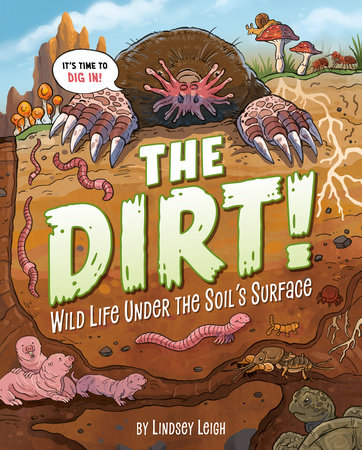
The Dirt!: Wild Life Under the Soil’s Surface by Lindsey Leigh (Penguin Workshop, 96 pages, grades 3-8). In this companion to The Dark! (caves) and The Deep! (oceans), readers get to explore the layer of soil that covers much of the surface of the planet. They’ll learn about the life forms that keep that soil healthy and fertile, from tiny bacteria to larger animals like meerkats and armadillos whose burrows help to aerate the soil. The final two pages offer tips for helping to protect soil from erosion, acid rain, and chemical fertilizers. Includes an index.

The graphic format and humorous tone in the writing and illustrations will draw in readers, but don’t be fooled by the light touch–there is plenty of fascinating information here about soil and the importance of the many, many life forms that support it. Readers will come away with a greater appreciation of the delicate balance necessary to keep soil healthy, and the final pages offers them ways to do their share to protect it.

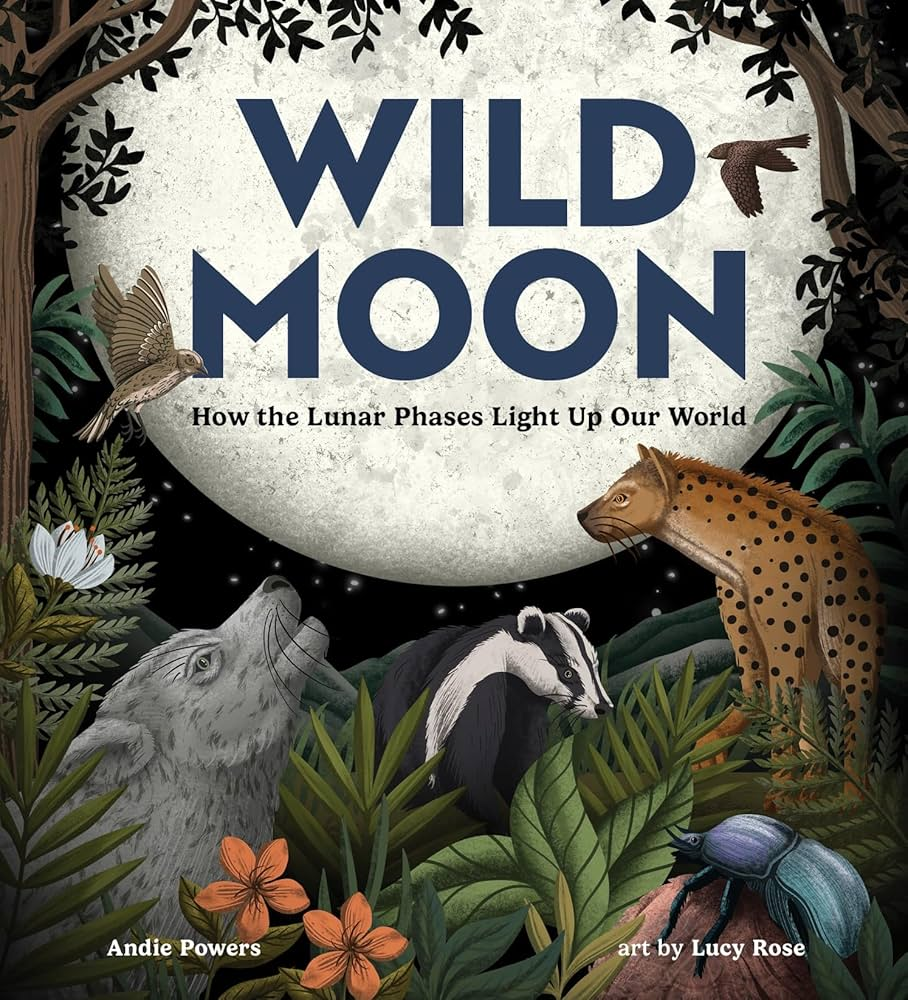
Wild Moon: How the Lunar Phases Light Up our World by Andie Powers, illustrated by Lucy Rose (Published by Gibbs Smith, 32 pages, grades K-4). The moon narrates this story of how its phases change, shifting the amount of light to reach the Earth, which affects animal behavior around the globe. The darker nights of the moon are better for animals such as lions who have good night vision, but more dangerous for prey animals with poorer eyesight, like zebras. The bright light of the full moon is a signal to some animals, such as coral in the Great Barrier Reef, to mate and breed. The super moon, micromoon, blood moon, and lunar eclipse are all briefly defined, and the end matter summarizes the moon phases, gives traditional full moon names for each month, and explains what a blue moon is.

The main text of this beautiful book is written as a poem, while facts about the different animals are presented in a smaller font around each page. The nighttime illustrations are gorgeous, with all kinds of animals shown in their habitats. Although the text is pretty short, there’s a lot of information packed into it, although I wish the explanation of the moon on the tides had been expanded on a bit, as that is a concept I struggle with.

Pioneering women scientists

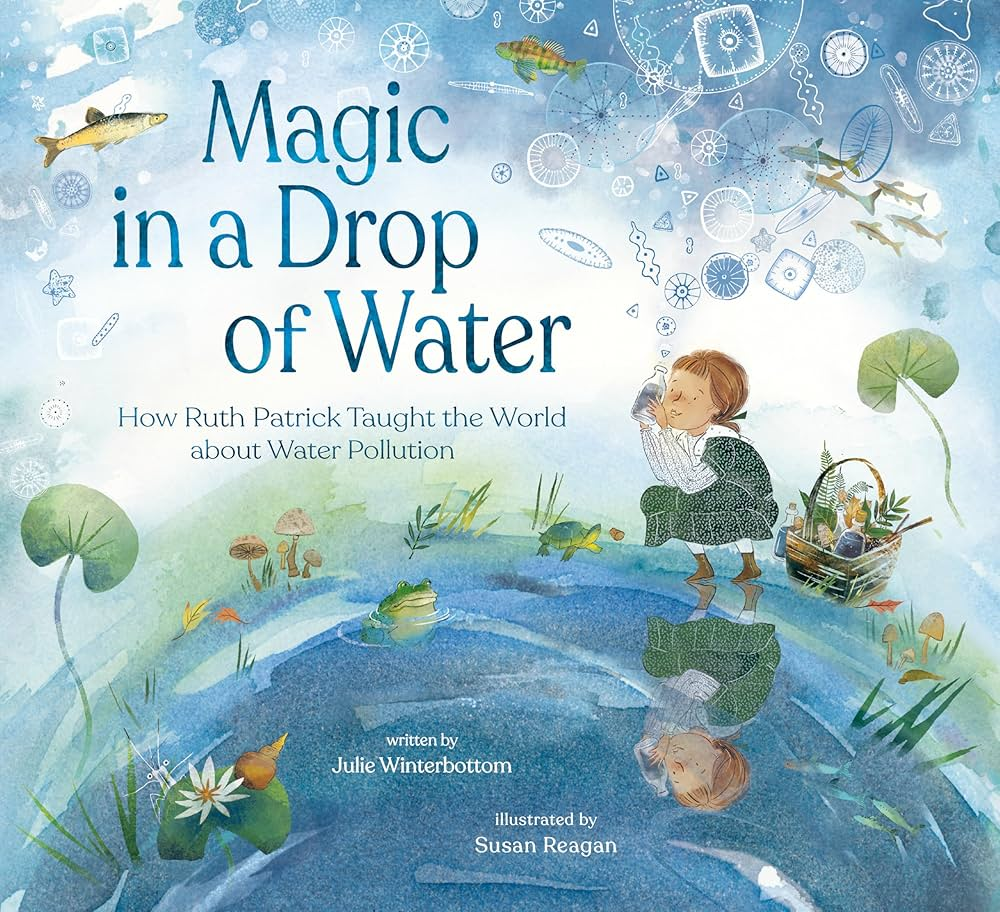
Magic in a Drop of Water: How Ruth Patrick Taught the World about Water Pollution by Julie Winterbottom, illustrated by Susan Reagan (Rocky Pond Books, 48 pages, grades 1-5). Encouraged by her father, Ruth Patrick grew up exploring woods and streams, fascinated by what she saw when she looked at her collections under a microscope. She went on to study biology, specializing in diatoms, the microscopic algae found in all bodies of water. Her questions about the effects of pollution on water led her to study both healthy and polluted streams, documenting all the life forms found in each, and discovering that pollution destroyed the balance of life that healthy water had. She became a lifelong advocate for clean water, including helping to write the Clean Water Act of 1972, and continuing to wade into streams and rivers just a few years before her death at age 105. Includes additional information, a timeline, and a bibliography.

Ruth Patrick lived up to her father’s advice to leave the world a better place than she found it, following her passion at a time when women weren’t particularly welcome in the scientific world and making many contributions to our understanding of water pollution and biodiversity. Her story is told in an engaging fashion, and the illustrations do a magnificent job of capturing Ruth’s work and her underwater observations, although I wouldn’t have said no to a slightly larger font for the text.

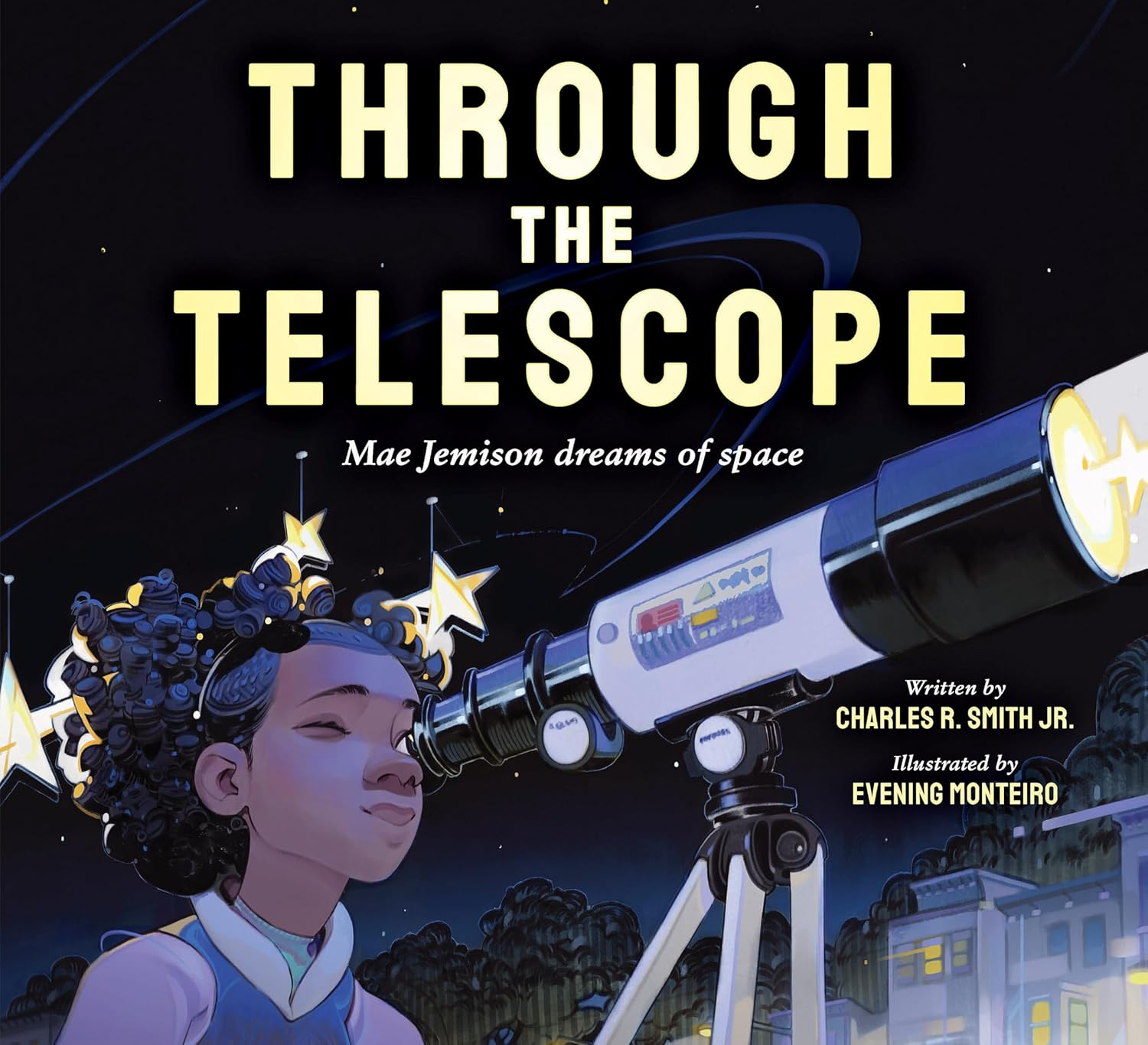
Through the Telescope: Mae Jemison Dreams of Space by Charles R. Smith, Jr., illustrated by Evening Monteiro (Orchard Books, 40 pages, ages 4-8). A young Mae Jemison peers through the telescope, dreaming of traveling into space. Rhyming text and illustrations explain what she sees: the moon, planets, constellations, and galaxies. As she looks, she imagines floating through space, and the final illustration shows an adult Mae in her astronaut suit standing behind the child. Includes ten facts about Mae Jemison.

This would make a good introduction to Mae Jemison for younger readers, and it includes quite a few astronomy terms and facts which they will find interesting as well. Like Mae Among the Stars, there’s very little biographical information. It would be great to get a longer picture book biography that gives a fuller picture of Jemison’s life.

Fireflies and dragonflies

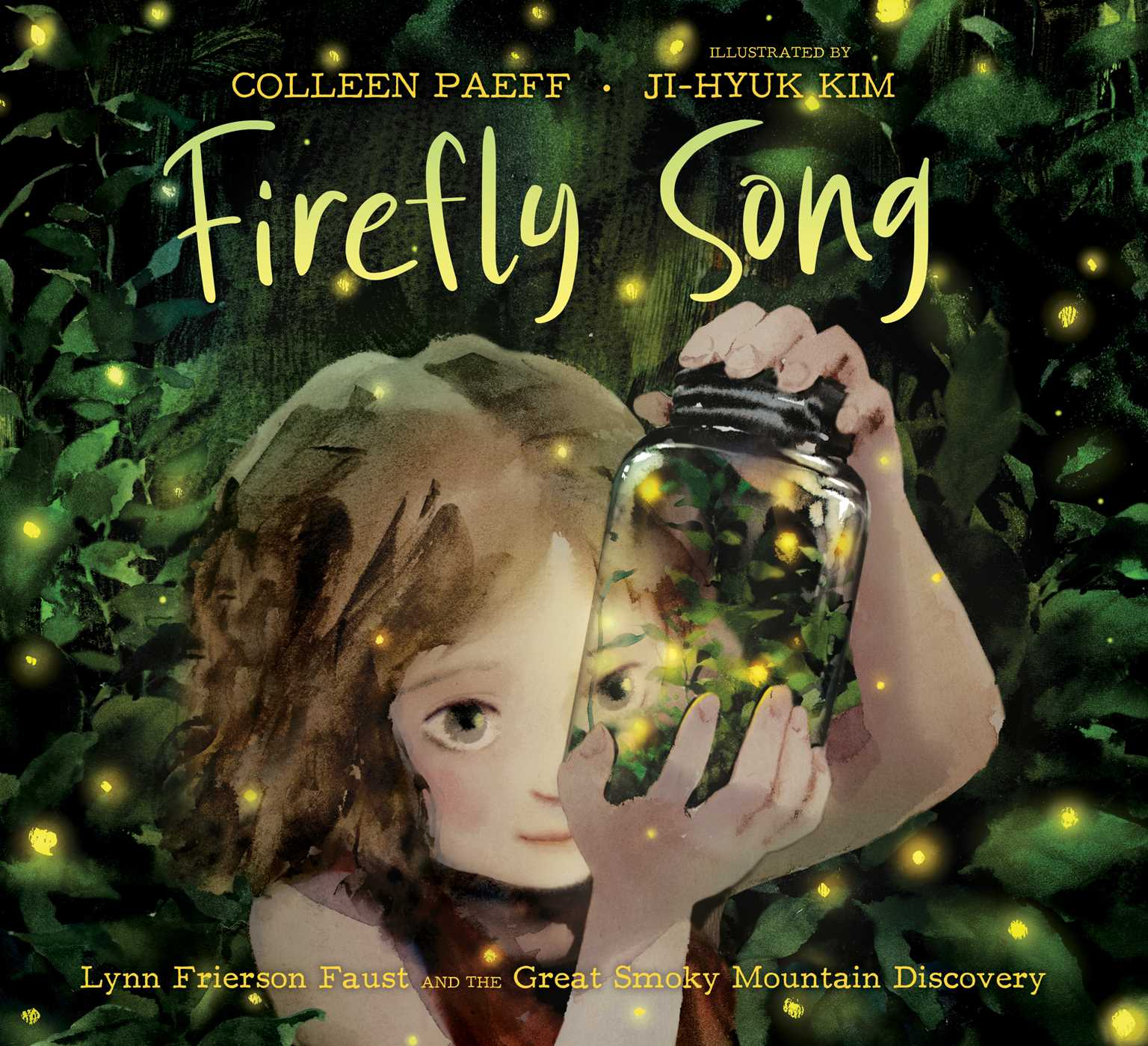
Firefly Song: Lynn Frierson Faust and the Great Smoky Mountain Discovery by Colleen Paeff, illustrated by Ji-Hyuk Kim (Margaret K. McElderry Books, 40 pages, grades 1-5). As a child spending summers in the Great Smoky Mountains, Lynn Frierson Faust was fascinated by fireflies who would flash their lights and go dark in unison. Years later, her family’s summer cabin and the land it was on became part of the national park, but Lynn never forgot those fireflies. When she read that synchronous fireflies didn’t exist in North America, she was determined to prove that they did. Working with other scientists, Lynn’s perseverance over many years finally paid off when she helped a biologist and his team observe the synchronous phenomenon. Although her scientific training is self-taught, Lynn is known globally for her firefly expertise. Includes tips for observing fireflies, firefly facts, a bibliography, and an author’s note.

Lynn’s story is a fascinating one and may inspire readers to become citizen scientists, or at least to be persistent in pursuing their passions. The illustrations are gorgeous, with backgrounds that look like slightly blurry photos, making the fireflies’ lights even more striking. I think the illustrator lives in South Korea, so unfortunately not eligible for a Caldecott, but this would be a good choice for another Sibert award for Colleen Paeff.

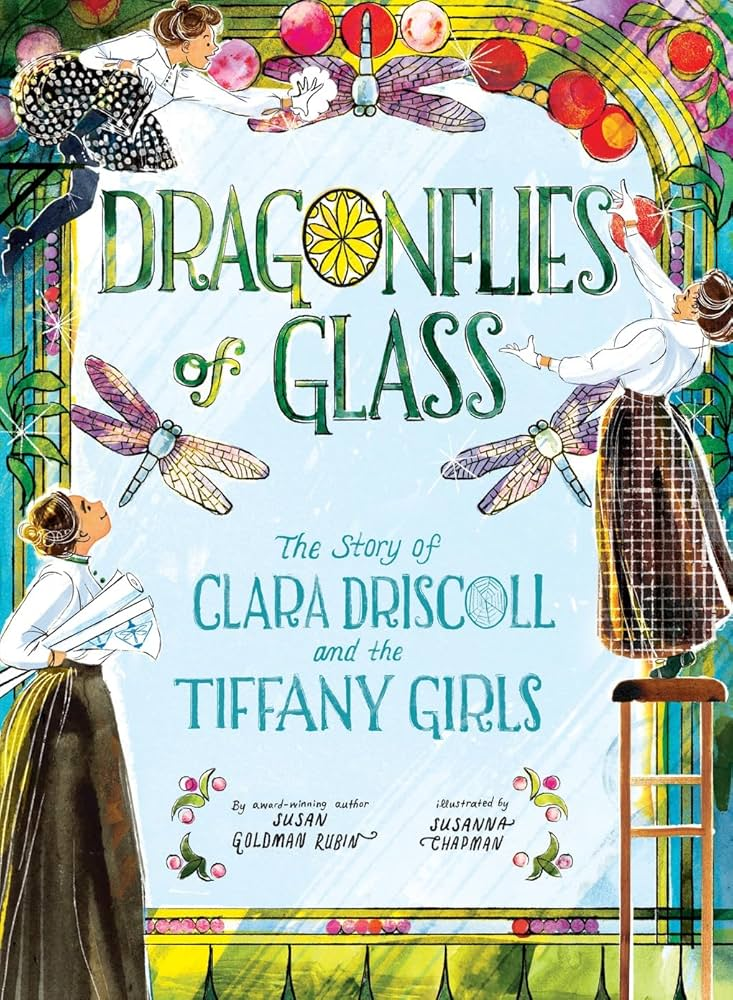
Dragonflies of Glass: the Story of Clara Driscoll and the Tiffany Girls by Susan Goldman Rubin, illustrated by Susanna Chapman (Harry N. Abrams, 40 pages, grades 1-5). Clara Driscoll grew up on a farm in Ohio, where she loved drawing the flowers and animals she observed around her. Her father died when she was 12, but her mother encouraged Clara and her sisters to become self-sufficient. In 1888, Clara and her sister Josephine moved to New York City to study at the Metropolitan Museum of Art School. Clara was hired by Louis Comfort Tiffany, son of the famous jeweler, to work in his studio making stained glass. She was part of the women’s division there, where she learned to cut glass and turn it into designs. Drawing on her memories of the Ohio farm, she was soon creating her own designs incorporating dragonflies, butterflies, and flowers, including the wisteria that was part of Tiffany’s most famous lamp. Includes notes from the author and artist, a list of places to see Clara’s work, and a bibliography.

Another story of an amazing woman who built a full artistic life at a time when sexism was a big obstacle. While Louis Comfort Tiffany sounds pretty progressive (he defended the women’s division when the men threatened to strike if he didn’t get rid of it), the author’s note reveals that Clara was forced to quit working there after she got married. The illustrations are gorgeous, especially the depictions of the Tiffany lamps. Clara’s story came to light thanks to round robin letters that she, her mother, and sisters wrote, and the story of those letters arriving at the farm is shown in small illustrations running along the bottom of each page.

New science books

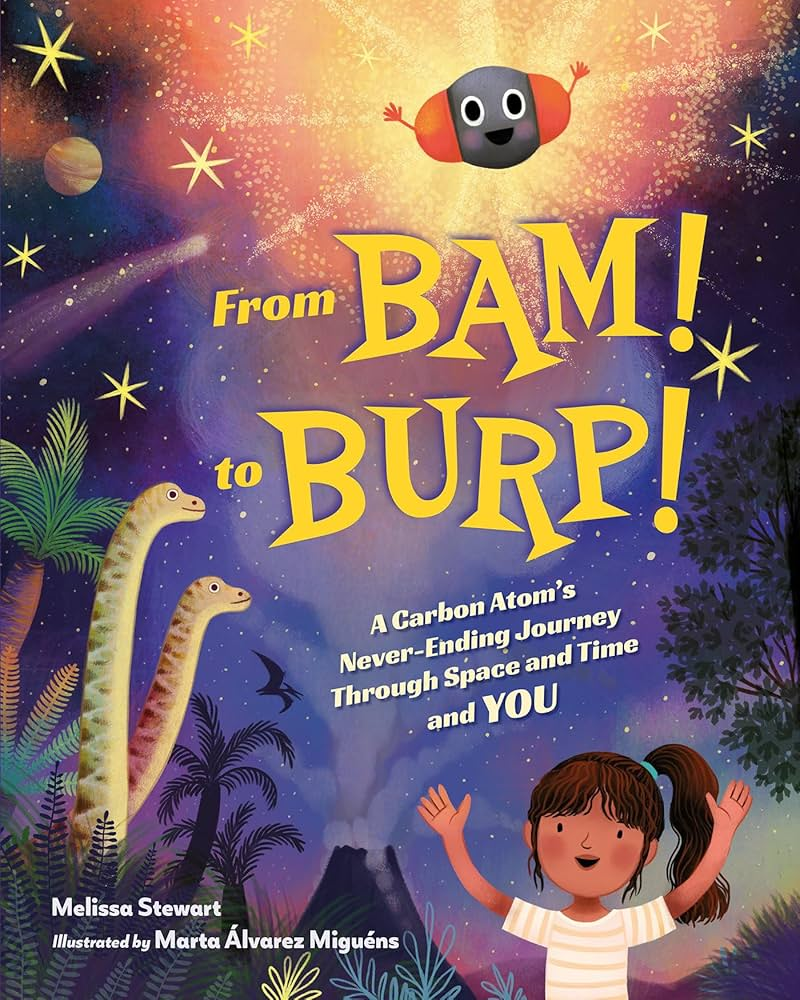
From Bam! to Burp!: A Carbon Atom’s Never-Ending Journey Through Space and Time and You! by Melissa Stewart, illustrated by Marta Alvarez Miguens (Charlesbridge, 40 pages, grades 1-4). The story begins with a planet called Theia, which 4.5 billion years ago smashed into Earth (the bam! of the title) and broke into pieces, some of which eventually became the moon, and some of which were buried deep into the Earth’s core, including carbon atoms. The carbon atom featured in this story combined with oxygen to become carbon dioxide, which was later released from the Earth’s core following a volcanic eruption. The molecule wanders the Earth until it’s pulled apart by a plant that uses it to make sugar. The journey continues through a dinosaur, a rotting pumpkin, even toilet paper, until the carbon winds up in maple syrup, entering the body of a present-day kid who eats it on pancakes, and later burps it out into the world once again. Includes a wonder wall with questions and answers about carbon and related topics, additional facts about carbon, fossil fuels, and the climate crisis, as well as notes from the author and illustrator about the evolution of this book.

Seems like finding a fun picture about chemistry is about as likely as a carbon atom becoming a diamond, but budding scientists will enjoy this one and learn all sorts of information about carbon in the process. The presentation, both text and illustrations, really bring this potentially dry topic to life. I also appreciated the notes from the author and illustrator that emphasized the need for many drafts and much hard work to produce the final book.

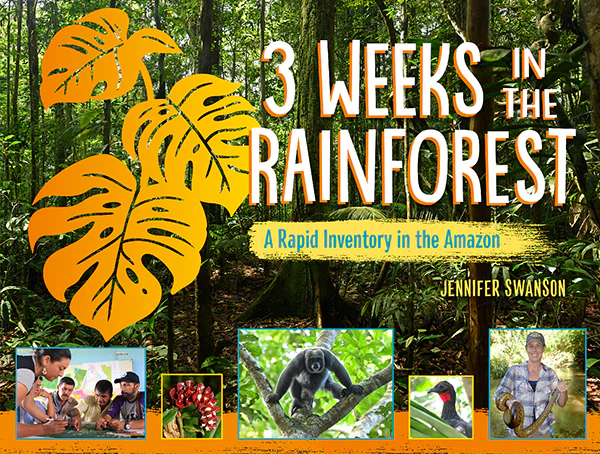
3 Weeks in the Rainforest: A Rapid Inventory in the Amazon by Jennifer Swanson (Charlesbridge, 80 pages, grades 3-7). To measure the health of Colombia’s rainforest, a rapid inventory team from Chicago’s Field Museum spends three weeks observing and recording plants, birds, fish, mammals, and reptiles. They also work with the indigenous people there to learn what they need to live sustainably on the land. The narrative follows different teams of scientists as they travel to this remote area, set up camp, and tirelessly work round the clock in all kinds of weather to inventory as many species of plants and animals as they can in three weeks. After leaving the rainforest, the team compiles its findings into a report to the Colombian government with their recommendations for preserving this ecosystem. Includes a note from the rapid inventory team, an author’s note that recounts how an exhibit at the Field Museum inspired her to write this book, a list of those who were on the team, and an index.

This engagingly written science book offers readers an intriguing look at scientists in the field, with plenty of photos and sidebars to keep things interesting. It was refreshing to read a book about the rainforest that was pretty upbeat in its reports on the health of this particular portion of it, and the descriptions of the fascinating work being done to preserve it will no doubt inspire future generations of scientists.

Science and nature

Sunflower Seeds by Ellen Heck (Levine Querido, 48 pages, ages 4-8). A boy tells of his adventures growing sunflowers, starting when his kindergarten teacher reads a book about them near the end of the year. Each student gets three seeds: one for the birds, one for the rain, and one to grow. On the last day of school the kids take their seedlings home in paper cups. The boy puts his cups outside, and sure enough, one gets knocked over in a rainstorm and never recovers. His parents help him plant the remaining two plants in the ground. One gets nibbled on by a deer, but the last one soars to a height over the heads of the tallest humans he knows. Everyone enjoys the big yellow flowers for a few weeks until they start to droop. The family cuts them off and counts the seeds inside–over 1,000! As the boy looks forward to sharing his sunflower stories in first grade, he visits the library, and opens a new book. What will he learn about next?

I’m putting this on my list of books to read to preschoolers and kindergartners in the spring. Not only is there a lot of information, told in a story that kids will connect with, but the oil paintings of sunflowers are amazingly detailed, as you can see from the cover. I also like the message that books are gateways into learning about all sorts of interesting things. I wish there had been a little back matter with some additional information about sunflowers.

Dear Acorn (Love, Oak) by Joyce Sidman, illustrated by Melissa Sweet (Clarion Books, 40 pages, grades 1-4). In eight pairs of poems, two objects address each other, showing their relationship to each other while highlighting each one’s unique perspective. There’s the acorn and oak pairing of the title, as well as bubble/sky, cloud/droplets, pebble/river, brick/school, button/coat, toes/child, and sea turtle/ocean. Each letter poem is pretty short–no more than a few stanzas of brief lines–and each is accompanied by a colorful collage drawing. The final pages includes simple, specific guidelines to help kids write their own letter poems.

Two masters of their crafts–Newbery honor winner Joyce Sidman and Caldecott honor winner Melissa Sweet–team up to create an engaging set of poems written in a format that invites kids to think about writing their own pairs of letters. The poems are simple and brief to read to primary grades yet interesting enough for older kids, and the beautiful collage illustrations could also be used as a starting point to encourage creativity.

This magic moment

Dawn by Marc Martin (Candlewick, 48 pages, ages 4-8). Each page has just one word, starting with “Dawn” and ending with “Sun”. In between, all sorts of animals and plants can be seen in gorgeous watercolor illustrations moving, eating, waking, or making noise, all illuminated by the changing light as the sun rises. Some of the words are alliterative (“sound, spring, still” to describe a series of pictures of a deer), others list the animals on the page (“dragonfly, cicada, bee, beetle”), while still others are a series of action words describing the movements in the panels (“jump, catch, dive, swallow” shows a fish leaping out of the water to catch an insect then diving back in). The final page, with the sun rising over the lake, looks peaceful and still, but readers will know all the activity the water and woods are hiding.

This book is visually stunning, and the different words would make a unique mentor text to show ways to succinctly describe what you see or hear. At 48 pages, it might not be engaging to read the way you would a story, so give the kids things to look for as you savor each of the stunning illustrations.

This Moment Is Special: A Día de Muertos Story by John Parra (Simon and Schuster/Paula Wiseman Books, 40 pages, ages 4-8). A boy narrates the moments of the day as he and his family celebrate Día de Muertos. Starting with breakfast with the family, he travels to school in a bus reading “Oaxaca”, spends a day at school, then comes home to play with his friends and eat dinner with his family. Each page of text has a few sentences in English and one summarizing sentence in Spanish. It’s an ordinary day in some ways, but also a special one marked with the white paint and decorations on people’s faces and hands, a performance at school, and a visit from abuela. The whole neighborhood is shown celebrating at the end, some wearing make-up and others not, carrying flowers and pictures of the dead. An author’s note asks a series of questions inviting readers to think about and celebrate special moments in their own lives.

There really aren’t enough Día de Muertos/Day of the Dead books for kids, and this one makes a nice addition, with John Parra’s distinctive artwork and the bilingual text that not only show readers different aspects of the holiday, but encourage discussion about appreciating people and events in the moment. I would have loved additional information about the holiday at either the beginning or the end of the book, as I know very little about it.

Science acclaim, a mouse’s name, and the G.O.A.T. of the game

Jellyfish Scientist: Maude Delap and Her Mesmerizing Medusas by Michelle Cusolito, illustrated by Ellen Rooney (Charlesbridge, 32 pages, grades 1-5). Maude Delap never left home or went to school, but she became a scientist by studying the ocean life around her home on Valencia Island, Ireland. This story takes place from June, 1899 until September, 1900, a time when Maude made important discoveries about the compass jellyfish’s life cycle through careful observations in the Department, her name for her home lab. After unlocking the mysteries of this jellyfish, she’s shown on the last page scooping up a blue jellyfish, beginning the process all over again. Includes additional information about Maude, jellyfish (including an illustrated guide to their life cycle on the endpapers), notes from the author and illustrator, and some additional resources.

Told in the present tense, with dates shown on each page, this story conveys an air of you-are-there excitement about the scientific process. Maude had to overcome some very unfair obstacles to have a scientific career, but the main theme in the book is perseverance and the joy of new discoveries. The back matter reveals that she made significant contributions to marine science. The illustrations do a great job of capturing that joy, showing Maude with a young niece assisting her, her lab, and the jellyfish.

The Woman Behind the Magic: How Lillian B. Disney Shaped the Disney Legacy by Brittany Richman, illustrated by Joanie Stone (Beach Lane Books, 40 pages, grades 1-5). As the youngest of ten children, Lilly Bounds never had much, but she always enjoyed the magical moments that she shared with her warm, loving family. After her older siblings left home and her dad passed away, Lilly moved out to California to be near one of her sisters. She got a job at the fledgling Disney Brothers Cartoon Studio, where she inked and colored cartoons, eventually impressing her boss Walt enough that she became his secretary and then his wife. The studio almost went out of business a few times, but Lilly helped behind the scenes, most notably naming Mickey Mouse after Walt proposed the name Mortimer. From Snow White to the opening of Disneyland, Lilly gave her opinions and feedback that shaped the Disney empire. When Walt died shortly before the opening of Walt Disney World, Lilly pushed herself to step into the spotlight for the grand opening. Includes a three-page author’s note with additional information and a timeline of Lillian’s life.

It was fascinating to learn more about the early days of the Disney empire, particularly this quiet unassuming woman who liked to work behind the scenes, but who had a big impact on the Disney we know today and who saved us from Mortimer Mouse. This illustrations are charming, calling to mind some of the older animated Disney movies.

Messi’s Magic: How Lionel Messi Became the G.O.A.T. by Caroline L. Perry, illustrated by Luciano Lozano (Scholastic, 48 pages, grades 1-5). Lionel “Leo” Messi grew up in a loving, soccer-obsessed family in Argentina. From an early age, his talent was obvious, and his Grandma Celia was his biggest fan. As he got older, though, Leo faced obstacles to his soccer career. His grandma passed away, and he was diagnosed with a growth disorder. Without daily injections, he wouldn’t grow big enough to play professional soccer, but his family couldn’t afford the medicine. At the age of 13, he was signed to FC Barcelona, who also agreed to pay for his medical treatment. Leo struggled to fit in at Barcelona’s youth academy, but his soccer skills helped him find his place. He’s gone on to become one of the greatest soccer players of all times, and if you see him pointing to the sky when he makes a spectacular goal, you’ll know that he’s dedicating it to Grandma Celia. Includes a timeline, additional information about Messi, and notes from the author and illustrator.

Thanks to Scholastic for providing me with a copy of this book, which will be released September 2. I know it will be a huge hit in my library, where I have many football/soccer fans. Leo’s story is inspiring, as he never gave up his dreams despite some pretty difficult setbacks, and went on to succeed beyond the wildest of those dreams. The additional information about Messi’s family life and charity work portray him an excellent role model.

Mysterious creatures of the deep

In the World of Whales by Michelle Cusolito, illustrated by Jessica Lanan (Neal Porter Books, 52 pages, grades K-4). When a small boat with people in search of sperm whales spots a clan, a free diver (diving without an oxygen tank) goes into the water to investigate. He soon discovers a newborn calf surrounded by its mother and other whales. As he swims nearby, taking pictures, other whales arrive, as if they’ve been summoned to meet the new baby. The mother seems to be introducing them to her newborn, and finally she nudges the baby toward the man. A gatefold page shows him face to face with the baby, while other whales swim around them. Finally, the whales swim away, and the man resurfaces. “He rides home in silence, forever changed.” Includes a labeled diagram of a sperm whale, additional information about free diving and whales, resource lists, and notes from the author and illustrator that tell about Belgian free diver Fred Buyle, who is the inspiration for this story.

Readers will be in awe of the whales in this book, as well as free diving, which seems like a scary but exciting adventure into the ocean. Jessica Lanan’s artwork is breathtaking, and potentially worthy of a Caldecott or another Sibert award.

The Escape Artist: A True Story of Octopus Adventure by Thor Hanson, illustrated by Galia Bernstein (Greenwillow Books, 32 pages, ages 4-8). Inky was a Maori octopus who lived in the National Aquarium of New Zealand. We’ll never know for sure what went on in Inky’s octopus brain, but this story speculates that he had all kinds of questions about the people and animals around him. The biggest question, though, was if there was a world beyond the tank. Inky got to find out out one night when he noticed the lid of his tank was ajar and managed to squeeze himself out (“An octopus body is boneless/like Jell-o wrapped up in a sack”). He couldn’t survive long outside of the water, but he managed to travel across the floor to a drain and slip into it. The next morning, zookeepers were baffled as to where Inky had gone until someone noticed a trail of water across the floor and deduced that he had traveled 164 feet through the pipe and into the sea. Includes additional information about Inky and other octopuses.

I wouldn’t have recommended writing the story of Inky in rhyme, but somehow, it works, thanks to an interesting story and some excellent rhyming that brings it to life. Kids will be cheering for Inky and undoubtedly inspired to learn more about octopuses.

Life lessons from animal friends

Axolotl and Axolittle by Jess Hitchman, illustrated by Sarah Rebar (Sourcebooks Jabberwocky, 40 pages, ages 3-8). Siblings Axolotl and Axolittle are very different–big sis Axolotl lives life to the max while younger brother Axolittle is quieter and more studious–but they’re still the best of friends. When Axolotl’s boisterous play ends up destroying Axolittle’s painting, though, an axo-squabble ensues. Finally, Axo-dad-l comes in to calm things down, and after a bit of a break, family harmony is restored.

Axolotls seem to be having a moment, due to Minecraft, I guess? Whatever the reason, this book will definitely catch the eye of many a young reader, and they won’t be disappointed by the lively rhymes, clever axolotl (and axolittle) plays on words, and relatable family situations. This would make a great sibling gift for the older child in a family with a new baby.

Don’t Trust Fish by Neil Sharpson, illustrated by Dan Santat (Dial Books, 40 pages, ages 4-8). After an introduction to mammals, reptiles, and birds, the narrator gets to fish: DON”T TRUST FISH! There are so many reasons, and those reasons grow more preposterous as the book goes on. Some have gills and some have lungs. Some live in salt water, some in fresh water. Very shifty. They live underwater where you can’t see them. They may be in your home, spying from that aquarium, and reporting back to the king fish! And they like to eat poor, innocent, kind crabs…which readers will learn on the last page is the animal responsible for all the information in this book.

I’ll admit I didn’t love this book the first time I tried reading it, and I only looked at the first few pages. But the four starred reviews and inclusion on possible Caldecott lists led me to take another look, and I’m happy to say that now I get it! It would be a fun story to read aloud and have kids try to guess who the narrator is. Dan Santat’s illustrations, of course, add immeasurably to the fun. It could also be a great introduction to a discussion with older kids about considering sources of information in the news and on social media.

You and Me, Anemone by Rachel Vail, illustrated by Chris Raschka (Greenwillow Books, 32 pages, ages 4-8). Using clever rhyming text, an anemone makes a plea to readers not to BOOP it, then goes on to encourage kids who prefer not to be booped to assertively make their wishes known. The anemone explains that it likes living harmoniously in community with other anemones, and that not being touched doesn’t mean that it doesn’t enjoy the company of others, “to live side by side in our own kind of unity! Resplendent, independently, extending as far as eye can see.” Includes an author’s note about how she learned recently not to touch anemones and giving kids tips for communicating their own preferences as well as noticing those of others.

This is an ingenious book, combining interesting information about anemones with ideas for kids on how to notice what they may or may not want and expressing that. The illustrations are made to look like applique on burlap, with lots of textures and colors.

Productive poops and undersea whoops

Worm Makes a Sandwich by Brianne Farley (G. P. Putnam’s Sons, 32 pages, ages 4-8). When a worm offers to make the reader a sandwich, it acknowledges that it seems like an impossible task. But give Worm some garbage, and it will eat and poop, and so will some of its friends, like snails, slugs, beetles, and millipedes. All that poop makes for some rich compost, which can then be added to the garden soil. And the soil helps grow tomatoes, which–you guessed it–can be made into a delicious sandwich. Includes additional information on composting.

Worm is a good narrator to introduce composting and gardening to the youngest readers, and the illustrations do a great job of showing each step in the process. Worm’s claim on the cover that it will make a sandwich “all by myself!” may be a bit misleading, since many other insects as well as a human gardener are shown facilitating the process, but Worm definitely plays a vital role.

What Fish Are Saying: Strange Sounds in the Ocean by Kirsten Pendreigh, illustrated by Katie Melrose (Sourcebooks Explore, 40 pages, ages 4-8). As a child and adult paddle their kayak, enjoying some peace interspersed with a few quiet sounds, they wonder if there’s noise under the water. The answer is a rousing yes, as the rhyming text moves undersea where creatures grunt, groan, squeal, burp, and more. We find out how and why they make noise, and why sound works so well under the water. The repeating refrain “It’s noisy down below” concludes the book with a two-page spread showing all their animals and their sounds. Includes two pages of additional information about undersea noises.

Kids will love these catchy rhymes, fascinating facts, and gorgeous colored illustrations of the busy (and noisy) undersea world. The book would make a great mentor text for teaching onomatopoeia. Some of the rhymes seemed just a syllable too long or short, so I would review it a couple of times before attempting to read it aloud.