The Secret Life of the Red Fox by Laurence Pringle, illustrated by Kate Garchinsky

Published by Boyds Mills Press
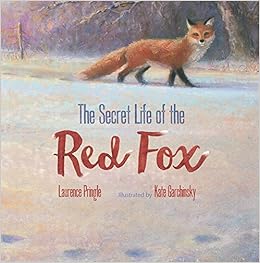
Summary:  A year in the life of Vixen, a female fox.  The reader follows her as she hunts in the snow, pouncing on a mouse in an acrobatic move, and escapes a couple of barking dogs.  She meets up with her mate, and eventually moves into a den.  When spring comes, there are four fox kits in the den.  The grow all summer, and on the last page, they are ready to go off on their own, just as autumn arrives.  There are two pages of additional information about the red fox, plus a brief glossary and bibliography.  32 pages; grades 1-4.

Pros:  The story of Vixen is packed with information about foxes.  Woven into the story are facts about how foxes find food, what they eat, how they take over other animals’ burrows for their dens, and how the parents take care of their babies.  The illustrations are beautiful and add additional information.  There is plenty here for a research report, or simply to satisfy a curious child.

Cons:  I seriously hope I never stumble across a hole in the snow like the one Vixen used as a storage place for her dead mice.
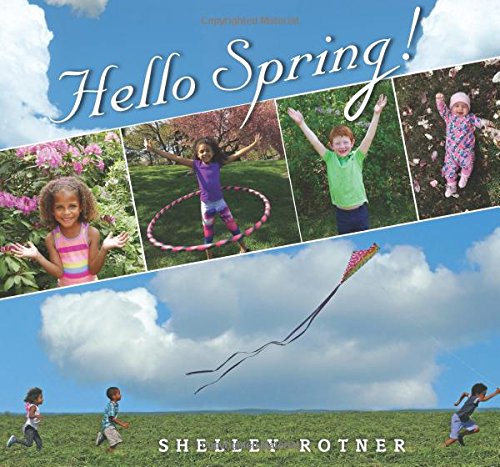
Hello Spring! by Shelley Rotner

Published by Holiday House

Summary:  Lots of colorful photographs provide an introduction to spring.  The focus is all on flora and fauna as a diverse group of kids discover flowers and other plants and hold baby farm animals.  Wild animals are also mentioned, particularly those who are waking up after a long winter’s sleep.  The text is brief, with some rhyming words and plenty of action verbs (“Frogs hop.  Earthworms creep.  Turtles crawl.”).  The final page announces the longest day of the year, which means the season changes again, to summer.  Includes a brief glossary.

Pros:  Young readers will enjoy familiar springtime sights and will learn to be on the lookout for signs of spring.  The photos are large, colorful, and appealing.

Cons:  It would have been nice to include signs of spring in the city, along with all the suburban/rural photos.

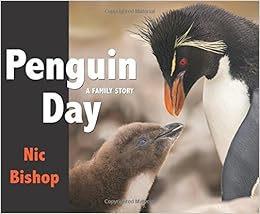
Penguin Day: A Family Story by Nic Bishop

Published by Scholastic Press

Summary:  When a baby rockhopper penguin is hungry, his mother goes in search of food while his father stays home to protect him.  The mother is part of a group of penguins that climbs cliffs and dives into the ocean, braving sea lion and orca predators, to hunt for fish and krill.  Meanwhile, when the baby penguin wanders off to explore, his father must protect him from a hungry skua (bird).  Finally, the family is reunited, and baby penguin gets his (apparently regurgitated) meal.  An author’s note gives more information on these Antarctic penguins.  32 pages; ages 4-8.

Pros:  Nic Bishop has another winning collection of nature photographs that will be popular with primary grades.  The story will draw them in, and the author’s note can be used to teach more about the penguins.

Cons:  The story was a bit more mundane than the photos.

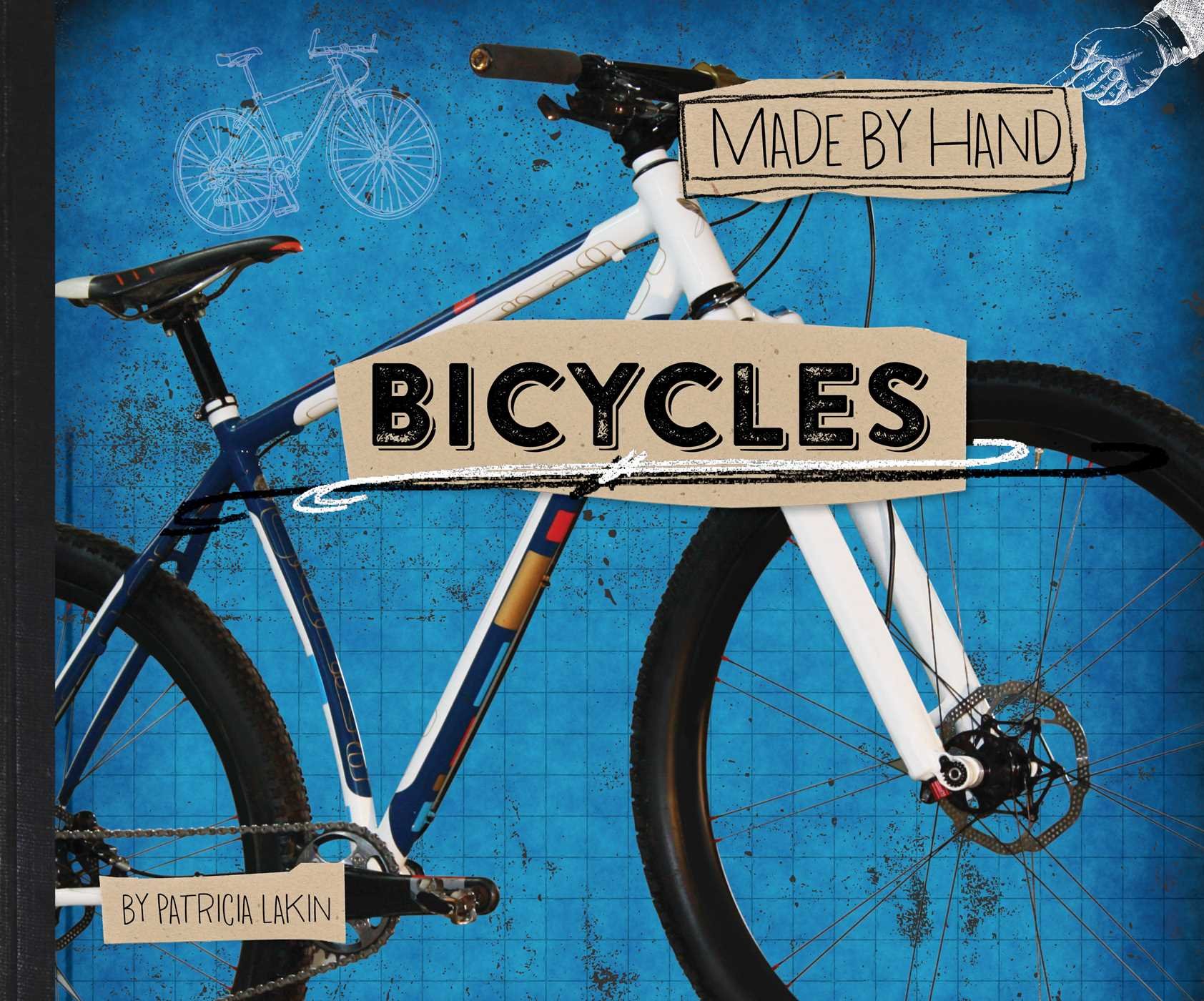
Bicycles by Patricia Lakin

Published by Aladdin

Summary:  Aaron Dykstra is a craftsman who creates handmade bicycles and sells them through his company, Six Eleven Bicycle Company (named for the 611 train that was supposedly the best and most beautifully designed).  The first few pages of this book give a history of the bicycle and a brief biography of Dykstra and how he came to be a bicycle maker.  Then the reader is shown the twenty steps of his creation process, from getting the customer’s specifications to the final item rolling out of the shop.  There’s a photo of each step, with a short caption explaining the process.  The next two pages tell about Aaron’s program for middle school students, The Making Foundation, and invite readers to try creating by hand.  Finally, there is a four-page timeline of the bicycle, followed by a glossary and resources (books and websites).  32 pages; grades 3-7.

Pros:  A perfect complement to any makerspace program.  A second book in the series, Skateboards was published simultaneously.  The book’s design has the feel of a blueprint or how-to manual, and the photos and biographical information about Aaron make the creation process appealing.

Cons:  I looked at Aaron’s website, and he requires a $1500 deposit before starting on a bike.

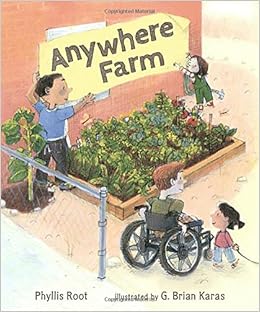
Anywhere Farm by Phyllis Root, illustrated by G. Brian Karas

Published by Candlewick

Summary:  A celebration of gardening and plants, told in rhyming text.  Gardens can be anywhere: “An old empty lot/makes a good growing plot. But a pan or a bucket,/a pot or a shoe,/a bin or a tin, or a window will do.”  You just need seeds, dirt, water and sunlight to grow all kinds of things.  The landscapes shown are mostly urban, and the gardens range in size from small containers to large plots.  If enough people in your community get inspired, the anywhere farm might just turn into an everywhere farm.  32 pages; ages 2-7.

Pros:  Perfect for springtime, the rhymes are extra catchy and would be fun to read aloud.  The gardeners come in all shapes, sizes, ages, and colors, and the gardens are equally diverse.

Cons:  The whole gardening process is a bit oversimplified.

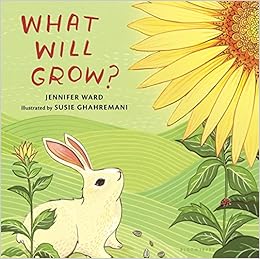
What Will Grow? By Jennifer Ward, illustrated by Susie Ghahremani

Published by Bloomsbury USA Children’s

Summary:  A dozen seeds are introduced with rhyming couplets and illustrations (“Shiny, brown.  Bumpy crown.  What will grow?  Oak tree.”)  Most of the seeds have the rhyme on the left-hand page with the plant shown on the right, but four have pages the fold out, up, or down to reveal the plant.  The final couplet is, “Dark, deep, fast asleep.  What will grow?” showing hibernating animals under the snow, followed by, “My garden!” over two pages of a colorful collection of plants blooming under a rainbow.  All 12 seeds are shown at the end, along with the time to sow them, steps for planting, and when it will grow.  The final two pages show four stages from seed to plant.  40 pages; ages 3-6.

Pros:  This follow-up to What Will Hatch? is a perfect springtime introduction to gardening for young readers.

Cons:  This seems like it could be a fun, interactive guessing game, except that eight of the plants are shown on the same page as the question.

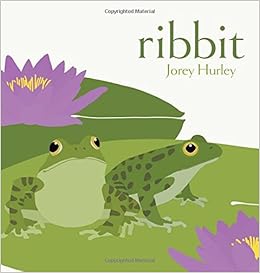
Ribbit by Jorey Hurley

Published by Simon and Schuster

Summary:  The life cycle of a frog is described through illustrations and one word of text per page.  It begins with “Wait”, as two frogs swim near a mass of eggs, and ends with “Ribbit”, as one of the hatchlings, now an adult, finds a mate. In between, the eggs hatch, a tadpole transforms into a frog, and that frog catches an insect and hibernates in the mud.  An author’s note gives more information about frogs and their life cycles.  40 pages; ages 3-7.

Pros:  Young children will love the bright, clean illustrations depicting the frog and its environment around a pond.  The single words convey a lot of information.

Cons:  A list of books and/or websites about frogs would have been a nice addition.

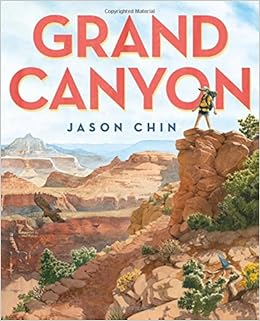
Grand Canyon by Jason Chin

Published by Roaring Brook Press

Summary:  A man and his daughter take a backpacking trip through the Grand Canyon, learning about the geological history as they go.  Starting at the bottom, they study the rocks and fossils of each layer traveling upward to discover what Earth was like in the past.  The girl imagines herself in different eras, with illustrations showing what the canyon looked like in those times.  Small cutouts in some pages give preview peeks as to what’s ahead on the next page.  Borders of many of the main illustrations show the flora and fauna that live at the different levels within the canyon.  The final two pages of the main text open up into an amazing four-page spread of the “the grandest canyon on Earth.”  Back matter includes quite a bit more information on the Grand Canyon, as well as a long list of sources and some books for further reading.  56 pages; grades 2-7.

Pros:  Jason Chin produces another natural history masterpiece, with illustrations so lifelike they almost look like photographs.  The pages are packed with information, both in the text and the pictures and diagrams.  Readers will want to be on the next flight out to Arizona to experience the Grand Canyon for themselves.

Cons:  While extremely informative, the text isn’t always quite as engaging as the illustrations.

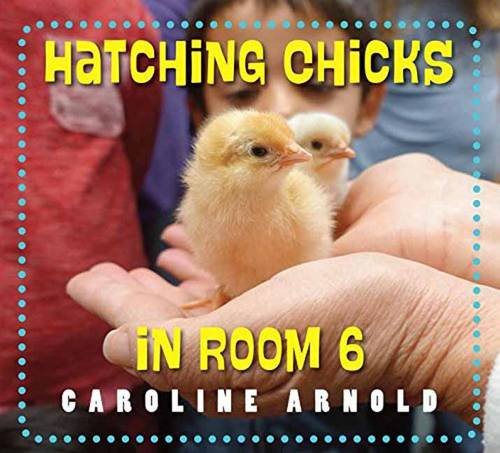
Hatching Chicks in Room 6 by Caroline Arnold

Published by Charlesbridge

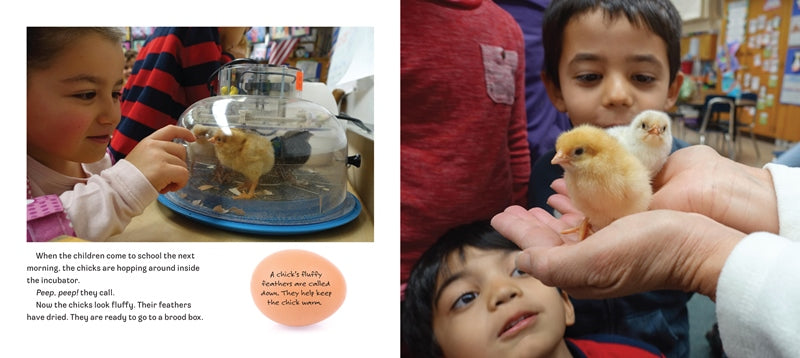
Summary:  Mrs. Best raises chickens in her backyard, and she brings in some eggs for her kindergarten class to observe.  The class keeps the eggs in two incubators and counts down the 21 days it will take for them to hatch.  They–and the reader–learn about chickens and what is going on inside the egg.  Excitement grows as day 21 arrives, and cracks start appearing in the shells.  Pretty soon, there are 14 baby chicks in the incubators.  From there they move into a brood box, then an outdoor pen, and finally, when they are a month old, back to Mrs. Best’s house to join the rest of her chickens.  Includes questions and answers, a glossary, and books and websites with additional information.  40 pages; ages 4-8.

Pros:  This is a must-have for any classroom that embarks on an egg-hatching project.  Even if you’re not that ambitious, it is an engaging introduction to the life cycle of the chicken, with plenty of great photos of Mrs. Best, her class, and the eggs and chicks at various stages.

Cons:  The list of books at the end doesn’t include the awesome A Chicken Followed Me Home by Robin Page (2015).


The Secret Project by Jonah Winter, illustrated by Jeanette Winter

Published by Beach Lane Books

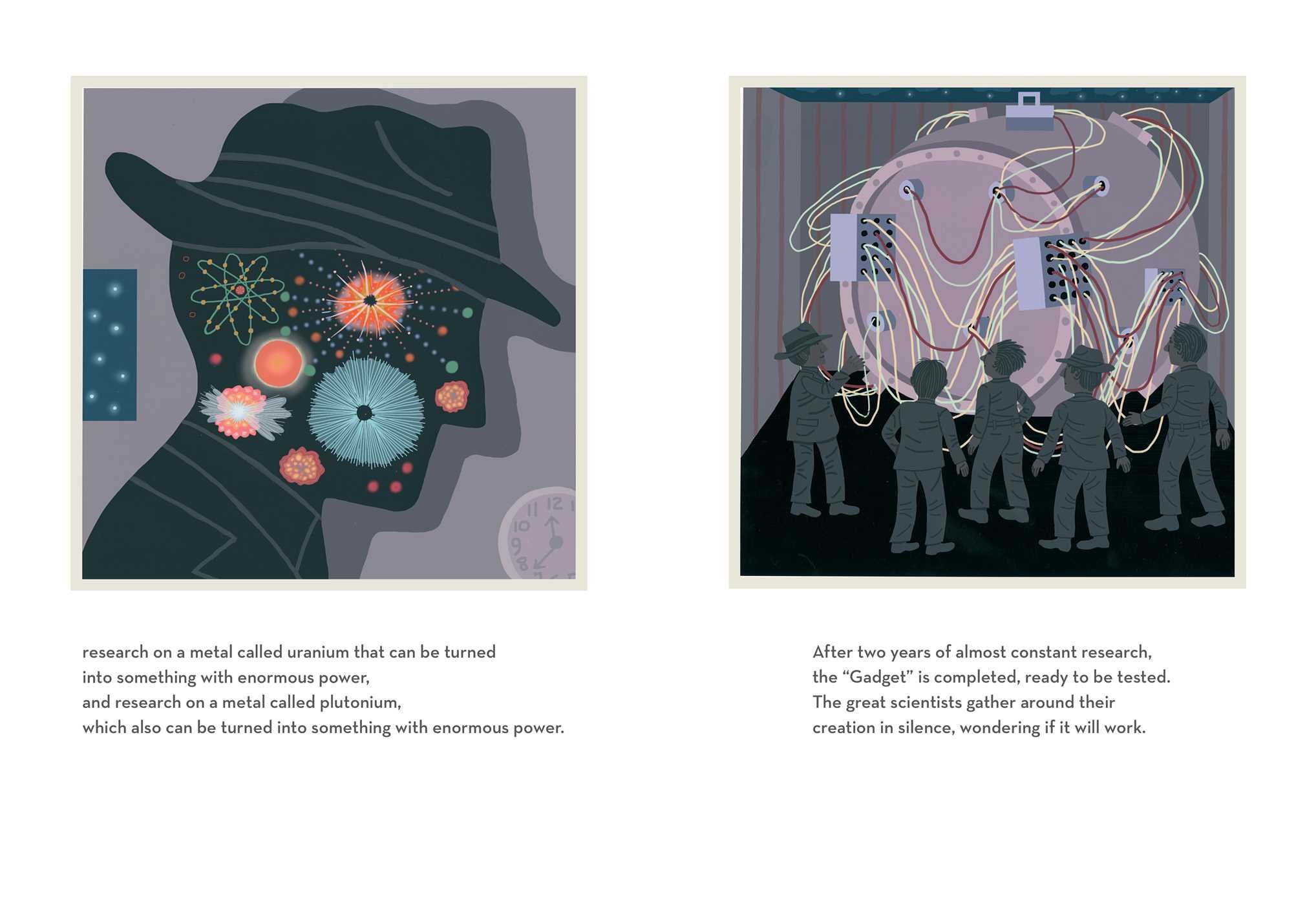
Summary:  A peaceful boys’ school in the New Mexican desert is suddenly ordered closed by the U.S. government.  Scientists arrive from all over the country to work on a top-secret project known simply as “The Gadget”.  Other workers don’t know what the scientists are working on, and the outside world has no idea their project even exists.  The scientists work long at hard, trying to figure out how to split atoms from uranium and plutonium.  At last, The Gadget is ready.  It’s placed on a stand in the middle of the desert, then the scientists drive far away.  The countdown begins…10, 9, 8, 7, 6, 5, 4, 3, 2, 1.  A huge fireball erupts, turning into a gigantic orange mushroom cloud .  The text ends with  two blank black pages.  Includes an author’s note giving more history of the Manhattan Project, and a list for further reading.  40 pages; grades 2-5.

Pros:  Mother-son team Jeanette and Jonah Winter have created a remarkable book, giving a brief history of the Manhattan Project in a way that is accessible for elementary school kids.  The illustrations convey the air of secrecy about the project, showing the scientists as black shadows throughout the story.  

Cons:  All the scientists portrayed are men. In reality, quite a few women scientists and mathematicians worked on the Manhattan Project.