Stone Age Beasts by Ben Lerwill, illustrated by Grahame Baker-Smith

Published by Candlewick

Summary:  Following a four-page introduction to the Stone Age, the book gets down to business with a series of two-page spreads on some of the large animals of the era.  Each one includes a portrait with a few paragraphs of information and some sidebars, including one with fast facts, a map showing the animal’s range, and a size comparison to a human.  There are old favorites like the woolly mammoth and saber-toothed cat, along with some that may be less familiar, such as the elephant bird and giant short-faced kangaroo.  A final page looks at why the animals disappeared and how we learned about them.  Includes a glossary.  48 pages; grades 2-5.

Pros:  Dinosaur fans will enjoy learning about gigantic beasts from another time period, particularly the ferocious illustrations that dominate each page.  The information is engagingly written and presented.

Cons:  The Stone Age seems scary.

When Moon Became the Moon by Rob Hodgson

Published by Rise x Penguin Workshop

Summary:  In 11 very short chapters, readers learn about the moon–how it was created, its orbit, craters, phases of the moon, and its relationship to Earth.  Most chapters are just a few sentences, illustrated with colorful anthropomorphized celestial bodies that talk with cartoon bubbles.  Kids will gain a greater appreciation for the moon and its effects on Earth and may be inspired to dream of traveling there some day after reading the final chapter on space exploration.  64 pages; ages 4-8.

Pros:  Fans of Stacy McAnulty’s Our Universe series will enjoy this book with its colorful illustrations and humorous, easy-to-understand information.  

Cons:  No back matter? Lunacy.

Fungi Grow by Maria Gianferrari, illustrated by Diana Sudyka

Published by Beach Lane Books

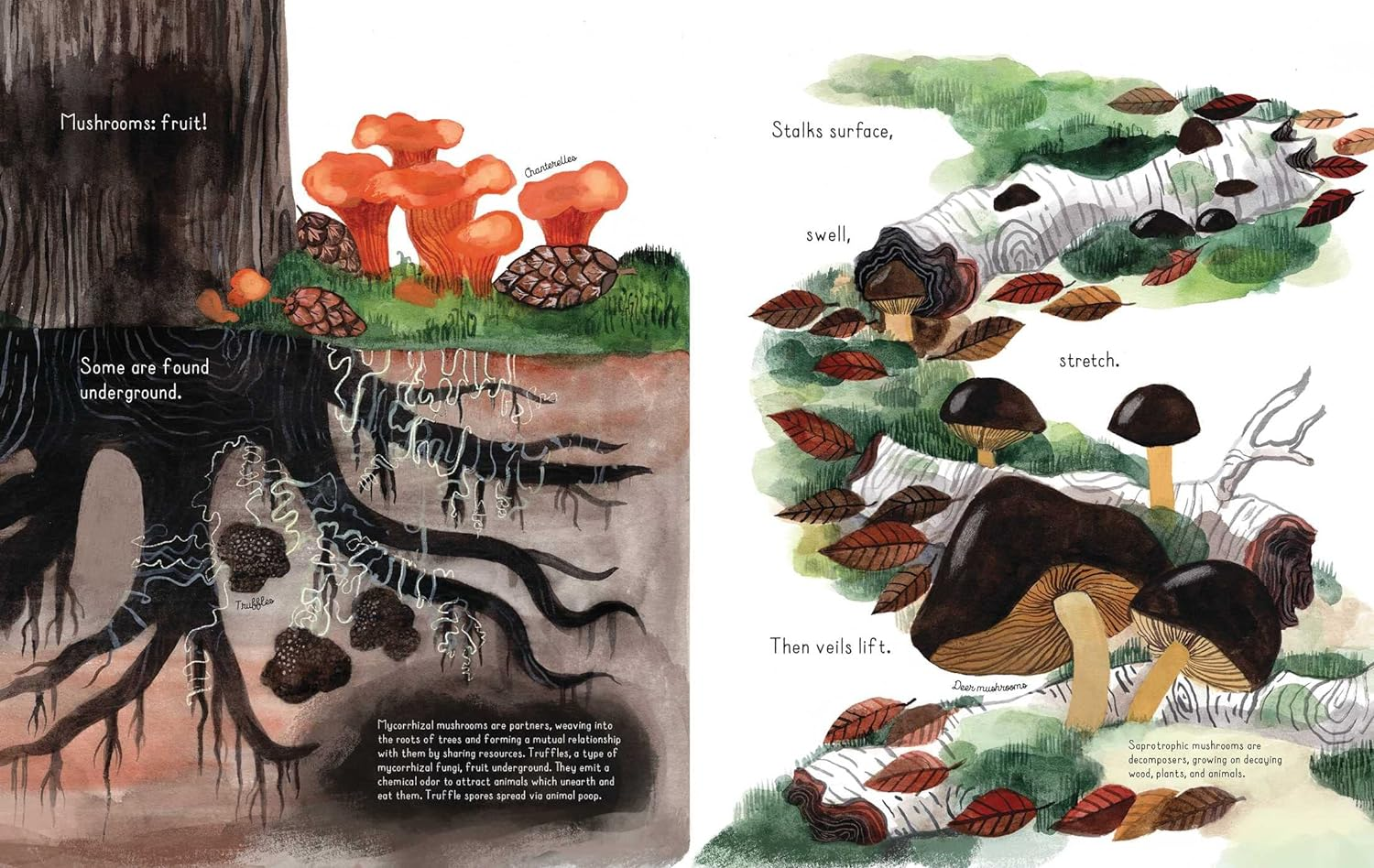
Summary:  There are lots of books about plants’ life cycles, but this one focuses on fungi, which grow from spores, not seeds.  The text begins with how the spores travel and reproduce, then describes all kinds of fungi, showing readers a colorful array that they can see, as well as cutaways that show the underground fungal world.  Specific species are described in greater detail with a smaller font.  Fungi can be poisonous, but they can also help humans in a variety of ways.  Includes additional information and a glossary, list of sources, and additional resources.  48 pages; grades K-4.

Pros:  A fascinating and beautiful look at a wide range of species that many readers may have noticed in passing but will now have reason to examine more closely.  Diana Sudyka is one of my new favorite illustrators this year, illuminating the text with bursts of colorful mushrooms and other fungi.  

Cons:  The zombie ant fungus may give you nightmares.

The Snow Man by Jonah Winter, illustrated by Jeannette Winter

Published by Beach Lane Books

Summary:  When he first came to the mountain, he lived in an abandoned shack with no electricity or running water.  Eventually, he built himself a house with solar panels and a greenhouse.  Boredom drove him to start measuring and recording the natural world around him: snowfall, the return of animals in the spring, the first wildflower blossoms.  In between, he would chop wood, watch movies, and ski to town and back for supplies (800 miles every winter).  He stayed for many years and began to notice patterns: less snow, earlier springs.  When he shared his information with a scientist, the scientist was amazed at his painstaking records that showed the patterns of climate change.  Older now, he no longer chops wood or skis, but he continues his record-keeping on animals, plants, and–for now–snow.  Includes additional information about billy barr, a man who has spent most of his life living a solitary existence in the Rocky Mountains of Colorado; also, a short list of additional resources. 40 pages; ages 4-8.

Pros:  A fascinating story about a man who chose an unconventional path in life but has found a way to make a difference in the world, observing climate change before much of the rest of the world did. 

Cons:  The story is a little confusing without the context given in the author’s note, so you might want to read that first.

The City Tree by Shira Boss, illustrated by Lorena Alvarez

Published by Clarion Books

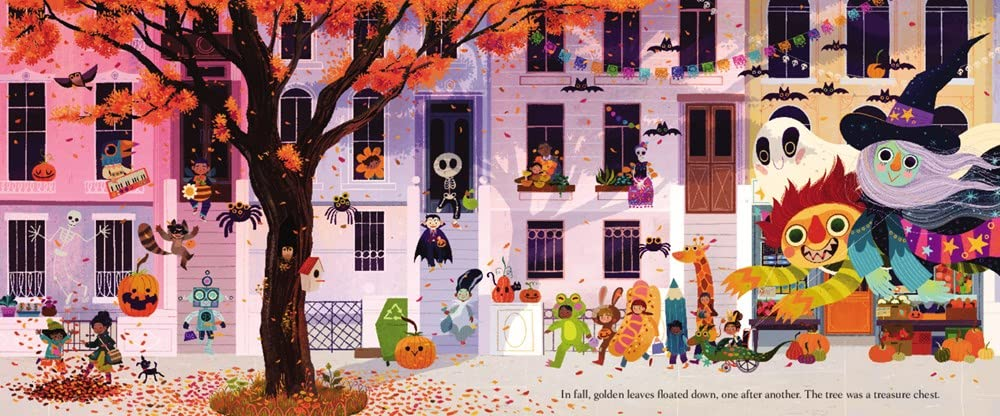
Summary:  Dani lives in a city apartment building with a big hole in front of it.  One day, a truck pulls up with a tree that gets planted in that hole.  The tree brings positive changes to Dani’s world, as birds’ chirping replaces traffic noise outside her window, and the sound of rustling leaves adds a calming note to the busy pace of the city.  Although Dani enjoys the bigger trees in the park, her tree is special.  It changes with the seasons and with different types of weather.  Dogs and people passing by are not always kind to the tree, so Dani and her friends learn how to help it, and in return, the tree becomes an important part of the neighborhood.  Includes additional information about how street trees help people, how people can help them, and a list of resources.  40 pages; ages 4-8.

Pros:  A lovely introduction to the benefits of urban trees, with brilliantly colored illustrations filled with details of Dani’s neighborhood that kids will enjoy tracking from one page to the next.  The back matter makes it a great resource for all ages.

Cons:  The tree seemed to grow at a supernaturally fast rate.

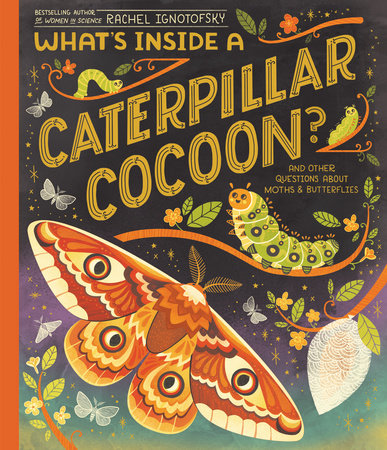
What’s Inside a Caterpillar Cocoon? And Other Questions About Moths and Butterflies by Rachel Ignotofsky

Published by Crown Books for Young Readers

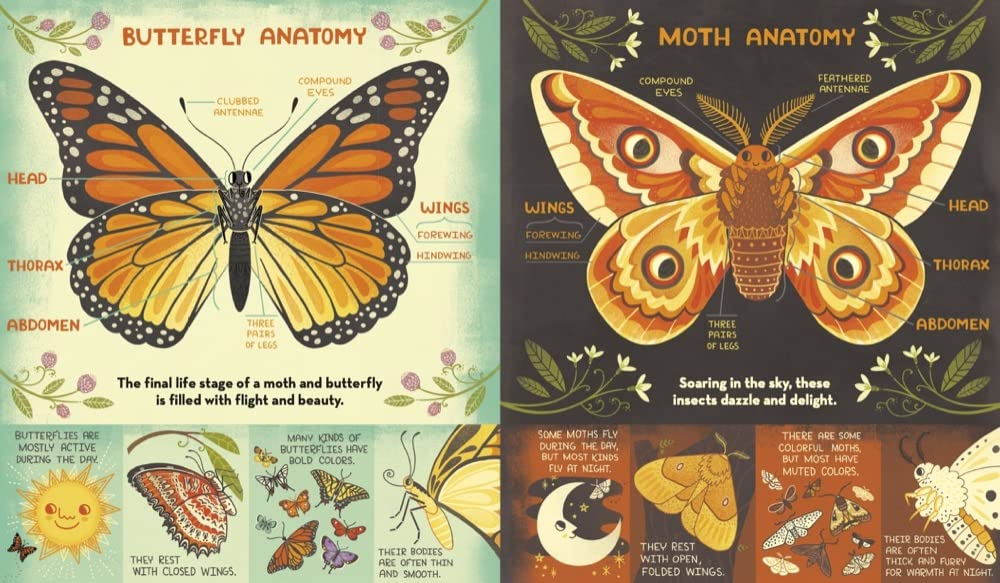
Summary:  From egg to caterpillar to pupa (called a cocoon for moths and a chrysalis for butterflies), butterflies and moths have similar life cycles.  Readers will learn the intriguing answer to the title question, as well as answers to many other questions about butterflies and moths.  Detailed illustrations portray a wide range of caterpillars, butterflies, and moths with labels to identify each one.  In addition to the life cycle, there is plenty of fascinating information about anatomy, food, defenses, and more.  Includes a page of sources and resources.  48 pages; grades K-3.

Pros:  I missed last year’s What’s Inside a Flower? and am delighted that I discovered this beautiful and informative science book.  The illustrations are unique and detailed, containing at least as much information as the text.  Just as I was wishing I knew the differences between butterflies and moths, I turned the page to discover a detailed comparison suitable for framing and hanging in the science corner.

Cons:  This book seemed a little long for the intended audience.  With so much information, you might want to break it up into several sections and read one at a time.

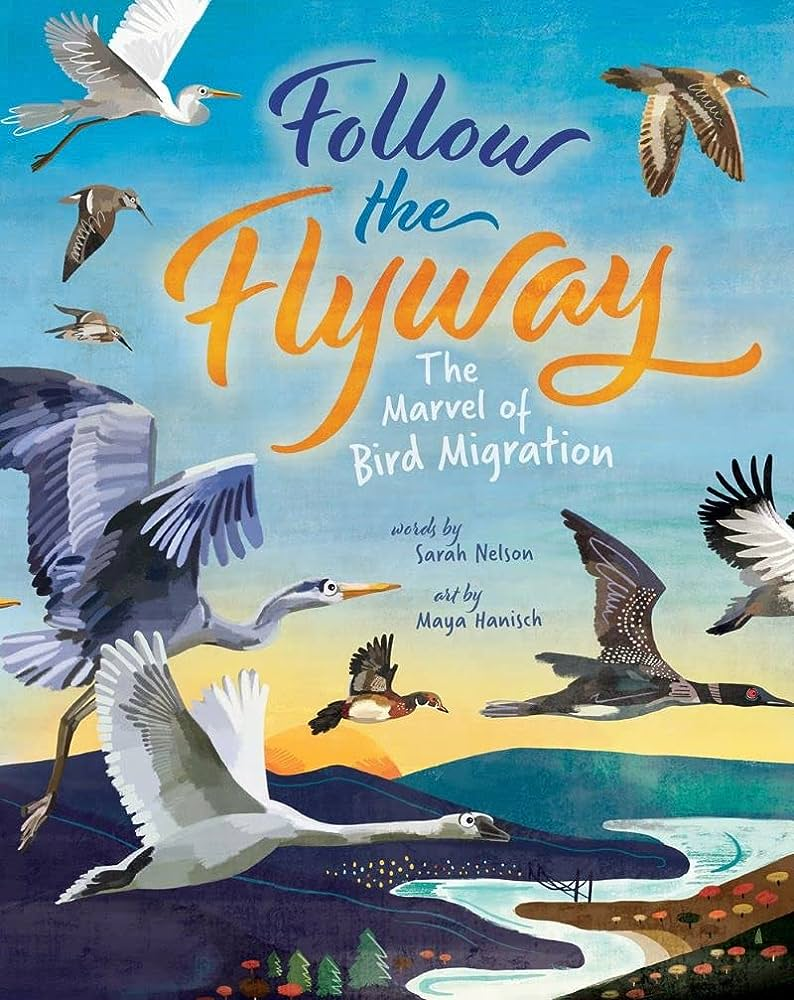
Follow the Flyway: The Marvel of Bird Migration by Sarah Nelson, illustrated by Maya Hanisch

Published by Barefoot Books

Summary:  The text follows a variety of birds, starting with hatchlings emerging from eggs, and continuing as those babies learn to fly.  By the time autumn comes, they are strong enough flyers to join the flyway of birds migrating to warmer places.  Flying in groups of all sizes, they head south, stopping for a week or two to rest until the cold catches up and sends them on their way.  When they reach the ocean, they settle in and wait until spring arrives to call them back north again.  Includes additional information about bird migration, including ways to help migratory birds; a map of the four North American flyways; thumbnail portraits and additional information about the twelve birds in the book; and sources of additional information.  32 pages; grades K-4.

Pros:  A great introduction to bird migration, with poetic text and lots of interesting pictures of a variety of birds.  The back matter makes it a good resource to begin further research.

Cons:  The only birds covered were water birds.

Stranded! A Mostly True Story from Iceland by Ævar Þór Benediktsson, illustrated by Anne Wilson

Published by Barefoot Books

Summary:  “This is the story of my grandfather: how he got stranded on a volcanic island, was almost turned into barbecue and found the most important moment in the world.”  The island is Surtsey, formed in the 1960’s by underwater volcanic explosions off the coast of Iceland, where Ævar’s grandfather (also named Ævar) was from.  Ævar Senior was an explorer, a scientist, and a photographer, so when he heard about Surtsey, he wanted to go check it out.  A fisherman dropped him and a friend off, and the two scientists enjoyed a day of exploring.  Unfortunately, the fisherman never returned, and they spent two days trying to keep warm (the molten lava helped) and surviving on the small amount of food and drink they had with them.  On the third day, an American man, part of a U.S. scientific expedition, found them (at the most important moment in the world).  They made it back to Iceland and lived happily ever after, although they never found out why the fisherman didn’t pick them up.  Includes additional information about Iceland, Surtsey, volcanoes, a few Norse gods, and the legend of Surtsey’s tomatoes, which involves poop.  32 pages; grades 2-5.

Pros:  This quirky book is a total delight, both the folksy story and the illustrations that perfectly capture the magic and colors of Iceland.  The author states on the title page that everything in the story is true, except for one little thing, and invites readers to see if they can spot it.  That made me want to read carefully, which we can hope will be the result for kids as well.  

Cons:  The detail that is not true turns out to be quite the anticlimax, although Benediktsson has fun pointing out the outlandish parts that are true throughout the story.

Night Owl Night by Susan Edwards Richmond, illustrated by Maribel Lechuga

Published by Charlesbridge

Summary:  Sova is eager to accompany her scientist mother on one of her evening owl watches, but every time she asks, Mama tells her that a scientist must learn to wait.  Finally, Sora is old enough, and the big night arrives when the two of them go off together.  Once again, there’s a lot of waiting: Mama sets a timer for thirty minutes, and the two of them play games in the wildlife sanctuary’s cabin until the timer goes off.  They go out to check the nets for owls.  The first two times, there are just leaves, but on the third trip–finally–there’s a saw-whet owl.  Back at the cabin, Mama measures and bands the owl, explaining how the bands help scientists track the owls’ migration.  Together, the two of them release the owl, and Sora feels a part of herself take wing and fly away with the owl.  Includes additional information about four types of owls; a note from the author about saw-whet owl banding (with a photo); and additional resources.  32 pages; ages 4-9.

Pros:  Fans of Jane Yolen’s Owl Moon will enjoy this story with its portrayal of a woman scientist.  It’s remarkably engaging, considering how much waiting is involved, and incorporates quite a bit of scientific information.

Cons:  I was getting a little impatient to finally see an owl.

Tee Time on the Moon: How Astronaut Alan Shepard Played Lunar Golf by David A. Kelly, illustrated by Edwin Fotheringham

Published by Calkins Creek

Summary:  When Apollo 14 launched in 1971, astronaut Alan Shepard had a secret stash he was carrying with him.  He revealed what it was after he and fellow astronauts Stuart Roosa and Edgar Mitchell had a successful landing, and he and Mitchell had walked on the moon.  Shepard had a golf club and ball and wanted to see how far he could hit the ball in the low-gravity atmosphere of the moon.  In front of TV cameras, he made a couple of unsuccessful swings before giving the ball a good whack, sending it flying into space.  How far?  It took almost fifty years to find out.  A photographer used software to sharpen the moon images and discovered that the ball had only gone about 120 feet–a far cry from the miles Alan Shepard had claimed.  The stunt made viewers think differently about the moon, though, seeing it as a place where one day everyday events like playing sports could take place.  Includes five pages of additional information, including information about each of the Apollo missions, photos, and a bibliography.  40 pages; grades 2-5.

Pros:  Alan Shepard, Jr.’s golfing stunt provides a great hook to draw readers into a history of the Apollo missions, with information on the history of the program, how the launches worked, and the space suits the astronauts wore, among other things.  The additional information provides a good starting place for learning more.

Cons:  The tiny font of the back matter was hard on my elderly eyes.