Slice of life picture books

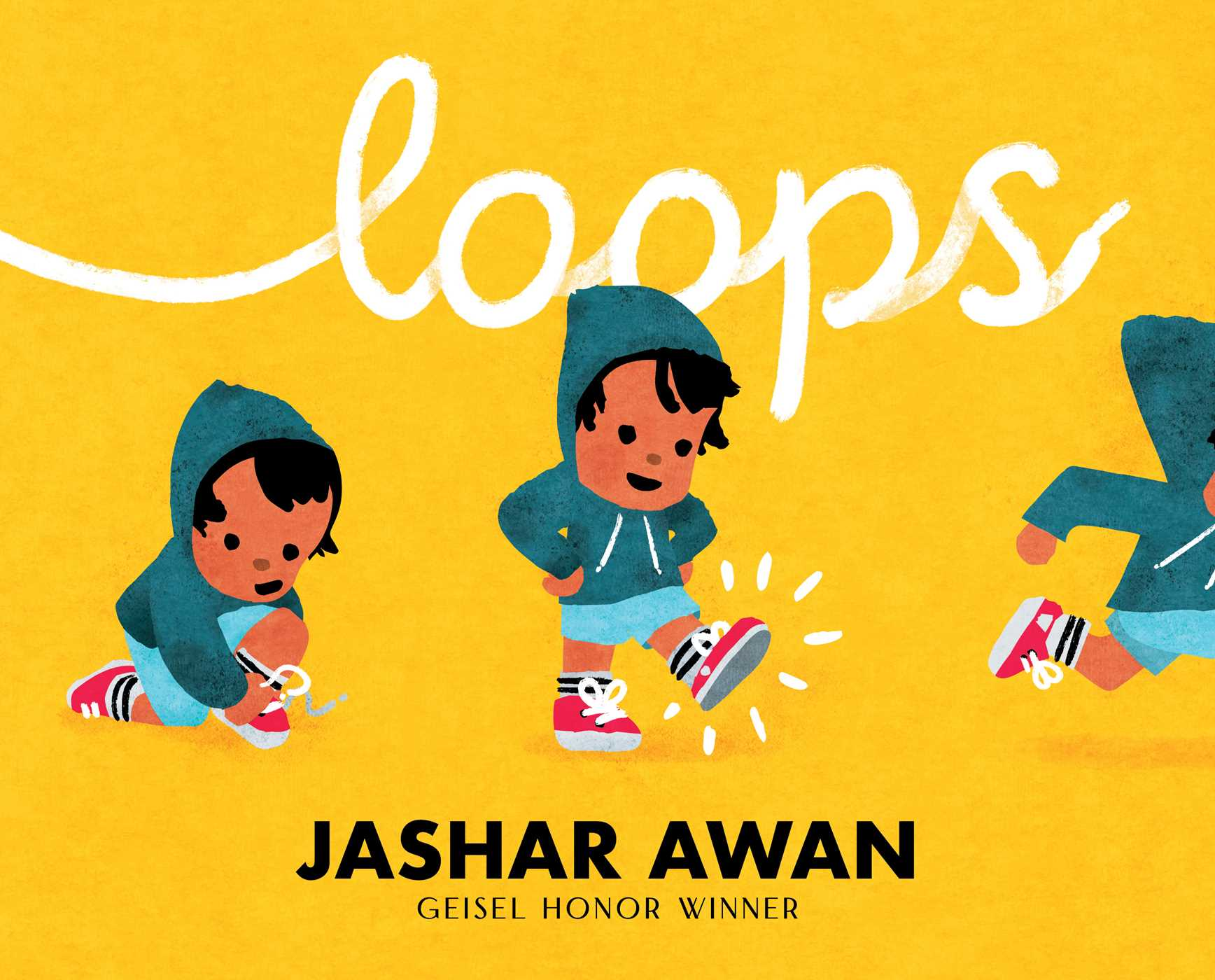
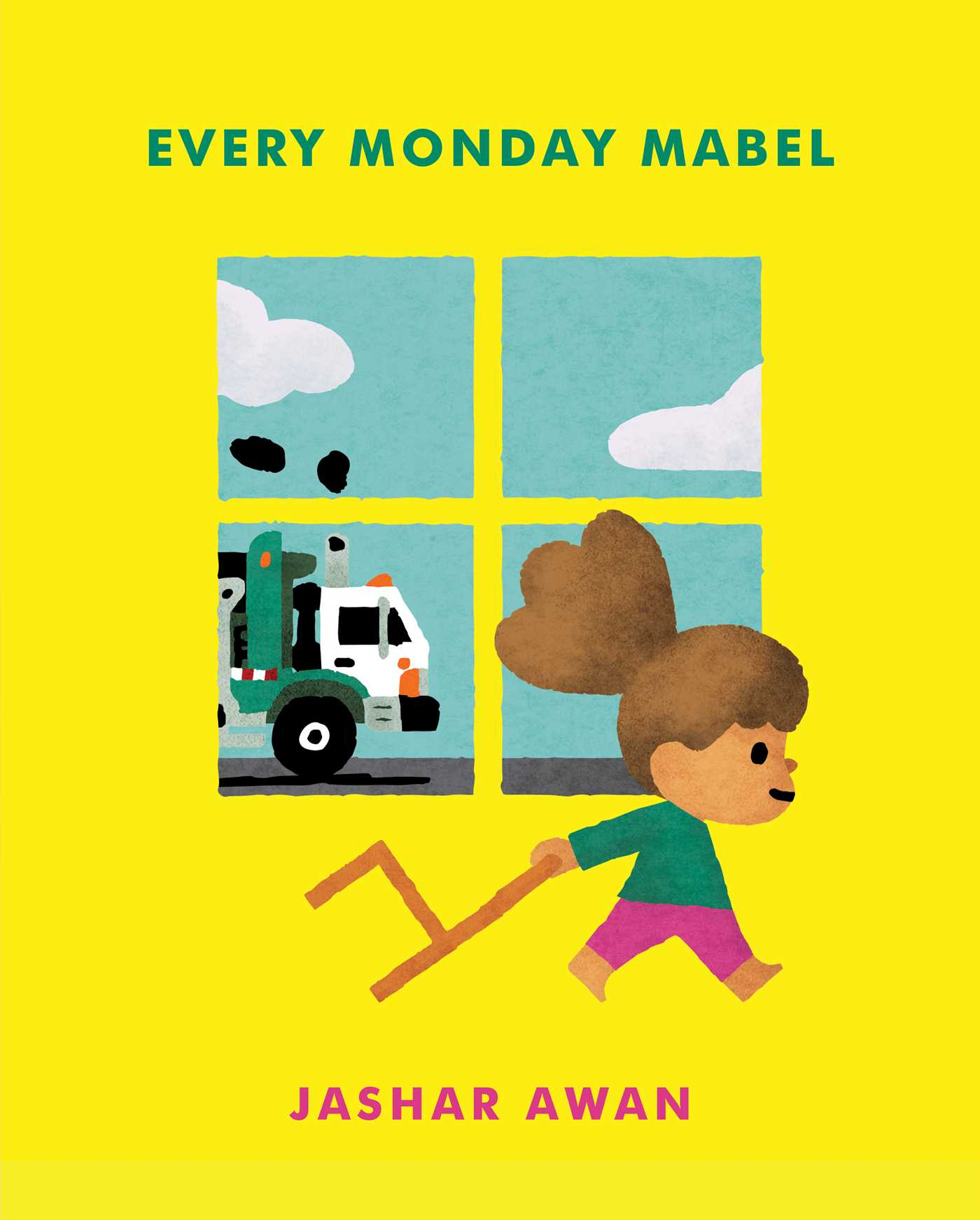
Every Monday Mabel by Jashar Awan (Simon and Schuster Books for Young Readers, 48 pages, ages 3-7). Monday is the best day of the week as far as Mabel is concerned, and the reader slowly gets to find out why as Mabel wakes up early, grabs some cereal, and heads outside, ignoring her older sister (who thinks she’s boring), her mom (who thinks she’s cute), and her dad (who thinks she’s funny). Perched on a chair, she hears the garbage truck before she sees it, and its arrival is worth the wait! Mabel cheers as the truck’s mechanical arm grabs the trash can, dumps the trash, and puts it back down again. As Mabel heads back home, the truck rumbles down the street, and the reader gets to see other eager faces pressed against their windows, enjoying the spectacle as much as she did.

Who doesn’t enjoy a good vehicle book? This one nicely captures the sights and sounds of the garbage truck, but it also celebrates enjoying small moments, something kids often do better than the older people in their families. The last page, showing other kids eagerly awaiting the truck, is a perfect validation of Mabel’s enthusiasm.

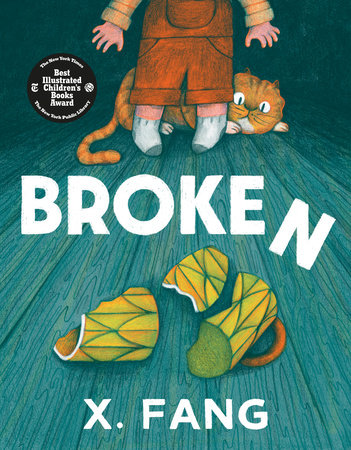
Broken by X. Fang (Tundra Books, 48 pages, ages 3-7). When Mei Mei accidentally breaks Ama’s cup after scaring Mimi the cat, she worries what will happen when Ama finds out. Ama serves tea, where she scolds Mimi about the broken cup. Mei Mei is tempted to let Mimi take the blame, but, overcome with guilt, she finally makes a tearful confession. Much to her surprise, Ama doesn’t get mad, but hugs Mei Mei, then goes about fixing the cup, reminding her that every patch and repair has a story to tell. On the last page, Mei Mei enjoys a slice of cake while Ama sips tea from her newly-mended cup.

This simple story will resonate with anyone who’s ever felt guilty about confessing a misdeed to a loved one and/or experienced forgiveness for said misdeed. There are some excellent lessons, but they are put forth in such a gentle and relatable way that kids won’t notice that they’re getting a good dose of SEL education.

Perceiving the world around us

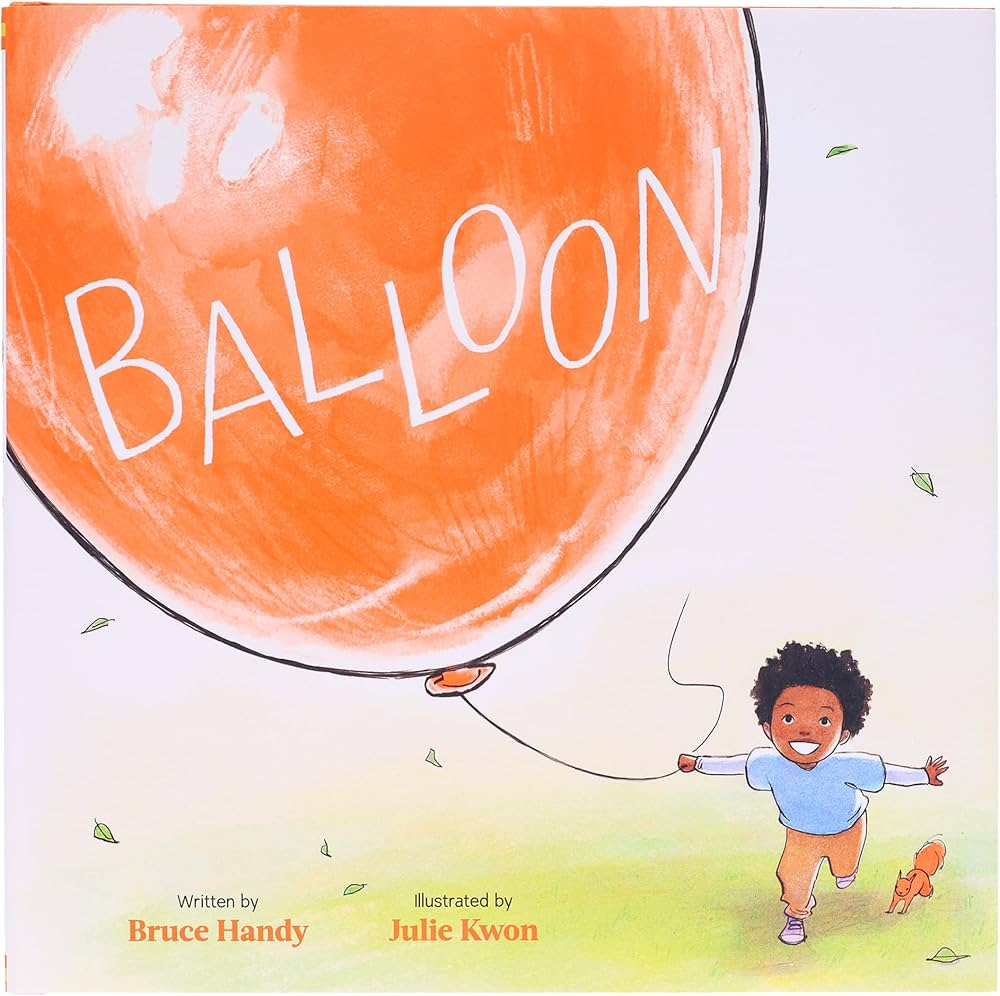
Balloon by Bruce Handy, illustrated by Julie Kwon (Chronicle Books, 44 pages, ages 3-7). A young child is devastated when a flock of pigeons causes him to let go of his orange balloon. Refusing a replacement, he goes on a search for the balloon through the city park. Illustrations show different objects that appear to be the balloon–a bit of an orange frisbee hidden by a picnic blanket, an orange cap on the head of a musician obscured by a crowd–but when the full picture is revealed, it’s never the balloon. Finally, the boy spots something else orange: a kitten for sale. He and his mom adopt the kitten, and the boy tells it, “Balloon. That’s your name.” As the two sleep together on the last page, astute readers will notice the tiny shadow of a balloon against the full moon. Includes an author’s note that tells how the story was inspired by his son, who also named his cat after a lost balloon.

This nearly wordless book is so much fun, giving kids an opportunity to guess what the various orange objects are and to spot the squirrel that enlivens many of the illustrations. The final page provides a most satisfying conclusion, not only with the boy and his new kitten, but the balloon in the background and a stuffed squirrel sitting on a bookcase.

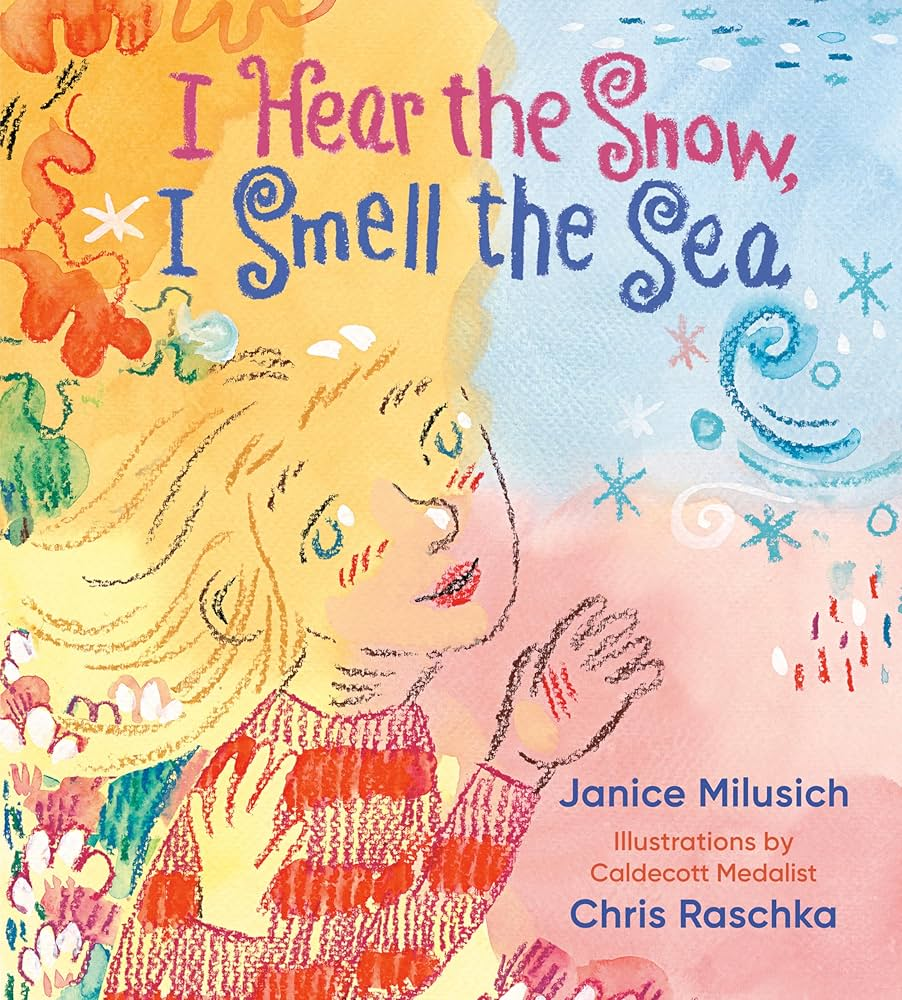
I Hear the Snow, I Smell the Sea by Janice Milusich, illustrated by Chris Raschka (Anne Schwartz Books, 48 pages, ages 4-8). Neveah enjoys the four seasons with her mother using her senses of hearing, smell, taste, and touch to experience them. Playing in the snow, taking a spring stroll, walking on the beach, and playing in the fall leaves, she enjoys the sounds, smells, and textures all around her. While she never mentions being visually impaired, the story and illustrations imply that, but it doesn’t slow her down from experiencing each season to the fullest.

I have a blind student who started kindergarten this year, which makes me extra appreciative of this book, not only for her, but for her classmates who can learn about perceiving the world through other senses. The simple illustrations do a great job of portraying the different seasons while leaving a great deal to the imagination, which will be inspired by the descriptions in the text.

Creating community

No More Chairs by Dan Gill, illustrated by Susan Gal (Little, Brown Books for Young Readers, 40 pages, grades K-3). On the first day of school, Mr. Gill’s students ask him why there’s an extra chair at the front of the room. He tells a story of when he was a kid, and he went to a birthday party with his best friend Archie. At the door, the host’s mother stared at Dan, who was white, and Archie, who was Black. “You can come in,” she told Dan, “but your friend cannot, because there are no more chairs.” At first Dan doesn’t understand, although Archie seems to, and he offers to bring a chair from home or sit on the floor. But when the mom is adamant, Dan finally realizes what’s going on. “Give these presents to Steve,” he says. “We’re going back to my house, where there are always enough chairs.” On the way home, Archie tells Dan he will speak up for him if Dan ever feels like he can’t speak for himself, and the two friends share a big bowl of ice cream. And that’s why, Mr. Gill explains, he always keeps an extra chair in the classroom, to make sure that everyone knows that there are always enough chairs, and everyone is welcome. Includes an author’s note of how he always told this true story from his childhood to his classes on Dr. Martin Luther King, Jr.’s birthday to help them understand the meaning of the day.

Use this short but powerful tale to either kick off the school year with a message of inclusion or to begin a conversation about the civil rights movement. It’s a story that will resonate with kids of all ages, as well as with adults, and points to the importance of people with privilege speaking up for those who are being marginalized.

Sunnyside School: A Community Helpers Book by Lindsay Ward (HarperCollins, 40 pages, grades K-3). Welcome to Sunnyside School! The first two pages show 39 different jobs that people have at the school. Then the story begins, with siblings Ali and Matty starting second grade and kindergarten, getting walked into the school by their mom. As the two go through their day, they meet all kinds of people: front office staff, classroom teachers, specialists, cafeteria staff, and more. Sidebars give additional information about their jobs, while questions are sprinkled throughout the text to keep kids engaged, and characters talk to each other via cartoon bubbles. Ali’s best friend has just moved away, and Matty’s going to school for the first time; each of them is successful and finding a new friend. At the end of the day, both kids meet their mom and report an excellent first day. Includes a search and find activity for kids to go back and find things like pencils and backpacks in the book, as well as a glossary.

This is an outstanding introduction to all the people who work in a school woven into a first day of school story that kids will relate to. I thought about reading this to kids at the beginning of school, but there’s so much information packed into it that it almost felt overwhelming to read it all in one sitting. it would be a great book to revisit a few times during the first week or two of school, as well as a good one to share with kids at home before their first day.

Life lessons from animal friends

Axolotl and Axolittle by Jess Hitchman, illustrated by Sarah Rebar (Sourcebooks Jabberwocky, 40 pages, ages 3-8). Siblings Axolotl and Axolittle are very different–big sis Axolotl lives life to the max while younger brother Axolittle is quieter and more studious–but they’re still the best of friends. When Axolotl’s boisterous play ends up destroying Axolittle’s painting, though, an axo-squabble ensues. Finally, Axo-dad-l comes in to calm things down, and after a bit of a break, family harmony is restored.

Axolotls seem to be having a moment, due to Minecraft, I guess? Whatever the reason, this book will definitely catch the eye of many a young reader, and they won’t be disappointed by the lively rhymes, clever axolotl (and axolittle) plays on words, and relatable family situations. This would make a great sibling gift for the older child in a family with a new baby.

Don’t Trust Fish by Neil Sharpson, illustrated by Dan Santat (Dial Books, 40 pages, ages 4-8). After an introduction to mammals, reptiles, and birds, the narrator gets to fish: DON”T TRUST FISH! There are so many reasons, and those reasons grow more preposterous as the book goes on. Some have gills and some have lungs. Some live in salt water, some in fresh water. Very shifty. They live underwater where you can’t see them. They may be in your home, spying from that aquarium, and reporting back to the king fish! And they like to eat poor, innocent, kind crabs…which readers will learn on the last page is the animal responsible for all the information in this book.

I’ll admit I didn’t love this book the first time I tried reading it, and I only looked at the first few pages. But the four starred reviews and inclusion on possible Caldecott lists led me to take another look, and I’m happy to say that now I get it! It would be a fun story to read aloud and have kids try to guess who the narrator is. Dan Santat’s illustrations, of course, add immeasurably to the fun. It could also be a great introduction to a discussion with older kids about considering sources of information in the news and on social media.

You and Me, Anemone by Rachel Vail, illustrated by Chris Raschka (Greenwillow Books, 32 pages, ages 4-8). Using clever rhyming text, an anemone makes a plea to readers not to BOOP it, then goes on to encourage kids who prefer not to be booped to assertively make their wishes known. The anemone explains that it likes living harmoniously in community with other anemones, and that not being touched doesn’t mean that it doesn’t enjoy the company of others, “to live side by side in our own kind of unity! Resplendent, independently, extending as far as eye can see.” Includes an author’s note about how she learned recently not to touch anemones and giving kids tips for communicating their own preferences as well as noticing those of others.

This is an ingenious book, combining interesting information about anemones with ideas for kids on how to notice what they may or may not want and expressing that. The illustrations are made to look like applique on burlap, with lots of textures and colors.

Be the change

Stalactite and Stalagmite: A Big Tale from a Little Cave by Drew Beckmeyer (Atheneum Books for Young Readers, 40 pages, ages 4-8). Two nubs of rock in a cave greet each other as the one above drips a steady stream of water drops onto the one below. They’re friends from the start and enjoy the company of other more transient creatures as they witness the history of life on Earth. First a trilobite, next an Ichtyostega with some new legs, then a triceratops who enjoys a dazzling light display before disappearing. Ice Age creatures give way to early humans, and finally, contemporary human tourists marvel at the stalactite and stalagmite that are almost touching each other. A futuristic city appears outside the cave, then darkness as the two fuse together into a column of stone. Includes additional information about some of the creatures and a timeline of the time period covered in the story.

Enjoy a warm, fuzzy friendship story while simultaneously feeling insignificant as you follow this rocky relationship over millions of years. Drew Beckmeyer makes it look easy to create an amazing picture book with plenty of humor that introduces the entire history of life on earth.

Papilio by Ben Clanton, Corey R. Tabor, and Andy Chou Musser (Viking Books for Young Readers, 48 pages, ages 3-7). Three friends and beloved author-illustrators have created a story in three parts about Papilio, a black swallowtail butterfly. In the first, by Clanton, Papilio hatches from an egg and explores life as a caterpillar before creating a chrysalis. Tabor takes the story from there, narrating from inside a chrysalis that is almost eaten by a bird. Having safely survived, the newly emerged butterfly’s tale is told by Musser, as she learns from other flying insects how to use her wings. The stories are tied together by Papilio’s interactions with a mouse, and readers will enjoy seeing the different depictions of it by the three different artists. Includes additional information about butterfly metamorphosis, as well as notes from each of the creators about how they came up with their stories and illustrations.

I was excited to see this book by Ben Clanton and Corey R. Tabor, who are well-loved in my library (I’m not yet familiar with Musser’s work), and it did not disappoint. Kudos to them for taking on the well-worn tale of butterfly metamorphosis and finding something new. It’s fun to compare the illustrations, which are similar but have distinctive differences from the three different artists.

Caboose by Travis Jonker, illustrated by Ruth Chan (Harry N. Abrams, 40 pages, ages 4-8). Hippo loves being first in line, and he’s learned all kinds of tricks to get there: running, sneaking, even slingshotting to the head of the line. But one day, Hippo takes it too far, and Fish gets hurt. “You may not be first anymore!” declares the teacher, and Hippo is banished to the end of the line. It takes a little adjustment, but before long, Hippo has a series of strategies to make sure he’s always the caboose: walking like a turtle, politely letting everyone go ahead, pretending his sneaker has a giant knot. But “caboosin’ it up” causes Hippo to go too far once again, and now his assigned place is in the middle of the line. And the middle proves to be the best place for him, right in the center of all his classmates.

Hippo definitely cracked me up, and there are lessons to be learned about working with others. Kids may recognize themselves or a classmate as Hippo slowly learns line etiquette and how to be respectful of his classmates. The illustrations are adorable, with a huge variety of animals, but I have to say I struggled a little to grasp the lesson Hippo learned at the end.

Graphic novels that deal with tough issues

Crumble by Meredith McClaren, illustrated by Andrea Bell (Little, Brown Ink, 208 pages, grades 3-7). Emily’s mother is often traveling to promote the family bakery, so Aunt Gina and Emily run the shop and keep things going back home. The two of them know how to infuse their baked goods with feelings, helping people to feel happier or more relaxed when they eat them. When Aunt Gina suddenly dies in a car accident, Emily and her mom are overwhelmed by grief. The only way Emily knows how to process her feelings is to bake, but baking while sad results in terrible-tasting pastries that somehow no one can stop eating. When Emily ends up making all of her classmates sick, she has to slow down and find new ways to deal with her feelings. She and her mom slowly create a new normal, and the last chapter shows them running a new baking school, while Emily has developed more empathy for people around her who are suffering.

This cheery graphic novel takes an unexpected twist when a panel showing Aunt Gina’s wrecked car changed everything for Emily. From there, the story does an excellent job showing how she processes her grief, feeling overwhelmed by it at first, then slowly finding a way to acknowledge her feelings and move on, even though things will never be the same. The reactions from the other kids–trying to cheer Emily up, asking too many questions about her aunt’s funeral–are helpful in showing readers what may or may not be helpful to those who are grieving.

Cassi and the House of Memories by Dean Stuart (Viking Books for Young Readers, 272 pages, grades 4-7). Cassi loves spending time with her grandparents, but sometimes Grandpa’s mind wanders. When he forgets who she is, Grandma reassures her that he is still there and that he loves her. One day, Cassi goes into the backyard with him, and he disappears into the woods. When she goes in search of him, she discovers a giant structure that looks like Grandpa’s head. Inside, she discovers all kinds of memories from Grandpa’s early life. Cassi is able to put herself into those memories, and in an exciting climax, to help change one of them from a traumatizing event to one that makes Grandpa into a hero. Eventually, she meets up with her present-day grandpa, and he leads her back home, where Grandma is waiting with dinner, not worried at all, just sure that the two of them have been having fun together. An author’s note tells of his experiences with his own father’s dementia and how he created this book for kids who may be dealing with someone in a similar situation.

I saw this book described as “melancholy” in a review, and that’s a perfect word for both the story and the artwork that creates an alternate world inside Grandpa’s head, where memories come and go. Cassi’s ability to change some of the memories demonstrate how selective and imperfect all of our memories are. A thought-provoking book that will help kids see those with dementia in a new way.

Struggles at school

Mixed-Up by Kami Garcia, illustrated by Brittney Williams (First Second, 208 pages, grades 3-7). Stella is excited to start fifth grade, but her excitement turns to panic as the homework starts to pile up and she falls further and further behind. She and her two best friends often play a favorite video game, but when a new manual comes out, Stella feels alienated when she can’t keep up with her friends’ reading. And to add to her worries, the big fifth grade project isn’t the art project she was hoping for, but one that features students’ writing. When Stella’s teacher calls home, she’s sure she’s in trouble, but it turns out that the adults in her life want to help. Once she’s gotten a dyslexia diagnosis, Stella’s able to work with special education teachers to develop new skills to help with her reading. This also takes away her shame at feeling like she’s not as smart as everyone else, leading to an honest conversation with her friends that helps them resolve their issues. And Stella’s understanding teacher lets her create a graphic novel for the writing project that allows Stella’s artistic talents to shine.

Speechless by Aron Nels Steinke (Graphix, 256 pages, grades 3-7). Mira’s determined that middle school will be a fresh start for her, but on the first day, she finds that, once again, she can’t bring herself to talk at school. Home is a different story, the place where she can be herself and pursue her passion of stop-motion photography. But this haven is taken away when former-friend-turned-mean girl Chloe comes for an extended stay. A phone call from school alerts Mira’s parents to her selective mutism, and she begins to work on her issues with an understanding therapist. A kind and patient new friend, Alex, also helps her by volunteering to be Mira’s partner with a project and defending her from bullies. Mira learns to take things one step at a time, communicating with notes and whispers. She even finds a way to reach out to Chloe (by letter), opening the way for them to resolve their differences. By the end of the story, Mira’s enjoying sixth grade, learning to succeed in her own way. Includes a note from the author (creator of the Mr. Wolf’s Class series) about his own struggles with social anxiety and difficulties talking in public.

These graphic novels offer stories that will both empower kids who may be dealing with learning differences like Stella’s or social anxieties like Mira’s, and create empathy in kids who may have classmates like them. I loved how the girls got help and support both at school and home but ultimately had to find their own ways. Each was able to discover her own talents and see her struggles as something she could overcome while staying true to herself.

\

Two books with heart(s)

Bigfoot’s Big Heart by Sarah Glenn Marsh, illustrated by Ishaa Lobo (Viking Books for Young Readers, 32 pages, ages 4-8). Bigfoot is a shy fellow who doesn’t like loud sounds, especially the noises people make when they see him. He keeps to himself, living in a cozy cave and writing to his mythical pen pals, like Nessie, Mothman, and Chupacabra. Valentine’s Day is coming, and Bigfoot decides to make valentines for all of his friends, telling him exactly why he likes them so much. On his way to the mailbox, though, he’s spotted by a group of Scouts, and the valentines get blown away in a blustery wind. A few of the quieter Scouts talk to Bigfoot instead of shouting or running away, and they come up with a plan. They connect online with Scouts around the globe who go on a worldwide monster search to deliver Bigfoot’s valentines. Nessie decides it’s time for an in-person (in-monster?) gathering, and monsters and humans gather at Bigfoot’s cave on Valentine’s Day. “Suddenly the world feels a little less lonely…thanks to friends who understand.”

Heartfelt by Elaine Vickers, illustrated by Samantha Cotterill (Simon and Schuster/Paula Wiseman Books, 56 pages, ages 4-8). The narrator likes to make hearts, especially the small ones which they like to give away. Love is felt with all the senses, and the child tells how love can look, feel, taste, smell, and sound. Each loving deed is accompanied by one of the small hearts until all of them are gone. Or are they? As the narrator looks around, it’s clear that love is being shared and spread throughout the community. Includes an author’s note about a favorite Sunday School lesson, in which each student was given a bag of hearts to distribute when they did kind deeds during the week, which they reported on the next week.

I’m thinking of reading both of these books to classes in the next few weeks as Valentine’s Day draws near. Bigfoot is a great way to introduce both the different mythical creatures in the story and where they live around the world. And the activity described at the end of Heartfelt is a fun and easy way for kids to practice kindness and community.

Heartbreaking/heartwarming stories

I Know How to Draw an Owl by Hilary Horder Hippely, illustrated by Matt James (Neal Porter Books, 32 pages, ages 4-8). Belle’s teacher holds up her picture of an owl for the class to see. “How did Belle make his eyes so wise? Belle’s owl almost looks alive.” Belle doesn’t want to tell the class, but she shows the reader how she learned to draw an owl. She and her mom have been living in their car in a deserted park. At night, they hear an owl hooting, and her mom tells Belle that the owl is keeping an eye on them. One night, there’s no sound, but suddenly the owl appears in a nearby tree and locks its wise eyes with Belle’s. She’s sure she’ll never tell the story to any of her classmates, but one day a new boy gets dropped off in a car that looks just like the one that she and her mom live in, and just like the owl, she vows to keep an eye on him.

This moving story shows a girl and her mom surviving a tough time with courage and resilience, resulting in Belle’s kindness when she sees another child who may be going through something similar. The owl adds an interesting element to the story, which will engage kids and build empathy for others who may be experiencing homelessness.

Shark Teeth by Sherri Winston (Bloomsbury Children’s Books, 304 pages, grades 4-7). At age 12, Sharkita has far too many responsibilities weighing on her, often being forced to care for her younger siblings while Mama is out drinking and partying. The family has been split up before, the kids sent to foster care, and Sharkita’s mom has been given a last chance to prove herself. At first, things seem pretty good, and Sharkita is cautiously optimistic that she can lead a normal middle school life, hanging out with friends, being a baton twirler, having her first boyfriend, and maybe even getting help for her hyperdontia (extra teeth). But soon, Mama starts disappearing, leaving Sharkita to take care of 5-year-old Lilli and 8-year-old Lamar, who has fetal alcohol syndrome. When Sharkita defies her mom one night to go out with her friends instead of babysitting, disaster strikes, and the kids are placed in foster care once again. Ultimately, they’re split up, but end up in loving homes. Sharkita begins to receive therapy for her panic attacks and sleep paralysis, learning that it’s okay to take care of herself as well as her siblings, and that the three of them will always be a family no matter what.

I could not put this book down, and I hope it will be considered for awards. Sharkita’s family is, as she learns, in crisis, and the brunt of that has fallen on her. The topics are not easy to read about, and I was on the edge of my seat for most of it. It seems like there have been more middle grade novels this year with terrible mothers, whether they are unrepentant criminals or criminally neglectful. It does make for rewarding reading to watch their resilient kids, like Sharkita, find their own way and manage to connect with loving adults who can actually support and take care of them (which sadly is not always how things turn out in real life). Sharkita’s support all comes from staff at her school, serving as a reminder of how much social work schools are doing these days.

Picture books to share

Mr. Fox’s Game of “No!” by David LaRochelle, illustrated by Mike Wohnoutka (Candlewick, 40 pages, ages 4-8). Here’s how Mr. Fox’s game works: every time he asks a question, you have to say “no,” or you will be sent back to the beginning of the book. Ready to play? Better not say yes! Do you want a taste of Mr. Fox’s scrumptious-looking sundae? A free trip to Hawaii with a million billion dollars thrown in? If you’re still in the game, how about this: are you stronger than a baby? Are you wearing underwear? What do the letters Y-E-S spell? If you make it all the way to the end of the book, there’s a final question: have you ever read a funnier, better written, more beautifully illustrated book than this one?

I’ve just been delighting first graders by reading them David LaRochelle and Mike Wohnoutka’s book, See the Cat: Three Stories About a Dog, and I look forward to trying this one out on them. It’s such a clever idea, and just the right humor for kids. I’m not sure about going back to the beginning of the book if they make a mistake…I might just make it a game where Mr. Fox gets points for the wrong answer.

First Day, Hooray! A Book of School Day Feelings by June Sobel, illustrated by Nabila Adani (Clarion Books, 40 pages, ages 4-8). Kids run into school on their first day with “backpacks filled with school supplies, but something else hides in disguise.” What’s hiding? Big feelings, shown with colored fonts in the text and colorful creatures surrounding different kids. Whether you’re feeling happy, scared, angry, or brave, it helps to name the feeling and to take a deep breath when needed. At the end of the day, kids pack up their backpacks–and their feelings–and head home with one more emotion: hooray! Includes a note from Yale early childhood professor Craig S. Bailey about ways to use this book to help kids explore their emotions.

I’m taking this book to school with me on Monday to share with our school counselors. It’s a simple but effective exploration of different emotions children (and adults) may experience, helping them to handle them better by identifying them. The illustrations of a diverse student body and fun magical creatures associated with the different feelings will appeal to kids as well.