A History of Me by Adrea Theodore, illustrated by Erin K. Robinson

Published by Neal Porter Books

A History of Me: Theodore, Adrea, Robinson, Erin: 9780823442577: Amazon.com:  Books

Summary:  “I was the only brown person in class.” The narrator feels the stares of her white classmates when they learn about slavery and civil rights.  Her mother tells her of ancestors who were enslaved or who only got to go to school for a few years, reminding her to be grateful for her own education.  She loves to learn but doesn’t like feeling like her race is what the other kids see about her.  The girl grows up to become a doctor with a daughter of her own.  When her daughter tells her of similar experiences at school, she encourages her to feel proud of herself and her ancestors, and to focus on what she sees when she looks in the mirror.  Includes notes from the author and the artist.  32 pages; ages 4-8.

Pros:  This book opens up interesting questions about how Black history is taught in schools and how to do it in a way that empowers children of color.

Cons:  The author’s note was in a font size that strained my middle-aged eyes.

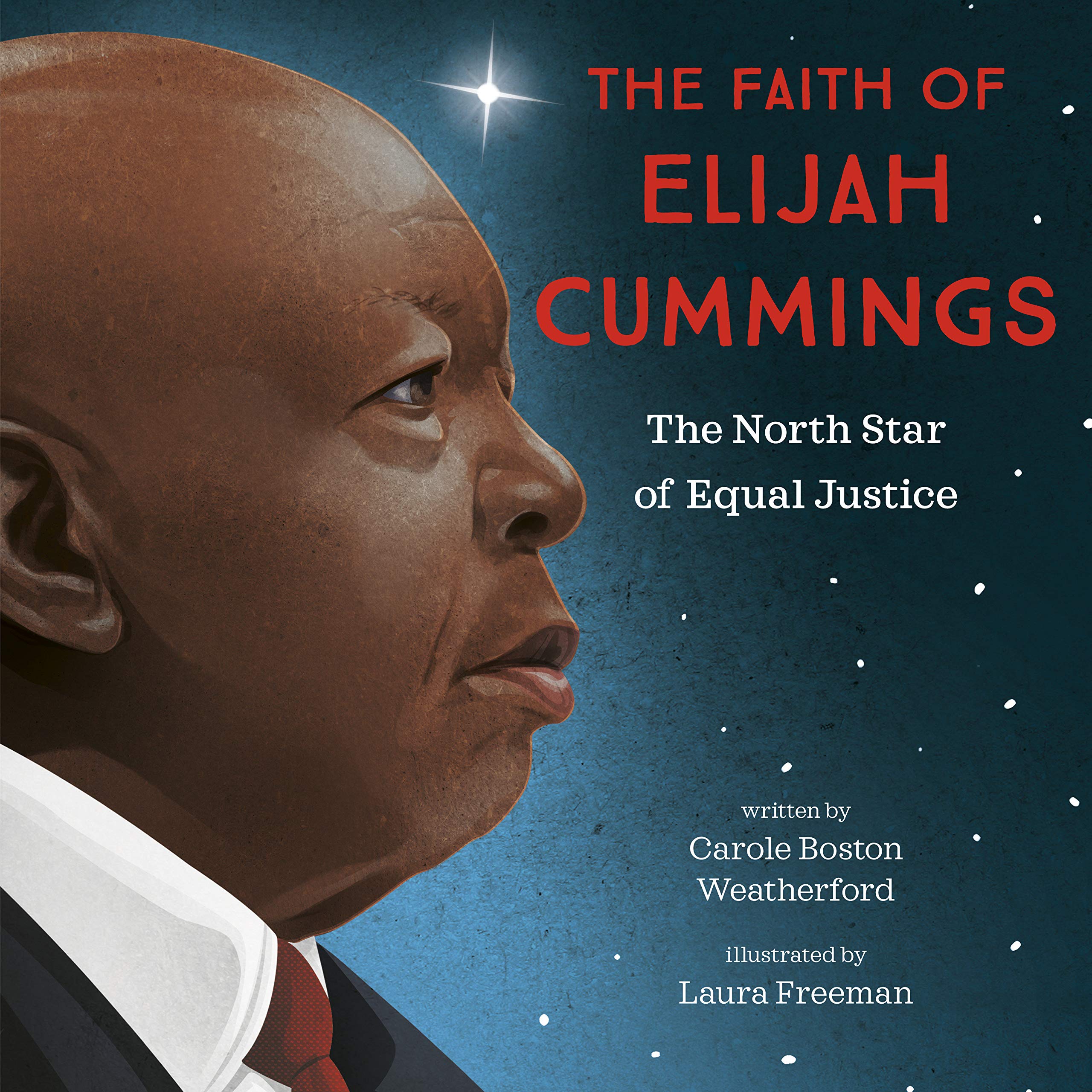
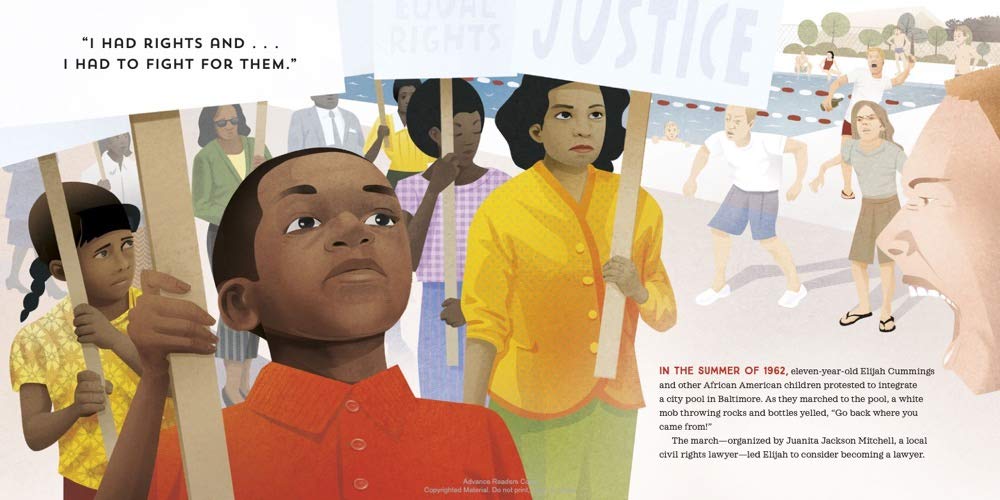
The Faith of Elijah Cummings: The North Star of Equal Justice by Carole Boston Weatherford, illustrated by Laura Freeman

Published by Random House Studio

The Faith of Elijah Cummings: The North Star of Equal Justice: Weatherford,  Carole Boston, Freeman, Laura: 9780593306505: Amazon.com: Books

The Faith of Elijah Cummings: The North Star of Equal Justice: Weatherford,  Carole Boston, Freeman, Laura: 9780593306505: Amazon.com: Books

Summary:  Elijah Cummings’ parents worked as sharecroppers on a South Carolina farm before moving to Baltimore to give their seven children a better life.  Elijah struggled in school, but with the help of his parents, the librarians at his public library, and his first employers, he went on to Howard University and eventually became a lawyer.  He served in the Maryland House of Delegates from 1983 until 1996, when he was elected to the U.S. House of Representatives.  Elijah was elected chair of the Congressional Black Caucus in 2003; when he died in 2019, he became the first African American legislator to lie in state in the U.S. Capitol.  Includes remarks by Nancy Pelosi and an excerpt of a statement from the Congressional Black Caucus following Elijah’s death as well as a timeline, a bibliography, and a list of sources.  40 pages; grades 1-5.

Pros:  The first part of the book about Elijah’s early life is an inspiring testimony to the power of hard work and having mentors.  The writing is engaging, and the illustrations are a kid-friendly enhancement of the text.

Cons:  I don’t want to diminish Elijah Cummings’ considerable achievements, but to me, the second part of the book was less interesting than the first. If I were reading this to elementary kids, I would want to supplement it in some way to make it more engaging for them.

Seeking Freedom: The Untold Story of Fortress Monroe and the Ending of Slavery in America by Selene Castrovilla, illustrated by E. B. Lewis

Published by Calkins Creek

Seeking Freedom: The Untold Story of Fortress Monroe and the Ending of  Slavery in America: Castrovilla, Selene, Lewis, E. B.: 9781635925821: Amazon.com:  Books

Summary:  May 26, 1861: George Scott, living in a cave in the woods after escaping slavery two years earlier, sees other Black people entering Fortress Monroe and not being returned.  He learns that the commander of the fort, Major General Benjamin Franklin Butler, has declared the Black people “contrabands of war”, which means he doesn’t have to return them to the Confederates.  When Scott tells Butler he can find the Confederate hideout, Butler sends him on a mission back into the woods where he’s been hiding.  Scott finds the Confederates gathered at a church, and the Union army attacks, thwarting the threat to the fortress.  As a reward, Butler writes a letter to President Lincoln making the case for Scott and the other contrabands.  His words play a part in what eventually becomes the Emancipation Proclamation.  Includes four pages of additional information about George Scott, Benjamin Franklin Butler, Fortress Monroe, and the contrabands, as well as a bibliography.  40 pages; grades 2-6.

Pros:  This well-written and engaging narrative tells a little-known Civil War story, illustrated with sepia-toned paintings that evoke the photographs from that era.  Seems like more should be written about Benjamin Franklin Butler, who went on to become governor of Massachusetts and was a leader in civil rights on many fronts.

Cons:  Apparently, “contrabands” was the term used for those who found refuge at the fortress, but it seems like a somewhat dehumanizing expression. 

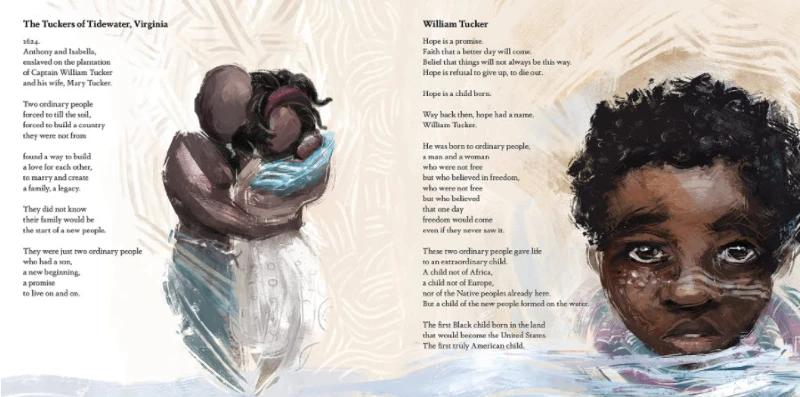
The 1619 Project: Born on the Water by Nikole Hannah-Jones and Renée Watson, illustrated by Nikkolas Smith

Published by Kokila

The 1619 Project: Born on the Water: Hannah-Jones, Nikole, Watson, Renée,  Smith, Nikkolas: 9780593307359: Amazon.com: Books
The 1619 Project (Picture Book): Born on the Water by Nikole Hannah-Jones  and Renée Watson

Summary:  In the first poem, titled “Questions”, a girl gets an assignment to trace her roots and realizes she can only go back three generations. At home, she asks her grandmother for help.  Her grandmother gathers the family together and tells them their story, beginning with their ancestors in West Central Africa who were kidnapped in 1619 and forced on a hellish journey aboard a slave ship.  Those who survived were forced into slavery in tobacco fields, fighting to hold onto their memories of home.  Their descendants went on to become great people in their new country.  By the end of the story, the girl is ready to return to school and finish her story; the final poem is called “Pride”.  Includes notes from the authors and the illustrator and the website for the 1619 Project.  48 pages; grades 1-5.

Pros:  The award-winning authors have crafted an empowering collection of poems that doesn’t shy away from harsh histories, but also celebrates an African history that is often overlooked.

Cons:  I wish there were more resources listed; the 1619 Project website has books connected to the project, but no others.

Revolution in Our Time: The Black Panther Party’s Promise to the People by Kekla Magoon

Published by Candlewick

Amazon.com: Revolution in Our Time: The Black Panther Party's Promise to  the People: 9781536214185: Magoon, Kekla: Books

Summary:  The history of the Black Panther Party is divided into three parts: Kindling (1619-1965), Blaze (1966-1982), and Embers (1983-present).  Packed with photos and original sources, the story is sympathetic to the Party, but does not shy away from differences among the members which eventually led to its dissolution (and were at least in part caused by the FBI COINTELPRO project to destroy them).  There’s an emphasis on the young people and women who contributed so much to all aspects of the group, from the armed oversight of police to the social programs for Black communities.  The final section ties the Black Panther Party to Black Lives Matter and invites young people to start their own revolution.  Includes an author’s note, a list of key people, a timeline, a glossary, further reading, 32 pages of source notes, an 11-page bibliography, and an index.  400 pages; grades 7-12.

Pros:  This is a bit above the age group I usually review for, but I’ve been fascinated by the Black Panther Party since I read One Crazy Summer by Rita Garcia-Williams and realized how much misinformation I had about the group.  This book is incredibly well-researched, yet also highly readable and accessible, and was chosen as a National Book Award Finalist.  The final section makes it relevant and inspiring for today’s young readers.  I hope it will win some awards: Printz, Sibert, and Coretta Scott King all come to mind.

Cons:  This book is seriously hefty, weighing in at three pounds or approximately twice as much as Harry Potter and the Goblet of Fire.  

Light for All by Margarita Engle, illustrated by Raúl Colón

Published by Simon and Schuster/Paula Wiseman Books

Light for All - Kindle edition by Engle, Margarita, Colón, Raúl. Children  Kindle eBooks @ Amazon.com.
Amazon.com: Light for All: 9781534457270: Engle, Margarita, Colón, Raúl:  Libros

Summary:  “From land to land, brave travelers arrive with hopes, dreams, skills, and determination.”  The lyrical text and illustrations of this book celebrate the immigrants who have come to the United States, and the Statue of Liberty that welcomes them.  The gifts that people bring in terms of skills, languages, and cultures are recognized, as are the harder truths that people have not always been made to feel welcome.  “The long, bitter story of the US” is also acknowledged, including “stealing land from Native people, bringing enslaved captives all the way from Africa, and then seizing a huge part of Mexico.”  The final image, though, is of Lady Liberty’s torch, and the book concludes on this hopeful note.  Includes notes from the author and illustrator about their personal experiences of immigration.  40 pages; ages 4-8.

Pros:  This would make an excellent introduction to immigration, with poet Margarita Engle’s text and Raúl Colón’s colored pencil illustrations depicting so many different nationalities coming to the US.  While some hard truths are acknowledged, the tone is basically hopeful and celebratory.

Cons:  A list of additional resources would have made this even more useful for older kids.

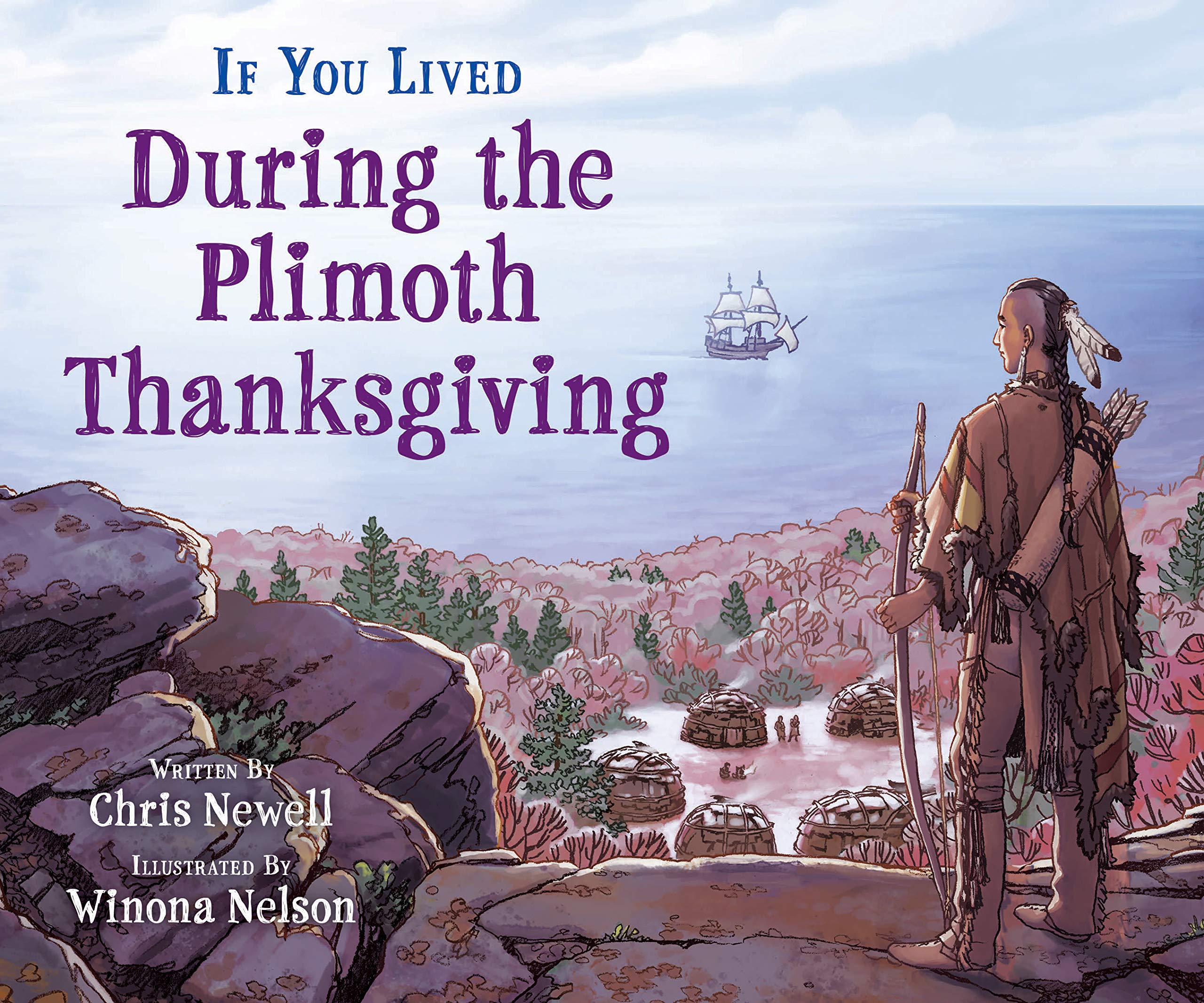
If You Lived During the Plimoth Thanksgiving by Chris Newell, illustrated by Winona Nelson

Published by Scholastic

If You Lived During the Plimoth Thanksgiving: Newell, Chris, Nelson,  Winona: 9781338726374: Amazon.com: Books

Summary:  Those of us who grew up reading Scholastic’s books like If You Sailed on the Mayflower in 1620 or If Your Name Was Changed At Ellis Island will recognize the question-and-answer format of this book that traces the history and culture of the Wampanoag people, the Europeans who sailed on the Mayflower, and what happened when their paths crossed.  This story does not end with the 1621 harvest feast that these groups shared, but continues on to what happened in the years afterward as Europeans increasingly moved onto indigenous lands and killed many of the people with wars and disease.  It also tells how Thanksgiving came to be a national holiday, more than 200 years after the event it purports to celebrate, and concludes with a discussion of American holidays  (or the lack of them) that recognize indigenous people.  Includes a glossary.  96 pages; grades 2-5.

Pros:  I enjoyed these books as a kid, and this one provides a much-needed correction to the traditional Thanksgiving story, with a greater emphasis on the Wampanoag history and culture, and a look at some of the history after 1621.  Definitely a resource that should be added to elementary school classrooms and libraries where Thanksgiving is part of the curriculum.

Cons:  Given the many, many questions around the traditional telling of the history of Thanksgiving, I was disappointed that this book didn’t include source notes, additional reading lists, or any information about the author. 

A Little Round Panda on the Big Blue Earth by Tory Christie, illustrated by Luciana Navarro Powell

Published by Amicus Ink

A A Little Round Panda on the Big Blue Earth: Christie, Tory, Powell,  Luciana Navarro: 9781681526546: Amazon.com: Books
A Little Round Panda on the Big Blue Earth - J. Appleseed

Summary:  In this follow-up to A Tiny Brown Monkey on the Big Blue Earth, a little round panda munches bamboo on a hill covered with mist.  A path leads from the hill to a river where people board a boat and travel down the river to a big city.  Lights blink from tall buildings that shine into the sky of the big blue earth.  Endpapers show the panda sitting in the Sichuan Province of China at the center of a map with the Yangtzee River, Indian Ocean, country of China, and continents of Asia, Europe, and Africa all labeled. 32 pages; ages 4-8.

Pros:  We’ve seen books before that start at a certain geographic point and slowly move out into space.  This one starts with a cute panda and moves to different locations in China with beautiful illustrations that warrant close examination.  This would be a great introduction to maps for younger kids.

Cons:  Except for the endpapers there was no back matter.

When We Say Black Lives Matter by Maxine Beneba Clarke

Published by Candlewick

When We Say Black Lives Matter: 9780734420428: Amazon.com: Books

Summary:  A couple tells their child the many different meanings of saying Black Lives Matter.  It can be whispered, screamed, sung, or sobbed to celebrate the lives of Black people, to remember what was done to them in the past, and to protest wrongs still being done to them.  The rhyming text highlights words with different fonts and shapes.  The illustrations show the baby growing up until the last page, “We see you, Black-child-magic, your radiant Black shine/We hear your Black Lives Matter, and we know we’ll be all right,” shows him in a cap and gown holding a diploma triumphantly in the air.  32 pages; grades 1-4.

Pros:  The many different facets of the Black Lives Matter movement are addressed here with beautiful watercolor pencil and collage illustrations filled with colors and shapes.  The rhyming text flows smoothly and is well-integrated into the illustrations. 

Cons:  I’d love to see this considered for the Coretta Scott King Award, but the author is Australian, so I don’t think that it qualifies.

Survivor Tree by Marcie Colleen, illustrated by Aaron Becker

Published by Little Brown Books for Young Readers

Survivor Tree: Colleen, Marcie, Becker, Aaron: 9780316487672: Amazon.com:  Books

Summary:  Before 9/11, the Callery pear tree stood, mostly unnoticed, in the shadow of the Twin Towers.  “One September day, the perfect blue sky exploded,” and the tree was buried in the rubble.  Workers noticed a green sprout growing out of it, and the tree was taken to a nursery where it gradually came back to life and flourished for the next ten years.  Eventually, it was transplanted back to the 9/11 Memorial, where people now stop and marvel at the tree, now known as the Survivor Tree, the last living thing pulled from the wreckage of the World Trade Center.  Includes additional information about the tree, an author’s note, an artist’s note, and a photo.  48 pages; grades K-5.

Pros:  This beautiful book tells the story of the Survivor Tree in sparse, poetic language, with watercolor illustrations by Caldecott honoree Aaron Becker.  The same tale is told from the tree’s perspective in another 2021 book, This Very Tree.  I’d be hard-pressed to choose one over the other; both offer stories and illustrations that will engage younger readers with enough back matter to make them excellent resources for older kids.

Cons:  I wish this book had been released prior to August 31 so I could have reviewed it in time for the twentieth anniversary of 9/11.