Celebrating Black History

The History of We by Nikkolas Smith (Kokila, 40 pages, grades K-5). Through poetic text and rich acrylic illustrations, Nikkolas Smith traces the history of the earliest humans in Africa from more than 200,000 years ago. The people are shown making music and dancing, created languages, built homes, growing crops, wondering at the stars, and eventually discovering ways to travel on the oceans. A world map at the end puts Africa at the center of civilization, from where humans traveled to settle other continents. The back matter includes information about each of the spreads, and the author’s note relates how he never learned about humanity’s roots in Africa, motivating him to create this book. Includes a timeline covering the period from 233,000 years ago to 5,000 years ago.

I’d love to see this book considered for a Caldecott or Coretta Scott King award. It would make a good companion to Before the Ships, introducing kids to the history of the people of Africa before American slavery. Both books use beautiful language and illustrations to draw readers of all ages into a fascinating history that has long been ignored.

So Many Years: A Juneteenth Story by Anne Wynter, illustrated by Jerome Pumphrey (Clarion Books, 32 pages, ages 4-8). “How would you dress after so many years of mending your clothes with rags?” This question is followed by others: how would you sing, dance, and eat after years of having to sing in code, painful work, and only having scraps for meals? “Oh, how you would dress!” shows off the fancy clothes worn in an emancipation celebration from 1920. The other questions are answered with illustrations of other Juneteenth celebrations through the years, as people dance, sing, and feast right up to the present. “Oh, how you would celebrate…so many years of a life…fully yours…fully free.” Includes information about the history of Juneteenth and the lyrics for “Lift Every Voice and Sing.”

Each spread just has a single sentence, but together they perfectly capture the sense of freedom and celebration that are part of Juneteenth. And the paintings by one of my favorite illustrators beautifully show that history, often combining the hardships of the past with the joy of the present in the same spread. Another award contender.

Celebrating citizen activism for Earth Day

Whales in the City by Nancy F. Castaldo, illustrated by Chuck Groenik (Farrar, Straus and Giroux, 40 pages, grades K-4). “Before there were ships and streets and buildings and a city called New York, we were here.” Whales narrate the first half of this book, explaining how they were slowly driven out of the Hudson River by pollution. The few that survived headed for the cleaner waters of the North Atlantic. Humans take on the story from there, telling how they had finally had enough and started demanding clean water around the city. Starting with the first Earth Day, their activism eventually helped lead to the passage of the Clean Water Act. As time passed, the river grew cleaner, fish returned, and people could enjoy it once again. And finally, after a century, the whales came home to the waters around the city. Includes an author’s note, additional information about whales, a timeline of Hudson River history, profiles of a few of the people who led protests, a list of ways kids can help clean up rivers, and a list of sources.

I think we all could use a book right now that shows the positive effects of citizen action, and here is one that can be enjoyed by kids (and adults) of all ages. I liked how the narration was shared by the whales and the humans, and the back matter makes this an excellent resource that could lead to further research. The illustrations are amazing, as you can see from the cover.

Kaho’olawe: The True Story of an Island and Her People by Kamalani Hurley and Harinani Orme (Millbrook Press, 40 pages, grades 2-5). This history of Kaho’olawe, the smallest of the Hawaiian islands, begins with her birth from a volcano and continues with the arrival of the the first humans, Polynesian voyagers who settled there more than 1,000 years ago. Environmental devastation began when Europeans brought goats to the island and later used it for cattle ranching, but the total destruction began during World War II. The day after the attack on Pearl Harbor, the U.S. military took over Kaho’olawe and used it for bombing practices for the next 30 years. In 1976, activists began a campaign to stop the bombing, and finally, in 1992, the U.S. Congress officially ended the bombing and budgeted $400 million for clean-up efforts. Kaho’olawe is still suffering from the effects of all the damage, but today native Hawaiian groups, grassroots organizations, and scientists are working to restore the island and learn about its archaeological history. Includes notes from the author and illustrator (both Native Hawaiians), a timeline of Kaho’olawe’s history, a glossary, a paragraph about how to help, and additional resources and sources.

And here’s another tribute to activism in a fascinating history of a place I’m sure many of us (myself included) have never heard of. The history is sad, but the hard work of so many people in the face of seemingly insurmountable obstacles is inspiring. I loved the colorful illustrations which I’m guessing were inspired by Native Hawaiian art. Each page has a few sentences telling the story, with a paragraph giving additional information, making this a good resource for a wide range of ages.

Life during wartime

The Enemy’s Daughter by Anne Blankman (Viking Books for Young Readers, 288 pages, grades 4-7). Marta and her papa are traveling aboard the Lusitania, trying to get back to Germany with falsified documents. Just as her father’s true identity is discovered, the Lusitania is torpedoed, and the two must fight for their lives. Although they both survive, Papa is arrested immediately upon their arrival in England, while Marta manages to slip away. Hiding in a barn, she’s befriended by an Irish girl named Claire, whose family is poor but manages to find food and shelter for Marta. Marta’s talent for acting and imitating accents comes in handy to conceal her German identity and impersonate a Dutch girl. The two girls work together in a chocolate factory, and Marta saves her earnings for a train ticket to Amsterdam, where she hopes she can book passage back to Berlin. Despite having been taught to hate the British, Marta can’t help but respond to Claire’s friendship and the loving kindness of her family. When Marta’s true identity is discovered by a factory employee, Claire is horrified at first, but eventually she too realizes that their friendship is real and helps Marta escape. The last pages see Marta getting ready to travel to Amsterdam, worried but hopeful that her family will be reunited at last in Germany.

Readers will be drawn into this book right away with the tragic sinking of the Lusitania in the early chapters, followed by Marta’s struggle to survive and find her way home. I was hoping for a bit more resolution to her story, as well as finding out what happened to her father, but it’s a realistic ending given the time and place. The reflections on humanity and who is an enemy occasionally felt a little didactic but could definitely engender some interesting discussions.

Revolutionary Mary: The True Story of One Woman, The Declaration of Independence, and America’s Fight for Freedom by Karen Blumenthal and Jen McCartney, illustrated by Elizabeth Baddeley (Roaring Brook Press, 40 pages, grades 2-5). Mary Katharine Goddard didn’t get to go to school like her younger brother William did, but her mother taught her reading and math at home. When William decided to pursue bigger ambitions, Mary and her mother took over his print shop. After her mother died, Mary took charge, running a successful business until her brother asked her to move to Baltimore to help him with another shop. Once again, he left to pursue other interests, and Mary took over. As news of a revolution made its way through the colonies, Mary engaged in the risky business of publishing news and opinions about independence. After the Declaration of Independence was signed, the Continental Congress moved from Philadelphia to Baltimore, where they made the bold decision to send a copy of the document to each of the thirteen colonies. Mary was chosen as the printer, and she included her name on the declaration, using her full name, Mary Katharine Goddard instead of her usual M. K. Goddard signature. Includes additional information about Mary Katharine Goddard, the Declaration of Independence, and printing and publishing in colonial times; also a bibliography and an author’s note from Jen McCartney that tells how she completed this book after her mother (Karen Blumenthal) died in 2020.

This engaging story of a courageous woman deserves a place in any study of the American Revolution. The text and illustrations are lively, with action words like crank, whoosh, pound, and revolution woven into the pictures. The author’s note about completing the book after her mother passed away unexpectedly at the age of 61 adds a poignant note to the story of a woman who was inspired by her own strong mother.

Feminism, past and present

Tear This Down by Barbara Dee (Aladdin, 304 pages, grades 4-7). Freya has always liked asking lots of questions and having strong opinions, but as she’s gotten older, she’s learned to stay quiet rather than risk being made fun of. A school project leads her to the discovery that town founder Benjamin Wellstone, an outspoken abolitionist, opposed giving women the vote. Teaming up with new friend Callie, Freya embarks on a series of actions to tear down Wellstone’s statue and replace it with one of a local suffragist Octavia Padgett. After the girls sneak out of the house for some late-night statue vandalism before a big town festival, they are both grounded and forced to reconsider their tactics. Freya’s activist grandmother helps her to see that there’s room for both Benjamin and Octavia in town and leads her to come up with an idea of creating a quilt celebrating the suffragists that unites people rather than tearing them apart.

A good choice for Women’s History Month, the latest by Barbara Dee portrays an idealistic, outspoken protagonist who sometimes feels like her strong opinions need to be silenced. I always enjoy Dee’s books that tackle difficult issues with a light touch. Thanks to Aladdin Books for providing me with a free copy.

One Girl’s Vote: How Lucy Stone Helped Change the Law of the Land by Vivian Kirkfield, illustrated by Rebecca Gibbon (Calkins Creek, 40 pages, grades 2-5). From an early age, Lucy Stone felt the unfairness of the ways she and other girls were treated as inferior to boys. Her teacher called on the boys before Lucy, even though Lucy’s hand was raised first, and her father dictated family policy, including the decision that Lucy would not attend college like her brothers. Lucy was determined, though, and earned enough money to pay her tuition at Oberlin College, the first American college to accept women. But even at Oberlin, there was inequality, and Lucy fought back, organizing a secret women’s debate society and striking for equal wages to men’s for her campus jobs. After graduation, she was hired by William Lloyd Garrison to work for the New England Anti-Slavery Society. She soon became well-known as a passionate speaker, and her work evolved to include women’s rights. The work and travel was exhausting, but Lucy Stone’s voice helped pass the Thirteenth Amendment, abolishing slavery, and paved the way for women to get full voting rights 27 years after her death. Includes a timeline for Lucy Stone and the fight for women’s rights and equality for all, a couple photos, fun facts, and a bibliography.

In my experience, Lucy Stone is lesser known than fellow suffragists Elizabeth Cady Stanton and Susan B. Anthony, so I’m happy to see this delightful picture book that emphasizes Lucy’s early days but gives a nod to her tireless work for abolition and women’s rights. The timeline offers quite a few milestones in women’s history. I did not know that Lucy Stone was married to Elizabeth Blackwell’s brother, and that women who kept their maiden names, as Lucy did, were sometimes called Lucy Stoners.

Skywalkers, buffalo hunters, and ribbon dancers: three books about Indigenous Americans

To Walk the Sky: How Iroquois Steelworkers Helped Build Towering Cities by Patricia Morris Buckley, illustrated by E. B. Lewis (Heartdrum, 40 pages, grades 1-5). For more than a century, members of the Mohawk tribe from Canada’s Caughnawaga reserve have worked construction as “skywalkers,” balancing on beams high above the ground. Many of them were working on a bridge across the St. Lawrence River near Quebec City that collapsed in August, 1907, killing 75, including 33 from Caughnawaga. Beginning in the 1920’s, Mohawk skywalkers from New York and Canada traveled to New York City to build skyscrapers, including the World Trade Center. After the towers’ destruction on September 11, 2001, skywalkers helped dismantle broken beams and later were an important part of building One World Trade Center. Today, skywalkers continue their work across North America, including Native women who have entered the profession. Includes an author’s note about her family’s connection to the story, additional information about the Quebec bridge collapse and the Kahnawà:ke reserve (formerly Caughnawaga), a glossary, and a list of some of the buildings constructed by skywalkers.

Kids will be fascinated by the story of these skilled, courageous workers who have helped build some of the most famous structures in North America. The Mohawks originally worked as unskilled laborers in exchange for some of their reserve land, but soon proved their fearless skill as skywalkers and have continued the tradition for over a century. Look for YouTube clips to supplement the book with heart-pounding visuals.

The Gift of the Great Buffalo by Carole Lindstrom, illustrated by Aly McKnight (Bloomsbury Children’s Books, 40 pages, grades K-3). Rose is excited to be at the semi-annual Métis buffalo hunt. Pa is a captain for the first time, in command of ten other hunters. After several days of scouting, no buffalo have been seen, and Rose hears Pa saying they’re scarce because of the settlers and their iron horse. Rose is sure she could find the herd, but Pa says she’s too young to help. But Rose is determined, and with the help of a wolf skin, she finds the buffalo, and the men hunt what they need for their people. At the end of the day, she tells Pa she wishes he would take her with him on the next hunt. “I just might,” he replies. Includes an author’s note relating how she enjoyed the Laura Ingalls Wilder books but felt alienated by their portrayal of Native Americans as savages, and how that led her to write this story about the same time and place; also includes additional information about the buffalo hunt and a bibliography.

This is a fascinating parallel story to Laura Ingalls Wilder’s books. Rose has Laura’s same independent spirit and desire to help her family, and she even calls her parents Ma and Pa. It’s a much-needed portrayal of the indigenous people of the plains who are often marginalized in the Little House books.

Raven’s Ribbons by Tasha Spillett, illustrated by Daniel Ramirez (Little, Brown Books for Young Readers, 32 pages, ages 4-8). Raven loves participating in round dances with his family and friends, and his favorite part is watching the ribbon skirts. His grandmother is famous for making these colorful garments that are created with just the right ribbons for each dancer. When Raven asks if he can have a ribbon skirt, Grandma says, “I’ve lived for a long time, Nosesim, and have never seen a boy in a ribbon skirt.” While Raven sleeps, however, she works late into the night, and by morning there is a beautiful ribbon skirt that looks just like a rainbow. “I’ve lived for a long time, Nosesim,” she tells him, “And I’m lucky to see beautiful things that I’ve never seen before.” Includes notes from the author and the illustrator with additional information about the Round Dance and Two-Spirit people.

This simple story celebrates Indigenous dancing as well as offering a gentle, empowering message about being yourself and affirming gender differences. I loved how Grandmother was able to acknowledge both that a boy wearing a ribbon skirt was new to her and that there can be beauty in doing things in a new way.

Black History for younger kids

Greatness by Regis and Kahran Bethencourt (Little Brown Books for Young Readers, 40 pages, ages 4-8). When Nasir and Imani visit Grandma, she pulls out a special photo album handed down to her from her mother. Inside are photos of great people from Black history. The kids get out dress-up clothes and pretend to be Bessie Coleman, a Tuskegee Airmen, and business people from Black Wall Street. Then some magic happens, and they are pulled into the album, where they become the famous people in the photos, like Katherine Johnson, Barack Obama, Colin Kaepernick, and Ruby Bridges. For Grandma, though, nothing compares to the greatness she saw in the two babies pictured at the end–and after spending so much time imagining themselves among greatness, Imani and Nasir feel like nothing is impossible. Includes some photos and additional information about all the people from the photo album.

Every year, I gather books for our big Black History read-aloud, where community members come to our school and read to all the classes. It can be challenging to find books for the younger grades, and this one would make a great introduction to a wide variety of historical figures, encouraging kids to think about their own dreams. The photos of the kids dressed up are fun and inspiring, although I wish there had been photographs of all the famous people at the end.

Sharing the Dream by Shelia P. Moses, illustrated by Keith Mallett (Nancy Paulsen Books, 32 pages, ages 4-8). Agnes is excited to be on a bus with her parents, traveling from Birmingham, Alabama to Washington, D.C. in August, 1963 to attend the March on Washington. There’s a stop at Frederick Douglass’s house, where Agnes is amazed to see Black and white people drinking from the same water fountain. Then it’s on to the March, where Agnes sits on Daddy’s shoulders to hear John Lewis and Josephine Baker speak, and Mahalia Jackson sing. Finally, Dr. Martin Luther King, Jr. steps up to the podium. “Tell ’em about the dream,” Agnes hears Mahalia Jackson say, and Dr. King delivers his now-famous words about his dream. Afterwards, Agnes sees Black and white people sitting side by side, soaking their tired feet in the reflecting pool, before she and her parents get back on the bus heading home to Birmingham. Includes an author’s note and thumbnail profiles of six people at the March who are mentioned in the story.

I’m so happy to see this book describing the 1963 March on Washington from a young child’s perspective. Agnes is probably about six years old, telling about events in a way that primary students will understand. There’s plenty of information packed into her story, though, with an introduction to such celebrities of the time as Lena Horne, Sidney Poitier, and Jackie Robinson. The straightforward story and illustrations make this a perfect introduction to this important event from Black history.

Blinded with science

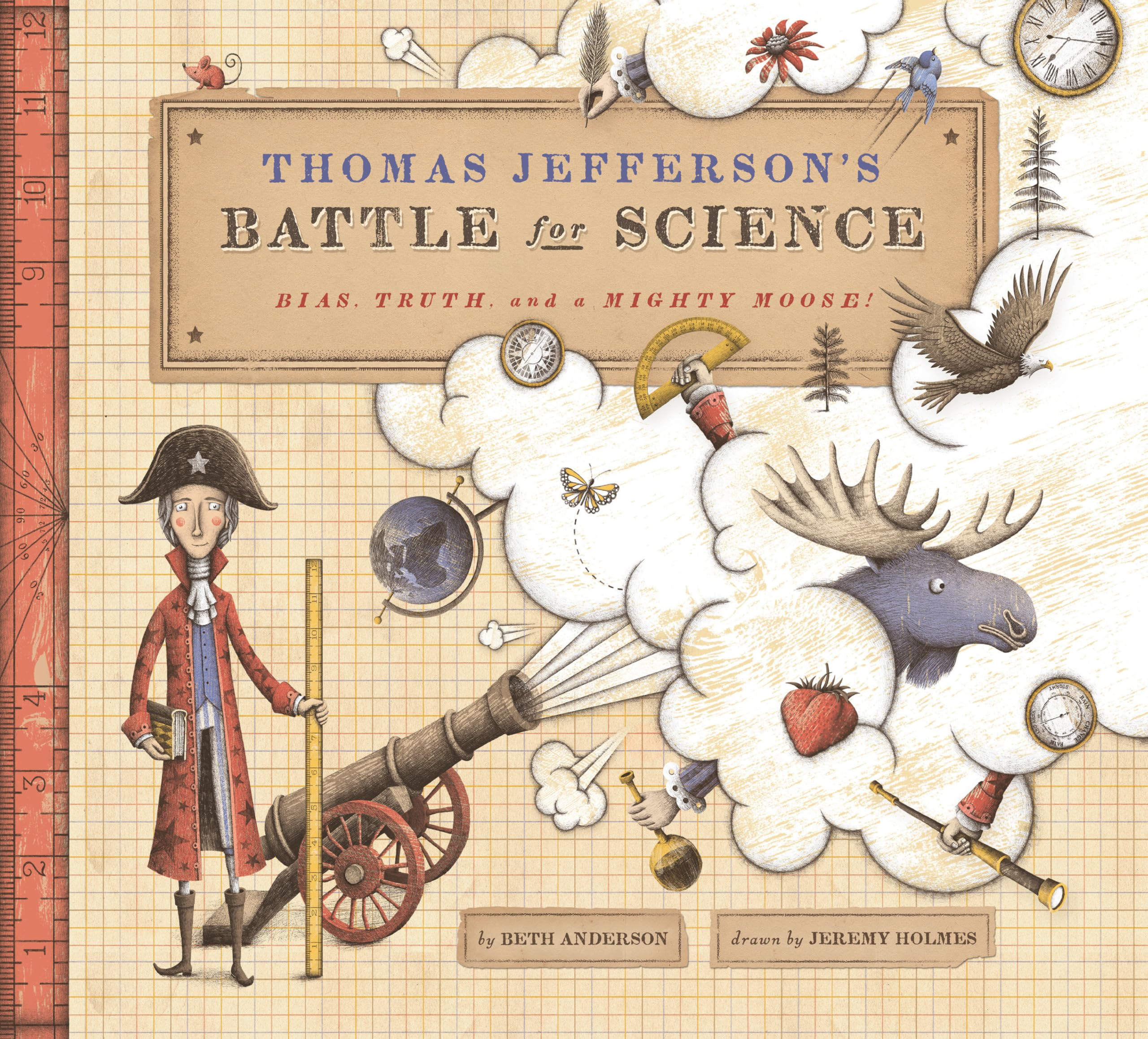
Thomas Jefferson’s Battle for Science: Bias, Truth, and a Mighty Moose! by Beth Anderson, illustrated by Jeremy Holmes (Calkins Creek, 48 pages, grades 2-5). Thomas Jefferson loved science, and one of his favorite books was Count Georges-Louis Leclerc de Buffon’s encyclopedia of the natural world. But he was incensed by Buffon’s descriptions of American wildlife, comparing it unfavorably to the animals found in Europe. Thomas decided to measure as many American animals as he could, and recruited friends from different parts of the country to assist him, eventually putting together his own book that he showed Buffon when he became minister to France. So committed to the truth about American fauna was Jefferson, that he actually had friends hunt a moose and ship it to France (you can read more about that here). When Buffon saw (and smelled) the enormous moose, he promised to revise his book, but unfortunately passed away a few months later. Jefferson’s book became well-known, and people started sending him information and artifacts to add to it, helping him to promote the idea that the New World was not inferior to the old one…just measurably different. Includes an author’s note, a list of five steps to use for a scientific inquiry process, a timeline of Jefferson’s life, and a bibliography.

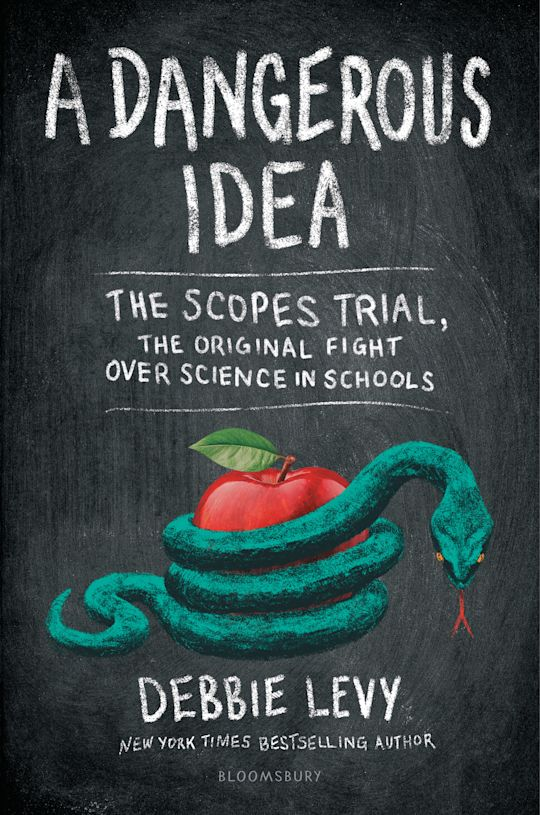
A Dangerous Idea: The Scopes Trial, the Original Fight Over Science in Schools by Debbie Levy (Bloomsbury Children’s Books, 288 pages, grades 6 and up). This account of the 1925 trial of John Scopes, a young high school teacher accused of teaching evolution, gives background information on evolution, the law that banned teaching it in Tennessee, and the two great orators, Clarence Darrow and William Jennings Bryan, who served as prosecuting and defense attorneys. The trial itself is described in detail, capturing both the serious debates about religion and the circus-like atmosphere. The story concludes with information about Susan Epperson, a biology teacher who challenged a similar law in Arkansas, leading to a 1968 Supreme Court ruling striking down the law and allowing evolution to be taught in high schools. There’s also information about the play and movie Inherit the Wind, which took some pretty big liberties with the truth about the Scopes trial. Includes an epilogue tying the case to current events, a detailed timeline from 1831-2005, and an extensive bibliography, index, and list of sources notes.

These books could not be more timely with their reminders that attacking science is a tale as old as time. Both are told with a lighthearted, humorous tone, but the back matter shows how extensively researched they are. I enjoyed the Jefferson illustrations that resemble a naturalist’s notebook, with lots of cartoon bubbles and captions. The authors’ notes will give readers plenty to think about, and I thought Debbie Levy did an especially good job of connecting the events of the Scopes trial to current news stories. Beth Anderson delves into the scientific method and explains how Jefferson made mistakes, too, lest any of us think we have any sort of monopoly on the truth.

Get ready for Presidents’ Day

The Painter and the President: Gilbert Stuart’s Brush with George Washington by Sarah Albee, illustrated by Stacy Innerst (Calkins Creek, 40 pages, grades 2-5). George Washington was a man of action who preferred sitting astride a horse to posing for a portrait. Gilbert Stuart was a portrait painter with a knack for capturing his subjects while making the process fun for them. But Washington had him stumped. Not only did he show up with his face swollen from his ill-fitting false teeth, but he refused to engage with Stuart in any of the topics the painter tried desperately to introduce. Finally, he noticed Washington gazing happily at a horse out the window and started talking about horse racing. It worked! He invited George to bring family and friends to their next appointment, and that worked too. Today we see the happy (or not) results of Gilbert Stuart’s hard work every time we look at a dollar bill. Includes replicas of all six presidential portraits that Stuart completed, a time line, additional information about Washington’s teeth, how the painting was used to create the engraving for the dollar bill, and a bibliography.

This lighthearted introduction to Gilbert Stuart’s portraits would make a great addition to an art class. GW may not come off as a barrel of laughs, but readers will wince sympathetically when learning of his dental issues (although there’s no mention of the fact that he bought human teeth from enslaved people). Full disclosure, this book was published in 2024, but I thought it warranted a place in the Presidents’ Day post.

Hiding In Plain Sight: Kate Warne and the Race to Save Abraham Lincoln by Beth Anderson, illustrated by Sally Wern Comport (Calkins Creek, 48 pages, grades 2-5). When newly-elected U.S. President Abraham Lincoln traveled from his home in Illinois to Washington, DC in February, 1861, rumors of assassination were swirling. A plot was uncovered in Baltimore, and members of Allan Pinkerton’s detective agency took immediate steps to foil it. Central to their work was Kate Warne, the first female detective in the agency, whose undercover work as a lady from Alabama helped discover the Baltimore plot. Later, she posed as Lincoln’s sister, helping her “sick brother” board a train in Philadelphia that traveled in secret through Baltimore and on to Washington. When the supposed inaugural train arrived, word got out that Lincoln had already arrived, and Kate Warne faded into the cheering crowd, ready to take on her next assignment. Includes a six-page afterword with photos and additional information about Lincoln and Kate Warne, as well as a bibliography and illustrator’s note.

This exciting detective story would make an excellent read-aloud for both Presidents’ Day and Women’s History Month, with the mysterious Kate Warne playing a central role in preventing what could have been a national tragedy. The illustrations resemble period photographs and the whole book has kind of a scrapbook feel (the illustrator describes the scrapbooks that inspired her work in the note at the end). The additional information in the afterword provides some thought-provoking ideas and observations that could lead to some interesting discussions. Considering how little we know about Warne, there are quite a few children’s books about her: How Kate Warne Saved President Lincoln, The Eye That Never Sleeps: How Detective Pinkerton Saved President Lincoln, and the fictional The Detective’s Assistant.

George Washington’s Spectacular Spectacles: The Glasses That Saved America by Selene Castrovilla, illustrated by Jenn Harney (Calkins Creek, 32 pages, grades 2-5). By the end of the American Revolution, George Washington needed glasses, but he refused to let anyone see him wearing them. When he needed to read something, he would go into his office and slam the door. Everyone thought he was grouchy, but in March of 1783, it was his army officers who were the grouchy ones, after not getting paid for all the years of the war. They were threatening to storm Congress and demand their pay. Washington consulted a congressman about the issue, who wrote a reassuring letter that George thought would appease the officers. But when it came time to read it to them, he realized he needed his spectacles. He finally put them on, and his men, realizing what their beloved leader had sacrificed during the years of war, and agreed to wait on their pay. Includes additional information about this incident, an author’s note about her research and creative process in writing this story, and a bibliography.

Truth really is stranger than fiction, I thought as I read this quirky tale which ends unexpectedly with the army officers wiping away tears as they agree to continue to work without pay. All because George Washington put on his glasses, which, according to the back matter, is exactly how it happened. It’s an interesting story that will undoubtedly prompt some discussion, which could be seen as an example of Washington’s inspirational leadership or what happens when you’re willing to be vulnerable in front of your employees, but personally it kind of made me question the wisdom of those army officers.

Nonfiction that will make you question humanity

Glenn Burke, Game Changer: The Man Who Invented the High Five by Phil Bildner, illustrated by Daniel J. O’Brien (Farrar, Straus, and Giroux, 32 pages, grades 2-5). As a kid, Glenn Burke was a five-tool talent: fast runner, powerful and accurate hitter, good catcher, and strong pitcher. So it was no surprise that he got called up to play for the Los Angeles Dodgers. He made a name for himself there, and was an enthusiastic teammate, greeting runners at home plate by putting up his right hand, which the player would then smack. The high-fiving team made it to the World Series in 1977, but the next year Glenn was traded to the Oakland Athletics, a team at the bottom of the baseball standing. Why? Glenn Burke was gay, and homophobic manager Tommy Lasorda didn’t want him on the team. The trade led Glenn to quit baseball altogether. He enjoyed success playing in the San Francisco Gay Softball League and winning gold in the Gay Olympics, but struggled with drug use and unemployment, shattering his leg in a car accident and dying of AIDS at the age of 42. He lived long enough to see his high five become a universal greeting, but not to see the open acceptance of gay players in the MLB. Includes an author’s note, bibliography, and timeline.

Phil Bildner writes in the author’s note how he originally envisioned Glenn Burke’s story as a picture book, but his editor wanted a middle grade novel, which became A High Five for Glenn Burke, published in 2020. While the origin story of the high five may seem like a perfect choice for younger readers, the MLB’s homophobia and Burke’s death from AIDS may make this a better choice for older kids. It’s a moving and well-told story, ending on a note that is both sad and hopeful.

It Happened in Salem by Jonah Winter, illustrated by Brad Holland (Creative Editions, 32 pages, grades 6 and up). “You know what I’m talking about. You start whispering things about a person–hurtful things you know will get that person in trouble, untrue things you may have convinced yourself are actually true.” This second-person introduction to the Salem Witch Trials situates readers right in the middle of the action. The text is spare, relating the basic events and facts, and illustrated with haunting paintings of people in stocks and hanging from nooses. An author’s note gives more information, including the fact that it took 325 years–until 2017–for Salem to put up a plaque commemorating the individuals who were executed.

I found this book disturbing from the cover to the author’s note, which seems appropriate for the subject. You can generally count on Jonah Winter to put a unique and relevant spin on history that will have readers thinking about their own lives. I saw recommendations for this book starting in fourth grade, but I personally would not get this for an elementary library. It would be an excellent supplement for middle school or high school students learning about this period of American history, no doubt initiating some interesting conversations on gossip and bullying. I wish there had been some additional resources given at the end.

Persistence, resistance, and a fight for existence

Ernö Rubik and His Magic Cube by Kerry Aradhya, illustrated by Kara Kramer (Peachtree, 32 pages, grades K-4). Ernö Rubik was a solitary kid who enjoyed reading and solving puzzles in his Budapest home. He grew up to be a teacher who would build models to teach his students about three-dimensional objects. His curiosity about cubes led him to try making a big cube out of small ones that could move around but stay connected. His first attempts failed, but he finally found the secret: 26 cubes in three rows, with a round mechanical core. And the rest is history as Ernö’s invention, the Rubik’s Cube, went on to become one of the most popular puzzles of all time. Includes additional information about Rubik and his cube, an author’s note, and a list of three books about the cube.

Although there are some details about Ernö Rubik’s life, the focus is on the Rubik’s cube and the perseverance needed to solve a difficult problem. If kids haven’t tried the cube, they will definitely get their hands on one and start searching YouTube for various solutions.

They Call Me Teach: Lessons in Freedom by Lesa Cline-Ransome, illustrated by James E. Ransome (Candlewick, 40 pages, grades 1-5). A young enslaved man is known as Teach, due to his abilities to read and write that he learned growing up with the master’s son. By day he works as a clerk in the master’s store, but at night he teaches other enslaved people to read. He secretly helps people by reading their letters and, in one case, writing a receipt to help a woman escape. Just looking at a newspaper in public results in punishment, leaving readers to infer that there could be much more serious consequences for teaching literacy to other Black people. An author’s note gives more information about Black people’s quest for education throughout history. Includes a list entitled “More Books on Resistance.”

This husband and wife team has created a fascinating story that focuses on the large majority of enslaved people for whom escape was impossible and who tried to resist and improve themselves in the ways that were available to them, despite the risk of cruel punishments. Sure to be a Coretta Scott King award contender.

Wild Places: The Life of Naturalist David Attenborough by Hayley Rocco, illustrated by John Rocco (G. P. Putnam’s Sons Books for Young Readers, 48 pages, grades K-3). The story of David Attenborough’s life is told by another husband and wife team. Young David loved exploring the natural world around his English home, and he continued those studies as a university student. When he graduated, television was just becoming popular, and he got a job introducing viewers to the world of nature. Before long, he was traveling all over the world to show people plants and animals of different ecosystems. His travels made him more aware of the ways that wild places were shrinking and living creatures were losing their habitats. David shifted his focus to helping people understand what was happening and giving them information to help them make better choices for the planet, work that he continues today in at the age of 98. Includes an author’s note with additional information about David Attenborough and rewilding, a couple of photos, and a bibliography.

Like the Ernö Rubik biography, this is an engaging read that’s a little light on biographical information. Most pages only contain a sentence or two of text, along with award-winning illustrator’s John Rocco’s beautiful depictions of the natural world. Quotes from David Attenborough are scattered throughout the book, and the end matter fleshes out his life a bit more.