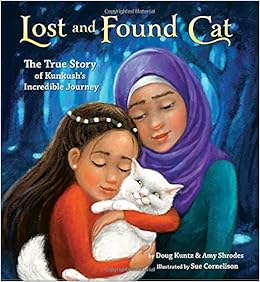
Lost and Found Cat: The True Story of Kunkush’s Incredible Journey by Doug Kuntz and Amy Schrodes, illustrated by Sue Cornelison

Published by Crown Books for Young Readers

Summary:  When Sura and her five children decided to secretly leave their home in Mosul, Iraq in 2015, another family member was hidden among their belongings: their beautiful white cat, Kunkush.  Smugglers helped them out of the country, across Turkey, and to a boat that carried them to Greece, but those smugglers would have charged them much more money to bring a cat along, so Kunkush had to stay hidden.  When the family finally arrived in Greece, the cat carrier broke, and Kunkush ran away.  The heartbroken family searched for as long as they could, but eventually had to move on.  An American aid worker found the cat months later, filthy and half-starved, and took him home with her.  She launched a search for the family via Facebook, and they were eventually located, resulting in a happy reunion with Kunkush.  Includes a note from the authors, who helped Kunkush in Greece, a map of the cat’s journey, and photographs of him and his family.  48 pages; ages 4-10.

Pros:  Mosul may seem far away, but readers will connect with this family’s loss of their beloved pet, while learning about the difficulties they encountered as refugees.

Cons:  2017 seems to be the year of the refugee in children’s literature, a sad reflection of the world situation.  

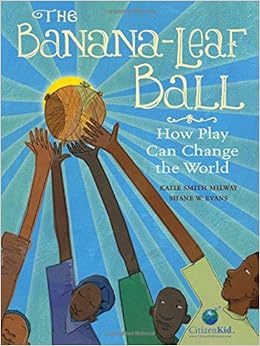
The Banana-Leaf Ball: How Play Can Change the World by Katie Smith Milway, illustrated by Shane W. Evans

Published by Kids Can Press

Summary:  When Deo is forced to flee his home in Burundi, he gets separated from his family and eventually ends up in a refugee camp in Tanzania.  Life there is difficult and sometimes scary, with a bully named Remy who forces the other kids to hand over their meager possessions to him.  Deo tries to make a soccer ball from banana leaves like the one he had back home, but Remy discovers it and takes it away.  One day, a man comes to camp with a leather soccer ball and starts organizing the kids into teams.  Deo and Remy end up on the same team and work together to score the winning goal.  It’s the beginning of a friendship; that and the soccer games sustain Deo until he is able to return home to his family and a chance to coach kids from his village.  Includes information and photos of the real Deo (see above); information about organizations that help kids learn how to trust each other and play together; and a paragraph called “What You Can Do”.  32 pages; grades 2-7.

Pros:  Another excellent entry from Kids Can Press’s CitizenKid series, introducing readers to other young people from around the world and showing them ways they can make a difference.

Cons:  The small font and large amount of text on each page may make this a more challenging read-aloud book.

The Quilts of Gee’s Bend by Susan Goldman Rubin

Published by Harry N. Abrams

Summary:  In 1845, plantation owner Mark Pettway moved his plantation to Gee’s Bend Alabama.  When the Civil War ended, the former slaves from that plantation stayed and formed a community that still exists today.  The women of Gee’s Bend have made quilts for generations, primarily to keep warm in the drafty cabins they lived in on the plantation, but also as a form of creative expression.  The history of this community and their quilts includes a visit from Martin Luther King, Jr. and participation by many in the Civil Rights movement.  The quilts were “discovered” in the 1960’s, and the women formed a collective that for a few years produced items to be sold in Bloomingdales and Saks Fifth Avenue.  In 2002, art collector Bill Arnett helped organize a quilt exhibit at New York City’s Whitney Museum, attracting record-breaking crowds.  The acclaim has helped the women to see their work as an art form that reflects the history of their unique community.  Includes instructions for making a quilt square, bibliography, and index.  56 pages; grades 5-8.

Pros:  The story is fascinating, but the real attraction of this book is the gorgeous full-page color photos of the quilts.

Cons:  The photo on page 8 appears to have been mislabeled with the wrong date.

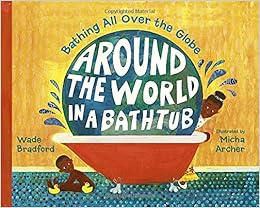
Around the World in a Bathtub: Bathing All Over the Globe by Wade Bradford, illustrated by Micha Archer

Published by Charlesbridge

Summary:  “Bath time!” says the mama.  “No, no!” says the boy.  “Yes, yes!” says the mama.  This scenario is repeated throughout the book in different countries, and with the no’s and yesses in different languages.  In Japan, family members bathe in age order in a large square tub called and afuro.  In Alaska, the family enters a steamy maqil.  Some day, a weightless mother may be chasing her floating child for a bath on board a space station.  From the Ganges River in India to the hot springs of Himalayan valleys to a muddy volcano in South America, kids resist taking baths, but often don’t want to get out once they’ve gotten in.  Includes two final pages of additional information on bathing in all the places mentioned in the text.  32 pages; ages 3-7.

Pros:  An unusual geography lesson based on a universal experience kids will be able to connect with.  The illustrations feature a multicultural cast, with the bathtub scene reminiscent of a similar one in Ezra Jack Keats’ The Snowy Day.

Cons:  Naked kids on almost every page will be sure to elicit a lot of giggling at storytime.

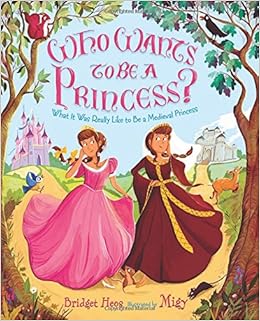
Who Wants to Be a Princess? What It Was Really Like to Be a Medieval Princess by Bridget Heos, illustrated by Migy

Published by Henry Holt and Co.

Summary:  For those dreaming about Disney life, this book provides a bit of a wake-up call as to what life for a princess was really like.  The author explains in her note that the “real” princess shown here is based on what life was like circa 1100-1300 in Great Britain.  Each two-page spread contrasts a fantasy princess with a real one.  Pink and purple castle?  Nope, it would have been drab stone surrounded by a moat stinking of sewage.  Beautiful gown?  Itchy brown wool was more like it  There might have been a handsome prince to marry…at around the age of 12, and that marriage would have been arranged.  The final page shows the princess falling asleep and dreaming of being “you”, the modern reader.  Includes an author’s note and a bibliography.  32 pages; ages 4-8.

Pros:  A clever way to teach a bit of history, using a concept that’s sure to catch the eye of certain readers.  The illustrations are kind of Disney-esque, which will add to the appeal.  There’s also a nicely subtle message about being happy with who you are.  If you’re struggling to loose your little cherub from her “Elsa” costume, this, just might do the trick.

Cons:  It’s a pretty cursory look; those wanting much information will have to look elsewhere.


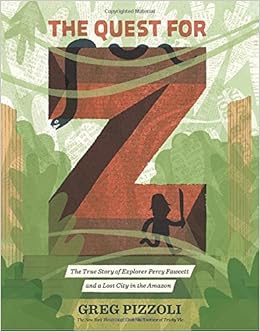
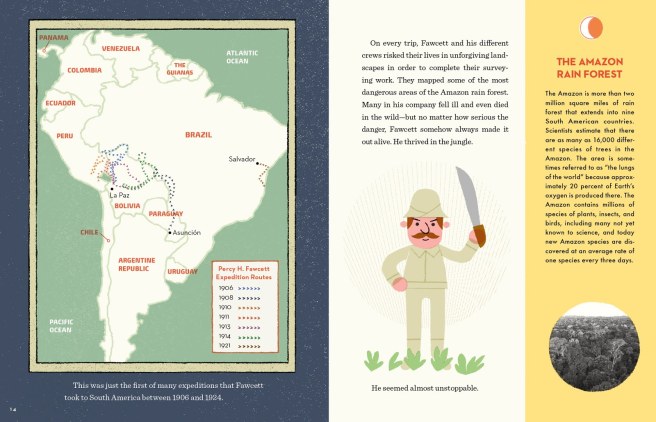
The Quest for Z: The True Story of Percy Fawcett and a Lost City in the Amazon by Greg Pizzoli

Published by Viking

Summary:  British explorer Percy Fawcett was fascinated by stories of a mythical city that had thrived in the Amazon rain forest, then mysteriously disappeared.  He called the city “Z”, and he was determined to find it.  For many years, he worked as a member of the Royal Geographic Society, surveying areas in Bolivia, Brazil, and Peru. He had many dangerous adventures on these expeditions, including a close encounter with a huge anaconda and the discovery of a missing member of his party with 42 arrows in his body (he was dead).  He heard more stories from the locals about the lost city of Z, and became obsessed with finding it.  The Royal Geographic Society wouldn’t support such a wild goose chase, so Fawcett organized a trip himself, taking only his son Jack and Jack’s friend Raleigh.  They set off for unknown territory in the Brazilian jungles, and (spoiler alert) were never seen again.  To this day, other explorers have tried to find out what happened to them, but their fate remains a mystery, and the city of Z has never been discovered.  Includes an author’s note, a page of “Fawcett hunters” describing other explorers who have tried to find out what happened to Percy Fawcett, a glossary, and a page of sources.  48 pages; grades 2-5.

Pros:  A perfect addition to a unit on explorers.  Fawcett’s story is compelling, but ultimately tragic, not unlike some of the better-known European explorers.  The cartoon-inspired illustrations add some fun, and sidebars provide context to the explorer’s life.

Cons:  Fawcett definitely seems to be a product of his time, with his stiff upper lip British Empire approach to exploration.

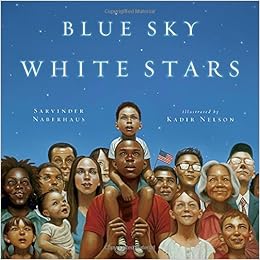
Blue Sky White Stars by Sarvinder Naberhaus, illustrated by Kadir Nelson

Published by Dial Books

Summary:  A few words of text on each page celebrate the American flag and the people of the United States.  On the left-hand side of each spread is a picture depicting an American landscape or icon; the facing page has to do with the flag, or has a flag as part of a picture.  For instance, “white rows” shows a line of covered wagons traveling west on the left, and the white stripes on the flag on the right.  Some of the phrases are homophones, such as Betsy Ross sewing the flag, described as “Sew together/won nation”, accompanied by “So together/one nation” showing a diverse group of Americans.  Includes notes from the author and illustrator.  40 pages; for all ages on the Fourth of July.

Pros:  A beautiful and patriotic tribute to patriotism, with gorgeous, multicultural illustrations by award-winning Kadir Nelson.

Cons:  Even this lovely book couldn’t quite pry the CNN-wrestling tweet out of my head.

My Beautiful Birds by Suzanne Del Rizzo

Published by Pajama Press

Summary:  Sami knows he is safe in the refugee camp with his family, but he can’t help missing his home in Syria and the pigeons he cared for there.  His memories of his village being destroyed by bombs scare him, and he has trouble joining the groups of children playing and going to school.  Slowly, he learns ways to manage his fears, and he is helped by the arrival of four birds that he adopts as pets.  Taking care of them helps him to focus on the positive things around him, and soon he is happier in his new home.  When he spots a new girl with tears in her eyes, he is able to reach out to her and offer his friendship.  An author’s note tells more about refugee camps where millions of Syrians have been forced to settle.  32 pages; grades K-4.

Pros:  A personal story about a contemporary crisis that gives readers a child narrator they can relate to.  The illustrations, created from polymer clay, are unique and eye-catching.  This would make a great introduction to a discussion of Syria and refugees.

Cons:  Life in the refugee camp appears to be more pleasant than it most likely is.

Rolling Thunder by Kate Messner

Published by Scholastic Press

Summary:  In brief, rhyming text, a boy tells of his journey to Washington, D.C. to ride with his grandfather in the Rolling Thunder Ride for Freedom, a parade of motorcyclists held on Memorial Day every year to honor America’s veterans.  The focus is the Vietnam War, where Grandpa fought and lost friends.  The motorcyclists camp the night before, then get up at dawn to join the parade.  It winds past the Lincoln Memorial and ends at the Vietnam Veterans Memorial, where there are speeches and tears.  Finally, the boy and his grandfather sit in a field at the end of the day, watching a shooting star in the night sky.  A brief author’s note tells about the Thunder Ride.  32 pages; ages 4-8.

Pros:  Readers with interests in the military, history, or motorcycles will enjoy this; it would also make a great Memorial Day read-aloud (sorry I’m a little late…maybe Veterans’ Day?).

Cons:  The illustrations don’t reflect the diversity of those who served in Vietnam.

This Is How We Do It: One Day in the Lives of Seven Kids from Around the World by Matt Lamothe

Published by Chronicle Books

Summary:  Seven children, ages 7-11, from seven different countries (Japan, Peru, Iran, Russia, India, Italy, and Uganda) explain what they do throughout their day. Readers learn what they eat, who is in their family, how they get to school, what they learn there, and what they do after school.  The last page says, “This is my night sky,” indicating that children all over the world sleep under the same sky.  The last two pages show photos of the real families that the kids come from, and an author’s note explains how those families were chosen and that, while they represent their countries, not everyone in their country has the same tastes, interests, and experiences as those described in the book.  Includes a glossary and endpapers with a map of the world showing where each child lives.  52 pages; grades 1-4.

Pros:  The large, colorful pages are an engaging way for kids to learn about the lives of others their age around the world.  The focus on everyday activities will allow readers to make many connections with their own lives.

Cons:  The text was kind of stilted.