Nell Plants a Tree by Anne Wynter, illustrated by Daniel Miyares

Published by Balzer + Bray

Summary:  Before children climbed the giant pecan tree, Nell planted a seed.  Before they ran races to the base of the tree, Nell watered a sprout and made sure it had sun.  Before grandchildren helped their grandmother Nell bake goodies with pecans from the tree, Nell dug a hole and planted her sapling.  Over the years, that sapling became a tree, putting down roots and spreading its branches as Nell grew up, too, and created a family in the house next to the tree.  At sunset, that family eats at a long table beneath the spreading branches of the giant pecan tree.  Includes notes from the author and illustrator.  40 pages; ages 4-8.

Pros:  A celebration of trees and families, and the long-term commitment needed to see both of them flourish, with beautiful illustrations that help tell the story.  I love the final spread with its gorgeous sunset colors and the tree sheltering the family.

Cons:  It looked like Nell had at least three kids, but only one made it back for the dinner under the tree.
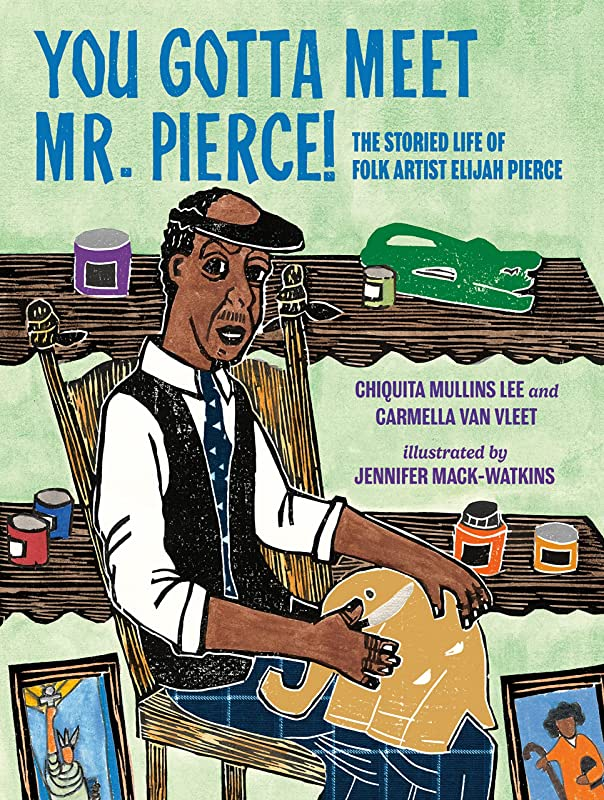
You Gotta Meet Mr. Pierce! The Storied Life of Folk Artist Elijah Pierce by Chiquita Mullins Lee and Carmella Van Vleet, illustrated by Jennifer Mack-Watkins

Published by Kokila

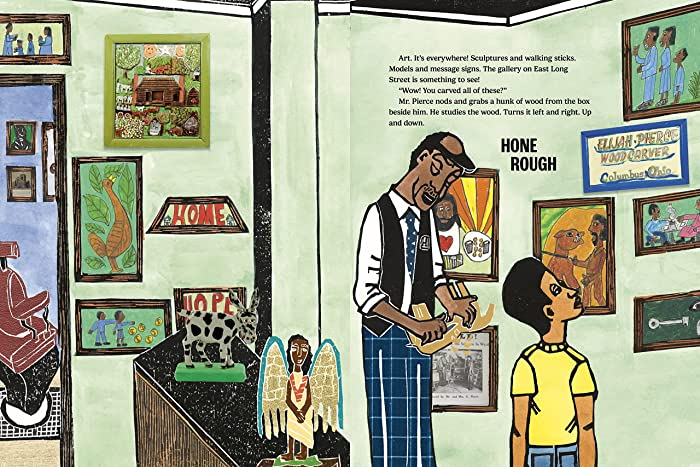
Summary:  In this fictionalized story about real-life artist Elijah Pierce, a boy and his dad enter Mr. Pierce’s barbershop.  The shop is full of wood carvings, and Mr. Pierce is happy to share stories about his life and art.  The boy has some new colored pencils and is trying to get an idea for a picture.  Mr. Pierce tells him how his art often came from stories, whether they were from his own life, the Bible, or something someone told him.  After the haircut and the stories are finished, Mr. Pierce gives the boy a carved elephant.  “I think I know what I want to draw…” he says as he and his dad leave the shop.  The final page shows a father and son (I think the father is the boy who is now grown up) about to enter a museum with an exhibit of Elijah Pierce’s work.  Just like the dad at the beginning of the story, the man tells his son, “You gotta meet Mr. Pierce!”  Includes a timeline of Elijah Pierce’s honors, additional information about the exhibit at the Corcoran Gallery in Washington, D.C., places to see Elijah’s work, and notes from the author and illustrator with additional information about Elijah Pierce, the book, and the illustrations.  40 pages; grades 1-5.

Pros:  A charming story about a little-known artist who will get some well-deserved recognition with this book.  The fictional format is engaging, and the folk-art inspired illustrations are the perfect complement.

Cons:  I found the ending a little confusing, as I couldn’t figure out what the boy had decided to draw, and I wasn’t sure who was pictured on the last page. 

My library disaster

Last weekend, New England experienced an arctic chill, with wind chills diving down to nearly 40 below. Predictably, pipes froze and burst, and one of the casualties was my school’s library. Water rained down from a broken sprinkler system pipe, soaking two areas of the library and resulting in the destruction of thousands of books.

I work in an urban school with high poverty rates that was without a library for many years. Thanks to a principal who thinks a school library is important, I was hired as a librarian back in 2020 and given a very generous book budget. The kids love coming to the library, and it’s been exciting to give them so many choices of books to check out.

Two of the areas that were hardest hit by the flood were the early readers and early chapter books, two of the most popular collections. Fortunately, many of the books were checked out, but everything that was in the library that day had to be thrown out. These are books that new readers can use to practice their skills, and they’re used by kids at every grade level.

I”ve started two Donors Choose projects to raise funds to replace some of the lost books. This will be a big help in getting the library up and running again. Right now, I am traveling to classrooms with a cart of books, but I hope to reopen the library as soon as possible. If you would like to contribute to either of my projects, you can check out the early reader one here (the books in the photo are the ones that were destroyed) and the chapter book one here. Thank you for considering this!

Beaky Barnes: Egg on the Loose by David Ezra Stein

Published by Penguin Workshop

Summary:  When uptight Town Inspector Cobb loses the egg out of his sandwich, he goes off on what seems like a simple search for a replacement.  The quest starts at a restaurant with a chef who has a secret to hide, a fish in search of something more to life than being eaten, and two customers–a woman and a chicken–who set off a chaotic chase through town.  By the end of the story, Inspector Cobb is wearing a barrel and a lovestruck rooster is wearing his uniform.  The whole story is presented as a movie, with several commercial breaks advertising products that turn out to be useful for the characters.  The final few pages fast forward six months, wrapping everyone’s story up with a happy ending.  128 pages; grades 2-5.

Pros:  David Ezra Stein of Interrupting Chicken fame has created his first graphic novel that is sure to be a hit with the Dog Man crowd with plenty of slapstick humor and a fun, offbeat cast of characters.

Cons:  I would have liked to have seen the “which came first” chicken and egg issue more fully addressed.

To Boldly Go: How Nichelle Nichols and Star Trek Helped Advance Civil Rights by Angela Dalton, illustrated by Lauren Semmer

Published by HarperCollins

Summary:  The story begins with the author recounting how her family loved watching the original Star Trek, particularly because of Lieutenant Uhuru, acted by Nichelle Nichols, a Black woman who played the communications officer on the Enterprise.  The narrative then goes back to Nichelle’s childhood where she was encouraged by her parents to do whatever she wanted.  She loved performing, first as a ballet dancer and later as a singer and actress.  This gave her confidence when she got the part on Star Trek, but that confidence began to wane when she experienced racism on the show.  She told Gene Rodenberry that she was quitting, but changed her mind when she met a fan–Martin Luther King, Jr. who told her Star Trek was the only show he and his wife let the kids stay up late to watch.  He convinced her to stay on the show and serve as a role model to Black children.  Includes information on Nichelle’s role with NASA helping to recruit a more diverse workforce, including Mae Jemison and Guion Bluford; also an author’s note.  40 pages; grades 1-5.

Pros:  I’m excited to read this book to several of my classes beginning today.  The subject matter, the engaging writing style, and the colorful illustrations make it an excellent choice for sharing Black history…and the cameo by MLK was a fun surprise!

Cons:  No additional resources listed.

Yoshi, Sea Turtle Genius: A True Story About an Amazing Swimmer by Lynne Cox, illustrated by Richard Jones

Published by Anne Schwartz Books

Summary:  Yoshi the sea turtle gets another picture book about her record-breaking swim from South Africa to Australia.  After getting entangled in a fishing net, she was rescued and sent to Two Oceans Aquarium in Cape Town, South Africa, where she lived for the next twenty years.  She spent 18 months training to swim in the ocean before being released with a tracker attached to her shell.  The tracker showed when she left Africa and began heading to her native Australia.  Over the next twenty-six months, Yoshi swam 22,998 miles, the longest recorded swim of any animal.  She found her way back to where she had started her life, laying eggs on the very same beach.  Includes a note from the author, who is also a long-distance swimmer, with additional information about Yoshi and sea turtles.  40 pages; grades K-4.

Pros:  Like Yoshi and the Ocean, this picture book will appeal to animal lovers, telling Yoshi’s story with a sense of awe that is reflected in the gorgeous underwater illustrations.

Cons:  I wouldn’t have objected to a larger font.

The Superteacher Project by Gordon Korman

Published by Balzer + Bray

Summary:  Oliver’s surprised when his new homeroom teacher Mr. Aidact intercepts his spitball on their first day of school.  Before long, Mr. Aidact shows other surprising traits that are annoying at first but soon become endearing.  He has an almost endless knowledge of trivia and proves himself a surprisingly adept girls’ field hockey coach.  When there’s an accident on a field trip, Mr. Aidact turns out to be a skillful bus driver.  Oliver and his best friend Nathan do some sleuthing and make a shocking discovery–Mr. Aidact is actually a robot, a form of artificial intelligence being tested by the government in a project all the adults at school know about.  Try as they might, they find it impossible to keep this information a secret, and when parents get wind of it, an angry mob demands that Mr. Aidact must go.  When Oliver and Nathan intercept the Department of Education’s plans to dismantle their teacher, they hatch a daring plot to rescue him.  If they succeed, their beloved teacher will be gone for good.  But as Mr. Aidact tells them, “I’ll never forget you.  Unless I stand too close to a strong magnet.”  304 pages; grade 4-7.

Pros:  Gordon Korman’s latest book is a timely tale of artificial intelligence, told in his trademark style of multiple narrators, including memos to the Department of Education on the status of their project.  Kids will enjoy the humor and the realistic middle school characters and situations and will also be challenged to think about the line between human and machine.

Cons:  The human teachers were for the most part portrayed as boring and/or slackers.

9 Kilometers by Claudio Aguilera, illustrated by Gabriela Lyon, translated by Lawrence Schimel

Published by Eerdmans Books for Young Readers

Summary:  It’s still dark when the boy leaves to walk the nine kilometers (5.5 miles, 15,000 steps) to school.  His walk takes him through the forest, across a stream, and under a barbed wire fence that he props up with a forked stick.  Some days the walk feels like “a stone inside a worn-out shoe” while other days it is “as sweet as a handful of blackberries or a ripe apple.”  He meets up with friends as he approaches the school, a small building in the middle of acres of farmland.  The last several pages tell about kids in other countries who walk as much as 30 kilometers round-trip to get to school.  There are also descriptions of all the birds the narrator sees on his trek.  56 pages; grades K-3.

Pros:  This book, originally published in Chile in 2021, reminded me of My First Day, with its beautifully illustrated description of a child in another country traveling to school.  The back matter showing other kids’ journeys is an important part of the book: “We hope that their steps guide us toward the construction of a society in which education is a right and not a privilege, and we hope that their footprints serve as a reminder of one of the greatest inequalities of our world.”

Cons:  Imagine all the reasons–disability, illness, fatigue, bad weather–that would make this journey to school impossible.

Black Swans by Laurel van de Linde, illustrated by Sawyer Cloud

Published by Sunbird Books

Summary:  Six Black dancers, three men and three women, are profiled, each one given a few pages describing his or her career and the racism each one encountered and overcame to achieve groundbreaking success.  The six are listed in chronological order, beginning with Essie Marie Dorsey, who lived from 1893-1967, and finishing with Michaela DePrince, born in 1995 and currently dancing with the Boston Ballet.  The author’s note at the end lists eight other Black ballet dancers, with the years they lived and the companies they danced with.  40 pages; grades 1-5.

Pros:  Dancers will find plenty to inspire them in these stories, timed perfectly to celebrate Black History Month.  The illustrations capture the grace, strength, and beauty of the ballerinas.

Cons:  I wish there was more historical context for the biographies.

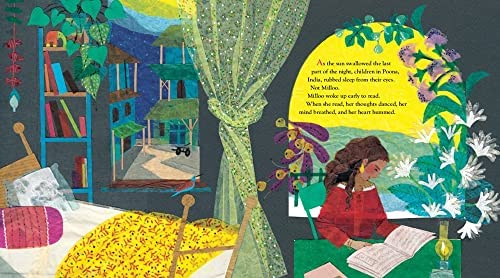
Milloo’s Mind: The Story of Maryam Faruqi, Trailblazer for Women’s Education by Reem Faruqi, illustrated by Hoda Hadadi

Published by HarperCollins

Summary:  The author of Unsettled tells the story of her grandmother, Milloo, who grew up in India in the early 20th century.  Milloo loved school, but her parents told her at the end of fifth grade that she was done with education.  Milloo launched a campaign all summer long and finally got her parents’ permission to enter sixth grade.  She went on to finish high school and college at the top of her class, then became a teacher herself.  After getting married, she tried staying at home as her husband wanted, but found that cooking and sewing were not her thing.  She started a girls’ school in her home, and when classes outgrew that space, she founded a series of schools.  The author’s note tells that the Happy Home Schools in Karachi, Pakistan are still thriving.  40 pages; grades K-4.

Pros:  Both the text and the collage illustrations exude a bright energy that reflects Milloo’s enthusiasm and passion for education.  File this away to read for Women’s History Month next month.

Cons:  I was a bit confused by Milloo being referred to as Maryam in the subtitle, which was not explained until the author’s note (Milloo was her father’s nickname for her, and she’s referred to by that name throughout the story).