New from Here by Kelly Yang

Published by Simon and Schuster Books for Young Readers

Summary:  As the story opens, Knox’s parents are making the difficult decision to take the three kids to California from their home in Hong Kong, where the coronavirus is spreading.  His dad has to stay behind and work, while his mom can work remotely from the small house in the Bay Area that the family has inherited.  This proves impossible, and before long, Mom is frantically looking for a new job while Knox, his older brother Bowen, and his younger sister Lea adjust to American schools.  Knox’s ADHD has made school difficult in the past, but he loves his new teacher and makes a new friend right away.  Bowen has a harder time and often takes his frustrations out on his younger brother.  The kids pull together, though, to raise money to get their dad a plane ticket to join them.  In the background is the news of increasing COVID cases in the US, and the story ends in the spring of 2020, with everything, including school, closing down.  The future feels uncertain, but the challenges of the past few months have pulled the family together in a way that makes navigating those challenges seem possible.  Includes an author’s note about her family’s experiences that were the basis for this book.  368 pages; grades 4-7.

Pros:  I started this book months ago and abandoned it after the first few pages; after seeing it on some best of 2022 lists, I decided to give it another chance and am so glad I did.  Despite the feeling of impending COVID doom, there is plenty of humor (I especially enjoyed the kids’ attempts to create a LinkedIn account for their dad) and some pretty touching family scenes, especially when the kids have to deal with anti-Asian racism.  

Cons:  As I’ve mentioned before, I’ve had a hard time getting kids interested in reading anything that has to do with the pandemic.
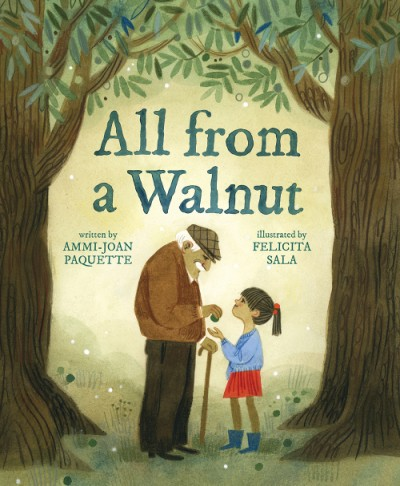
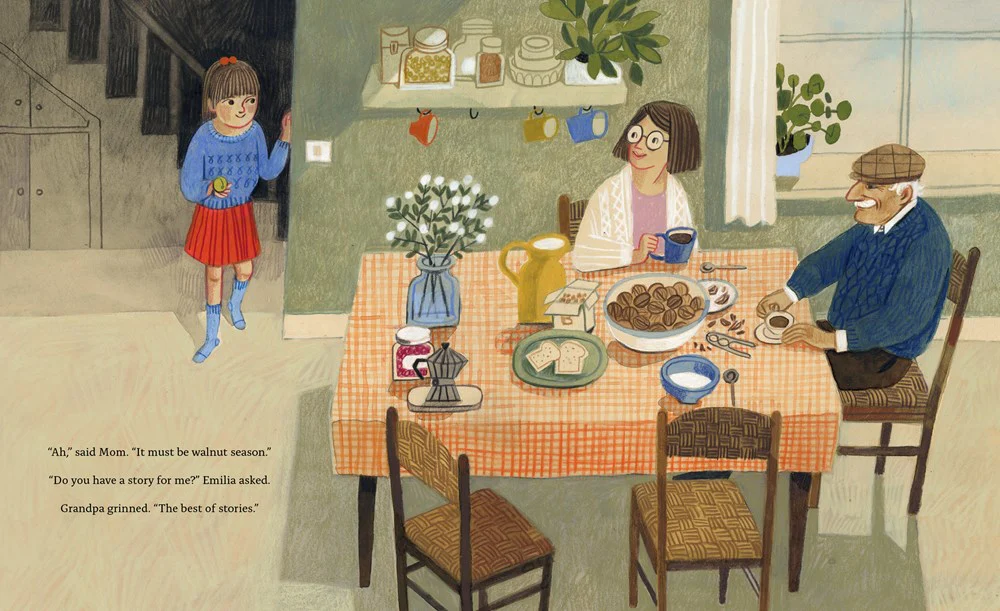
All from a Walnut by Ammi-Joan Paquette, illustrated by Felicita Sala

Published by Harry N. Abrams

Summary:  When Emilia wakes up to find a walnut on her nightstand, she asks Grandpa if he has a story for her.  He tells her how he immigrated to the United States as a boy, bringing with him a nut from a walnut tree.  When he got to America, he planted it, moving the pot it was in when his family moved, and eventually planting in the yard of the house he and his wife bought.  Now there are two trees, a smaller one planted by Emilia’s mother as a girl.  Grandpa helps Emilia plant the walnut she found.  It flourishes under her care, but at the same time Grandpa grows weaker, until finally, Emilia has to say good-bye to him.  When she notices her sapling looking “as droopy as she felt,” she decides to transplant it next to the other two trees in the yard.  She knows that one day, she will give a walnut to her own child to begin a new tree.  40 pages; grades K-4.

Pros:  A beautiful story that explores grief and loss but also looks at how life continues with each new generation.

Cons:  The new tree looked like it was planted too close to the bigger trees.

The Bird Book by Steve Jenkins and Robin Page

Published by Clarion Books

Summary:  The husband-and-wife team of Jenkins and Page have created a picture book jam-packed with information about birds.  From their anatomy and physiology to their evolution from dinosaurs to record-holders in the avian world, readers will learn fascinating facts about birds, accompanied by Steve Jenkins’s trademark cut-paper illustrations.  Includes a four-page table listing every bird mentioned in the book, with its size, diet, range, and the page where it can be found; also, a list of books and websites with more information.  48 pages; grades 1-5.

Pros:  Another beautiful offering by Robin Page and the late Steve Jenkins, with a ton of information offered in an appealing format with stunning illustrations.

Cons:  Another childhood bubble was burst when I learned that the oldest bird on record is a pink cockatoo that lived to the age of 83, not Dr. Dolittle’s 199-year-old parrot Polynesia.

Mae Makes A Way: The True Story of Mae Reeves, Hat & History Maker by Olugbemisola Rhuday-Perkovich, illustrated by Andrea Pippins

Published by Crown Books for Young Readers

Summary:  Published in collaboration with the Smithsonian National Museum of African American History and Culture, this book traces the story of Mae Reeves, a Black woman who left Georgia in the 1930’s to become a milliner.  She eventually opened her own shop in Philadelphia, creating hats for celebrities like Marian Anderson, Lena Horne, and Ella Fitzgerald.  She kept her business going while raising three children and being active in her community, helping other Black businesses.  Mae lived to be 104, long enough to see artifacts from her shop included in the Smithsonian’s National Museum of African American History and Culture.  Includes interviews with Mae’s daughter Donna and with Dr. Reneé Anderson, Head of Collections at NMAAHC, as well as information about the museum and a list of sources.  48 pages; grades 2-5.

Pros:  A fascinating biography of a woman who never became famous but who lived a full life, following her own dreams and helping others.  Readers will be inspired to head to Washington, D.C. to see Mae’s hats in the museum.

Cons:  It’s a long picture book for reading aloud.

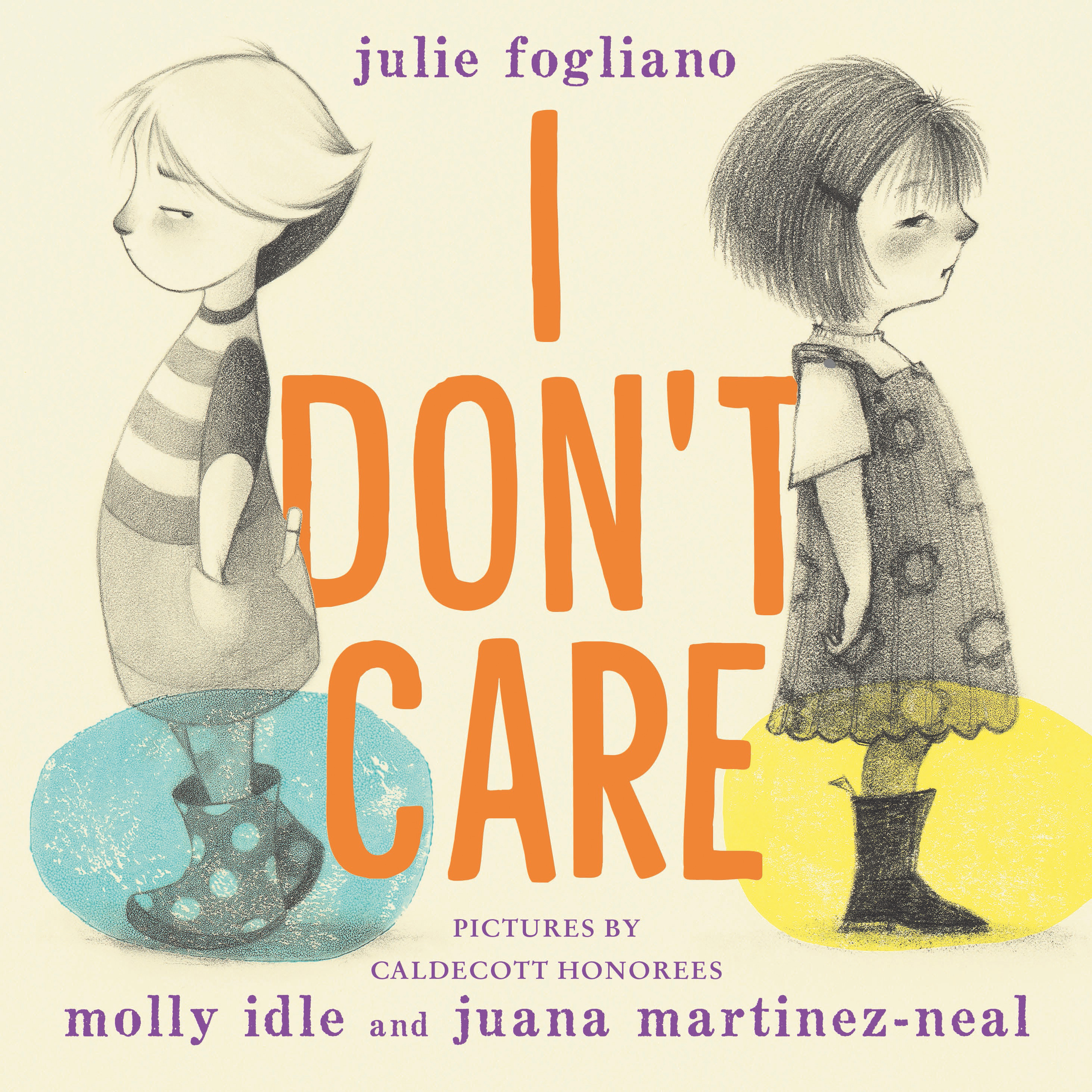
I Don’t Care by Julie Fogliano, illustrated by Molly Idle and Juana Martinez-Neal

Published by Neal Porter Books

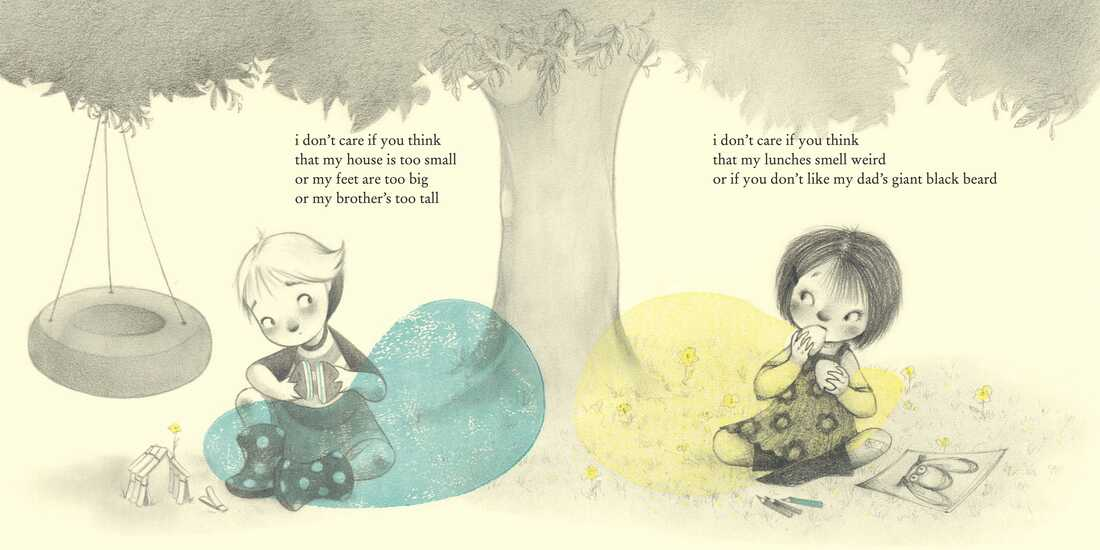
Summary:  Two girls start off by listing all the things they don’t care about each other: each one claims not to care what the other thinks of her hair or clothes or drawings.  But then the meaning shifts: they don’t care about those things because they like each other so much.  Finally, they name the things they DO care about: that both girls like to share (most of the time), to pretend things, to go on picnics together, and most of all, to be good friends.  Includes notes from both illustrators about how they worked together to create illustrations for this book.  40 pages; ages 3-6.

Pros:  Three award winners have teamed up to create this sweet book about friendship with unique illustrations created by the two different artists. Each girl has her own distinctive look and is shown with an identifying color: teal blue for the Molly Idle girl and yellow for the Juana Martinez-Neal one.  

Cons:  Personally, I prefer illustrations with a little more color.

Frances in the Country by Liz Garton Scanlon, illustrated by Sean Qualls

Published by Neal Porter Books

Summary:  Frances is a city girl, but “the city never seems quite right for Frances.”  The crowds and small spaces make it hard for her to run and shout the way she likes to, and it seems like someone is always telling her to stop what she is doing.  When she goes for a visit to her cousins in the country, she loves the field and barns that allow her to play the way she wants to.  But her sisters and her mother are missing her back in the city, so the visit must come to an end.  Returning to the city, Frances appreciates the music and bustle of the streets there and is happy to be welcomed home by her family.  32 pages; ages 4-8.

Pros:  Frances leads an exploration of the eternal “city vs. country” question which is enhanced by Sean Qualls’s distinctive collage-style illustrations.  Frances is an energetic and likable protagonist who seems to flourish (most of the time) in any environment.

Cons:  Does not definitively make the case for either the country or the city.

A Duet for Home by Karina Yan Glaser

Published by Clarion Books

Summary:  Tyrell has lived at Huey House, a homeless shelter in the Bronx, for over three years.  June arrives with her younger sister Maybelle and their mother, who has fallen into a mute depression following the sudden death of their dad.  Both kids love classical music: Tyrell listens to a neighbor practicing her violin every night, and June is a viola player who must hide her instrument from the somewhat draconian shelter director.  Kinder staff members, as well as Tyrell and some of the other shelter residents, help June and her little sister Maybelle adjust to losing their home, getting them to school and finding a way for June to practice her viola.  June and her family are starting to get some help when they learn that a new city policy will force all shelter residents to move out in 90 days.  Desperate to stay where they are, Tyrell and June take on City Hall to try to make their voices heard about the importance of Huey House in their lives.  Includes an author’s note about her experience working in a similar shelter.  368 pages; grades 4-7.

Pros:  Told in alternating chapters between June and Tyrell, this moving story humanizes people who have lost their homes for many reasons and shows how their needs can get lost in political rhetoric.  Readers will be rooting for the two kids, as well as many of the other shelter residents and workers.

Cons:  The ending was touching but felt a little unrealistic.

Mock awards: Caldecott and Coretta Scott King 2023

As I did last year, I’ve created a Mock Caldecott slideshow that I’m selling on Teachers Pay Teachers. It includes an introduction to the award and 20 books that I think may win. Each book gets its own slide with the title, author, and publisher, as well as a picture and facts, questions, and things to notice about the book.

I’m trying something new this year: a Coretta Scott King Award slideshow, also available on Teachers Pay Teachers. This has a similar introduction, with ten slides for the illustrator award and ten different books for the author award.

Each slideshow sells for $6.00. Please stop by and take a look!

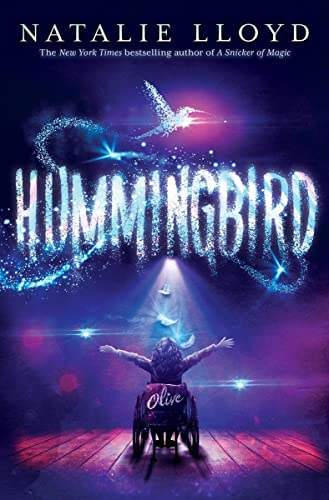
Hummingbird by Natalie Lloyd

Published by Scholastic

Summary:  Olive has been homeschooled her whole life due to her osteogenesis Imperfecta, or brittle bone disease, that means she spends most of her time in a wheelchair.  She longs to go to school, find a best friend, and maybe fulfill her dream of acting, so she’s thrilled when her parents agree to let her attend the local middle school.  After a rough first day, Olive begins to find her way, making a new friend named Grace, auditioning for the school play, and even connecting with her taciturn stepbrother Hatch, who is in her class.  When magical events foretell the return of a mysterious wish-granting hummingbird, Olive, Grace, and Hatch are determined to find the bird and make their wishes come true.  But life and magic are both unpredictable, and Olive has to learn to embrace some difficult turns of events and appreciate to the everyday magic that is already in her life.  Includes an author’s note telling about her own life with osteogenesis Imperfecta. 368 pages; grades 4-7.

Pros:  Olive is a spunky and indomitable narrator who doesn’t sugarcoat her disease, but who is also optimistic, loving, and appreciative of her family, friends, and community.  The magic realism adds a fun touch to the story.

Cons:  A little spunk can go a long way, and Olive occasionally seemed a little too good to be true. 

Two by Phillip C. Stead: Every Dog in the Neighborhood illustrated by Matthew Cordell and The Sun Is Late and So Is the Farmer illustrated by Erin E. Stead

Both published by Neal Porter Books

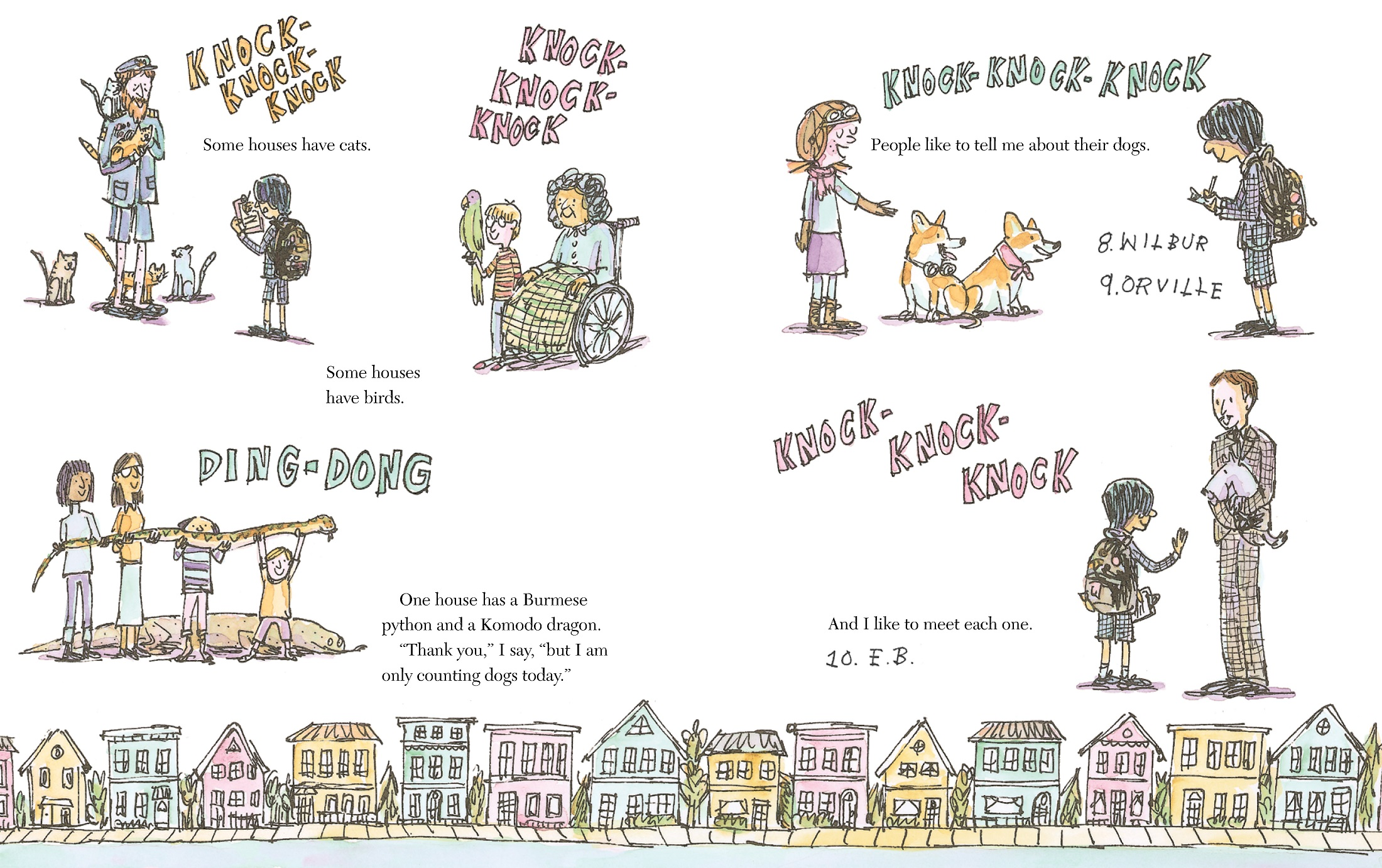
Summary: In Every Dog in the Neighborhood, a boy wishes for a dog. When his grandmother tells him there are enough dogs in the neighborhood, he decides to find out the exact number. Watching his grandmother write to city hall about an issue of her own, then get to work when she receives an unsatisfactory reply, the boy decides to do a dog census himself. As he knocks on doors and collects his doggy data, Grandma is seen working in an abandoned lot nearby. The boy learns there are 20 dogs in the neighborhood, but dog #20 needs a new home. He gets his dog, and all the dogs in the neighborhood get to enjoy the dog park that Grandma has created. 40 pages; ages 4-8.

It should come as no surprise that both the sun and the farmer are late in The Sun Is Late and So Is the Farmer. This worries the mule, the milk cow, and the miniature horse, who are concerned that they may not get breakfast. They consult wise Barn Owl, who sends them on a journey out of their familiar barnyard to the very edge of the world (or the farm, depending on your perspective). “Bring Rooster,” the owl tells them. “Rooster will know what to do.” So off they go, following the route and occasionally ruminating on such questions as what do sheep dream about? When they reach their destination, Rooster lets out a tremendous “Cock-a-doodle-doo” practically under the farmer’s window. The last page shows her, coffee in hand, leading the three animals back to the barnyard. 32 pages; ages 4-8.

Pros and cons: I sometimes find Philip Stead a bit esoteric for my admittedly lowbrow tendencies, and I quickly skimmed Every Dog in the Neighborhood months ago and dismissed it. Fortunately, the publisher sent me a free copy which has been in my library, and when I saw The Sun Is Late, I decided to give it another try. I really loved it this time and appreciate Matthew Cordell’s quirky drawings of the dogs and their owners (with a few jokes that will probably go over kids’ heads but will be appreciated by their adults). The Sun Is Late borders on that esoteric line, but it’s a sweet story, almost like a folktale, and kids will surely enjoy the animals and get a chuckle from their big quest.