Lights, Camera, Cook! (Next Best Junior Chef) by Charise Mericle Harper, illustrated by Aurelie Blard-Quintard

Published by Houghton Mifflin Harcourt
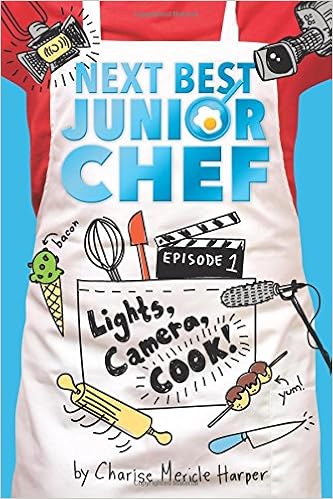
Summary:  Rae, Tate, Caroline, and Oliver all want to be the Next Best Junior Chef, but only one can win the title.  They’ll have to survive three big competitions in which one chef will be eliminated.  Along the way are field trips and mini contests that allow them to choose kitchen gadgets or get private cooking lessons that may help them in their quests to be the best.  They’re surrounded by professional chefs and strict rules about TV behavior.  Friendships are formed and rivalries develop as the four kids try to do their best under the pressure of trying to be the best.  Includes tips for how to use a chef’s knife and a preview of book two.  192 pages; grades 3-5.

Pros:  A series based on a reality cooking show in which one contestant is eliminated at the end of each book…how has no one thought of this before?  Kids will love this quick and easy read, with plenty of illustrations and illustrations of each character talking to the reader in cartoon bubbles every few pages.

Cons:  Who will be next?  Readers have to wait until mid-February to find out!
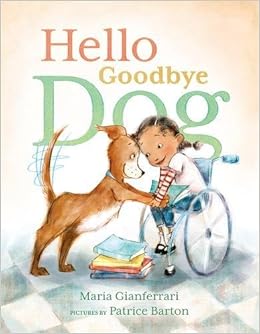
Hello Goodbye Dog by Maria Gianferrari, illustrated by Patrice Barton

Published by Roaring Brook Press

Summary:  Moose the dog loves hellos and hates good-byes.  When his friend Zara goes to school, he finds ways to join her.  Each time he gets into school, it takes more and more people to get him to leave again, until finally, Zara’s parents and teacher, the principal, the librarian, and the lunch ladies are all in on the act.  One of Moose’s favorite parts of school is listening to books, and this gives Zara an idea.  She signs Moose up for therapy dog training, and he proves to be a natural.  With his new certification, he is welcome in school, listening to kids practice their reading each day.  An author’s note gives more information about therapy dogs and how they differ from service dogs; two websites are included for more information.  40 pages; grades K-2.

Pros:  Moose is pretty irresistible, and his antics will amuse young readers.  Zara is in a wheelchair, but this is scarcely touched on in the story and she is fully integrated into her classroom and a capable trainer for her dog.

Cons:  Moose’s behavioral turn-around seemed overly optimistic to me.

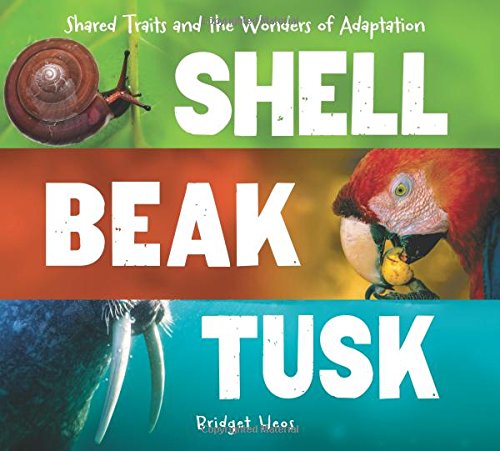
Shell Beak Tusk: Shared Traits and the Wonders of Adaptation by Bridget Heos

Published by HMH Books for Young Readers

Summary:  Porcupines and echidnas both have spiky spines.  Turtles and snails both have shells.  Yet these animals aren’t related to each other, and, in the case of the porcupine and echidna, don’t live on the same continents.  Animals often evolve with shared traits, even if they’re not closely related.  Each two-page spread shows a photograph of both of the animals with a paragraph about that animal and the trait the two share.  The first and last page give additional information about adaptation and evolution.  Includes a pretty extensive bibliography and an index.  32 pages; grades 1-4.

Pros:  The large, colorful photos provide a draw to pick up this book.  The idea of shared traits is an interesting concept that could be extended by having kids think of and research other animals who have shared traits.

Cons:  The writing and format are pretty straightforward, and may not have as much appeal as some flashier books about animals.

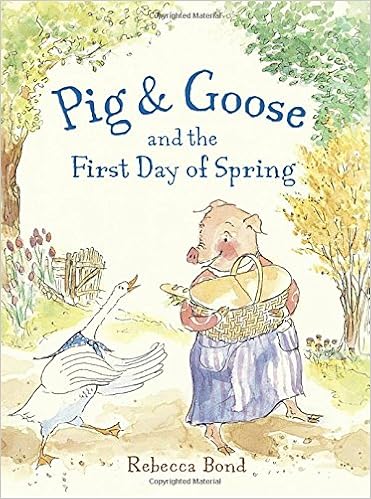
Pig & Goose and the First Day of Spring by Rebecca Bond

Published by Charlesbridge

Summary:  Pig is excited to be heading out for a picnic on the first day of spring, when she’s surprised by a goose who lands at her feet.  She admires his flying, and he tries (unsuccessfully) to teach her to fly.  She invites him to join her on her picnic; they enjoy it so much that she extends the invitation to a first-day-of-spring party at her house that night.  During the day, Pig has wished for Goose’s abilities to fly and to swim, but at the party, Goose gets to see Pig’s talents as she keeps her guests entertained, well-fed, and happy.  They part ways with the promise of a picnic the next day, and the hope that there will be a sequel featuring these two friends.  48 pages; grades K-3.

Pros:  Fans of Poppleton and Frog and Toad will enjoy this new three-chapter book for emergent readers.  The watercolor illustrations are cute and cheery, and the friendship and humor will keep kids reading.

Cons:  The humor is more of a smile than Frog-and-Toad laugh-out-loud.

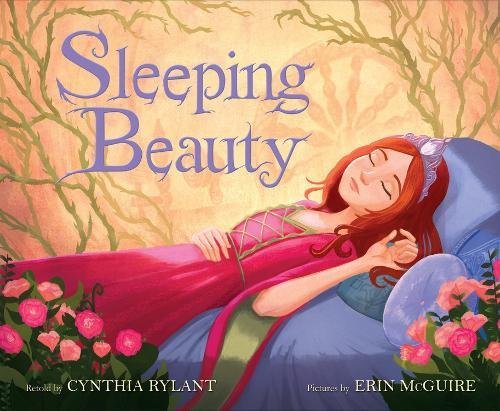
Sleeping Beauty retold by Cynthia Rylant, illustrated by Erin McGuire

Published by Disney Hyperion

Summary:  A retelling of the classic fairy tale by master storyteller Cynthia Rylant.  This version is geared toward a younger crowd, with simple language, a short amount of text on each page, and Disneyesque illustrations.  The whole story is told by an omniscient narrator, with the only dialog being when the angry fairy puts a spell on the sleeping baby and when the final fairy comes along and makes a counter-spell that will undo the evil one after a century.  Most of the story takes place at the celebration of the princess’s birth, attended by the various fairies.  After all the spells have been cast, the tale moves along quickly to the fateful spinning wheel accident, the 100-year slumber of the kingdom, and the awakening by the prince.  40 pages; ages 4-8.

Pros:  A simple, straightforward introduction to the story of Sleeping Beauty.  The illustrations of fairies and royal family members will appeal to young readers, and the story will be easy for them to understand.  I didn’t realize Cynthia Rylant has also done retellings of Cinderella and Beauty and the Beast.

Cons:  An author’s note giving the history of this fairy tale would have been an interesting addition.

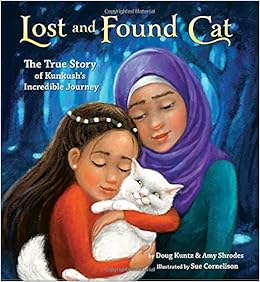
Lost and Found Cat: The True Story of Kunkush’s Incredible Journey by Doug Kuntz and Amy Schrodes, illustrated by Sue Cornelison

Published by Crown Books for Young Readers

Summary:  When Sura and her five children decided to secretly leave their home in Mosul, Iraq in 2015, another family member was hidden among their belongings: their beautiful white cat, Kunkush.  Smugglers helped them out of the country, across Turkey, and to a boat that carried them to Greece, but those smugglers would have charged them much more money to bring a cat along, so Kunkush had to stay hidden.  When the family finally arrived in Greece, the cat carrier broke, and Kunkush ran away.  The heartbroken family searched for as long as they could, but eventually had to move on.  An American aid worker found the cat months later, filthy and half-starved, and took him home with her.  She launched a search for the family via Facebook, and they were eventually located, resulting in a happy reunion with Kunkush.  Includes a note from the authors, who helped Kunkush in Greece, a map of the cat’s journey, and photographs of him and his family.  48 pages; ages 4-10.

Pros:  Mosul may seem far away, but readers will connect with this family’s loss of their beloved pet, while learning about the difficulties they encountered as refugees.

Cons:  2017 seems to be the year of the refugee in children’s literature, a sad reflection of the world situation.  

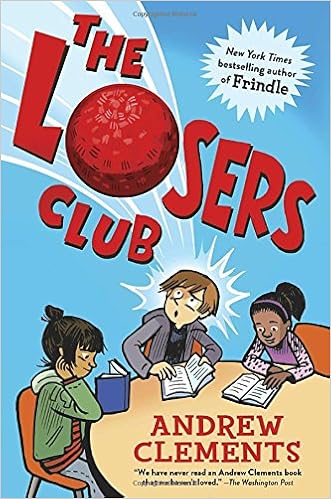
The Losers Club by Andrew Clements

Published by Random House

Summary:  Alec’s sixth grade year is off to a rocky start, and it’s all because he loves reading too much.  His habit of reading during class has his teachers threatening summer school, and even at the extended day program after school, he’s expected to do (non-reading) homework or participate in a group activity.  When he learns that kids can start new clubs, he thinks he has the perfect idea: find another reader and call themselves The Losers Club.  That way, they can read all they want, uninterrupted, and no one else will want to associate with the “losers”.  But the plan backfires when other readers want to join.  Not only that, but the first new member is Nina, a new girl who has caught the attention of Kent, Alec’s former friend turned bully.  Alec learns that life in sixth grade is far more complicated than the worlds in the books he likes, but it can also be more interesting and rewarding.  Includes a two-page list of all the books mentioned in the story.  240 pages; grades 3-6.

Pros:  Andrew Clements fans won’t be disappointed in his latest story about a resourceful kid who finds his own way to overcome difficulties.

Cons:  In referencing Charlotte’s Web, Alec mentions Fern’s younger brother Avery and mentions that Avery reminds Alec of his own younger brother.  News flash, Andrew Clements (and your editor at Random House): Avery is Fern’s older brother.

Jabari Jumps by Gaia Cornwall

Published by Candlewick Press

Summary:  Jabari is full of bravado as he approaches the pool with his father and little sister, informing them that he will be jumping off the diving board today.  “I’m a great jumper,” Jabari tells them, “so I’m not scared at all.”  But when he gets to the bottom of the ladder, he has to think about what kind of special jump he’s going to do.  Then he realizes he’s forgotten his stretching exercises!  Finally, his dad tells him it’s okay to be scared and gives him some advice about how to handle it.  Take a deep breath and tell yourself you’re ready.  “Sometimes it stops feeling scary and feels a little like a surprise,” Dad says.  Jabari loves surprises!  He climbs the ladder, walks to the end of the board, takes a deep breath, and splash!  He makes a truly spectacular jump.  32 pages; ages 4-8.

Pros:  A great choice for summer reading, short but funny, with a bit of a lesson subtly inserted.  The illustrations perfectly capture the feelings of the pool and the diving board.

Cons:  I wish I had reviewed this when it first came out in May.  Feels like those days at the pool are numbered.

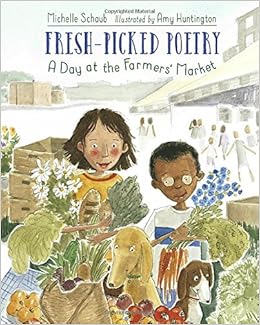
Fresh-Picked Poetry: A Day at the Farmers’ Market by Michelle Schaub, illustrated by Amy Huntington

Published by Charlesbridge

Summary:  A collection of 18 poems describes a farmers’ market from “Early Risers” through “Day’s End”.  The poems vary somewhat in format, including one poem for two voices, and appear in a variety of ways on the page, sometimes weaving through the illustrations.  Many of the poems are about the farmers’ produce, but there are also some about other features of the market, like the bakery, a musical duet, and Antonio’s Old-Time Sharpening, who will sharpen  your dull knife or scissors.  The last page gives five reasons to spend a day at a market, giving more information about the benefits of local food and a website to find a farmers’ market near you.  32 pages; grades PreK-3.

Pros:  Not only a rollicking look at the bounty available at the farmers’ market, but a great introduction to poetry as well.

Cons:  The rhythm of “Market Melody”, the poem about the musicians, felt a little clunky.

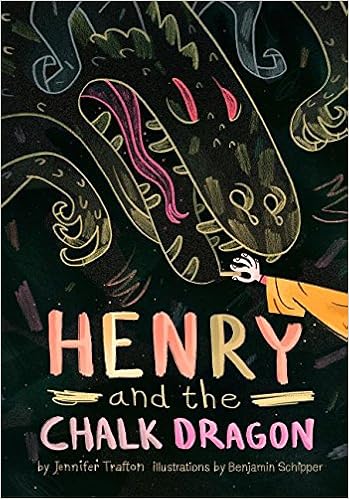
Henry and the Chalk Dragon by Jennifer Trafton, illustrated by Benjamin Schipper

Published by Rabbit Room Press

Summary:  When Henry draws an amazing dragon on the chalkboard in his room, he’s almost sure he sees it move.  Before he goes to bed, he tells his mom he’ll erase the dragon in the morning, and that’s enough to cause the creature to flee.  When Henry wakes up the next morning, there’s a gaping hole in his door, and the dragon is nowhere to be seen.  It eventually winds up at school with Henry and his friends, Oscar and Jade.  The dragon has the ability to morph into different forms, and eventually Henry realizes they are all different pictures he has drawn come to life.  Eventually, the dragon causes complete chaos throughout the school, and it’s up to Henry, Oscar, and Jade to use their unique creative gifts (art, science, and music, respectively) to tame it, and to get the school back to normal…or maybe a slightly improved version of normal.  240 pages; grades 3-5.

Pros:  A fantastic adventure all brought to life by the kids’ imaginations.  This would make a good read-aloud in an elementary classroom.

Cons:  The message–you have to be brave to be an artist–at times overwhelmed the action of the story.