Her Name Was Mary Katharine: The Only Woman Whose Name Is on the Declaration of Independence by Ella Schwartz, illustrated by Dow Phumiruk

Published by Christy Ottaviano

Summary:  Mary Katharine Goddard grew up in the Connecticut colony with her parents and younger brother William.  Unlike most girls of the time, she learned to read and write alongside her brother.  When her father died, she and her mother moved to Providence, Rhode Island, while her brother served an apprenticeship as a printer.  He started several newspapers but had the unfortunate habit of abandoning them to move onto other endeavors.  Mary Katharine learned the business and took over the papers, first in Providence, then in Philadelphia, and finally in Baltimore.  When William started a new project, creating a postal service for the colonies, Mary Katharine took on additional responsibilities as postmaster of Baltimore.  She was known as a loyal patriot, so when the Continental Congress decided to print a copy of the Declaration of Independence with the names of the signers, they gave her the job.  Usually, Mary Katharine used the name M. K. Goddard for her printing work, but for the Declaration she used her full name, the only name of a woman to appear on the document.  Includes an author’s note, list of important terms with definitions, and a list of sources.  40 pages; grades 2-5.

Pros:  This is a great resource to add to American Revolutionary War units, featuring a little-known but fascinating woman who seems to have been way ahead of her time.  The author’s note gives lots of additional information, including the fact that Mary Katharine had an enslaved woman who helped her run her business (and to whom she granted freedom and left all her possessions when she died).  

Cons:  I saw this recommended for kids as young as 5, but the text-heavy story, small font, and need for some historical context make it a better choice for older kids.

I Am Mozart, Too: The Lost Genius of Maria Anna Mozart by Audrey Ades, illustrated by Adelina Lirius

A handful of picture book biographies about women arrived for me at the library this week, and since March is Women’s History Month, I’ll be featuring them for the rest of the week.

Published by Farrar, Straus, and Giroux

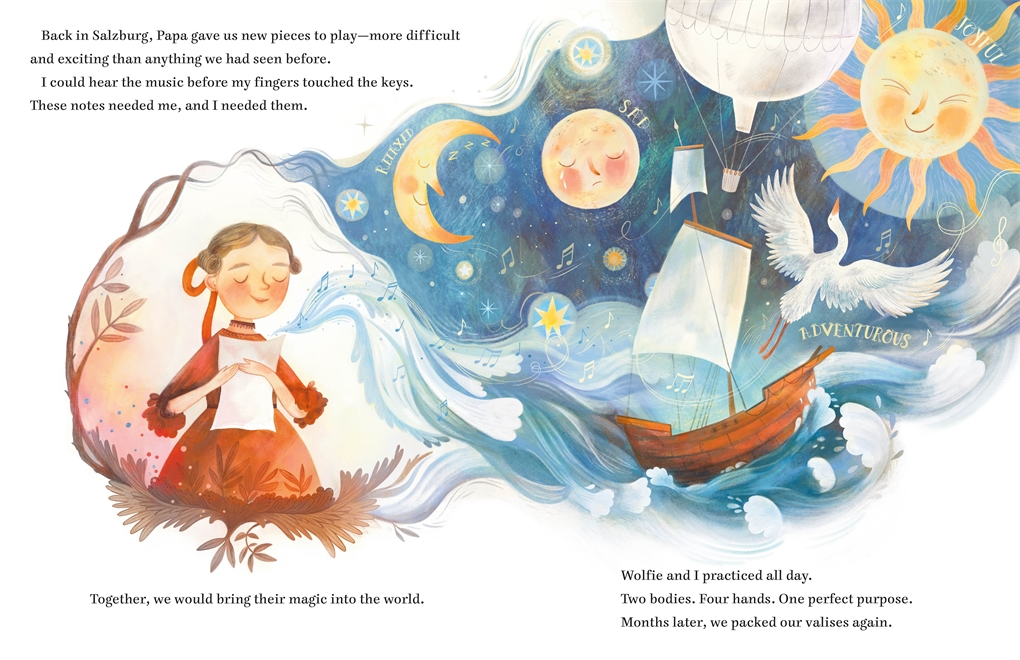
Summary:  Maria Anna Mozart, known as Nannerl, tells the story of her life growing up with her younger brother, Wolfie.  The two of them took to music at an early age and were playing concert halls in cities across Europe from the ages of five and ten.  Nannerl also loved composing, but her father forbade it, saying that writing music was only for men.  When Nannerl turned eighteen, she was told that touring was over for her and that she would stay home and get married.  Wolfie continued to tour, and their correspondence grew less and less frequent until one devastating day when she learned of his death.  Nannerl lived for almost forty more years, returning to Salzburg and her beloved harpsichord.  Includes an author’s note explaining that this book is creative nonfiction, not a strict biography; also, a timeline, glossary, and list of books and online sources.  40 pages; grades K-4.

Pros:  This is a fascinating story made more interesting by being told in Nannerl’s voice.  The illustrations are a beautiful addition, particularly the ones that show the music created by the Mozarts.

Cons:  A quick look at Wikipedia tells me there is a lot more to Maria Anna’s story and her relationship with her brother and father than this book is able to cover.

When the World Turned Upside Down by K. Ibura

Published by Scholastic

Summary:  Ai, Ben, Liam, and Shayla have grown up together in the same apartment building, but lately things have been changing.  Shayla has been moving away from the group, and Liam is dealing with panic attacks.  The story opens on the day school closes down due to Covid-19.  During the next few weeks, everyone is struggling to get through this abrupt change, which has exacerbated family issues for all four of the kids.  A well-intentioned but ill-advised mission to help a sick neighbor lands three of the kids in quarantine, where they use their time to come up with better ways to help others in the apartment building.  As the spring wears on, news of George Floyd’s murder reaches the children, and they become aware of protests in their neighborhood.  While they’re not allowed to join the protests, they find other ways to raise awareness about racism.  There are no easy answers as the story ends with the pandemic still in its early days, but the four children have learned how to be more active participants in their own lives, helping themselves, their families, their neighbors, and possibly the greater world around them.  288 pages; grades 4-7.

Pros:  I was drawn into this story right away, with its four interesting characters and the ways they dealt with the events that we all lived through.  While I do find that some of my students are not interested at all in reliving the early days of the pandemic, those who are will find the people and events of this story very relatable.

Cons:  I know schools closed abruptly, but the teacher in this story announces that school is closing down for two weeks about a minute before dismissal, with no time for discussion, just a hurried handout to take home to parents. 

Raquela’s Seder by Joel Edward Stein, illustrated by Sara Ugolotti

Published by Kar-Ben Publishing

Summary:  Raquela and her family live in Spain during a time when it’s forbidden for them to practice their Jewish faith.  They celebrate Shabbat each week in their wine cellar, but Raquela has only heard about Passover.  One year she asks her parents if they can have a seder.  Her mother says it’s too dangerous, but her father, a great fisherman, gets a thoughtful look in his eyes.  The night before Passover begins, Raquela’s parents pack a basket, and the next night they sneak onto her dad’s fishing boat.  Papá takes them to his favorite secret fishing spot, where they drop anchor and proceed to have a seder dinner.  An old fisherman sees them when they return, saying that it must have been a special night for Papá to take his family out fishing with him.  Raquela says to her father, “It was a night different from all other nights.”  Includes additional information about Passover and the Spanish Inquisition and its consequences for Spanish Jews.  32 pages; grades K-3.

Pros:  An excellent book for celebrating Passover that weaves the original Passover story into the Spanish one and focuses on the hope and endurance of both groups of Jews.

Cons:  I wouldn’t have objected to a bit more historical back matter.

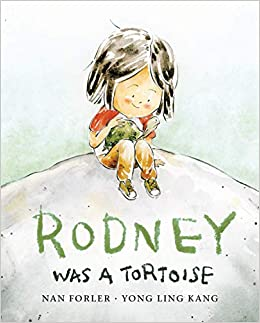
Rodney Was a Tortoise by Nan Forler, illustrated by Yong Ling Kang

Published by Tundra Books

Summary:  Bernadette’s oldest friend is Rodney, a tortoise is older than she is, older than her dad, even older than her Great-Aunt Clara.  Bernadette loves to play games with Rodney, to bring him to school for show and tell, and to read to him before bedtime.  Rodney has always been slow, but he gradually gets slower until one day he dies.  Bernadette brings her grief with her to school, where it feels like the other kids don’t really care.  Like Rodney, she sits on a rock at recess, drawing deeper into her shell.  Then one day, a boy named Amar climbs onto the rock with her, acknowledging her sadness about Rodney and remembering some good things that he remembers about the tortoise.  Amar used to have a budgie named Samuel, so he’s not unfamiliar with loss.  Bernadette responds by inviting Amar over for a game of Crokinole, something she used to enjoy with Rodney.  40 pages; ages 4-8.

Pros:  This gentle tale of love and loss will resonate with anyone who has ever experienced grief.  

Cons:  I had never heard of Crokinole and had to use my context clues to figure out what it is.

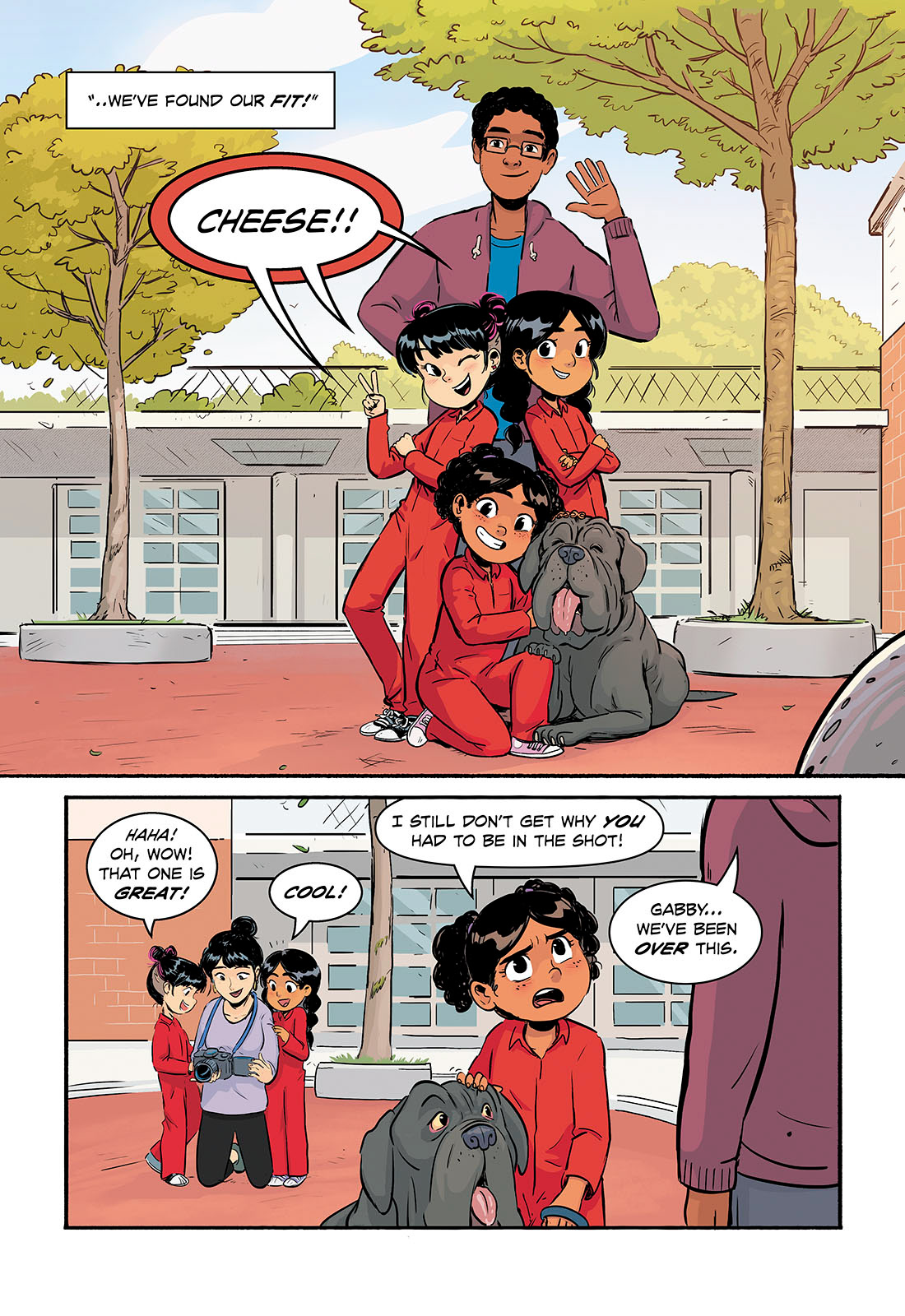
Gabby Gets It Together (PAWS book 1) by Nathan Fairbairn, illustrated by Michele Assarasakorn

Published by Razorbill

Summary:  The book opens with Gabby struggling to walk five dogs and losing track of four of them.  How did she get into this desperate situation? She explains how she and her friends Mindy and Priya love animals but for one reason or another can’t have pets.  They brainstorm how to get more animals into their lives and come up with PAWS, a dog-walking business.  Right away, they find five clients, but a lack of communication among the three of them leads to a series of misunderstandings that threatens the business.  Which brings us back to the opening scene, when Priya and Mindy have stood Gabby up, and she is trying to walk all five dogs.  Fortunately, all three girls have a change of heart, and Priya and Mindy show up in time to rescue the dogs and the business.  They talk about how to fix their mistakes, and PAWS is back in business and ready for book 2.  176 pages; grades 3-6.

Pros:  This graphic novel is going to be very, very popular in my library with all those kids who love The Baby-Sitters Club and Allergic, with believable tween protagonists, cute dogs, and colorful artwork.

Cons: Mindy and Priya seem to have the upper hand because they’re both a year older than Gabby.

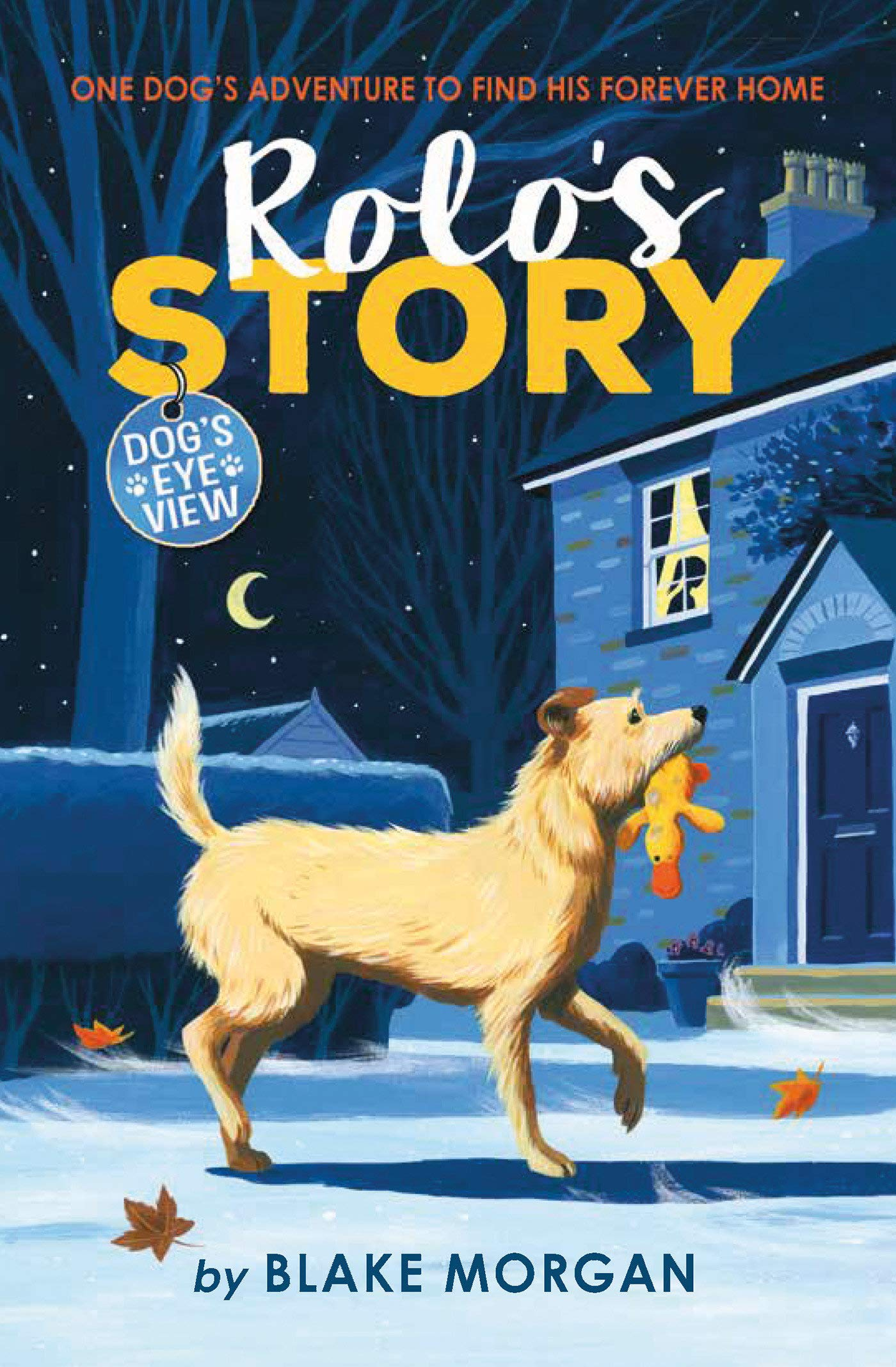
Rolo’s Story (Dog’s Eye View, book 2) by Blake Morgan, illustrated by David Dean

Published by Tiger Tales

Summary:  Rolo starts life with a cruel owner, often tied up in the backyard with a rope and without enough food.  He finally runs away but finds life as a stray to be a precarious existence.  After his friend and mentor Scrap is taken away to the pound, Rolo takes shelter in a shed where he is discovered by a girl named Freya.  Freya lives with her single mother, who is stressed by her many responsibilities and isn’t sure about adding an untrained puppy to the household.  Freya and Rolo’s obvious love for each other finally wins her over, and after a series of mishaps, Rolo finally gets some training.  His presence brings some changes to the household, and Mom finds a career that makes all of them happier.  192 pages; grades 2-5.

Pros:  I always enjoy a good dog-narrated story, and this one is particularly heartwarming, especially for readers who, like Rolo, may not always succeed at carrying out their good intentions.  This is book 2 in a series whose subject matter and relatively low page count is sure to appeal to a wide range of elementary readers.

Cons:  I wish there had been more illustrations besides the same picture of Rolo at the head of each chapter.  Also, Mom’s overnight career switch from accountant to dogwalker seemed a bit fiscally risky.

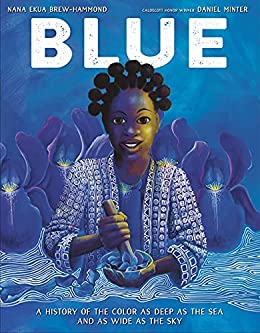
Blue: A History of the Color as Deep as the Sea and as Wide as the Sky by Nana Ekua Brew-Hammond, illustrated by Daniel Minter

Published by Knopf Books for Young Readers

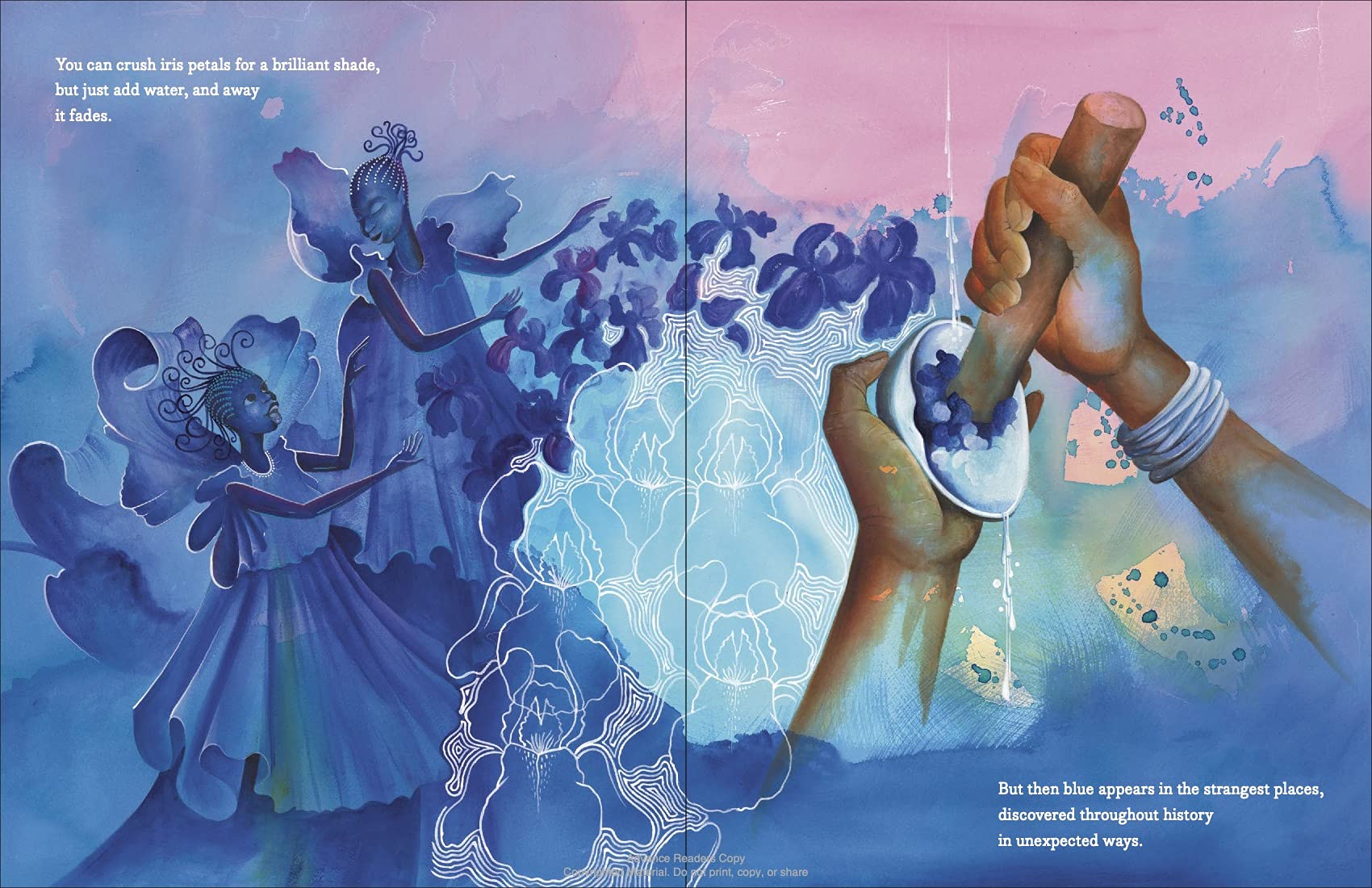
Summary:  Blue may be the color of the sky and the ocean, but for much of human history, it was a difficult color to produce.  Ancient Egyptians crushed the blue stone lapis lazuli to make paint and eye makeup that only the very wealthy could afford.  Later, people discovered shellfish that produced a blue dye, but each organism only produced a drop or two.  Finally, the indigo plant, a native of Asia, Africa, the Caribbean, and the Americas, became more widely known and cultivated.  The value of the plant’s blue dye led to abuses as people were tricked into growing it instead of food and enslaved to help mass produce it.  In 1905, Adolf von Baeyer was awarded a Nobel prize for, among other things, creating a blue chemical dye.  Now everyone can own something that’s blue, but the rarity of blue and the suffering created in its production remind us of expressions like “the blues”, “feeling blue”, and “out of the blue”.  Includes two pages of additional information and a list of selected sources.  40 pages; grades 1-5.

Pros:  Here’s a fascinating history of something I had no idea had a fascinating history: the color blue.  Kids will have a greater appreciation for blue jeans and other commonplace items after reading about the struggles and high value associated with blue.  The gorgeous illustrations feature many different colors but appropriately highlight blue.

Cons:  Some of the claims about the expressions noted above were pretty speculative, and when I looked into them, they don’t appear to have the connections to the color the author writes about.

Nigel and the Moon by Antwan Eady, illustrated by Gracey Zhang

Published by Katherine Tegen Books

Summary:  Nigel has big dreams: he wants to be a dancer, an astronaut, and a superhero.  At night, he tells his dreams to the moon, but during the day it’s harder to share them.  During career week at his school, other kids talk about their plans to become a doctor, an engineer, or a veterinarian, but when it’s Nigel’s turn, he’s afraid to reveal his dreams.  He’s also shy about revealing his parents’ occupations, feeling like they’re not as “fancy” as his classmates’.  On the last day of the week, parents come in to talk about their careers.  Nigel’s parents tell what they enjoy about their jobs as a mail carrier, truck driver, and the best job of all: raising Nigel.  Emboldened, Nigel stands in front of the room between his mom and dad and tells the class exactly what he hopes to become someday.  40 pages; ages 4-8.

Pros:  Nigel’s insecurities are realistically portrayed, as he struggles to find the courage to share his dreams.  The illustrations effectively portray the dreamy night sequences and the brighter daytime scenes.  This would be a great book for introducing community helpers as well as empowering shy kids to share more about themselves.

Cons:  It seemed kind of stereotypical to have Nigel, apparently the only Black kid in the class, also be the only one whose parents had more blue-collar jobs.

The Supernatural Society (book 1) by Rex Ogle

Published by Inkyard Press

Summary:  Will’s struggling with his parents’ recent divorce, his father’s abandonment, and a move from New York City to the small town of East Emerson.  At first he thinks that the monsters he’s seeing in his new town are some overenthusiastic Halloween fans, but before long he realizes that he alone can see the horrors all around him.  Alone, that is, except for his somewhat eccentric neighbor Ivy, who’s in possession of a ring that allows her to see them as well.  Her brilliantly geeky brother Linus doesn’t have the gift and isn’t sure what to believe, but the three of them ultimately form a team to solve the mystery of disappearing pets in town and discover the evil force behind it.  Narrated by Adam Monster, with a voice that evokes A Series of Unfortunate Events, the book ends with a number of unresolved issues, paving the way for book 2 and beyond.  288 pages; grades 4-7.

Pros:  Fans of Lemony Snicket, The Notebook of Doom series, and other books that combine humor and horror will enjoy this series opener that delivers plenty of both.

Cons:  I was sure that Adam Monster’s identity would be revealed in a way that would somehow tie into the rest of the story, but at least in book 1 he seemed to be a somewhat random choice for a narrator.