The Tryout by Christina Soontornvat, illustrated by Joanna Cacao

Published by Graphix

Summary:  Seventh grade is tough, and to Christina, the cheerleading squad looks like they have it all figured out.  She and her best friend Megan decide to try out, a two-step process that involves a first round with a panel of judges and a second round in which the whole school votes.  Christina, who is Thai-American, and Megan, who is Iranian-American, have often felt like outsiders in their small Texas town.  Megan decides to partner with someone else for the tryouts, feeling that they’ll stand out less if paired with white girls.  Christina is hurt but finds a new partner and throws herself into preparing for the big day.  Things don’t turn out the way the girls are hoping, but just getting through the terrifying experience of auditioning in front of their classmates gives both girls new confidence to pursue other goals.  Includes an author’s note and five pages of photos that give more information about Christina’s real-life middle school experiences.  272 pages; grades 3-7.

Pros:  Add this to the list of high-quality books produced by the incredibly prolific Christina Soontornvat. Readers will be entertained and inspired by her middle grade graphic memoir that looks at racism, bullying, and learning to be yourself.  

Cons:  This seems like a truly terrible way to choose a middle school cheerleading squad.
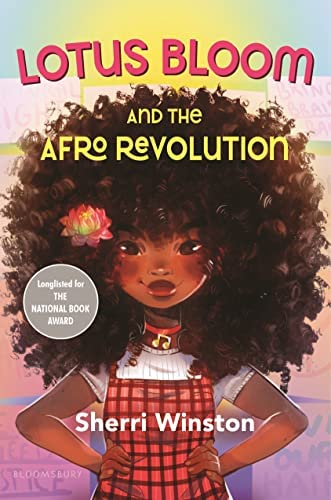
Lotus Bloom and the Afro Revolution by Sherri Winston

Published by Bloomsbury Children’s Books

Summary:  Lotus is a gifted violinist just starting at a new arts school.  Her best friend Rebel is still at their old, underfunded middle school, leading protests against the discrepancy between the two schools.  Lotus would rather keep the peace and focus on her music, but when the older boy she displaces as concertmaster starts bullying her, she finds it harder and harder to keep her temper.  Then the boy’s mother gets into the act by pressuring the school to threaten Lotus with expulsion if she doesn’t get rid of her Afro.  Torn between her politically active friend and her peace-loving mother, Lotus must learn to find her own way to express her views and navigate the path that is best for her.  304 pages; grades 4-7.

Pros:  Middle school kids will appreciate Lotus’s dilemma of wanting to speak up but being afraid to make waves.  I liked that ultimately she figured out what was right for her even though it was different from what Rebel was advocating.  This made the National Book Award longlist; the finalists were recently announced and can be found here.

Cons:  Lotus seemed stuck in inaction for a long time.

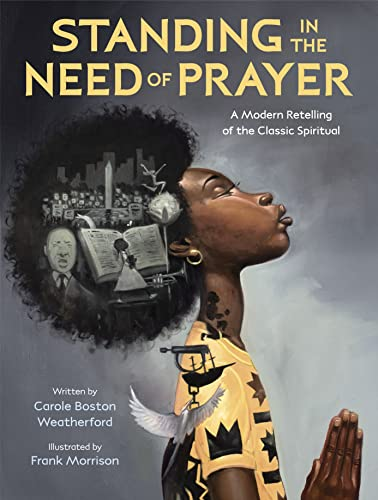
Standing in the Need of Prayer: A Modern Retelling of the Classic Spiritual by Carole Boston Weatherford, illustrated by Frank Morrison

Published by Crown Books for Young Readers

Summary:  Carole Boston Weatherford has created new words based on the traditional spiritual to trace the history of Black people in America.  Beginning with slavery, the verses and illustrations continue through Emancipation, the Great Migration, and the fights for integration.  The last few pages reflect the recent past and present: Florence Griffith Joyner, Colin, Kaepernick, and the Black Lives Matter Movement.  Includes additional information on each of the subjects, a list of online resources, and an author’s note.  32 pages; grades 1-5.

Pros:  Another beautiful resource for teaching Black history, with gorgeous thought-provoking oil illustrations.  The text, including the back matter, could serve as an excellent introduction to a variety of topics; readers can use the excellent list of online resources for further research.

Cons:  I wasn’t familiar with this spiritual and would have liked to have had the traditional words included somewhere.

Cornbread & Poppy by Matthew Cordell

Published by Little, Brown Books for Young Readers

Summary:  Cornbread is a mouse who likes to plan ahead, particularly when winter is coming.  His friend Poppy, on the other hand, prefers to live in the moment, having fun adventures, and not worrying about the future.  So when it starts to get cold, Cornbread is in good shape, but Poppy is not.  All the usual sources of food have already been foraged, so Poppy decides to go up Holler Mountain, a foreboding place rumored to have owls that hunt mice.  In fact, their friend Ms. Ruthie went up the mountain a few years back and was never seen again.  Cornbread is too good a friend to let Poppy go alone, so the two head off on their adventure together.  Without spoiling the ending too much, there is an owl, Ms. Ruthie is okay, Poppy ends up with plenty of food for the winter, and the two discover skiing…which Cornbread loves so much, he decides to ski instead of shoveling his walkway.  80 pages; grades K-2.

Pros:  Caldecott medalist Matthew Cordell proves himself an excellent writer in this beginning chapter book that has an engaging plot, adorable illustrations, and some pretty cozy winter scenes.  Book 2 came out in June; let’s hope there will be more.

Cons:  Seems as though Cornbread is picking up some bad habits from his friend.

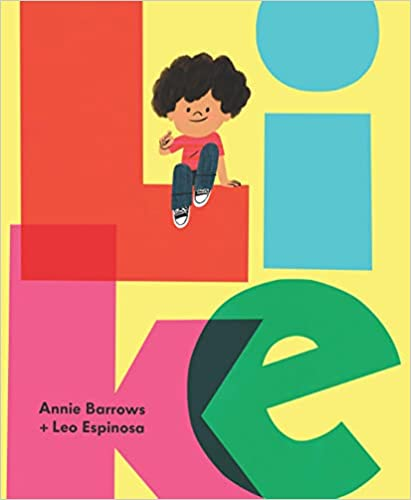
Like by Annie Barrows, illustrated by Leo Espinosa

Published by Chronicle Books

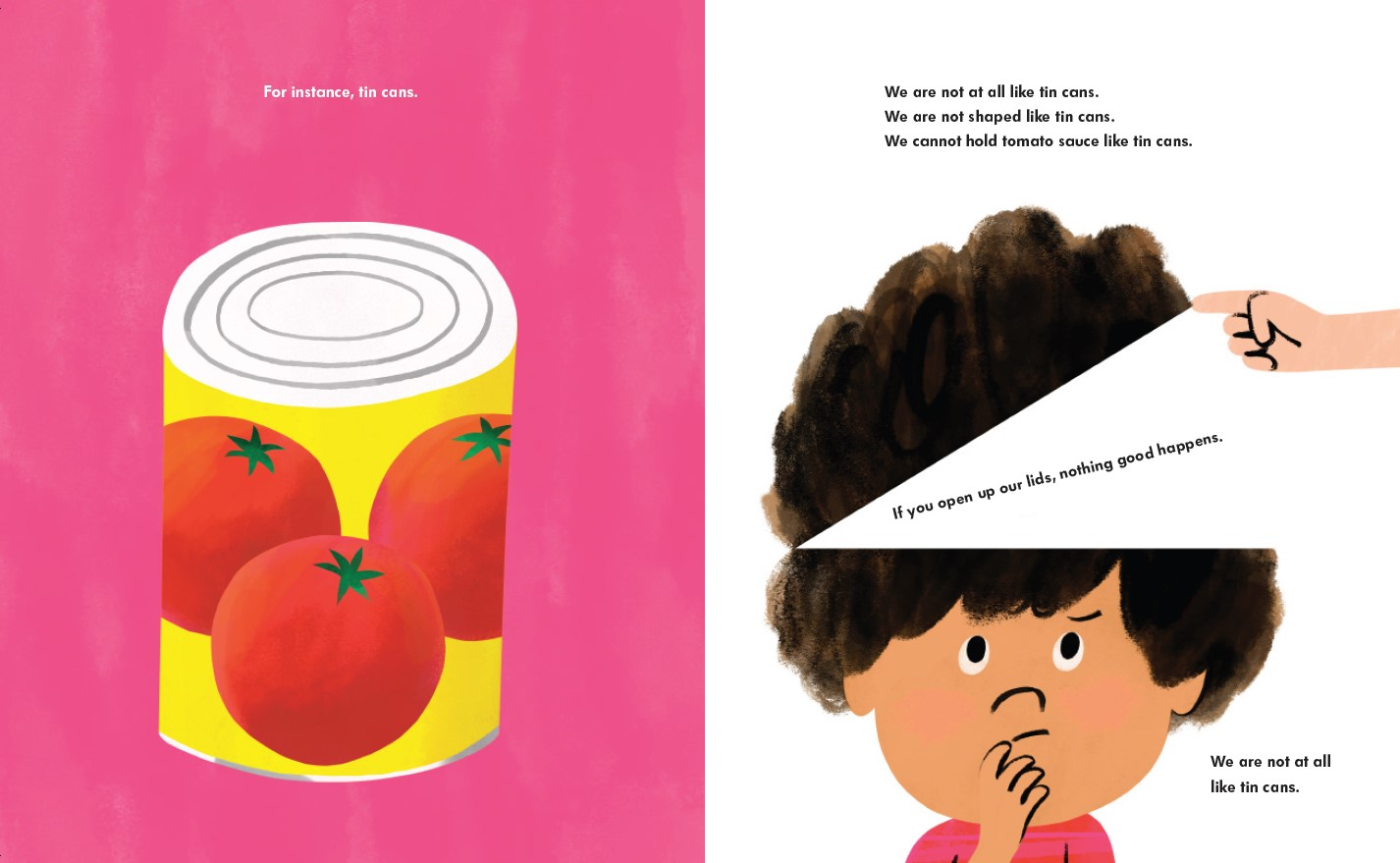
Summary:  We’re humans.  We’re different from most other things like tin cans, swimming pools, and excavators.  We’re a bit more like mushrooms, and even more like hyenas, but there are still plenty of differences.  For instance, hyenas don’t remember their birthdays, can’t plan a get-together, and might try to eat your baby brother if they come to your house.  Humans, on the other hand, remember their birthdays, wear clothing (usually), and get embarrassed (as well as feeling other emotions).  We may look different, but there is a lot more that is the same about us.  44 pages; ages 4-8.

Pros:  This quirky and thought-provoking book could serve as a good starting place to compare and contrast humans with all sorts of things…or with each other.  I love the illustrations by Leo Espinosa, who is quickly becoming one of my favorites.

Cons:  It takes a few pages to figure out where this book is going.

Giving Thanks: How Thanksgiving Became a National Holiday by Denise Kiernan, illustrated by Jamey Christoph

Published by Philomel Books

Summary:  Starting with a few thoughts about gratitude and how it’s expressed around the world, the book moves to the history of American Thanksgiving, with Sarah Josepha Hale’s campaign to create a national Thanksgiving holiday.  Abraham Lincoln finally agreed, declaring the holiday for November 26, 1863.  It was challenging to find much to be grateful for in the midst of the Civil War, but people celebrated and have continued to up to the present.  Turkey dinners, marching bands, and soup kitchens are all depicted as ways Thanksgiving is observed, and readers are asked to cite their own favorite parts of Thanksgiving.  Includes additional resources.  32 pages; ages 4-8.

Pros:  An excellent resource for those revisiting the history of Thanksgiving, as no mention is made of the Pilgrims or the Wampanoag.  It’s a good update to Thank You Sarah: The Woman Who Saved Thanksgiving by Laurie Halse Anderson (2002).  The excellent illustrations will serve as a good springboard for discussing kids’ heritages and traditions.

Cons:  It felt like the book tried to cover a lot of ground, making it feel a bit disjointed at times.

Boo! Hiss! By Cyndi Marko

Published by Aladdin

Summary:  Phyllis the ghost and Sheldon the snake have a pretty good life together in an old abandoned house, until–horrors!–a human family moves in.  The two of them flee to the attic where they make plans to take the house back again.  They start with the baby, who thinks they are a couple of fun toys, then move on to the older boy, who’s too absorbed in his book and science project to pay any attention.  Back in the attic, Phyllis and Sheldon get in a huge argument over who is scary or not scary, and the family hears lots of strange noises as a result, convincing them to move out.  Suddenly, the snake and ghost start to notice the humans’ more endearing traits and decide they’ve been wrong.  Their “un-scare plan” does the trick, and everyone settles back into the house–all together.  80 pages; grades 1-4.

Pros:  A cute graphic early chapter book that makes a perfect not-too-scary book just right for this time of year.  

Cons:  This seems like a great series starter, but I don’t see any evidence of book 2.

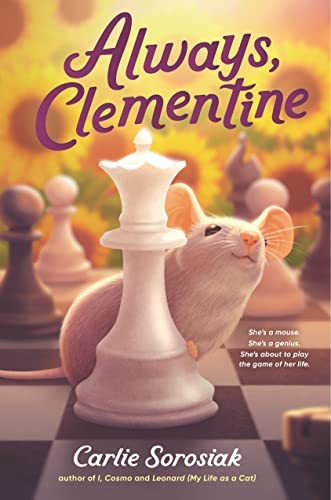
Always, Clementine by Carlie Sorosiak

Published by Walker Books US

Summary:  Clementine is a super intelligent mouse who has spent her whole life in the lab that bred her and several other mice.  Her closest friend is a chimpanzee named Rosie who also lives in the lab, and whom Clementine sneaks out to visit at night.  Told in a series of letters to Rosie, the story opens with a researcher named Felix stealing/rescuing Clementine and another identical mouse (he just wants Clementine but can’t tell the two apart) and leaving them in a mailbox.  This turns out to belong to a boy named Gus and his grandfather, Pop, who soon discover the mice.  As they get to know Clementine, they realize she is no ordinary mouse, and the APB alert from the lab that they see on TV helps them to understand more about her.  They also learn from the TV that the scientists plan to kill Clementine so that they can study her brain, and they begin to hatch a plan to rescue her, a plan that involves Pop’s background as a chess champion.  Freed from the lab, Clementine learns more about who she really is and how she can use her gifts to help herself and other animals.  Includes an author’s note with additional information about lab animals.  304 pages; grades 3-7.

Pros:  Starting with the adorable cover, this is a book that is sure to appeal to animal lovers and may turn some of them into activists.

Cons:  I felt like I never really got to know Rosie.

Maya’s Song by Renée Watson, illustrated by Bryan Collier

Published by HarperCollins

Summary:  Maya Angelou’s story is told in a collection of free verse poems, illustrated with watercolor and collage illustrations.  The story begins with her birth in 1928 and continues through her childhood spent in California, Arkansas, and Missouri, where “her mother’s boyfriend hurt her body, hurt her soul,” leading Maya to stop speaking for five years.  Her love of poetry helped her to recover her voice, and she went on to become a singer and then a poet, befriending James Baldwin, Martin Luther King, Jr., and Malcolm X.  Her memoir I Know Why the Caged Bird Sings brought her to national prominence; the story ends with her reading a poem at Bill Clinton’s presidential inauguration, fulfilling her grandmother’s prophecy that she would be a preacher and a teacher.  Includes a timeline and notes from the author and illustrator.  48 pages; grades 2-6.

Pros:  This amazing poetry biography is sure to be considered for multiple awards for both the writing and the illustrations.  I was immediately drawn into Maya Angelou’s story; Renée Watson is a masterful poet who tells the most difficult aspects of that story in a way that can be shared with young children.  The illustrations are gorgeous, layered with colors and patterns.

Cons:  No additional resources are given.

Farmhouse by Sophie Blackall 

Published by Little, Brown Books for Young Readers

Summary:  The story of a farmhouse and the family of 14 that lived there is told in one long rhyming sentence.  Starting in the front hallway, the action seamlessly transitions to the parlor (the “serious room”), the attic bedroom where all 12 kids sleep and dream, the barn with its prize-winning cows, the fields, and then back to the kitchen and dining room.  Things wrap up back in the front hall where the youngest child, now an old woman, waits for her sister to pick her up to “drive to the sea, which they’d always wanted to see.”  The farmhouse, now abandoned, settles and is taken over by animals and weather until Sophie discovers it, finding objects that spark her imagination and lead her to the creation of this book.  Includes an author’s note about her discovery of the farmhouse and creation of the illustrations. 48 pages; ages 4-104.

Pros:  There’s been a fair amount of buzz around this book, and I am here to tell you that it’s all true.  I got kind of emotional at the end, appreciating the circle of life that took place in this old farmhouse, and the way it inspired the creation of a beautiful work of art.  The note at the end made me go back and marvel at the details and layers of each illustration. To not consider this for a Caldecott would be a crime against the literary establishment.

Cons:  If you’re trying to teach kids not to write in run-on sentences, you may need to look elsewhere for a mentor text.