A Year of Good News: 52 Good News Stories from Around the World by Martin Smatana

Published by Boxer Books

Summary:  Martin Smatana began collecting good news stories during the pandemic, illustrating them with textile collages created from cast-off clothing.  Whether local, (a man who drove his 85-year-old grandmother 40,000 miles so she could see mountains and the ocean for the first time) or international (the eradication of polio in Africa), these 52 stories and pictures are designed to lift the spirits of those weighted down by all the less positive news in the world.  Includes a QR code that takes you to a website with additional good news stories.  112 pages; ages 7 and up.

Pros:  These happy stories and whimsical illustrations will lift anyone’s spirits and send readers on a search for more news that is positive.

Cons:  While I appreciated the human-interest stories, I would have liked to have seen a few more stories with broader scope like the polio one.
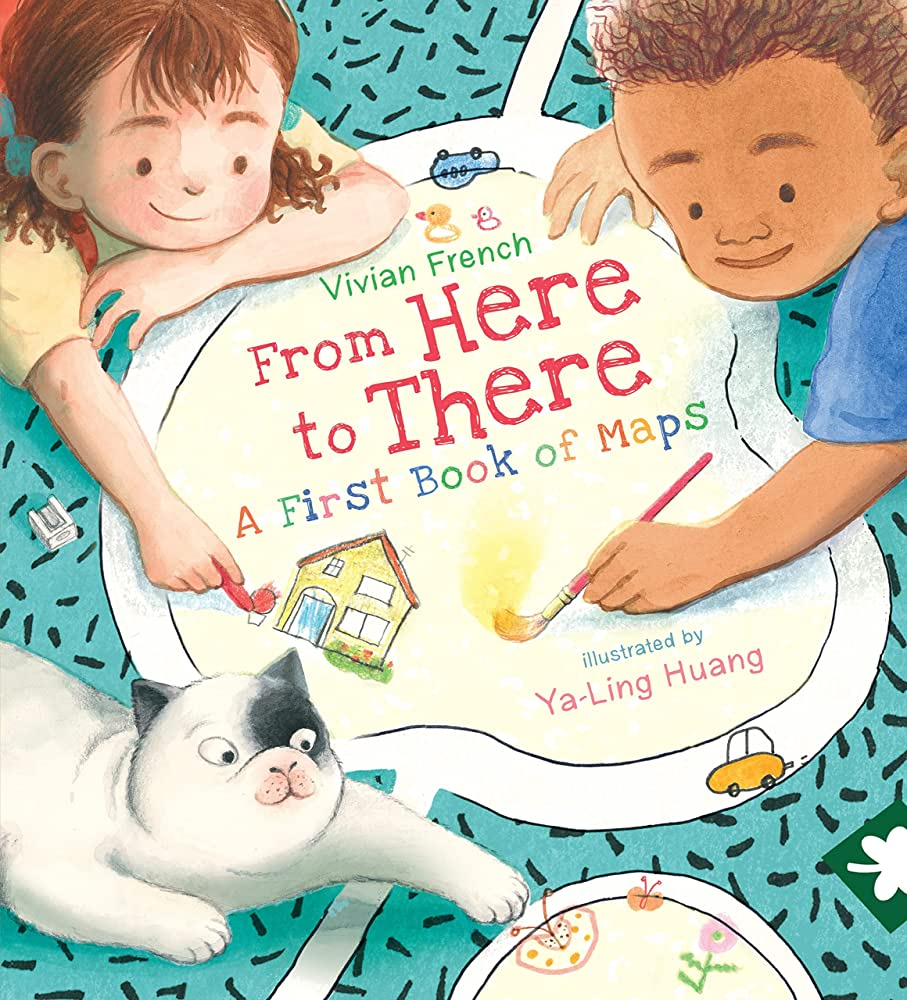
From Here to There: A First Book of Maps by Vivian French, illustrated by Ya-Ling Huang

Published by Candlewick

Summary:  When Zane sends Anna an invitation to his house with a map included, she’s annoyed that his house is in the middle of the map and hers is at the edge.  Dad suggests drawing her own map, but when Anna tries to include Grandma’s house, she runs out of paper.  Dad introduces her to the concept of a bird’s-eye view.  Once that map is completed, she draws one of her cat’s favorite places in the house, and Dad shows her a different kind of map he’s drawn: a family tree.  The next day, Anna and Dad follow Zane’s map to get to his house for the playdate.  Includes information about making your own map and an index with six terms.  32 pages; ages 4-8.

Pros:  Since maps are part of our kindergarten curriculum, I know there aren’t a lot of good introductory books for younger kids.  This book does a great job of expertly weaving map terms like scale and point of view into the story and encouraging readers to try to create their own maps.

Cons:  Introducing the family tree seemed a little confusing when all the other maps were about places.

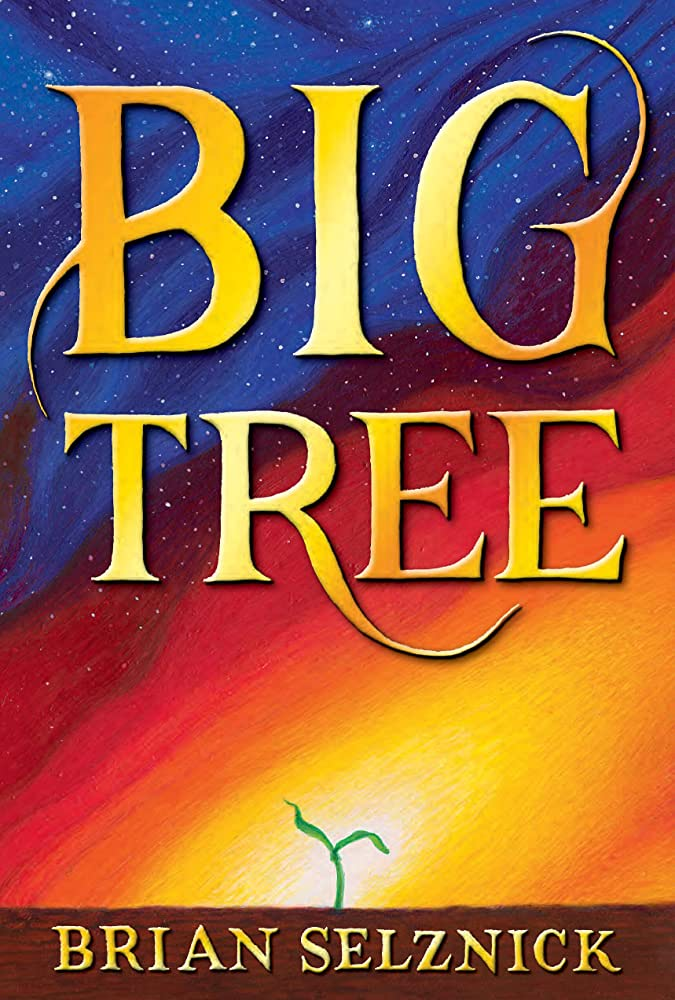
Big Tree by Brian Selznick

Published by Scholastic

Summary:  Melvin and Louise are two seeds nestled cozily in a seedpod, secure in the love and wisdom provided by their mother, a giant sycamore tree.  A natural disaster flings them into the world, where they travel over land and sea, meeting all kinds of wise and wonderful creatures.  While their mother sought to give them both roots and wings, imaginative Louise is filled with wonder and hope, while Melvin is bound by his worries and fears.  When the two are separated, Melvin finds himself trapped for many, many years, never forgetting his sister.  Eventually he learns the lessons of the universe that Louise already instinctively knew, and the two meet again in a wondrous reunion.  Includes an afterword that explains some of the scientific references, a bibliography, and an author’s note that tells how the story came to be.  528 pages; grades 3-7.

Pros:  Brian Selznick has created a masterpiece of prose and art in the style of his previous books.  This book was inspired by a movie idea that Steven Spielberg had, looking at the history of the Earth from the perspective of nature itself.  It is a wildly creative and ambitious story that includes dinosaurs, volcanoes, meteors, dinosaurs, mushroom ambassadors, and so much more.  

Cons:  Readers might need some guidance to understand all that is going on during this long period of Earth’s history.  The back matter is a useful guide for this.

Harmony & Echo: The Mermaid Ballet by Brigette Barrager

Published by Random House Studio

Summary:  Harmony and Echo are mermaid best friends who love collecting sea glass, reading fairy tales, and daydreaming.  But while Harmony is a carefree young mermaid who loves to have fun, Echo is more anxious, often worrying about details of her life.  The upcoming ballet performance has her stressed, so Harmony comes up with a solution: if Echo is feeling nervous during the show, she should reach over and squeeze Harmony’s hand.  On the big night, Echo begins to worry, but once she starts dancing, she’s fine.  The two mermaids hold hands for their final bows and agree to use the hand squeeze in the future as their secret way to calm Echo’s fears.  40 pages; ages 4-8.

Pros:  There can never be enough mermaid books, and the cover alone will have it flying off the library shelves.  Brigette Barrager is the Uni the Unicorn illustrator and works her magic with the underwater scenes and mer-world.

Cons:  Echo might want to seek out a mer-therapist to complement the hand-squeezing technique.

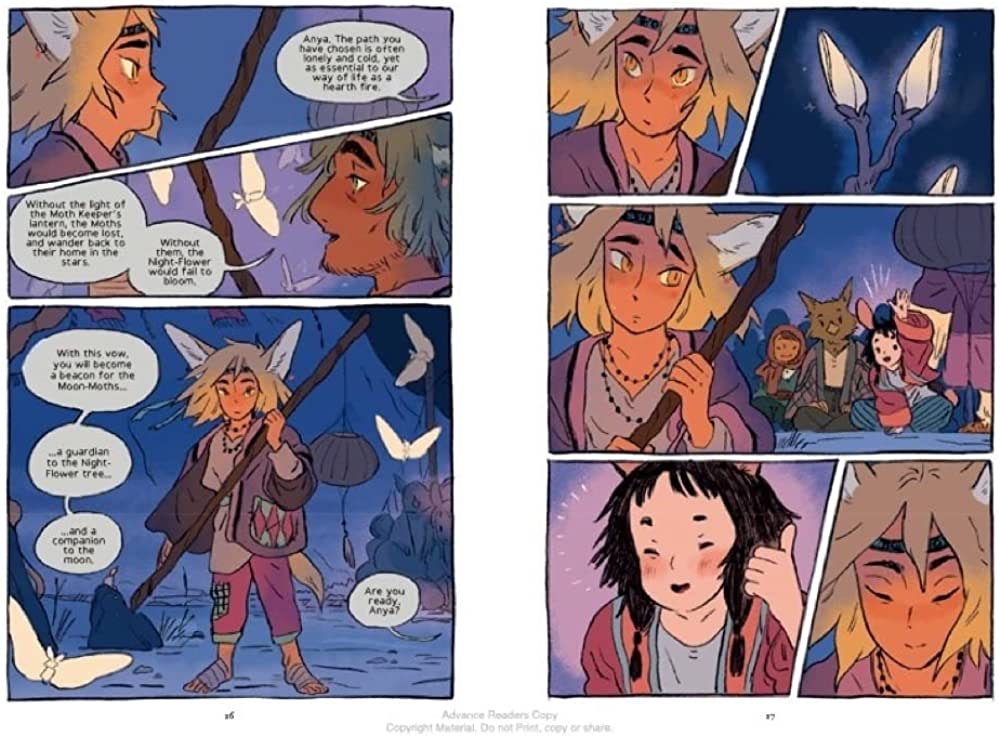
The Moth Keeper by K. O’Neill

Published by Random House Graphic

Summary:  Long ago, a community formed in the desert to live their lives at night and keep the Moon Spirit company.  In return, the Spirit gave them a special tree that made their lives easier.  The tree had to be pollinated once a year by Moon-Moths.  Now Anya has become an apprentice Moth Keeper, going out every night into the desert, sometimes with her guardian Yeolen and sometimes alone.  Anya had a tough childhood, seen in flashbacks, and she sometimes fears the dark and longs to spend her days in the daylight.  But when she causes a near-catastrophe with the moths, she realizes the importance of her community and her role in it.  Helped by them, she’s able to correct her mistake and finds new beauty and connection in her nightly work.  272 pages; grades 4-8.

Pros:  The gorgeous illustrations make this fantasy tale one that readers will want to revisit over and over again.  K. O’Neill has created a magical world filled with mystery, beauty, and a tight-knit, loving community.

Cons:  Be sure to spend plenty of time on the wordless pages of the book to fully understand the story. I found myself confused more than once.

Becoming Charley by Kelly DiPucchio, illustrated by Loveis Wise

Published by Knopf Books for Young Readers

Summary:  While the other caterpillars keep their heads down and eat milkweed the way they’re supposed to, Charley likes to look up at the trees and the clouds and the stars.  The caterpillars are taught to focus on the orange and black patterns that will one day make them into monarch butterflies, but Charley often gets distracted by the beautiful things all around him.  He’s excited when it’s time to form his chrysalis but once inside, he’s unsure of what to do.  Orange and black, right?  But Charley can’t help remembering the blues and yellows of the birds and sun.  As summer moves on, the other butterflies start to emerge, but Charley’s chrysalis remains unchanged.  “I’m not surprised,” says one of the older butterflies.  Then, finally, here comes Charley, but instead of black and orange he’s a unique, colorful montage of all the things he has ever loved.  40 pages; ages 4-8.

Pros:  The beautiful illustrations show the colorful world that Charley loves, and the story celebrates those who don’t always quite fit in or follow the rules.

Cons:  I love the message, but I thought it could have been delivered with a lighter touch, like Kelly DiPucchio did in Gaston, one of my favorite books to read to kids.

Simon Sort of Says by Erin Bow

Published by Disney Hyperion

Summary:  Simon and his parents have moved to Grin and Bear It, Nebraska, a small town in the National Quiet Zone, a place where there’s no internet to help astronomers better listen for sounds of life in outer space.  While most seventh graders would rebel about this, Simon is happy to hide away two years after he was the sole survivor of a school shooting.  It’s hard to blend in, though, when his mom’s the unconventional town undertaker and his dad is a sackbut-playing Catholic deacon dealing with what comes to be known as the Jesus squirrel, and before long Simon has two interesting new friends, Kevin and Agate.  Agate has a plan to give the scientists the extraterrestrial contact they’ve been looking for.  When Simon’s identity is discovered by his new town, he hopes that helping Agate will result in some even bigger news that will draw the attention away from him and his family.  Their plan kind of works, but all kinds of complications result in a satisfactory, if unexpected, ending.  320 pages; grades 5-8.

Pros:  I would not have thought it possible to write about the aftermath of a horrific school shooting with a light touch and one-of-a-kind characters, but Erin Bow pulls it off magnificently in an unforgettable novel that should be considered for all kinds of awards.

Cons:  I wish this book did not feel so timely.

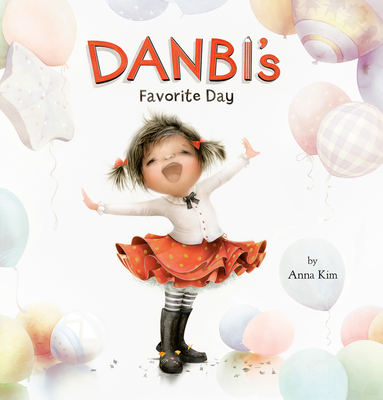
Danbi’s Favorite Day by Anna Kim

Published by Viking Books for Young Readers

Summary:  In this follow-up to Danbi Leads the School Parade, Danbi is excited to celebrate Children’s Day.  “Back in Korea,” Danbi tells her friends when she invites them to the celebration, “it’s the day when all your wishes come true.”  But Danbi’s parents, who have to work at their deli, can’t host a big party. Her mother reminds her that Children’s Day is “about celebrating the children on Earth who will one day lead the world.”  They compromise with a party behind the deli, and all the children arrive on the big day.  There’s dancing and drawing with sidewalk chalk until a sudden storm sends everyone inside.  Danbi is sure the party is ruined, but her parents give the kids permission to eat whatever they want from the deli, and that, combined with her mother’s special rainbow cake, makes Children’s Day a true celebration of children.  40 pages; ages 4-8.

Pros:  The story and illustrations convey the joyful energy Danbi seems to bring to all aspects of her life and can serve as a good introduction to the Children’s Day holiday.

Cons:  No additional information about Children’s Day.

A Girl Can Build Anything by e. E. Charlton-Trujillo and Pat Zietlow Miller, illustrated by Keisha Morris

Published by Viking Books for Young Readers

Summary:  Girls and women in these pages learn to build increasingly larger, more complex objects.  First, it’s a box or birdhouse, then they move on to designing a trellis, a table, and a treehouse for a new playground.  There can be setbacks when projects don’t go as planned, but taking a break and starting again can get you where you want to go.  By the end, a team of women has created a new building at the entrance of the playground.  32 pages; ages 4-8.

Pros:  The cheery text and illustrations provide an empowering introduction to get girls (and boys) excited about learning to use tools and building their own projects.  

Cons:  That it still seems like something of a novelty for girls and women to be using tools and building things.

The Book of Turtles by Sy Montgomery, illustrated by Matt Patterson

Published by Clarion Books

Summary:  Naturalist Sy Montgomery writes engagingly about turtles, starting with descriptions of their anatomy and evolution.  She describes turtle species who hold the records for most colorful, stinkiest, fastest, largest, and more.  There are celebrity turtle profiles and information on how turtles communicate.  Turtles, protected by their shells, have survived for more than 200 million years, but now many species are endangered due to human activities.  The final few pages tell readers different ways they can help them survive.  Includes a glossary, bibliography, and list of resources.  40 pages; grades K-4.

Pros:  Montgomery has a knack for focusing on facts and information that will be of most interest to readers.  The acrylic paintings look almost like photos and show incredible details of a wide variety of turtles.  Kids who already love turtles will be thrilled, and others may become fans after reading this book.

Cons:  I wish this book had been around during my daughter’s decade-long obsession with turtles.