The final leg of my trip took me back to Tennessee, first to Memphis and then to Nashville. I had a few issues with my accommodations in Memphis (let’s just say that I ended up repairing my Airbnb’s toilet with a piece of dental floss), so I only stayed one night instead of two.


I kicked off the morning with a visit to the National Civil Rights Museum. The website said to allow 1.5 hours, so I was there when the doors opened at 9:00, because I was meeting a friend for lunch at 11:00. I wished I had allowed more time, as I was hurrying through the last exhibit and didn’t get to visit the other buildings. Of all the museums I visited, this one had the most comprehensive history of the civil rights movement, and I would recommend putting aside at least two hours if you go.


I walked down Beale Street in Memphis and had plans to visit Sun Studio and Stax Records that afternoon, but honestly, I just wasn’t in the mood. Next time. I did take in some music history in Nashville, where I met up with my daughter Katherine. I benefited from her encyclopedic knowledge of music at the Country Music Hall of Fame and the National Museum of African American Music, and we both enjoyed our night at the Grand Ole Opry.
I’m going to briefly return to the beginning of the week to mention one other Nashville site I visited. It was July 4th, I had just realized that most places were closed, and I was trying to figure out how to spend the day. As I looked for a place to eat breakfast, I realized that I was near The Hermitage, home of U.S. President Andrew Jackson. I’m not a fan, but keeping in mind what I’ve been reading about public history in How the Word Is Passed (mentioned in yesterday’s Mississippi post), I decided to go to see how Jackson was portrayed at his homestead.
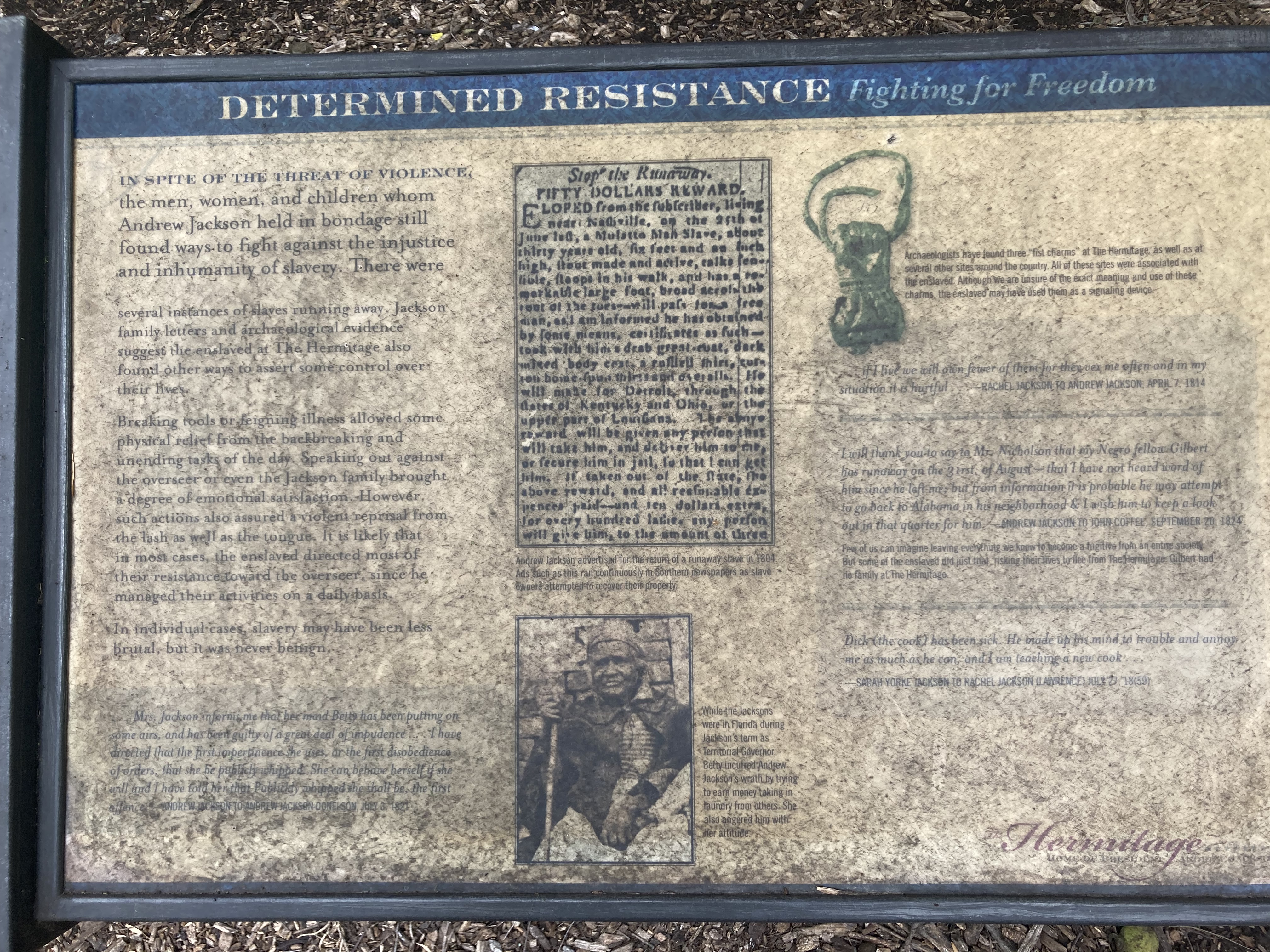

Unlike most places I went (except the Museum of the Mississippi Delta and the Grand Ole Opry), there was pretty much an all-white crowd, many dressed in red, white, and blue for the Fourth. I took the guided tour of the house, then walked around the grounds to the slave quarters. Compared to what I saw the next day at the Legacy Museum, slavery was portrayed in a pretty benign light, with Jackson represented as a man who tried to provide well for the enslaved people on his property. Interestingly, a sign describing slave life was half-hidden by an open door, and another one called “Determined Resistance” was covered by plastic so dirty and scratched it was difficult to read.
I include this, because as I traveled through the South for a week, I kept thinking about how history is the stories we tell, whether we are telling them to our children, to our students, or to ourselves. The stories can shine a light on certain people and events and keep others hidden away in the dark. They inform the way we move forward into the future, helping us decide who we want as leaders and which groups of people we want to lift up or to oppress.
One night in Alabama, looking for some comfort food after a long day, I stopped at an Applebee’s for dinner. My waitress was a young Black woman, cheerful but exhausted at 8 1/2 months pregnant. She told me that she was having a girl, and I asked her if she had a name picked out. Sincere, she said, a name she had chosen with her girlfriends years ago when they were back in school.
I’m sure Sincere has arrived by now, and I think of her, a Black girl growing up in Alabama, her mom full of hopes and dreams, working hard to support her. I hope Sincere can grow up learning the truth about her history, but also knowing the pride in her heritage, and with the confidence to pursue her dreams. And I know that if she does, it will be because of people like those Mississippi legislators who fought for more than a decade to get their civil rights museum, or the workers who replaced Emmett Till’s bullet-ridden sign for the fourth time, or the people (maybe you?) who write and promote books and fight to keep them in schools and libraries so that they can tell the truth about the past and offer hope for the future.
Books about Tennessee
Civil Rights
Evicted! The Struggle for the Right to Vote by Alice Faye Duncan (Calkins Creek, 2022)
Memphis, Martin, and the Mountaintop: The Sanitation Strike of 1968 by Alice Faye Duncan (Calkins Creek, 2018)
Martin Rising: Requiem for a King by Andrea Davis Pinkney (Scholastic, 2018)
Chasing King’s Killer: The Hunt for Martin Luther King Jr.’s Assassin by James L. Swanson (Scholastic, 2018)
Music
Elvis: The Story of the Rock and Roll King by Bonnie Christensen (Henry Holt, 2015)
Swing Sisters: The Story of the International Sweethearts of Rhythm by Karen Deans (Holiday House, 2015)
We Rock! (Music Lab): A Fun Family Guide for Exploring Rock Music History by Jason Hanley (Quarry Books, 2015)
Muddy: The Story of Blues Legend Muddy Waters by Michael Mahin (Atheneum Books for Young Readers, 2017)
The Roots of Rap: 16 Bars on the 4 Pillars of Hip-Hop by Carole Boston Weatherford (little bee books, 2019)
Elvis Is King! by Jonah Winter (Schwartz and Wade, 2019)
 A Kids Book A Day
Janet,
Thank you so much for sharing your trip to the South and your extensive list of resources. Such an important journey! Looking forward to hearing more about it sometime at a Kid Lit gathering.
LikeLike