If I Was a Horse by Sophie Blackall

Published by Little, Brown Books for Young Readers

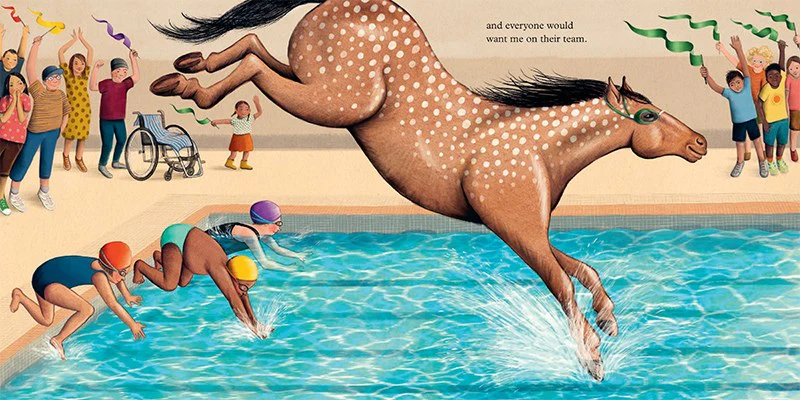
Summary:  The narrator imagines life as a horse, with more freedom to do things like not take a bath, not wear clothes (unless he was in a parade), and getting to go wherever he wants.  He would still enjoy some of the comforts of home, coming into the kitchen when he got hungry and giving his sister a ride to school.  It would be fun to roll in the mud, and the swim team would be thrilled to have him.  The last wordless page shows a boy giving his sister a piggyback ride, revealing the human narrator.  32 pages; ages 4-8.

Pros:  An ode to the power of pretending, gorgeously rendered with Sophie Blackall’s imaginative illustrations.

Cons:  I assumed this would be one of my Caldecott contenders, but it didn’t quite rise to that level for me.
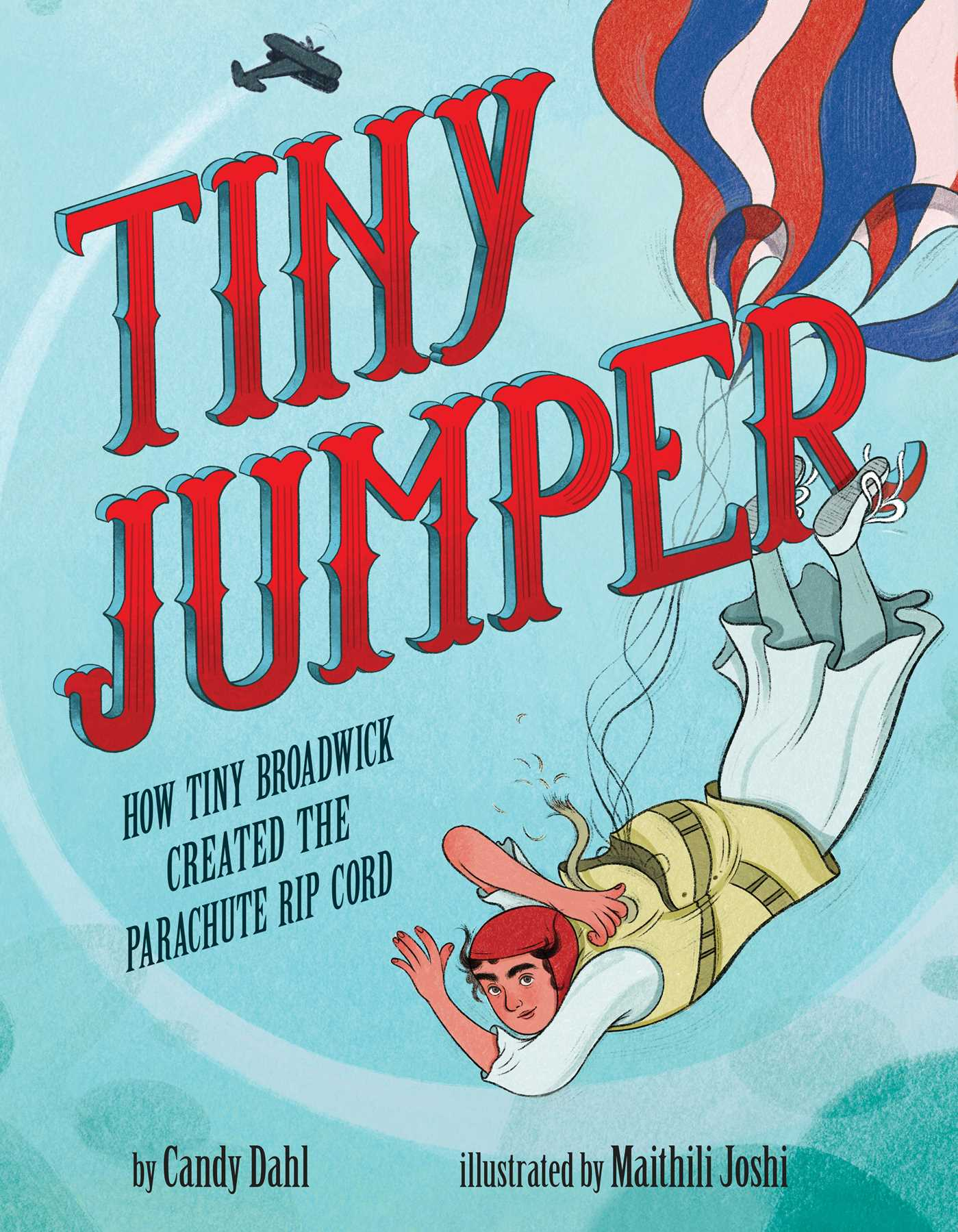
Tiny Jumper: How Tiny Broadwick Created the Parachute Rip Cord by Candy Dahl, illustrated by Maithili Joshi

Published by little bee books

Summary:  Georgia Ann Thompson only weighed three pounds when she was born in 1893.  She would remain Tiny all her life, both her stature and her nickname.  Forced to start working in factories at the age of 6, Tiny escaped by climbing trees and dreaming of the future.  When she saw a man parachute off of a hot air balloon at the 1907 North Carolina State Fair, she told the aeronaut that she must learn how to do the same thing.  Her determination paid off, and by the 1908 State Fair, she had become a parachutist.  She thrived in her career despite odd landing spots and multiple broken bones.  When airplanes arrived, Tiny became the first woman to parachute from a plane.  In one attempt, the line connecting her to the plane got tangled.  She cut herself loose, going into free fall until she was able to reach behind her and pull the cord that would open her parachute, inadvertently creating the first ripcord.  Includes an author’s note with additional information and photos of Tiny, as well as a bibliography.  40 pages; grades 1-4.

Pros:  A thrilling adventure story about a little-known woman whose courage and determination made her an early aviation pioneer.  

Cons:  I thought from the title that Tiny invented the ripcord, but it seems as though someone else developed it from her accidental innovativeness.

It’s Fall! By Renée Kurilla

Published by Little, Brown Books for Young Readers

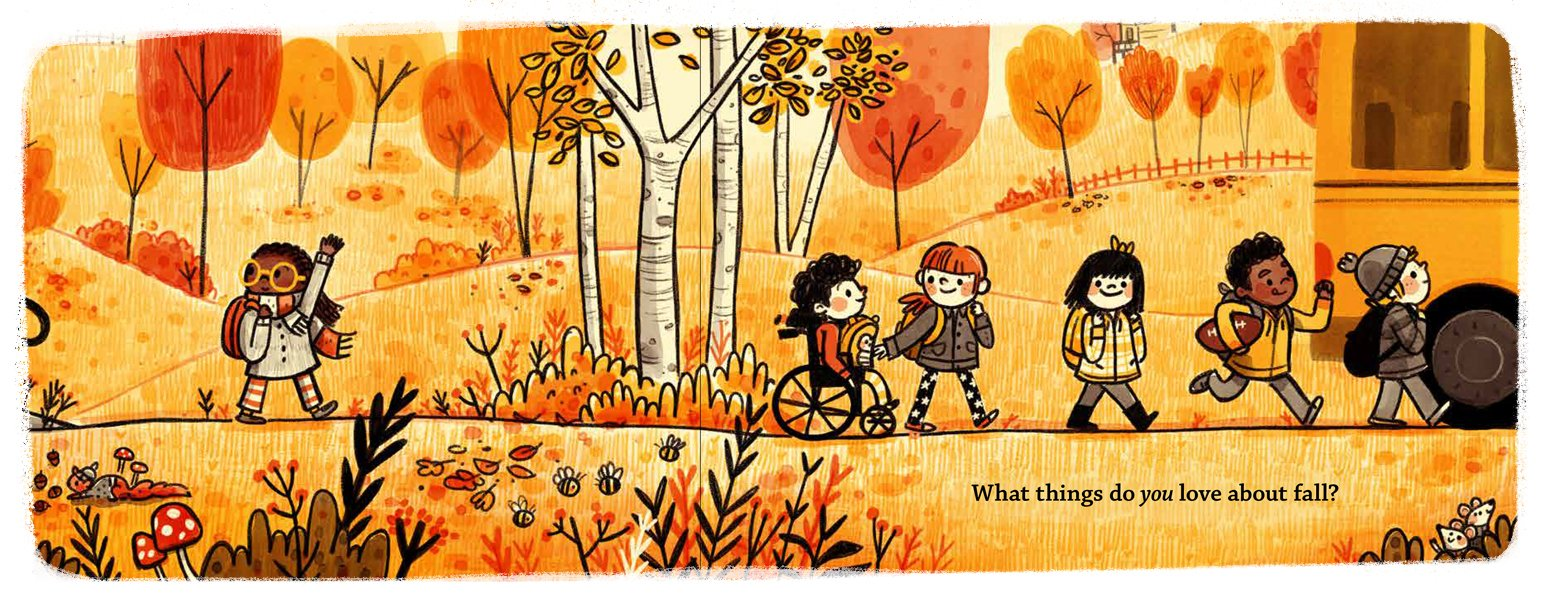
Summary:  Fall is introduced with rhyming text and lively illustrations.  A diverse group of kids, who appear to be in a class together, enjoy apple picking, pumpkin carving, Halloween, and Thanksgiving.  The illustrations reflect the season, with their predominantly yellow, orange, and red shades.  Be sure to check out the endpapers for kid-style drawings of their favorite fall things.  Between that and the question on the last page: “What things to you love about fall?” kids should be ready to write and draw about the season.  32 pages; ages 3-8.

Pros:  Preschool and kindergarten teachers will be thrilled to see this bouncy introduction to the simple joys of autumn with plenty of material to get kids thinking about what they enjoy about fall.

Cons:  I don’t see similar books about the other seasons, although this is listed on Amazon with a parenthetical “Celebrate the Seasons, 1”, so we can hope they’re on their way.

Wildfire by Breena Bard

Published by Little, Brown Ink

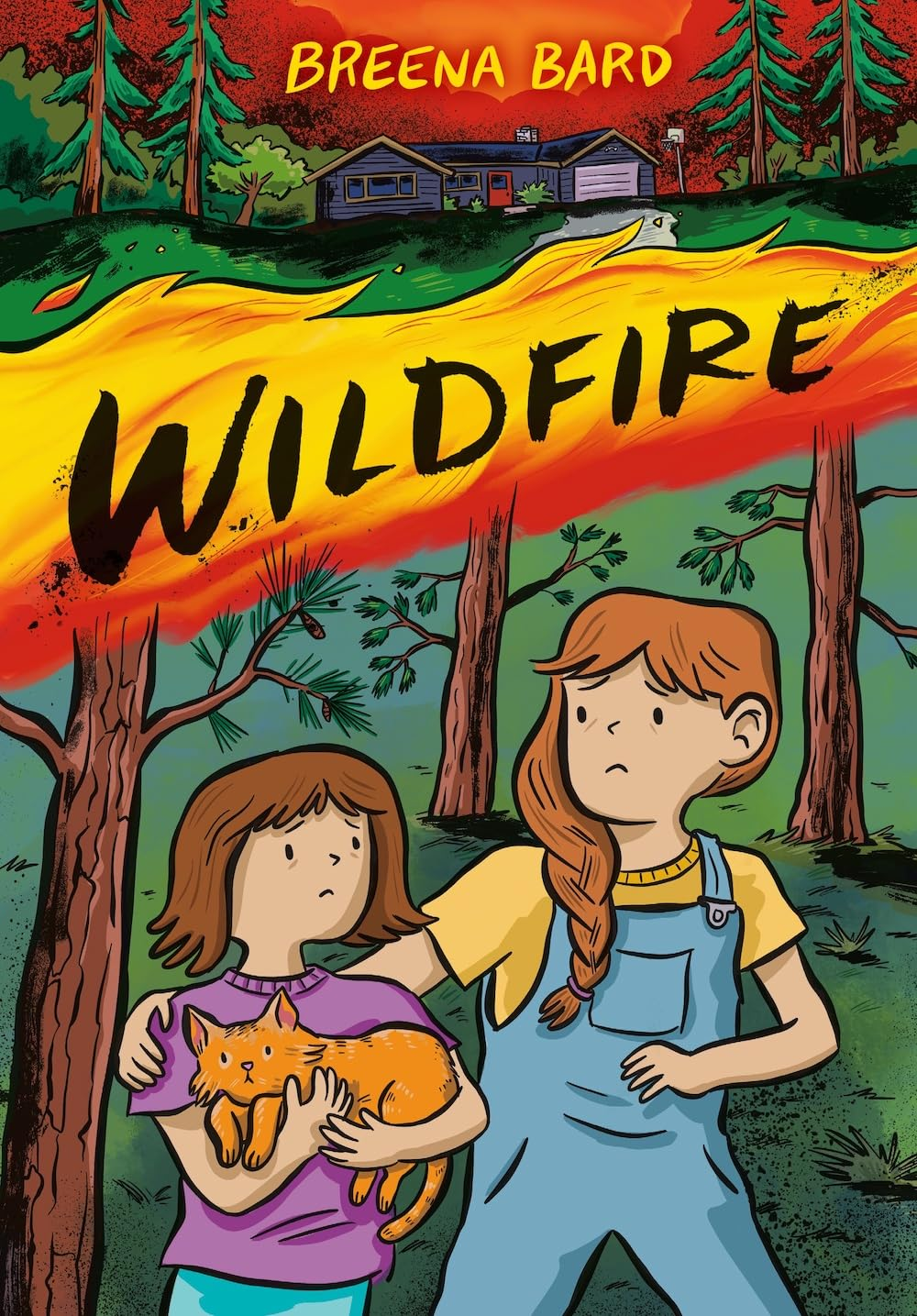
Summary:  Julianna’s heading home from a 4-H meeting near her home in rural Oregon when she runs into her ex-friend Carson with a group of boys bragging about some fireworks they have.  She tells them not to set them off due to the fire warnings in the area, but they ignore her.  Later, she and her family face a sudden evacuation from their home when wildfires sweep into the area.  They escape with their pet cat and goats, but their home is destroyed.  Weeks later, they’re starting over in Portland, Julianna starting eighth grade at a new school.  She finds new friends through an environmental club but is dismayed when Carson shows up.  As she and her family work through their anger and grief about all that they’ve lost, she begins to talk to Carson and discovers his guilt and shame about his role in the fire.  While she can’t bring herself to call him a friend, she’s able to understand and forgive him for what happened that day and to figure out a way to make a difference in a scary and uncertain world.  Includes an author’s note about her own experiences with Oregon wildfires and climate change and a list of additional resources.  288 pages; grades 3-7.

Pros:  An excellent graphic novel that deals with issues that are unfortunately timely and shows the emotions that go with facing the destruction of climate change.  Julianna and Carson have a lot to deal with, and Carson is portrayed sympathetically despite his disastrous choice.

Cons:  I started to get a bit frustrated with Julianna’s parents who seemed slow to recognize how devastating an experience this was for her.

CowPiggy (Shelley Frankenstein, Book 1) by Colleen Madden

Published by Top Shelf Productions

Summary:  Shelley Frankenstein is inspired by her famous ancestor, Dr. Frankenstein, and the monsters he created that still live with the family.  Pairing up with her little brother Iggy, she takes apart toys and sews them back together.  But her cronkey (crocodile-donkey) and shark kitty are failures, with the kids at school falling in love with what they consider adorable new animals.  Finally, the Frankensteins make CowPiggy.  When he’s deemed the cutest of all, Shelley gets the monsters to train him to be scary.  Their work pays off, but CowPiggy ends up scaring himself and running away.  When Shelley goes after them, they discover a community of bunnies who teach them a thing or two about being scary–and about being scared.  Returning home, CowPiggy embraces his adorable nature, and Shelley learns to love him exactly how he is.  168 pages; grades 3-6.

Pros:  Kids who enjoy a creepy atmosphere that has more laughs than screams will get a kick out of this graphic novel that features a cast of cute critters and pays homage to Mary Shelley’s Frankenstein.

Cons:  Those expecting something scarier may be disappointed.

Extra Normal by Kate Alice Marshall

Published by Viking Books for Young Readers

Summary:  Charlie Greer is the only “normal” kid in her family, with adoptive siblings that include a sister who’s a ghost and brothers who are telekinetic and a werewolf.  Both her mom, who has magic powers, and her dad, who does not, work for a paranormal investigative agency, and have been feeling increasingly burned out by their work and home responsibilities.  Charlie has decided that her power is being the responsible one, so when her parents take off for a short vacation, she vows to leave them alone, even when a mysterious family moves in across the street and neighbors start to disappear.  Soon it appears that all the Greer kids are in danger, leaving them to use their magic to save themselves, even Charlie, who discovers that even being normal can carry with it a certain superpower.  240 pages; grades 4-7.

Pros:  Elementary horror fans will love this spooky story which also delivers a good message about embracing who you are and not taking the weight of the world upon your shoulders.

Cons:  Horror is one of my least favorite genres, so October’s not really my favorite month. If you’re a fan, however, stay tuned.

The Snow Man by Jonah Winter, illustrated by Jeannette Winter

Published by Beach Lane Books

Summary:  When he first came to the mountain, he lived in an abandoned shack with no electricity or running water.  Eventually, he built himself a house with solar panels and a greenhouse.  Boredom drove him to start measuring and recording the natural world around him: snowfall, the return of animals in the spring, the first wildflower blossoms.  In between, he would chop wood, watch movies, and ski to town and back for supplies (800 miles every winter).  He stayed for many years and began to notice patterns: less snow, earlier springs.  When he shared his information with a scientist, the scientist was amazed at his painstaking records that showed the patterns of climate change.  Older now, he no longer chops wood or skis, but he continues his record-keeping on animals, plants, and–for now–snow.  Includes additional information about billy barr, a man who has spent most of his life living a solitary existence in the Rocky Mountains of Colorado; also, a short list of additional resources. 40 pages; ages 4-8.

Pros:  A fascinating story about a man who chose an unconventional path in life but has found a way to make a difference in the world, observing climate change before much of the rest of the world did. 

Cons:  The story is a little confusing without the context given in the author’s note, so you might want to read that first.

Ethan and the Strays by John Sullivan, illustrated by Hatem Aly

Published by Simon and Schuster/Paula Wiseman Books

Summary:  When Ethan and his big brother Sam discover three stray cats on their way to school, Ethan wonders if they could take them home.  “You know Dad said no pets,” Sam reminds him.  Ethan worries about the cats when the weather gets colder, despite the research Sam helps him do about how strays survive.  When the boys see a sign advertising a Trap-Neuter-Return campaign, they visit the animal clinic to learn what to do.  Not only do they trap the cats and take them to the clinic to be neutered, but Sam gets three outdoor cat shelters.  When the time comes to return the cats to their street, one of them seems to want to stay with the kids.  They decide to take her home to ask their dad, and the last page shows Dusty and Ethan curled up together on his bed. Includes an author’s note with additional information about strays and Trap-Neuter-Return (TNR). 32 pages; ages 4-8.

Pros:  Ethan is a kind-hearted protagonist who finds a way to make a difference in his community and gets a cute pet in the process.  The information about TNR is woven into the story without coming across as preachy, and the illustrations will make readers take Ethan, Sam, and the cats to heart.

Cons:  It seemed like a bit more adult supervision was warranted.

There Was a Party for Langston by Jason Reynolds, illustrated by Jerome Pumphrey and Jarrett Pumphrey

Published by Atheneum/Caitlyn Dlouhy Books

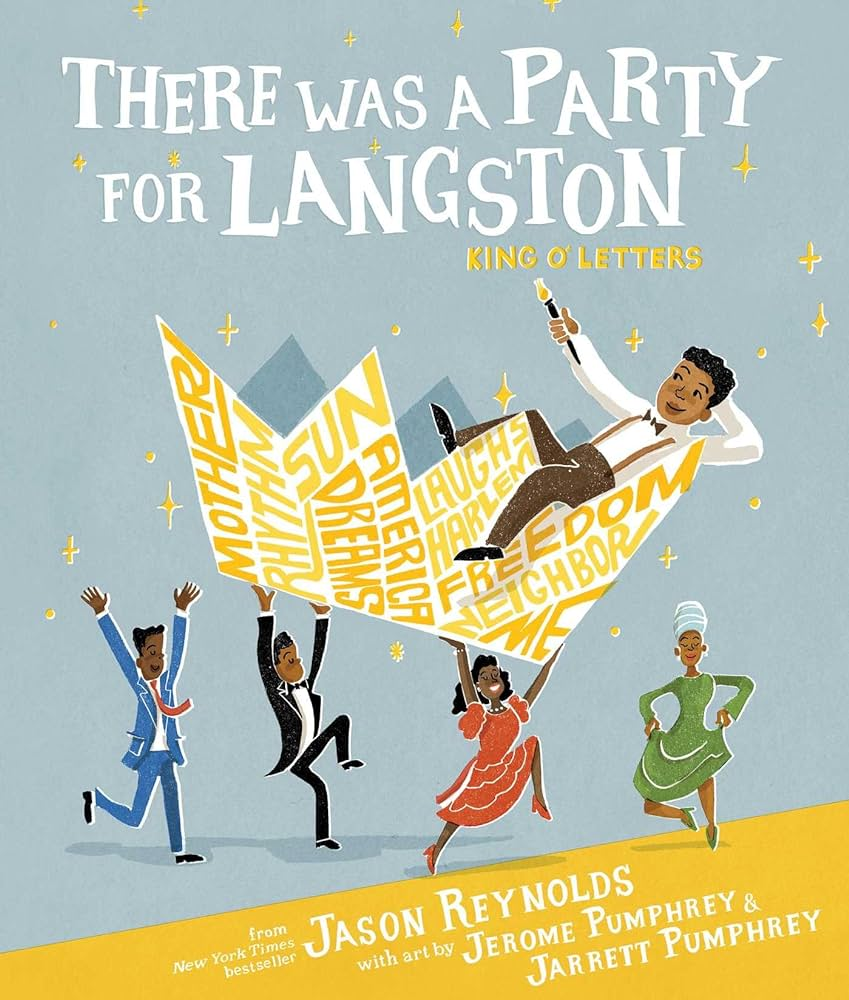
Summary:  When Jason Reynolds saw a photo of two of his favorite poets, Maya Angelou and Amiri Baraka, dancing at a party in honor of his all-time favorite Langston Hughes, he was inspired to write this ode to the three of them and their poetry.  They laughed at those who tried to ban their books or break their words, and those words are woven into the illustrations of the party held at the New York Public Library’s Schomburg Center in 1951.  Other stars of the Black literary world peek out from their books on the library shelves, arranged alphabetically from James Baldwin to Richard Wright.  Includes an author’s note with the photo of Maya Angelou dancing with Amiri Baraka.  56 pages; grades 2-5.

Pros:  One of the most anticipated books of the year, here’s the picture book debut of beloved author Jason Reynolds, illustrated by the inimitable Pumphrey brothers.  Sure to be a Caldecott contender.

Cons:  There were so many allusions in this book to people (like Amiri Baraka) and poems that I didn’t know about.  I wish that the author’s note had been at the front and that there had been a list somewhere of poems referenced in the book.

Things In the Basement by Ben Hatke

Published by First Second

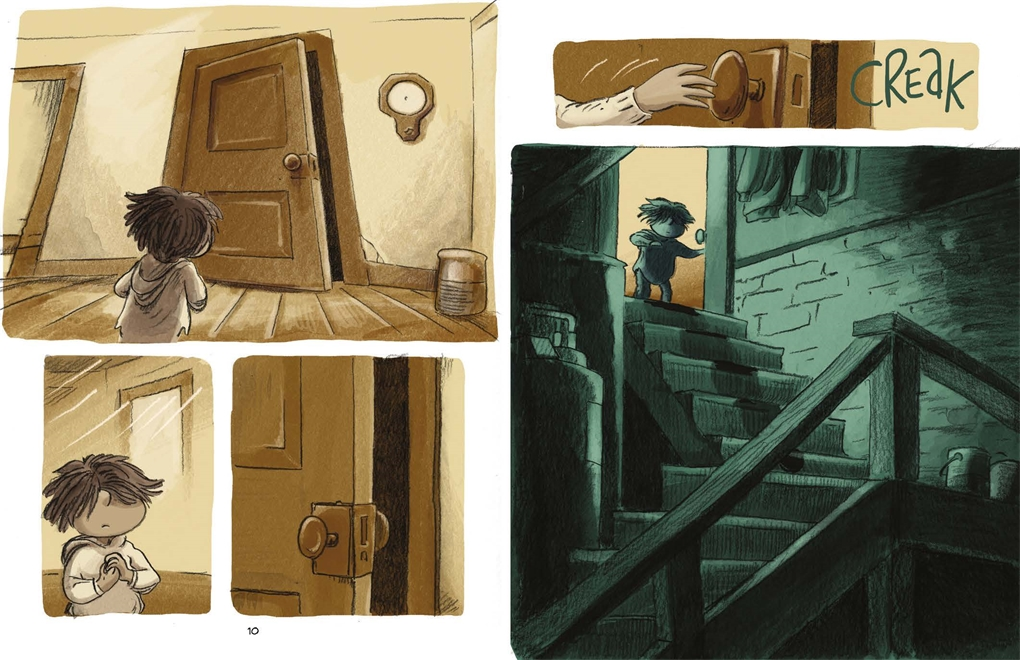
Summary:  When Milo’s mom sends him to the basement to find baby Lucy’s missing sock, a journey of epic proportions unfolds.  Milo hasn’t been to the basement of his new house, and he is in for an adventure as he discovers different rooms and floors deep underground, populated by all sorts of ghosts and monsters.  Some are helpful while others want to eat him and/or steal the sock, and it’s up to Milo to figure out the difference between friend and foe.  He learns to value those true friends and find ways to help them even when his own life is at stake.  Milo completes his hero’s quest to loving praise from his mother, who then asks him for something from the attic…book 2?  240 pages; grades 2-5.

Pros:  There aren’t many words in this graphic novel, but Ben Hatke has created an artistic masterpiece that kids (and adults) will want to pore over to make sure they take in all the sumptuous details.

Cons:  I’m afraid to do my laundry.