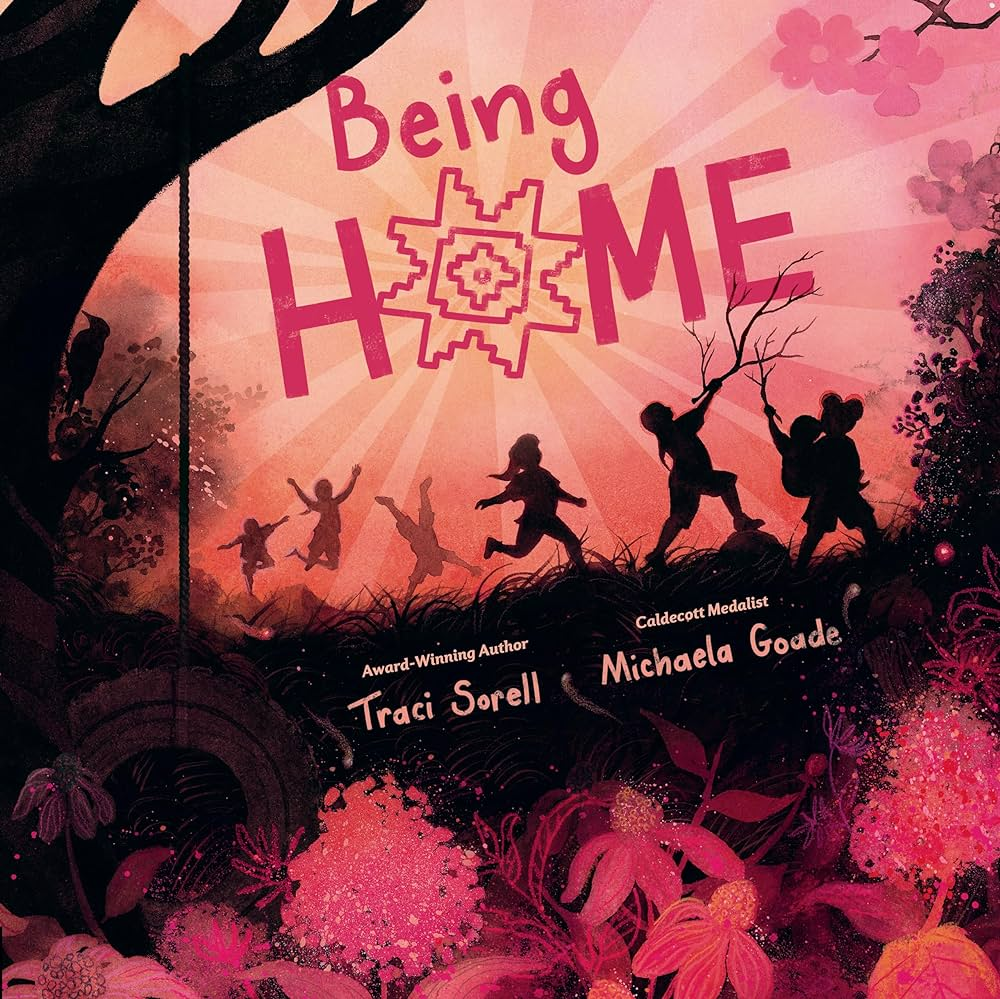
Being Home by Traci Sorell, illustrated by Michaela Goade (Kokila, 32 pages, ages 4-8). A family decides to move from the crowded city to the Cherokee reservation, where they can be close to nature, family, and community. The narrative begins on moving day in the city, continues through their journey, and finishes up in their new home, where they’re greeted with a feast and lots of children for the young narrator to play with. There are kid-drawn pictures showing a map of their trip, while other illustrations incorporate people, animals and symbols from the Cherokee Nation. Pink is the main color used to celebrate this family’s new life.
Both Traci Sorell’s (Cherokee) beautiful poetry and Michaela Goade’s (Tlingit) gorgeous illustrations celebrate indigenous communities that honor nature and help each other out through their connection. There’s always so much to see in Goade’s art, so be sure to take your time to appreciate how the colors she uses and shapes and figures she weaves into the main illustrations help tell the story.
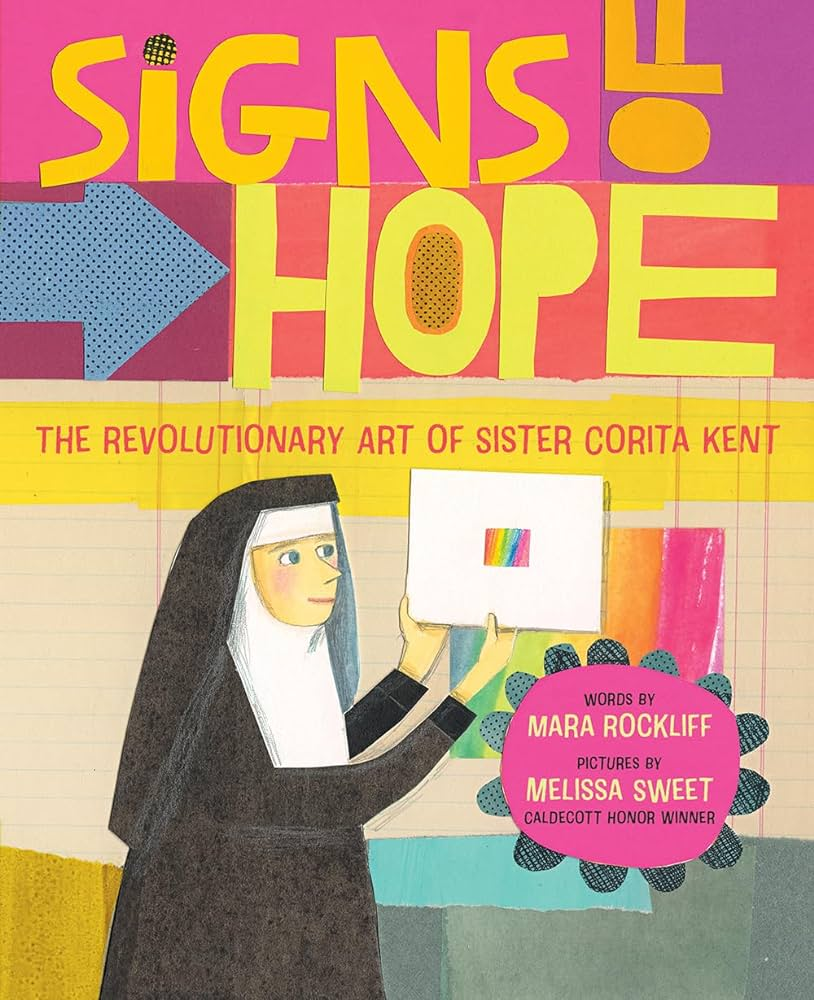
Signs of Hope: The Revolutionary Art of Sister Corita Kent by Mara Rockliff, illustrated by Melissa Sweet (Harry N. Abrams, 40 pages, grades 2-5). A student narrator describes what it was like to study art with Sister Corita Kent, learning to pay attention, breaking the rules, making prints inspired by words and pictures from magazines. Sometimes the students would take field trips to museums to learn about Pop Art, or to protests, where Sister Corita’s signs spoke out about peace and justice. After studying with Sister Corita, her students were ready to go into the world to express themselves through their own art. Includes an author’s note with biographical information about Sister Corita Kent, an illustrator’s note, a timeline, and additional resources.
Melissa Stewart’s style is a natural fit to celebrate Sister Corita’s joyful, playful art. The first-person present-tense narration brings an immediacy to the story that’s as vibrant as the illustrations. The text may be a bit confusing to a reader not familiar with Sister Corita Kent, but the author’s note adds helpful details about her life. I was disappointed that Matthew Burgess’s excellent Make Meatballs Sing: The Life and Art of Corita Kent wasn’t included on the resource list.
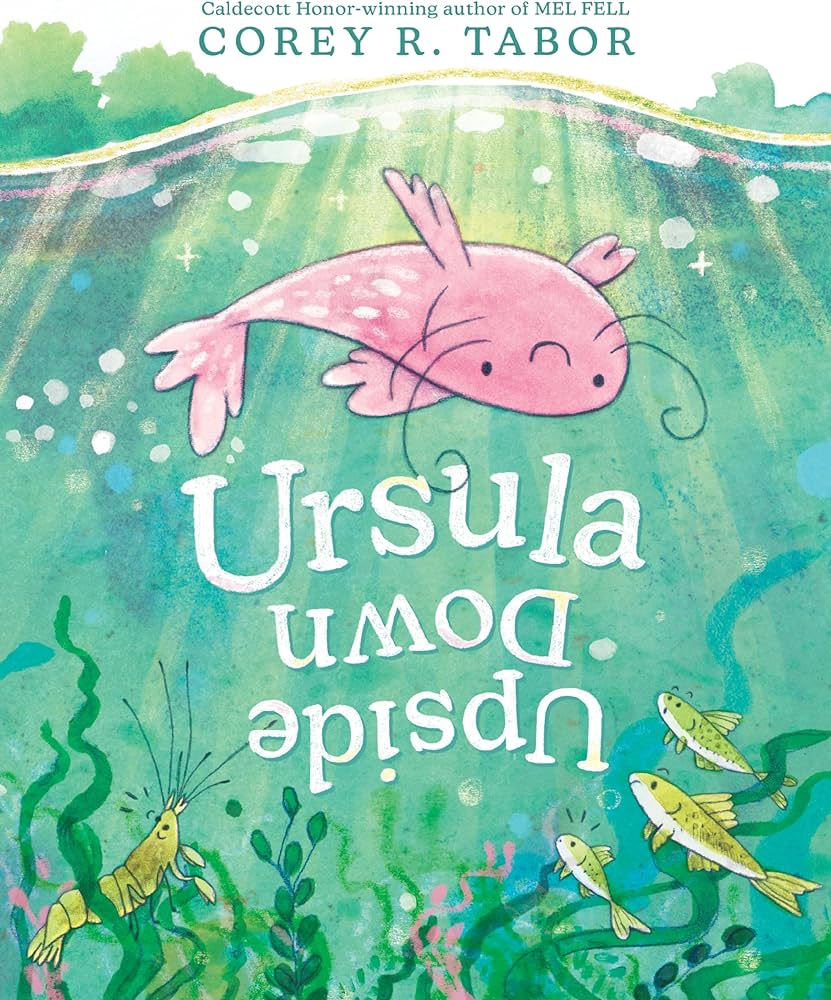
Ursula Upside Down by Corey R. Tabor (Balzer + Bray, 40 pages, ages 4-8). Ursula is a catfish who happily enjoys the beauty of her undersea world. But her view gets flipped when a fish asks her why she’s upside-down. “Just look around,” says the fish, and when she does, Ursula realizes she’s the only creature swimming her way. She tries turning over but gets so disoriented that she leaves the water altogether. A bat comes along and rescues her, and back in the water, Ursula observes the bat hanging upside down from a tree. “Upside down?” says the bat. “Says who?” This gives Ursula the confidence to go back to her old ways, and she’s happy once again, seeing things her own way. An author’s note introduces the upside-down catfish of the Congo River Basin and asks readers to consider that we might be the ones who are upside down.
Another cute picture book by Corey Tabor that involves flipping the book around a couple of times like some of his other works. My favorite is still the Caldecott honor book Mel Fell, but I’m sure kids will enjoy getting to know Ursula (and Vern the bat), and the story delivers a nice message about doing your own thing.
 A Kids Book A Day
All three look like amazing choices!
LikeLike