The History of We by Nikkolas Smith (Kokila, 40 pages, grades K-5). Through poetic text and rich acrylic illustrations, Nikkolas Smith traces the history of the earliest humans in Africa from more than 200,000 years ago. The people are shown making music and dancing, created languages, built homes, growing crops, wondering at the stars, and eventually discovering ways to travel on the oceans. A world map at the end puts Africa at the center of civilization, from where humans traveled to settle other continents. The back matter includes information about each of the spreads, and the author’s note relates how he never learned about humanity’s roots in Africa, motivating him to create this book. Includes a timeline covering the period from 233,000 years ago to 5,000 years ago.
I’d love to see this book considered for a Caldecott or Coretta Scott King award. It would make a good companion to Before the Ships, introducing kids to the history of the people of Africa before American slavery. Both books use beautiful language and illustrations to draw readers of all ages into a fascinating history that has long been ignored.
So Many Years: A Juneteenth Story by Anne Wynter, illustrated by Jerome Pumphrey (Clarion Books, 32 pages, ages 4-8). “How would you dress after so many years of mending your clothes with rags?” This question is followed by others: how would you sing, dance, and eat after years of having to sing in code, painful work, and only having scraps for meals? “Oh, how you would dress!” shows off the fancy clothes worn in an emancipation celebration from 1920. The other questions are answered with illustrations of other Juneteenth celebrations through the years, as people dance, sing, and feast right up to the present. “Oh, how you would celebrate…so many years of a life…fully yours…fully free.” Includes information about the history of Juneteenth and the lyrics for “Lift Every Voice and Sing.”
Each spread just has a single sentence, but together they perfectly capture the sense of freedom and celebration that are part of Juneteenth. And the paintings by one of my favorite illustrators beautifully show that history, often combining the hardships of the past with the joy of the present in the same spread. Another award contender.
Hurricane by Jason Chin (Neal Porter Books, 48 pages, grades 2-5). The story of a hurricane is told over a 12-day period, from three different perspectives: the storm itself, the scientists who track it, and the residents of Cape Hatteras, North Carolina who prepare for it to hit their community. The more scientific material includes labeled diagrams and sidebars that give plenty of information. Particularly exciting are the pages showing the Hurricane Hunters who fly planes directly into the storm. Meanwhile, the people of Cape Hatteras are portrayed with cartoon bubbles showing their conversations as they board up windows, check generators, and in some cases, evacuate. There’s a sense of community as they help each other get ready and clean up in the aftermath on the last few pages. Includes lots of additional hurricane information, additional resources, and an author’s note.
Jason Chin brings his amazing artistic talents to this nonfiction book that can be enjoyed on a variety of different levels. Younger readers will be drawn into the story of the Cape Hatteras residents preparing for and experiencing (or evacuating from) the hurricane, while older ones will learn a lot from the more scientific text and labeled diagrams. Definitely a contender for a Sibert award.
Island Storm by Brian Floca, illustrated by Sydney Smith (Neal Porter Books, publication date July 22, 2025, 48 pages, ages 4-8). A couple of award winners team up to show two children exploring outside before a storm hits. First they head to the ocean, where waves are crashing on the beach under a darkening sky. Rain starts to fall as they run into town, where they see deserted streets and boarded-up windows. A loud clap of thunder scares them into going home: “Home to relief, and love. Home to trouble, too! And forgiveness.” They dry off, warm up, and eventually head to bed while the storm rages outside. In the morning, the sun is shining, the sea is calm, and the kids and their mother enjoy a day at the beach.
The lyrical text and mostly blue, gray, and green watercolors (with some red highlights) perfectly capture the feeling of an impending storm, followed by the storm itself and its aftermath. The kids’ repeated refrain, “Is this enough, or do we try for more?” sends them from one scary-but-exciting spot to another (although I was relieved that they got into some trouble when they got home, as I was wondering what parent would allow their kids out in that weather). The last sentence: “And you and I go on,” expands the meaning to the kids being together through other kinds of difficulties.
Thanks to Holiday House/Neal Porter Books for providing me with review copies of both of these books.
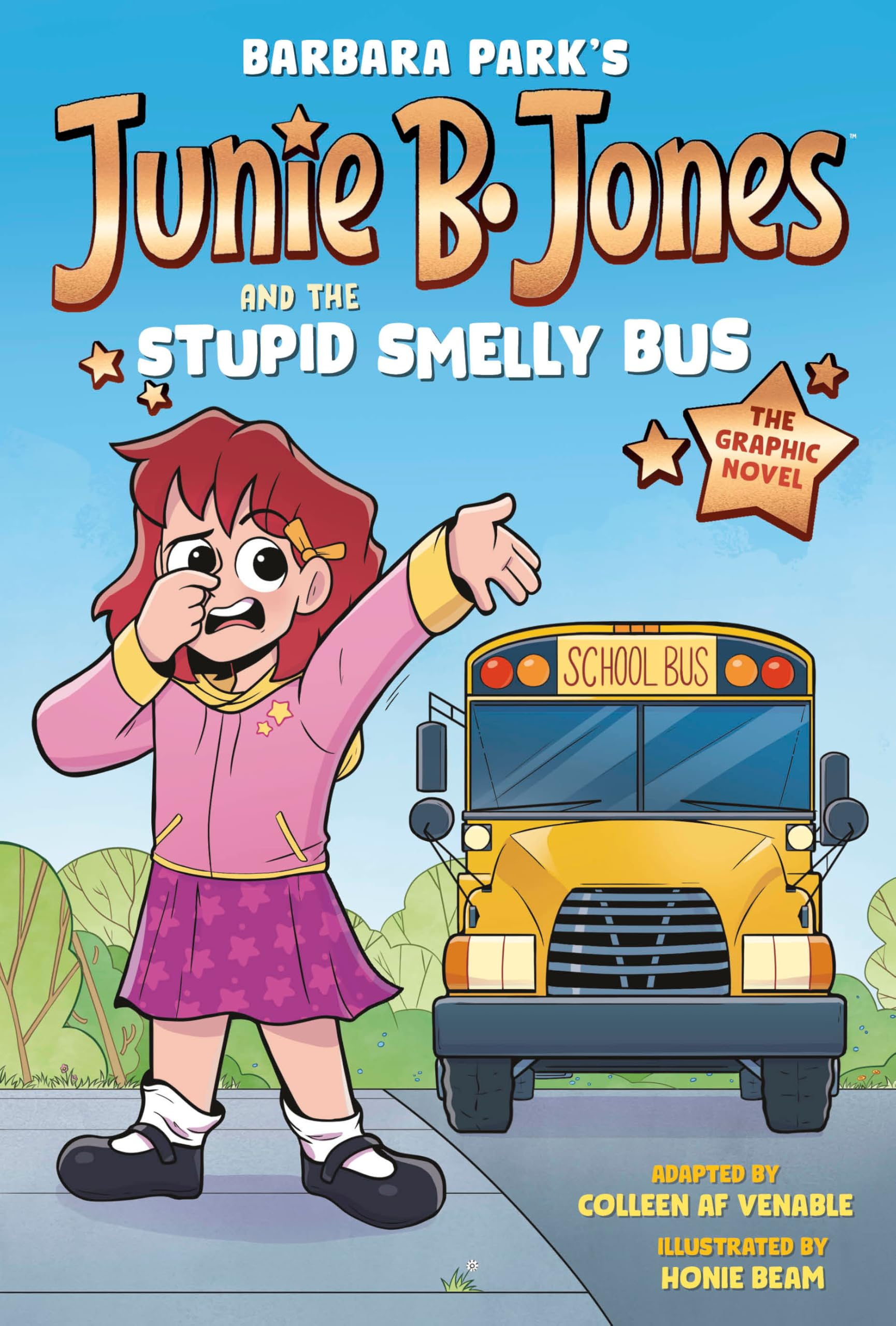
Barbara Park’s Junie B. Jones and the Stupid Smelly Bus: the graphic novel by Colleen AF Venable, illustrated by Honie Beam (Random House Books for Young Readers, 160 pages, grades 1-3). Junie B. is excited about going to kindergarten after acing her orientation, but she’s less thrilled about riding on the stupid, smelly bus. The reality turns out to be even worse than she had imagined, and as she end of the day approaches, she decides she can’t face a return trip. She hides during dismissal, then roams the school after hours, exploring the library, gym, nurse’s office, and more, all with her own unique take on things. Her frantic parents and teacher finally track her down, and the introduction of a new friend helps Junie B. feel like she can face the bus ride in the morning.
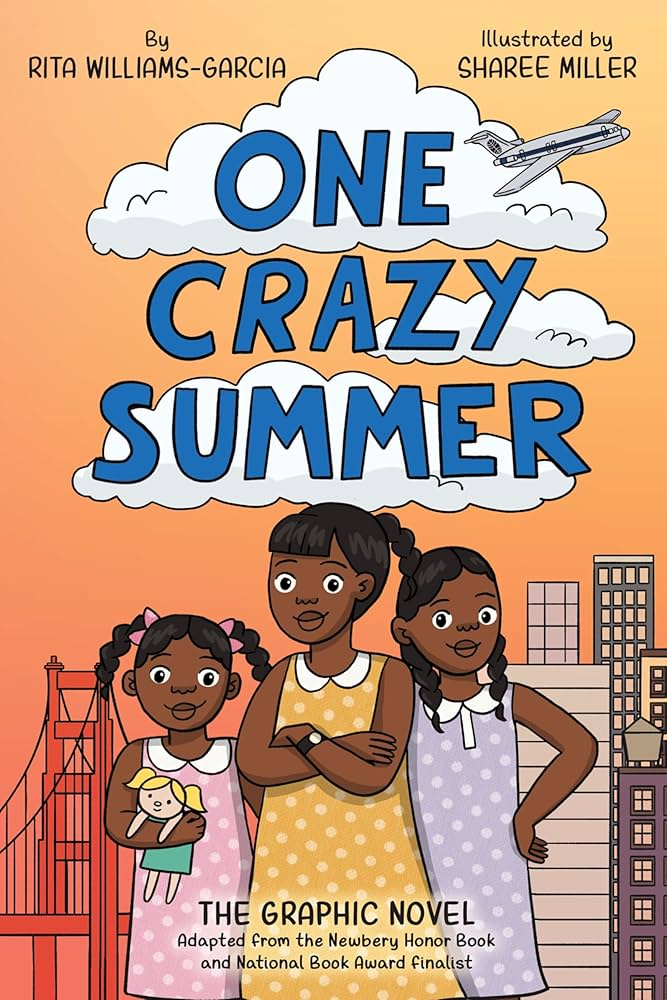
One Crazy Summer: the graphic novel by Rita Williams-Garcia, illustrated by Sharee Miller (Quill Tree Books, 304 pages, grades 4-7). 11-year-old Delphine tells the story of spending the summer of 1968 with their mother, Cecile, when she and her two younger sisters, Vonetta and Fern, are sent to Oakland to get to know the mother who abandoned them when Fern was a baby. The trip was decided on by their father and grandmother back in New York, and Cecile wants no part of the visit. Busy with her mysterious work, she sends the three girls to the kids’ program at the Black Panthers’ People’s Center. There, they get free meals along with lessons in Black Power and resisting the police. After Delphine leads them on an excursion to San Francisco, the girls return to see their mother being arrested along with a few others from the Black Panthers. After cleaning up Cecile’s destroyed workspace and discovering some of her poems, they move in with friends. A performance of one of her poems at a Black Panther rally concludes with a reunion with Cecile, whose time in jail seems to have changed her enough to have an honest conversation with Delphine about why she left. The girls return home with some new ideas and insights about their family and what it means to be Black in America.
Is it okay to have mixed feelings that it feels like every classic book is being turned into a graphic novel? Both of these are extremely well done, both the art and the storytelling, and I’m delighted that new audiences will be introduced to these characters. Junie B. will find a ready audience with fans of Baby-Sitters Little Sisters and the Magic Tree House (both now graphic novels that are way more popular than the originals). And reading One Crazy Summer reminded me of how that trilogy introduced me to so much from that era, completely changing my childhood perceptions of the Black Panthers. I missed the nuances of the original, though, for instance, the way Cecile’s complex character is slowly (and only partially) revealed throughout the story. In this version, the changes she makes toward the end of the story feel somewhat abrupt. So it does make me both a little sad to see Newbery books like A Wrinkle in Time, Turtle in Paradise, and now, One Crazy Summer turned into graphic novels, yet glad that these stories will now reach a wider audience.
Don’t Cause Trouble by Arree Chung (Henry Holt and Co., 256 pages, grades 4-7). Things don’t look good for Ming on his first day of middle school: his mom has given him his usual bowl haircut, and he’s dressed in the thrift store clothes she insists on buying. Ming’s accidentally placed in an ESL class, even though he only speaks English, but with his parents’ injunction, “Don’t make trouble” ringing in his ears, he goes along with it. Eventually, the teacher figures things out, and he’s moved to honors English, where he finds a couple of new friends,. When Ming’s desire to fit in lands the three of them in some serious trouble, he’s forced to reconsider what’s really important to him and try to make amends with his parents and his friends. Sixth grade ends on a high note, with the possibility of summer basketball, a new family business making egg rolls, and a new girl in the picture who may or may not a crush on him. Includes an author’s note and family photo telling how his own childhood inspired this story and several pages of instructions on making a graphic novel.
The story and art in this graphic novel are fairly simple and straightforward but really capture the feeling of being torn between two worlds: the Chinese one at home and the American one at school, as well as the pressure Ming feels as his parents, whose own dreams have been deferred, pin all their hopes on his success.
Outsider Kids by Betty C. Tang (Graphix, 288 pages, grades 5-8). In this sequel to Parachute Kids, the three Li kids are still living on their own in California while their parents try to supervise them from Taiwan. The burden falls on oldest daughter Jessie, who is trying to get into Harvard while working at a job where her boss knows he can cheat her because she’s in the country illegally. Meanwhile, middle brother Jason falls in love and must deal with his sisters finding out that he is gay. When cousin Josephine comes to stay, 10-year-old Ann’s excitement turns to dismay as Josephine is constantly mean to Ann and tries to steal her new friends at school. When Ann’s attempt at revenge on her cousin results in Josephine calling the police on them, the three siblings have a panicky scramble trying to figure out what to do next. They wind up at a new home in San Francisco, which I hope sets things up for a possible third installment. Includes an author’s note about her own life as a Parachute Kid from Taiwan.
I was excited to discover a sequel to Parachute Kids, and it didn’t disappoint. The Li kids are incredibly resourceful and supportive of each other despite their constant squabbling. The tension of their undocumented status is particularly relatable today. The book tackles subjects like Jason’s coming out and Josephine’s father’s adultery that made this feel like it was geared for a slightly older audience than the first one.
Some of Us: A Story of Citizenship and the United States by Rajani LaRocca, illustrated byHuy Voun Lee (Christy Ottaviano Books, 32 pages, grades K-4). “Some of us are born American. Some choose.” With just a sentence or two of text to accompany the vibrant illustrations on each page, the book shows people from all over the world, of all ages, in all sorts of circumstances, who choose to leave their homes, families, and native countries to come to America. They may come seeking jobs or education, or to escape poverty, war, or oppression, and they bring music, languages, food, and stories that enrich their new country. There’s a description of the process involved in becoming a naturalized citizen, including the rights and responsibilities that come with citizenship. An author’s note traces the history of US immigration and citizenship and tells her own story of becoming a naturalized citizen at age 15. Includes the United Nations’ Universal Declaration of Human Rights and a bibliography.
This book celebrating immigration and U.S. citizenship could hardly be more timely and important to share with kids right now. LaRocca does a masterful job of conveying lots of information and emotion in spare, simple language that’s easy to understand. Her text is illuminated by the beautiful illustrations that celebrate the many different cultures of people immigrating to the U.S. and that capture the pride of becoming a citizen.
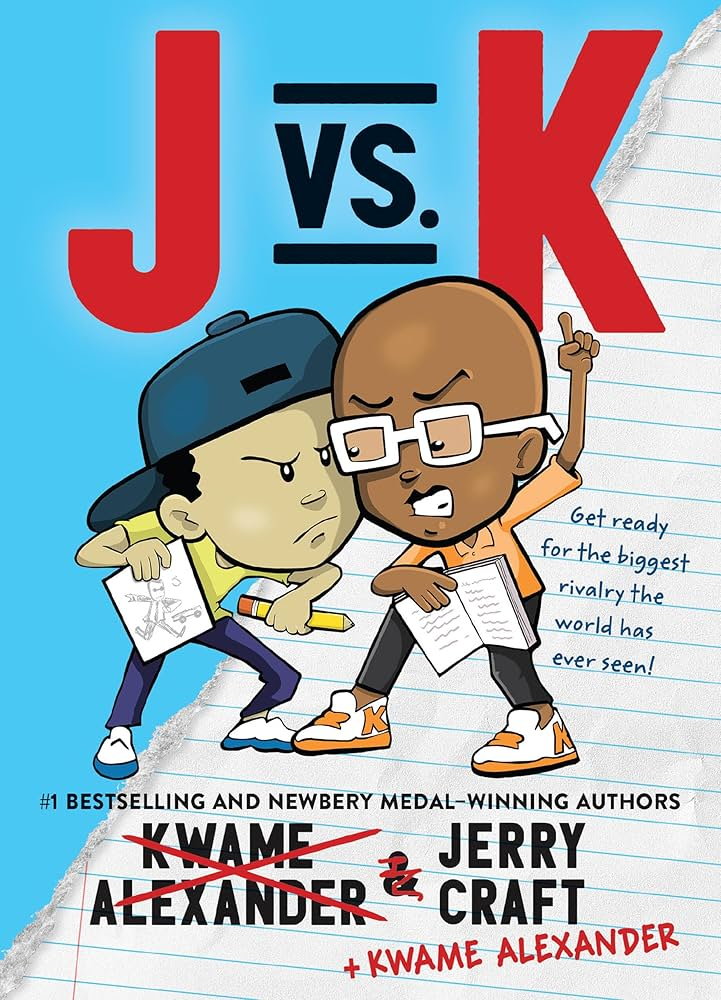
J vs. K by Kwame Alexander & Jerry Craft (Little, Brown Books for Young Readers, 240 pages, grades 3-6). K is new at the Dean Ashley Public School (DAPS), but he’s already making a name for himself with his writing. J is the best artist at DAPS, hoping to win the school’s annual story contest with one of his wordless comics, but worried that K will be stiff competition. Before long, K and J are out to sabotage each other, with K giving J bogus writing tips, and J purposely leaving a notebook full of bad drawing advice for K to find. When they team up on the basketball court, though, they turn out to be unstoppable, leading them to a decision to put their differences aside and work together on creating a graphic story. Although a dark horse wins it all, the two still place in the contest, and it looks like it will be the beginning of a beautiful friendship.
This is a cute illustrated chapter book which will undoubtedly appeal to Diary of a Wimpy Kid fans, but somehow I expected more from the Newbery Award winning team of Kwame Alexander and Jerry Craft. The plot was predictable from the beginning, and the authors seemed more concerned with inserting jokes and jabs at each other and making references to their other books than developing interesting characters. I’m sure the names on the cover will sell lots of copies, though, and I would not be surprised to see a sequel.
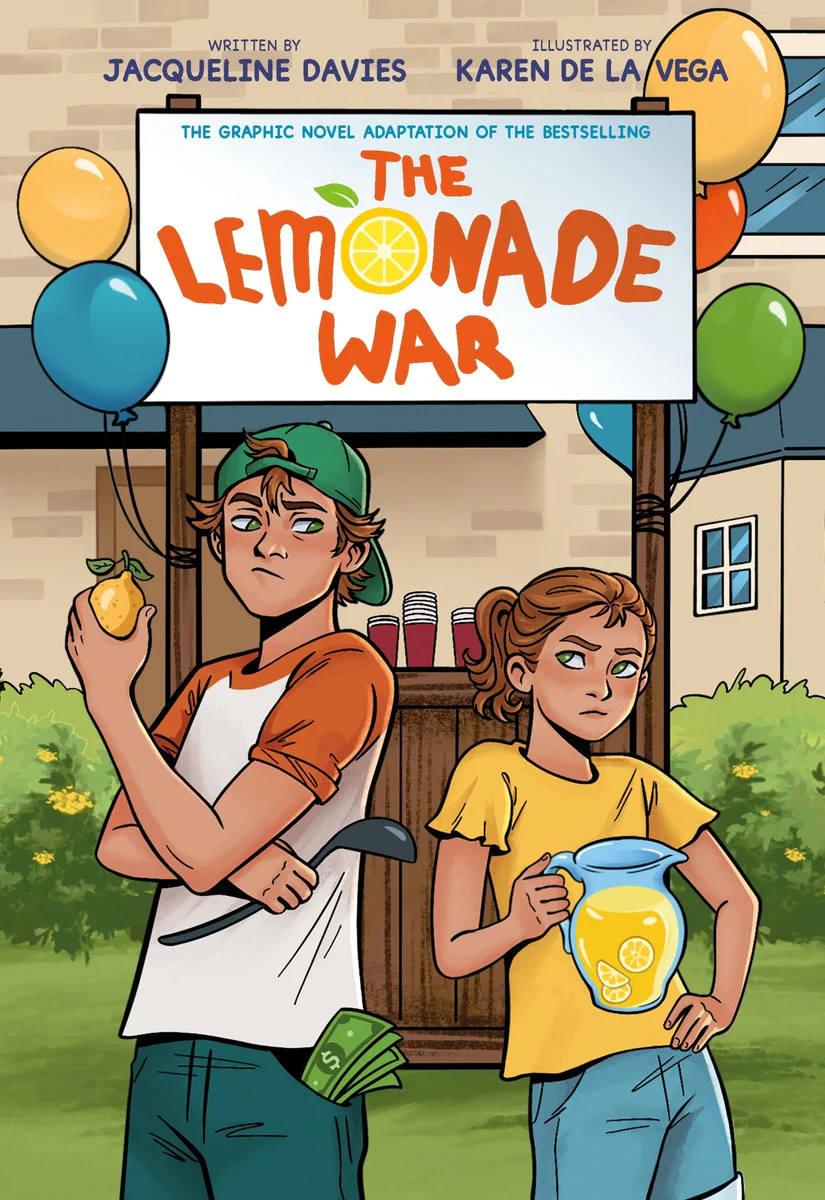
The Lemonade War: the graphic novel by Jacqueline Davies, illustrated by Karen De la Vega (Clarion Books, 207 pages, grades 3-7). Evan is feeling angry that his younger sister Jessie is skipping a grade and will be in his class at school. He lashes out at her, hurting her feelings. So when he and Scott (who turns out to be the neighborhood bully) team up to sell lemonade, Jessie asks another girl to partner with her for a rival stand. The siblings end up making a winner-take-all bet about which enterprise will make more money. Jessie has business and math smarts, while Evan is more gregarious and makes friends easily. The rivalry grows until things get completely out of hand and the two wind up sabotaging each other…and themselves. Admitting how things went wrong leads them to realize all the business lessons they learned, and they’re able to create a prize-winning project at the Rotary Club’s Labor Day contest.
It’s been years since I read the original version of this book, and it was fun to revisit it, with its innocent introduction to the world of capitalism. Each chapter begins with a definition of a business term that is relevant to the story, and all of that new vocabulary is incorporated into their final project. Many readers will relate to both siblings: Jessie shows signs of neurodivergence with her struggles to read people’s expressions and make friends, and Evan’s academic issues make him worry about getting upstaged by his younger sister. The ending is somewhat lame, and the bully appears to get away with stealing most of their money, but don’t worry, The Lemonade Crime gives him his comeuppance. Thanks to Clarion Books for providing me with a review copy.
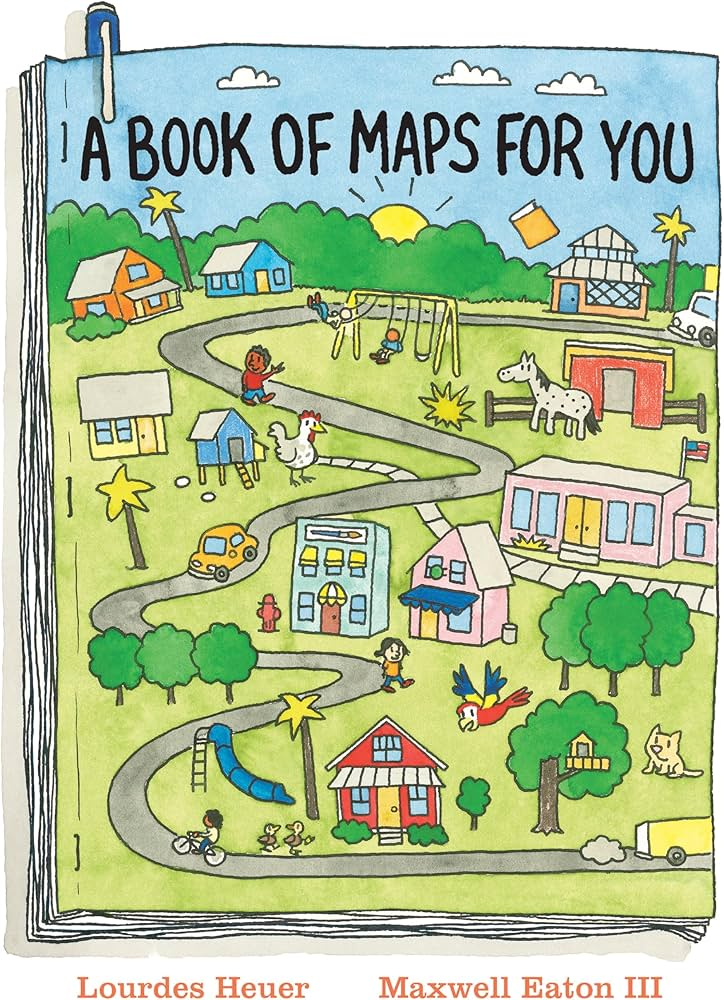
A Book of Maps for You by Lourdes Heuer, illustrated by Maxwell Eaton III (Neal Porter Books, 40 pages, grades K-3). “I made a book of maps,” the narrator explains, showing the cover which shares the title of this book. Inside there are maps of many places in the community: the narrator’s town, house, school, the library, the park behind the library, Main Street, a favorite art store. Helpful facts are included on each page, like the cafeteria lunch menu on Fridays and the best swing at the park. The purpose of this book of maps is made clear on the last two spreads, when the narrator leaves it on the front porch before climbing into a car behind a moving van, then a new kid sits on the porch, surrounded by boxes, and picks up the book.
This charming book will have readers thinking about what maps they could draw of different places in their communities and what facts to include about each. The ending is kind of poignant, although it could provide a helpful project for kids who are facing a move. My favorite book for teaching about maps remains What a Map Can Do, but this one is a close second and may have the edge for thinking about community and inspiring creative projects.
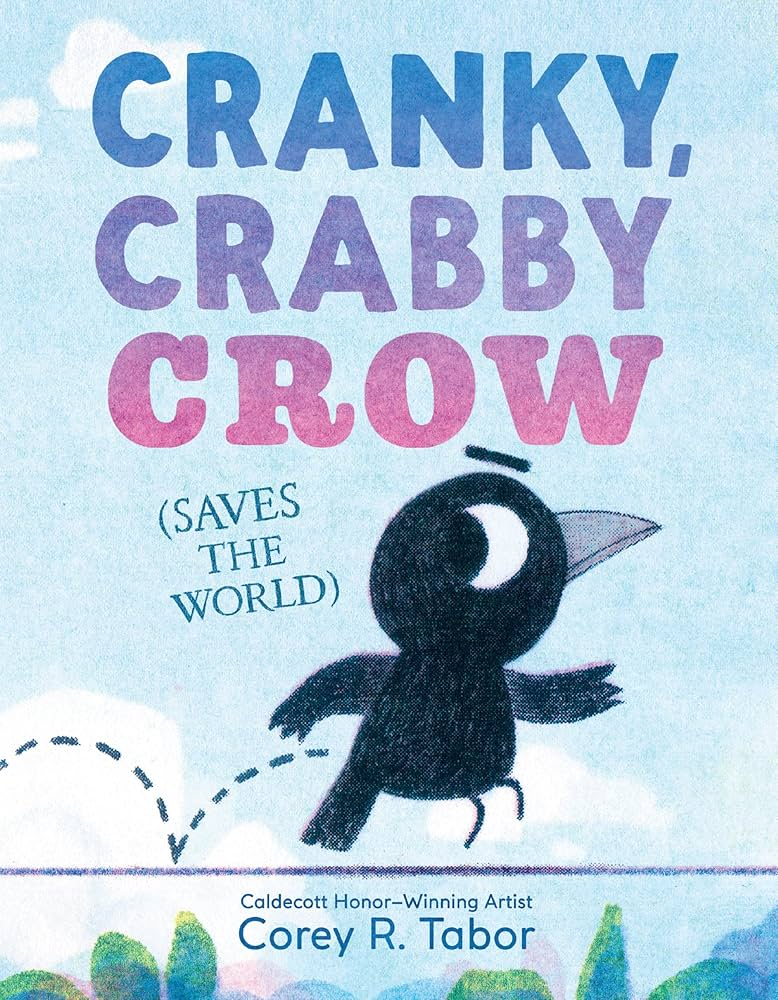
Cranky, Crabby Crow (Saves the World) by Corey R. Tabor (Greenwillow Books, 40 pages, ages 4-8). Crow greets each animal’s friendly overtures with a loud “Kaw!” which sends each one away, miffed at the bird’s rudeness. Finally alone, Crow gets a phone call from a red phone attached to a telephone pole. “Have you cleared the area?” asks a voice. “It’s time.” A door in the pole leads to an elevator, which Crow rides down to an underground bunker, where a bird-sized spacesuit and rocket are waiting. Crow flies into space to launch missiles and lasers that successfully destroy an asteroid threatening the Earth. Back home, Crow once again perches on the wire, where one by one the animals reappear, each clutching an invitation from Crow. Night falls, and there’s a spectacular display of shooting stars–or rather fragments of the asteroid traveling through space. Is Crow smiling?
I’m always delighted to learn that Corey Tabor has a new book out, and this one is sure to be a favorite. I found more details as I reread it, particularly in the clever illustrations that include visual humor like the buttons for cupcakes and bubbles alongside the missile and laser ones. The text is simple enough to make this a good choice for early readers, and also perhaps for a Geisel award, if not a Caldecott.
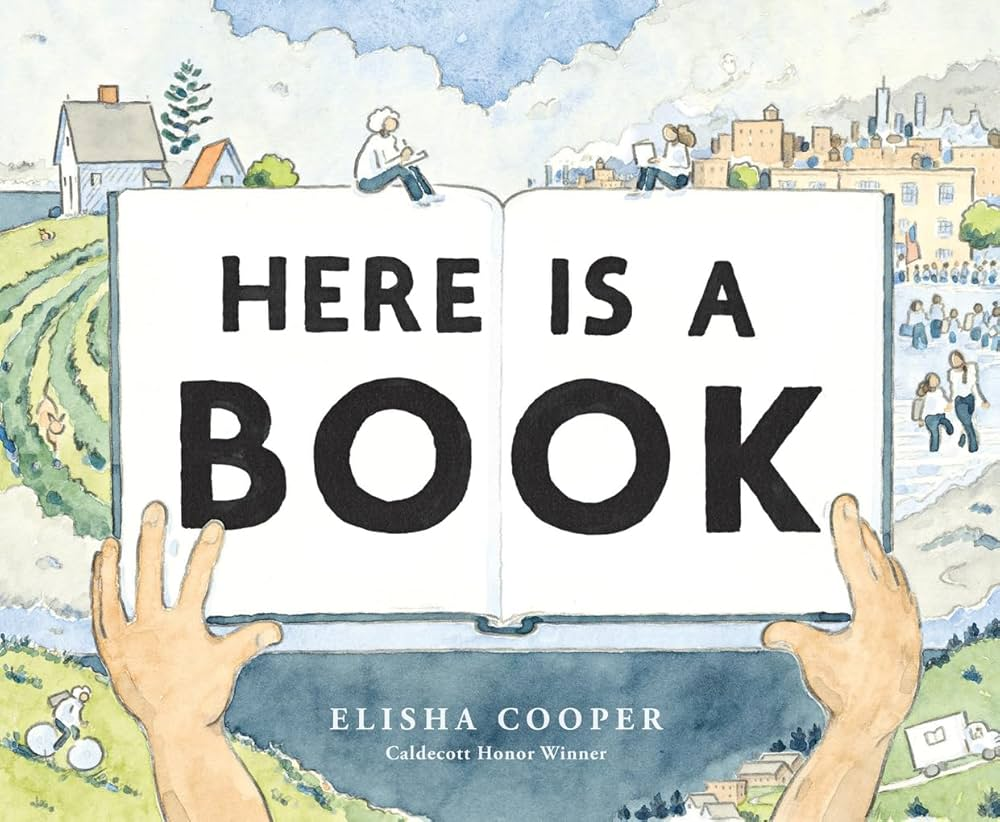
Here Is a Book by Elisha Cooper (Henry N. Abrams, 40 pages, ages 4-8). An artist is inspired by the nature around her and creates a book. She pedals her bicycle into town to deliver her work to her publisher. From there it goes to a printer, where it is turned into books. The books travel to the city, where one of them ends up in a school library. A child borrows the book and brings it home, where she is inspired by the illustrations to make a book of her own.
I was expecting this to be more of a “how a book is made” story, but I really loved the exploration of how one artist inspires another. Each step of the way includes a list of what is in that location: the artist’s garden has sun, rain, dirt, shovels, seeds, and love; the printer makes the book using paper, ink, printing presses, binding machines, glue, thread, and time; and the child’s room has paper, pencils, a desk,, a chair, stuffed bears, hot chocolate, days, nights, art, and wonder. The watercolor illustrations beautifully capture all of these things on each two page spread.
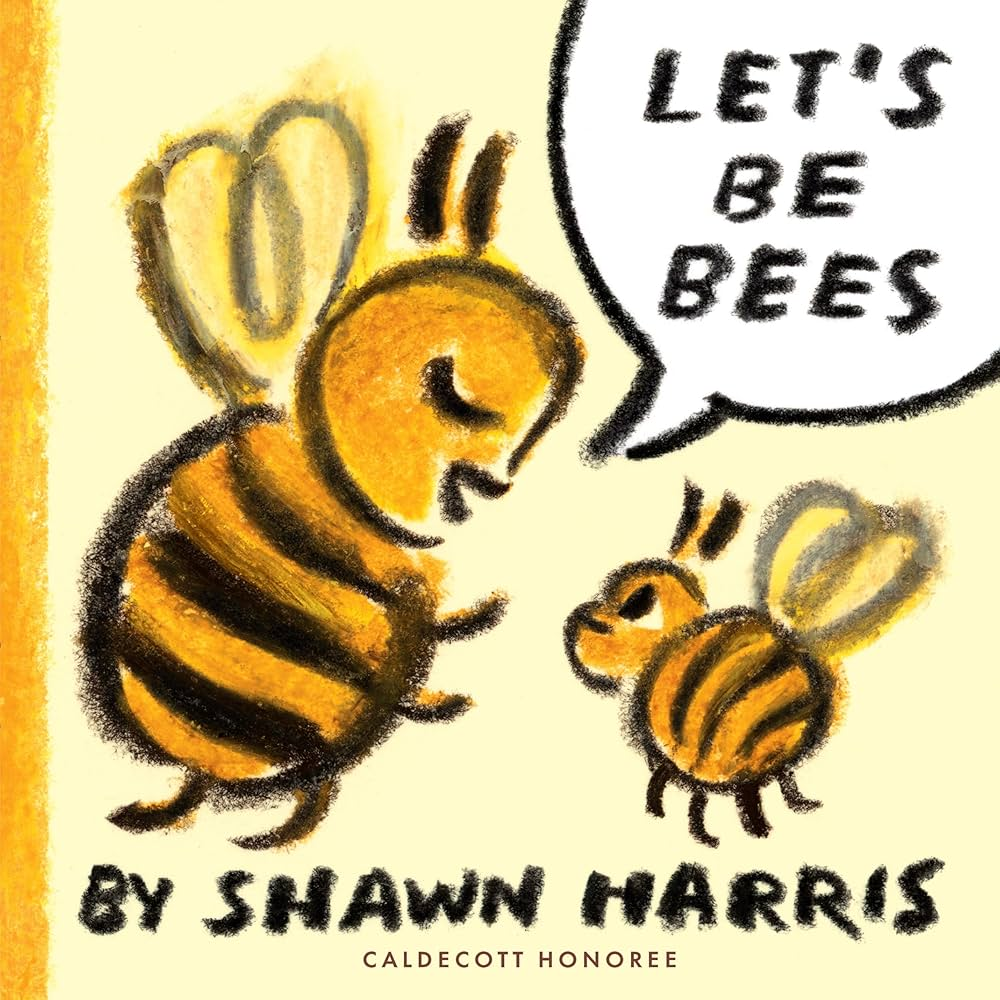
Let’s Be Bees by Shawn Harris (Neal Porter Books, 40 pages, ages 3-7). A man and a child are sharing a book; when the man says “Let’s be bees. Let’s buzz,” the two of them turn into bees, buzzing and popping right out of their human clothing. Similarly, they turn into birds, trees, a storm, and more, making the appropriate sounds and shape shifting into all sorts of things. Their final transformation is into the Earth, where they make every sound. The reader says, “Now let’s be me and say,” and the cartoon bubbles show both of them saying “The End,” each one sporting long hair and a beard like the reader. On the last page, they both turn into the child and say, “Again!!”
This simple but clever book celebrates the power of reading together and letting books unlock the imagination. The illustrations look like they were drawn by a child, and kids could use this book as a starting place for creating their own pictures based on its theme. Either one of these books could be considered for another Caldecott for their artists.
The Black Mambas: The World’s First All-Women Anti-Poaching Unit by Kelly Crull (Millbrook Press, 40 pages, grades 2-5). The Black Mambas are the first women park rangers in South Africa and the first women-led anti poaching unit in the world. They tell their story, explaining how they first got interested in protecting animals and describing some of the resistance they experienced from friends and family members who weren’t sure women could do this job traditionally held by men. They named themselves after the most feared snake in South Africa. Now they work out, train to survive in the wilderness, and patrol the reserve day and night, looking for signs of poachers and making arrests if they catch them. Their reserve, the Olifants West Nature Reserve, has become one of the most difficult reserves to poach animals, and the Black Mambas’ work has been recognized around the world. Includes more information about some of the animals on the reserve, the NATO Phonetic Alphabet that the rangers use, an author’s note, and a list of additional resources.
I loved this book, and I think a lot of kids will, too. Not only does it feature a lot of animals, but the Black Mambas are inspiring in their dedication, hard work, and success. The photos really capture the reserve the the women at work. I enjoyed the activities in a couple sidebars, like matching animal tracks and reading a map, which will keep kids engaged.
Marjory’s River of Grass: Marjory Stoneman Douglas, Fierce Protector of the Everglades by Josie James (Christy Ottaviano Books, 40 pages, grades 2-5). Marjory Stoneman Douglas moved to Florida soon after her graduation from Wellesley College, moving in with her journalist father whom she hadn’t seen since she was six. She joined him on the Miami Herald, starting as a society editor, but soon writing pieces about the Florida Everglades, a mysterious but beautiful ecosystem that her father had introduced her to. As real estate developers rushed to drain and reclaim the land, Marjory and other activists lobbied to make the Everglades a national park, protecting this wild area that provides the majority of southern Florida’s water. The publication of her book The Everglades: A River of Grass helped spread the word about this cause, and in 1947, Everglades National Park was officially dedicated. Despite this conservation effort, developers still sought to build in the Everglades, and Marjory was involved in a successful campaign to stop airport construction there in the 1970’s. Her activism and love for the Everglades continued until her death in 1998 at the age of 108. Includes an author’s note and photo of Marjory, additional information about the importance of clean water, a bibliography, and source notes.
This inspiring biography is an excellent starting point for learning about the life of this dedicated journalist and environmental activist. I appreciate the limitations of a picture book in telling the story of a woman who lived for more than a century, but I was sorry there wasn’t any information about Marjory’s childhood or marriage (both of which sounded pretty traumatic when I looked her up on Wikipedia). The bibliography will help those who want to more about Marjory’s life.
Lady of the Lines: How Maria Reiche Saved the Nazca Lines by Sweeping the Desert by Michaela MacColl, illustrated by Elisa Chavarri (Astra Young Readers, 48 pages, grades 2-5). Born in 1903 in Germany, Maria Reiche moved to Peru to be a nanny, but quickly became fascinated by the ancient Incan culture. When American anthropologist Paul Kosok showed her aerial photos of mysterious lines in the Nazca Desert, Maria was hired to investigate them. The Lines became her obsession, and Maria spent the rest of her life exploring and preserving them. She began by buying as many brooms as she could find to sweep away the dust that obscured them. Eventually, she realized that the Lines made shapes of enormous animals: a spider, a monkey, birds, and more. As she learned more about these ancient designs, Maria became an activist for their preservation, fighting off attempts to irrigate the the desert, then dealing with the tourists who came as a result of her publicity campaign. One thing Maria did not succeed at was figuring out the meaning of the designs in the desert, but she claimed to enjoy the mystery. “If everything were clear,” she said, “I would lose interest.” Includes additional information about the Nazca people, the Lines, and Maria, as well as a timeline and lists of additional resources.
Kids are sure to be fascinated by the Nazca Lines, which are now visible to everyone through Google Earth. Maria Reiche is almost as much of a mystery as the Lines are, completely dedicating her life to their study and preservation, to the exclusion, it would seem, of pretty much all else. She definitely is someone who lived life on her own terms and clearly did exactly what she wanted to do.
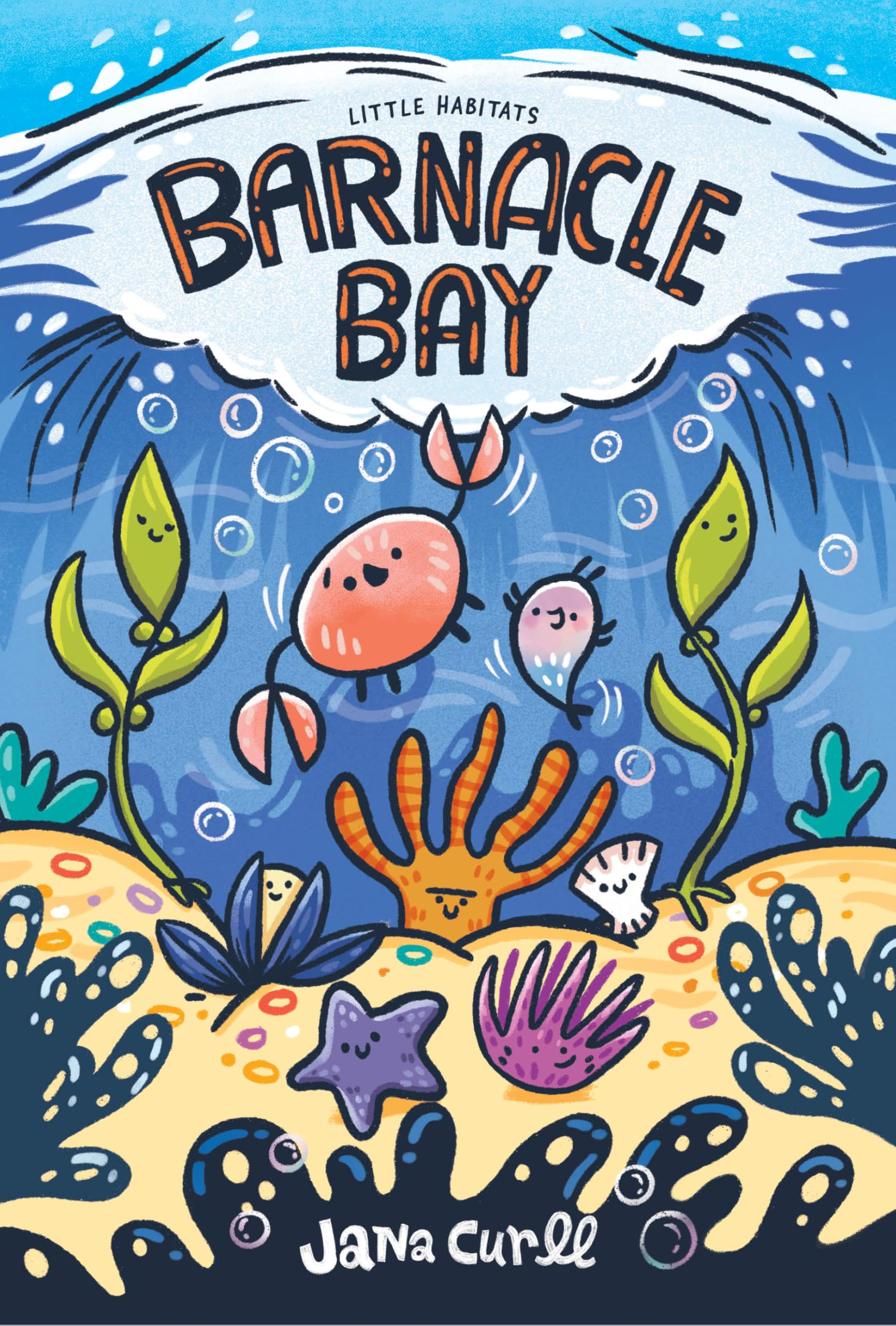
Barnacle Bay by Jana Curll (Greystone Kids, 76 pages, grades 1-4). When a slightly crabby crab meets a slightly lost larva, Crab reluctantly becomes Larva’s tour guide around the bay. As they travel and meet all kinds of different sea creatures, readers will effortlessly learn plenty of interesting facts about marine life. Packed with both information and clever marine-related wordplay that was appreciated and enjoyed by this reviewer, the story winds up with Larva transforming overnight. I won’t spoil the surprise, but the two creatures decide that life in the bay is a good fit for both of them, and it appears to be the beginning of a beautiful friendship.
Although I would love to see another adventure with these two, I’m equally delighted that the next book in this series is about a fern forest. Like Remy Lai’s Surviving the Wild series, this graphic novel seamlessly weaves together a story of cute animals and a lot of factual information.
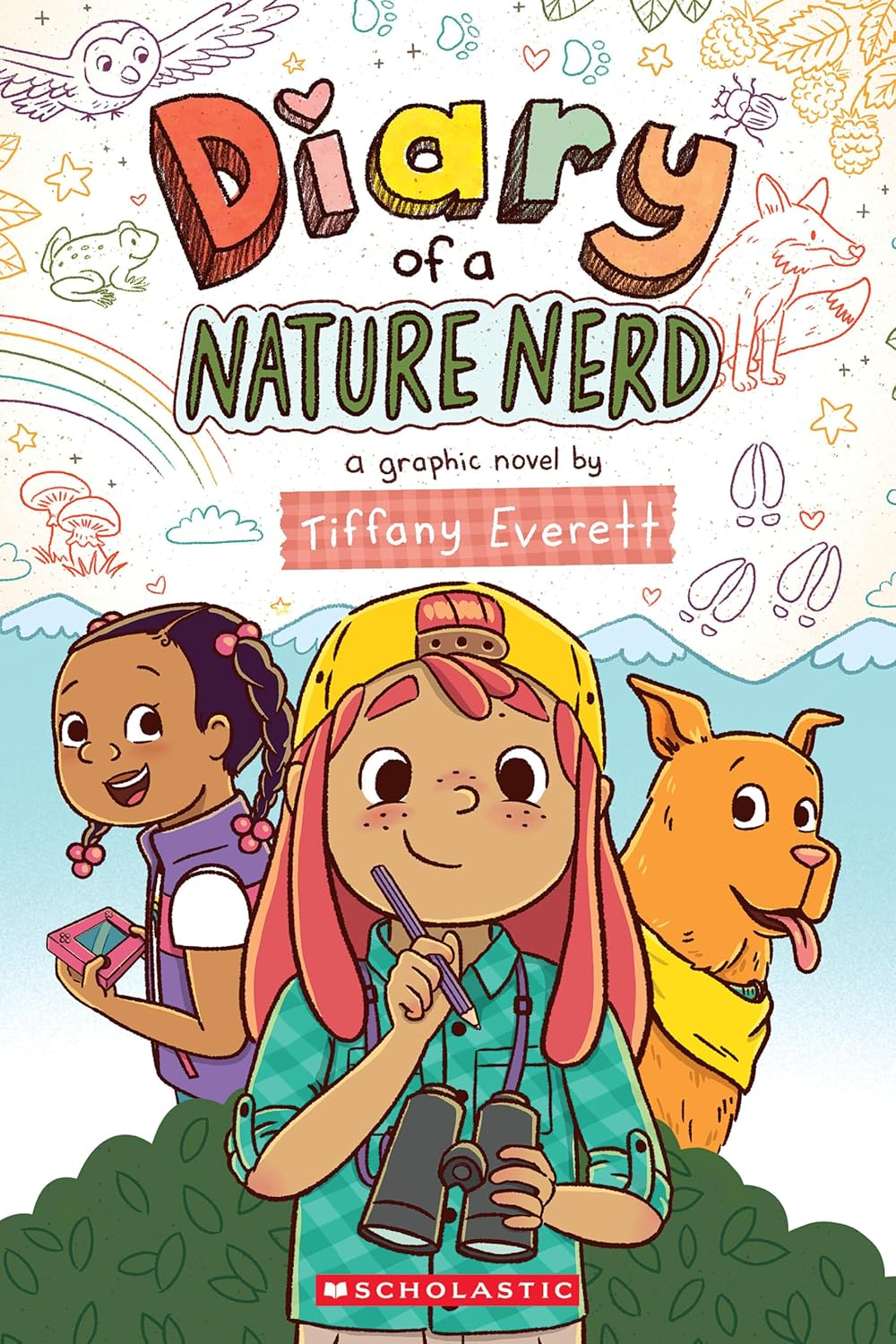
Diary of a Nature Nerd by Tiffany Everett (Graphix, release date August 19, 128 pages, grades 2-5). Brooke and her scientist mother live in an RV, traveling for her mom’s research. Brooke loves nature and keeps a detailed notebook with all of her observations. She’s seen many, many animals, but she’s still missing one: a moose. Her mom recently remarried; Brooke loves her new stepsister Jayla and shows her how to safely explore the woods. The two of them enjoy many adventures until one day when Jayla and her dad head off to explore a river. Brooke opts to stay home and update her notebook, and wouldn’t you know it, Jayla sees a moose. Brooke is jealous and becomes obsessed with finding a moose herself, leaving Jayla behind and forgetting many safety rules as she explores every inch of the woods. When her negligence puts both girls in danger, Brooke realizes that her relationship with Jayla is more important than any moose. The two talk things out, and just as Brooke has accepted that Jayla was fortunate enough to have an experience she hasn’t had, she turns around and sees…a moose!
This cute graphic novel about two animal-loving girls will appeal to fans of the PAWS and Animal Rescue Friends series. Brooke occasionally comes off as an annoying know-it-all, but her enthusiasm is contagious, and Jayla seems like a good friend for her. I hope this will be book one of a new series. Thanks to Scholastic for providing me with a free advance copy.
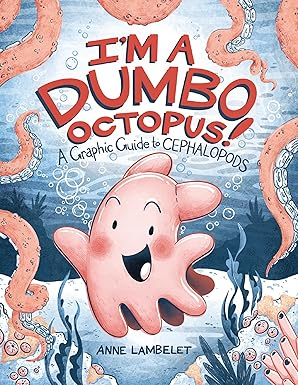
I’m a Dumbo Octopus! A Graphic Guide to Cephalopods by Anne Lambelet (Graphic Universe, 72 pages, grades 2-5). Grimpy–short for Grimpoteuthis–is a dumbo octopus who lives deep in the ocean. He gives readers an introduction to other cephalopods, a class of animals that includes octopuses, nautiluses, squids, and cuttlefish. Although they look quite different, they share common traits like blue blood, no backbone, and tentacles or arms. Many species have unique abilities, such as squirting ink amazing hiding skills, which make Grimpy a bit envious. Just as he’s starting to feel bad about himself, some of the others come along to tell him what his talents are, many of which are related to living in the deepest water of any octopus (over four miles deep). Feeling better, Grimpy says goodbye to his new friends and heads for his home in the depths. Includes an illustrated glossary, a photo and facts about the real-life Grimpy, a bibliography, and a list of books for further reading.
Grimpy is an endearing narrator in a relatively short graphic nonfiction book that’s packed with information about cephalopods. There are all kinds of the sorts of fun facts that kids love learning and sharing, and the illustrations really bring those facts to life. This is Anne Lambelet’s first books, but I hope it won’t be her last…readers will definitely be looking for more after meeting Grimpy.
The Trouble With Sunshine by Yamile Saied Méndez (Scholastic Press, 272 pages, grades 4-7). Dorani has gotten in trouble (again), this time for reading a banned book at school. But when her mother suffers a fatal heart attack on the way to pick her up, Dori is wracked by guilt and grief. Forced to leave her beloved Miami friends and family to go live with her seemingly cold and uncaring aunt on a Montana ranch, Dori finds an unexpected bond with a traumatized horse named Sunshine. The two begin healing together, and in the process, Dori finds new friends, a new family, and new causes to fight for. When Dori and Sunshine have to deal with an unexpected crisis at the ranch, they are able to rise to the occasion together, cementing their bond, as well as Dori’s new connection with her aunt. Thanks to Scholastic for providing me with a free review copy.
This heartfelt story will appeal to animal lovers. Dori’s journey through her grief will resonate with many readers, who will cheer her on as she discovers family secrets that lead her to a better understanding of both her mother and her aunt. The epilogue, told in three sets of texts to Dori’s best friend in Miami, felt a little rushed, although it was nice to see most of the loose ends tied up happily.
Please Pay Attention by Jamie Sumner (Atheneum Books for Young Readers, 240 pages, grades 5-8). Although Beatrix uses a wheelchair due to cerebral palsy, she’s a confident and happy sixth-grader. But that sense of security is shattered when a school shooter invades her small Christian school, killing five people including Bea’s teacher. Afterwards, Bea is supported by her adoptive mother Max and the kind couple who share their duplex, but she still is traumatized by nightmares and a fear of indoor spaces. When Max discovers a therapeutic horseback riding program that specializes in working with kids with disabilities, Bea is surprised to find herself bonding with a horse there whose connection starts a healing process. By the end of the book, she’s able to attend the reopening of the school and begin to find a new normal for herself. Includes an author’s note in which she writes about the school shooting at Covenant School near her home in Nashville in which a close friend was killed, and how this event influenced the creation of the book.
This novel in verse explores how trauma suddenly disrupts the fabric of everyday life, leaving a world in which nothing can ever be the same again. Bea is a funny and compassionate narrator, often a bit too hard on herself, who finds healing through riding and by advocating for better gun control laws. As I often find in novels in verse, her emotional journey felt a little hurried and not as deeply explored as other formats allow, but it also felt raw, realistic, and ultimately hopeful.








 A Kids Book A Day