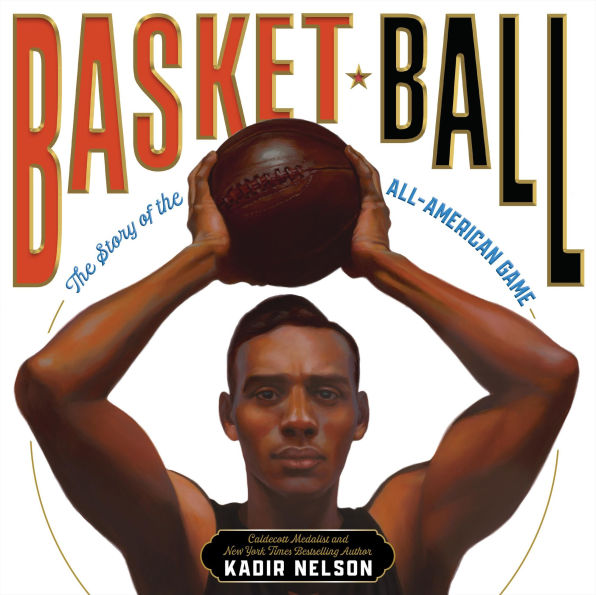
Basket Ball: The Story of the All-American Game by Kadir Nelson (Little, Brown Books for Young Readers, 112 pages, grades 4-8). This history of basketball starts with a chapter called Pregame that describes the invention of basketball on a rainy winter’s day in 1891 in Springfield, Massachusetts. In four quarters, Kadir Nelson takes readers through the history of the game from that point, focusing especially on Black contributions. There’s a chapter on the development of the NBA, another called The Revolutionaries that profiles some of the greats of the sport, and one that looks at winning teams over the years. The section labeled Halftime tells about the American Basketball Association (ABA) that only lasted a decade but had an outsized influence on the NBA. A final chapter called Overtime gives a brief history of women’s basketball. Includes an author’s note, timeline, glossary, index, and lists of notes and sources.
This book will fly off the shelves at my school. The cover is eye-catching, and Kadir Nelson’s illustrations capture the speed, motion, and excitement of basketball with plenty of portraits of players many readers idolize. The text is written in an easy conversational tone, perfect for the subject, but there’s a lot of it, and I’m guessing many kids will focus on the illustrations. I’d love to see the final chapter, which felt a little tacked-on, expanded into an entire book about women’s basketball.
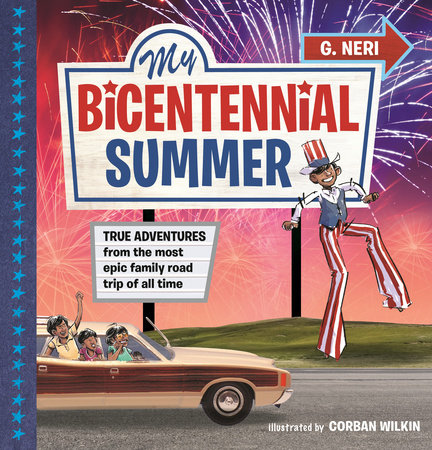
My Bicentennial Summer: True Adventures from the Most Epic Family Road Trip of All Time by G. Neri, illustrated by Corban Wilkin (Candlewick, 96 pages, grades 2-6). The summer G. Neri was eight years old, two things happened: America threw itself an epic 200th birthday party and his family decided to take a road trip to from southern California to Washington, D.C. and back again to be part of the celebration. In a 1967 wood-paneled station wagon (10 miles per gallon) and a pop-up tent trailer, Neri and his parents and two older brothers set off. The story is told in a scrapbook style, with illustrations of the family and cartoon bubbles drawn atop photos of the sights they saw. Taking the southern route to head east, they arrived in D.C. in time for a parade on July 3rd, then scrambled to Philadelphia for another one on the Fourth. They somehow got lost and wound up watching the People’s Bicentennial, which was a alternative protest parade, but that proved to be an interesting lesson as well. After catching the fireworks in Philly, they headed back west via the northern route, finishing up with a luxurious stay in Las Vegas before arriving home after seven weeks away. Neri ended up with plenty of material for “What I did over my summer vacation,” as well inspiration to live a life of travel and adventure. Includes an author’s note, facts about the United States, a list of big questions (with partial answers) about American history, additional information about traveling, and a list of recommended reading.
As a veteran of both the Bicentennial (as a child) and some fairly epic family road trips (as an adult), I couldn’t wait to get my hands on this book, and it surpassed my expectations. I thought it might be an exercise in nostalgia that wouldn’t be of much interest to 21st-century kids, but it captures the excitement, boredom, mishaps, and ultimate rewards of a long road trip in any era. As a biracial family traveling in the 1970’s, the Neris got into a few sketchy situations, and the author doesn’t shy away from noticing inequalities in the country. Ultimately, though, he celebrates America, the Founding Fathers, and the ideas of democracy, while emphasizing the need to protect and build on those ideals.
 A Kids Book A Day
One thought on “History books kids will want to read”