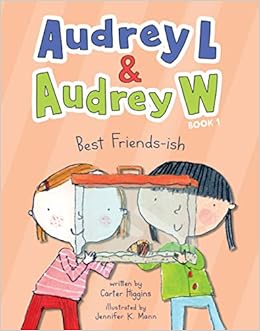
Best Friends-ish (Audrey L. & Audrey W. book 1) by Carter Higgins, illustrated by Jennifer K. Mann

Published by Chronicle Books

Audrey L and Audrey W: Best Friends-ish: Book 1 (Audrey L & Audrey W, 1):  Higgins, Carter, Mann, Jennifer K.: 9781452183947: Amazon.com: Books

Summary:  Audrey is struggling a bit with second grade, since her former best friend Diego has found himself some new friends.  Audrey feels like she’s kind of average, and wishes she could be the best at something.  When her teacher announces that there’s going to be a new girl in the class, Audrey’s not sure how she feels, especially after learning that the new girl’s name is also Audrey, and the original Audrey will now be known as Audrey L.  Audrey L. is chosen to be the Welcome Ambassador for Audrey W.  She bakes the new girl a cake (baking being something that she is actually good at), but then drops it on the floor.  Audrey W. is nice about it, though, and before long it seems like the two Audreys might become friends.  But second grade is not always easy, and the new friendship proves to be something of a roller coaster ride.  Things are cemented in the final chapters, and the ending offers promise that a book 2 could be in store.  184 pages; grades 1-4.

Pros:  A winning early chapter book that really captures the emotions of early elementary school.  Both Audreys suffer some insecurities, but are basically kind, and you will be rooting for their best friendship to emerge after a series of false starts.  The illustrations by Jennifer Mann add excellent visuals to the story.

Cons:  I did not know that it was bad for hermit crabs to paint their shells (although it makes sense), so the horror the girls felt in that part of the story was kind of lost on me.

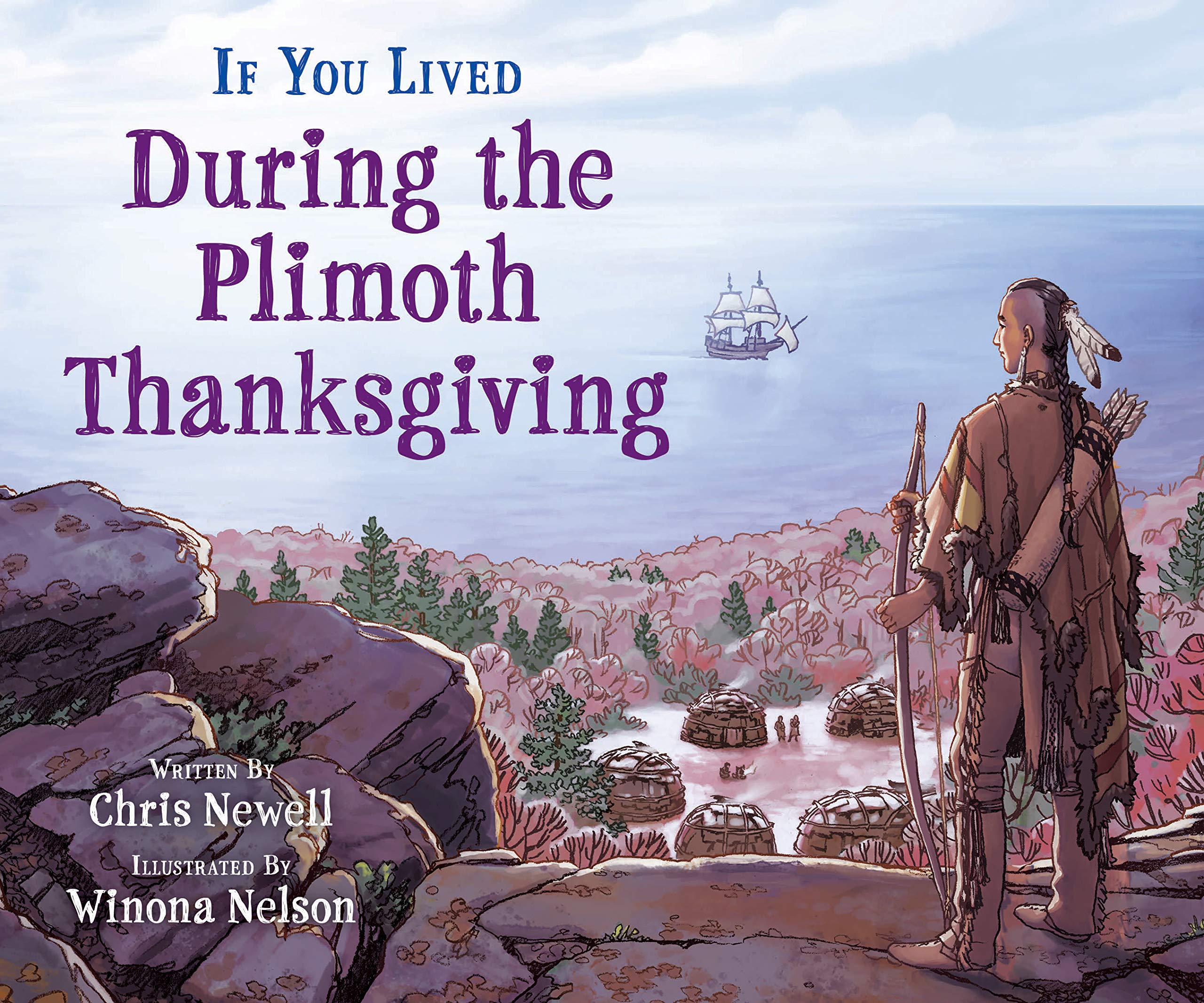
If You Lived During the Plimoth Thanksgiving by Chris Newell, illustrated by Winona Nelson

Published by Scholastic

If You Lived During the Plimoth Thanksgiving: Newell, Chris, Nelson,  Winona: 9781338726374: Amazon.com: Books

Summary:  Those of us who grew up reading Scholastic’s books like If You Sailed on the Mayflower in 1620 or If Your Name Was Changed At Ellis Island will recognize the question-and-answer format of this book that traces the history and culture of the Wampanoag people, the Europeans who sailed on the Mayflower, and what happened when their paths crossed.  This story does not end with the 1621 harvest feast that these groups shared, but continues on to what happened in the years afterward as Europeans increasingly moved onto indigenous lands and killed many of the people with wars and disease.  It also tells how Thanksgiving came to be a national holiday, more than 200 years after the event it purports to celebrate, and concludes with a discussion of American holidays  (or the lack of them) that recognize indigenous people.  Includes a glossary.  96 pages; grades 2-5.

Pros:  I enjoyed these books as a kid, and this one provides a much-needed correction to the traditional Thanksgiving story, with a greater emphasis on the Wampanoag history and culture, and a look at some of the history after 1621.  Definitely a resource that should be added to elementary school classrooms and libraries where Thanksgiving is part of the curriculum.

Cons:  Given the many, many questions around the traditional telling of the history of Thanksgiving, I was disappointed that this book didn’t include source notes, additional reading lists, or any information about the author. 

Lotería by Karla Arenas Valenti, illustrated by Dana SanMar

Published by Knopf Books for Young Readers

Lotería: Valenti, Karla Arenas, SanMar, Dana: 9780593176962: Amazon.com:  Books

Summary:  When Life and Death decide to play a game of Lotería, they choose Clara as the human whose life will hang in the balance.  The two discuss fate versus free will as they deal cards with symbols that start to affect Clara’s life.  When a seemingly random series of events leads to tragedy for Clara’s younger cousin Esteban, she vows that she will take care of him no matter what.  This promise ends up leading them both into the mythical land of Asrean where the struggle for both of their lives and souls continues.  Although Lotería has an ultimate winner, Clara’s life takes a most unexpected turn that blurs the line between life and death.  Includes additional information about magic realism, the Aztec folklore in the story, and the game of Lotería.   320 pages; grades 4-7.

Pros:  By now you may be onto the fact that I am trying to read as many award contenders as I can before the end of the year, and this one will undoubtedly be considered for both Newbery and Belpré.  The philosophical questions raised make it a great choice for a book discussion, and the folklore and Mexican culture are beautifully woven into the story.

Cons:  If you like an unambiguously happy ending, you may want to look elsewhere.

A Place to Hang the Moon by Kate Albus

Published by Margaret Ferguson Books

A Place to Hang the Moon: Albus, Kate: 9780823447053: Amazon.com: Books

Summary:  We first meet William, Edmund, and Anna at the funeral of their grandmother, a cold woman no one really misses, except for the fact that she was their last living relative.  The three orphans are determined to stay together, and decide to take the advice of their solicitor and evacuate London with a group of children from a local school, hoping to find a permanent family.  Their first foster parents seem okay, but have twin sons who are nasty bullies.  When Edmund puts a dead snake in one of their beds, the boy takes revenge in a way that gets all three kids kicked out of the house.  They next land at the home of an impoverished woman with four small children whose husband is at war, and whose hard circumstances make her unloving at best and downright cruel at worst.  Their one refuge is the library and the kind librarian, Mrs. Műller, who’s shunned by the village because her missing husband is suspected to have Nazi sympathies.  When disaster strikes at the second foster home, the children naturally gravitate to Mrs. Műller, hoping to finally find a family with her.  Includes a list of the many books mentioned in the story.  320 pages; grades 3-7.

Pros:  Please do not even attempt to read this book until you have access to a cozy fire, warm slippers, and a nice cup of tea.  Then settle in and prepare yourself for this year’s most enjoyable comfort read.  If The War That Saved My Life was a little heavy for you, this will be absolutely perfect.  I’m not sure that it’s quite Newbery caliber, but it is #8 on the Goodreads list right now.

Cons:  The ending was a little predictable…although totally satisfying.

The Last Cuentista by Donna Barba Higuera

Published by Levine Querido

Amazon.com: The Last Cuentista: 9781646140893: Higuera, Donna Barba: Books

Summary:  With Halley’s Comet hurtling towards Earth, Petra and her family are among a small group chosen to travel to the planet Sagan, a journey that will take over 300 years.  They’re put into a deep sleep, with people on board who will look after them and keep creating a new population of caretakers.  Alas, not only does a group called the Collective take over the ship, but something goes wrong with Petra’s sleep.  When she wakes up, she learns that she is the only one left who remembers life on Earth.  Petra is determined to help the other kids in her group remember, and she begins telling them the cuentos (stories) that she learned from her Mexican-American grandmother.  Although she does her best to blend in, members of the Collective soon become suspicious of Petra, and she realizes it’s up to her to lead an escape plan and try to find the group of Earthlings who were scheduled to arrive first.  It’s not clear whether or not Petra and the other kids make contact, but the book ends on a hopeful note.  336 pages; grades 5-8.

Pros:  This beautifully written book explores what it means to be human and the important contributions different cultures and stories make to that humanity.  It’s a rare year that a science fiction books wins the Newbery, but this could definitely be a contender for that award, as well as for the Pura Belpré.

Cons:  Would people in 2061 really name a planet after Carl Sagan?

Mock Caldecott 2022


Are you doing a mock Caldecott in your classroom or library this year? It’s something I’ve done for the last few years. In my previous job, I would book talk about 20 books and leave them in the classroom for the kids to read over the course of a week, voting on their top three choices. This year, I’m reading some of the contenders each week to second and third graders, then having a vote at the end.

To prepare for my own event, I put together a PowerPoint slideshow that I’m selling for $5.00 on Teachers Pay Teachers. It includes a simple introduction to the Caldecott Medal and 22 books with a picture of each book’s cover, information about the authors (including some links to interviews), and what to look for in the illustrations. The slides are editable so you can take out ones you don’t want to use, add others, or change the information.

Click on the picture at the top to head over to Teachers Pay Teachers and take a look.

I hope to have one for the Newbery available in the next week or so. Enjoy, and please feel free to put any feedback in the comments.

Saturday at the Food Pantry by Diane O’Neill, illustrated by Brizida Magro

Published by Albert Whitman and Company

Saturday at the Food Pantry: O'Neill, Diane, Magro, Brizida: 9780807572368:  Amazon.com: Books

Saturday at the Food Pantry: O'Neill, Diane, Magro, Brizida: 9780807572368:  Amazon.com: Books

Summary:  When the food supply dwindles at Molly’s house, her mother tells her they’re going to the food pantry on Saturday.  “Everybody needs help sometimes,” says Mom, lifting her chin a little higher.  Waiting in line, Molly says hi to Caitlin, a girl from her class, but Caitlin turns away.  When Molly walks over to her, Caitlin says she doesn’t want anyone to know she and her grandmother are there.  Molly convinces Caitlin to draw pictures with her while they wait in line, and they cheer people up with their creations.  Inside, Molly and Mom fill their cart, and they walk out with Caitlin and her grandmother, who turn out to be neighbors.  They decide to eat lunch together, the adults sharing stories of job loss and illness, and the two girls remembering how their drawings made people happy.  Includes a note about food insecurity from Kate Maher, CEO of the Greater Chicago Food Depository.  32 pages; ages 4-8.

Pros:  A realistic look at what it’s like to shop at the food pantry with important messages addressing the stigma that kids might pick up on from adults.  

Cons:  There are too few books that address issues faced by low-income families.

Saving Sorya: Chang and the Sun Bear by Trang Nguyen, illustrated by Jeet Zdung

Published by Dial Books

Saving Sorya: Chang and the Sun Bear: Nguyen, Trang, Zdung, Jeet, Zdung,  Jeet: 9780593353639: Amazon.com: Books

Summary:  The author based this story on her life, portraying herself as a young girl named Chang who commits to becoming a wildlife conservationist after witnessing people extracting bear bile on a bear farm.  As she grows up, she’s given little encouragement due to her gender and age, but she persists in her goal, and eventually is accepted as a volunteer for an organization called Free the Bears.  There she meets a sun bear cub named Sorya and takes on the task of reintroducing her to the wild.  This proves to be a long process, since Sorya is shy and becomes attached to Chang.  Again, Chang’s persistence pays off, and after many months, Sorya gradually goes back to the wild.  Chang misses her friend, but is happy that Sorya is where she belongs.  128 pages; grades 3-7.

Pros:  This unusual graphic story features gorgeous artwork showing the forests of Vietnam and an inspiring story about a determined young woman who is able to make a difference with her conservation work.

Cons:  The scene at the bear farm is a bit disturbing.

Circle Under Berry by Carter Higgins

Published by Chronicle Books

Amazon.com: Circle Under Berry: 9781797205083: Higgins, Carter: Books

Summary:  Nine shapes of different colors are introduced on the front endpapers; nine animals created from those shapes appear on the back ones.  These 18 objects are used to demonstrate prepositions and the concepts they denote.  The yellow circle is under the red berry on one page; the berry is under a green square on the next.  Sometimes an object is referred to by its shape, sometimes by its color, and sometimes by its animal name.  The concepts of right and left, here and there, and up and down are all introduced as well.  The last pages circle back to the first with the circle under the berry and the berry over the square.  52 pages; ages 3-6.

Pros:  A concept book featuring collage art on the white backgrounds brings to mind Eric Carle, and this book will surely appeal to a similar audience.  It has board book covers with paper pages, making it a good early book for young children.  Kids will love the animals and identifying shapes and colors.

Cons: 52 pages felt a little long for preschoolers.

It Fell from the Sky by the Fan Brothers

Published by Simon and Schuster Books for Young Readers

It Fell from the Sky: Fan, Terry, Fan, Eric, Fan, Terry, Fan, Eric:  9781534457621: Amazon.com: Books

Summary:  When a marble falls from the sky, the insects are amazed.  They spend the day speculating on what this marvelous object might be.  The next morning, they discover that the thing is caught in Spider’s web.  Spider claims it now belongs to him, and no one can remember whether or not the web was there before.  Soon, Spider has created WonderVille, a place to come see the amazing object that fell from the sky.  Spider gets wealthier, but also greedier, and eventually animals stop coming.  Then the worst happens: a hand reaches down from space and grabs the marble.  But Spider has a plan: after building another web, he patiently waits for other objects to fall into it.  His persistence pays off, and soon WonderVille is launched again, this time freely available to all.  56 pages; ages 4-9.

Pros:  The Fan Brothers have done it again, creating amazing illustrations that seem to pop off the page.  Their use of color helps tell the story: most of it is in black, gray, and white, with only the marble and the leaves Spider collects in color.  The last few pages, when everyone can enjoy Spider’s wonders, are in full color.

Cons:  Most of the insects were male; Luna Moth was the only one referred to as “she”, Her reaction to the marble was to try to keep it warm and hatch it, which seemed a little stereotypical.