Captain Pug: The Dog Who Sailed the Seas by Laura James, illustrated by Eglantine Ceulemans

Published by Bloomsbury
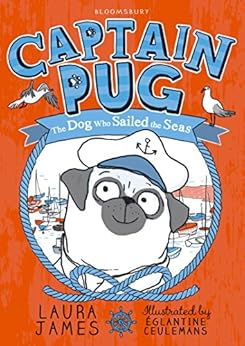
Summary:  Lady Miranda and her pug Pug have been invited to a birthday party at the lake.  Despite his new captain’s uniform, Pug’s not crazy about the water, but he likes the fact that there’s lots of picnic food around.  He dives into a basket for a closer look, but accidentally gets stuck inside and carried off by the Picnic Lady onto a bus.  Thus begin Captain Pug’s adventures.  He serves as the coxswain on a crew boat, and gets rowed out to a cruise ship where he meets a real sea captain.  All the while, Lady Miranda is searching everywhere for her beloved pet.  An errant seagull finally leads her to Pug’s ship, where she makes quite a splash.  Girl and dog are reunited and head back home…until their next adventure.  128 pages; grades 1-3.

Pros:  Fans of Mercy Watson and Princess in Black will enjoy this funny early chapter book, with plenty of illustrations and not a lot of text on each page.

Cons:  I just can’t warm up to pugs.
Martin’s Dream Day by Kitty Kelley, photographs by Stanley Tretick

Published by Atheneum Books for Young Readers


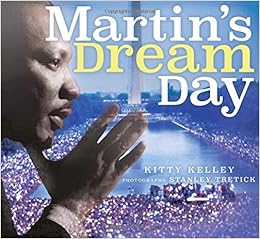
Summary:  Written to highlight photos by Look photographer and JFK favorite Stanley Tretick, this book focuses on Martin Luther King, Jr.’s “I Have a Dream” speech.  King is showed on the first page, nervous as he prepares to address 250,000 people at the Lincoln Memorial.  From there, the text and photos go back to explain King’s role in Civil Rights movement.  He is shown with John F. Kennedy, along with quotes from Kennedy urging Congress to pass his civil rights bill.  When Congress did nothing, King began to organize the March on Washington.  Photos are shown of individuals and crowds at the march, culminating with quotes from Martin Luther King’s speech.  On the last page, the reader learns of the passage of the Civil Rights Act of 1964 and the Voting Rights Act of 1965. Includes an author’s note and three websites with additional information.  40 pages; grades 1-5.

Pros:  A good introduction Martin Luther King, Jr.’s most important speech and the history behind it.  Seeing the author was Kitty Kelley–yes, that Kitty Kelley–I kept looking for gossipy passages about some King or Kennedy scandal, but don’t worry, you can safely read this to your first-grader.  The many photos bring an immediacy to the story and provide faces of real people instead of just the huge crowds.

Cons:  There could have been a lot more additional resources given.

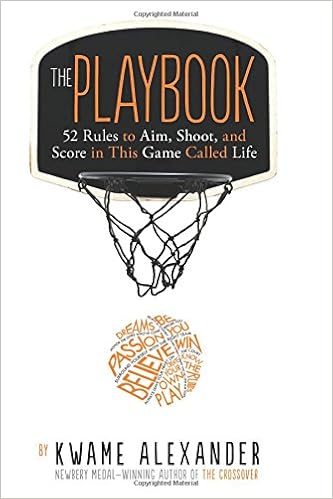
The Playbook: 52 Rules to Aim, Shoot, and Score in This Game Called Life by Kwame Alexander, photographs by Thai Neave

Published by HMH Books for Young Readers

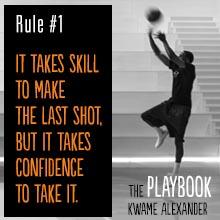
Summary:  Kwame Alexander begins this book with his own athletic journey from basketball to football to tennis, where he finally found the sport that made him a high school champion.  After this introduction, the book is divided into four quarters, like a game, entitled Grit, Motivation, Focus, and Teamwork.  Each section begins with a profile of an athlete who personifies that trait, then there are 13 rules, each one accompanied by a drawing or photo of an athlete, and an inspirational quote.  Alexander refers to the rules as “poems”, but that feels like a bit of a stretch.  The quotes are mostly from athletes, but a few other celebrities like Oprah Winfrey and Michelle Obama are included. 176 pages; grades 5-8.

Pros:  Anyone looking for a little inspiration will find plenty of it in these pages.  Young athletes will particularly enjoy the sports stories and quotes.  The sharp black, orange, and gray graphics are similar to the covers of Alexander’s books “The Crossover” and “Booked”.

Cons:  This feels more like a graduation gift or self-help seminar than an actual reading experience.

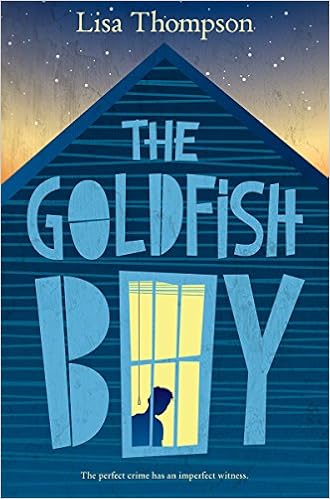
The Goldfish Boy by Lisa Thompson

Published by Scholastic

Summary:  12-year-old Matthew almost never leaves the house due to his incapacitating OCD.  Petrified of germs, he spends most of the day in his room, watching his neighbors and taking notes on their comings and goings.  So when a little boy disappears from his grandfather’s front yard, it turns out Matthew was the last person to see him.  He decides he is going to solve the mystery.  Reluctantly at first, he enlists the help of Jake and Melody, two kids from his grade who live in the neighborhood.  As the story unfolds, the reader gradually learns of Matthew’s guilt over his own baby brother’s death, and how this has led him to choose his sterile, lonely existence.  By the end of the book, the case has been solved, Matthew has made a couple of new friends, and he is beginning to take the first steps toward recovery.  320 pages; grades 4-7.

Pros:  A suspenseful mystery, told with understated humor in Matthew’s British voice.  Readers will empathize with Matthew’s seemingly strange behavior, and cheer him on as he starts to uncover the demons that have plagued him for much of his life.

Cons:  I cringed at the scenes where Matthew washed his hands until they cracked and bled.

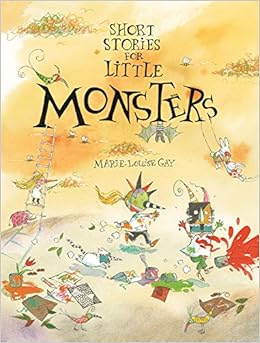
Short Stories for Little Monsters by Marie-Louse Gay

Published by Groundwood Books


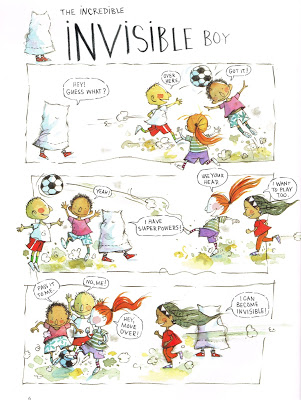
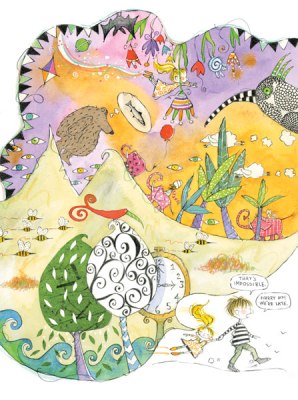
Summary:  19 stories are 48 pages, each one a two-page spread with plentiful illustrations.  All kinds of critters are featured, from “The Secret Life of Rabbits” to “What Do Trees Talk About?” to “Snail Nightmares”.  There are also plenty about humans, including “The Incredible Invisible Boy” and “Zombie Mom”.  Many of the stories are told in panel format, similar to graphic novels.  Readers will enjoy studying some of the more complex illustrations, such as the one showing where a rabbit goes when he jumps down a hole or what a little girl sees when she closes her eyes.  The endpapers feature a colorful parade of kids and animals.  48 pages; grades K-3.

Pros:  A charming and witty book that will definitely be appreciated by kids of all ages. The stories are funny, the illustrations complement them perfectly, and the comic book format is appealing.

Cons:  Wait, is the title implying that kids are monsters?

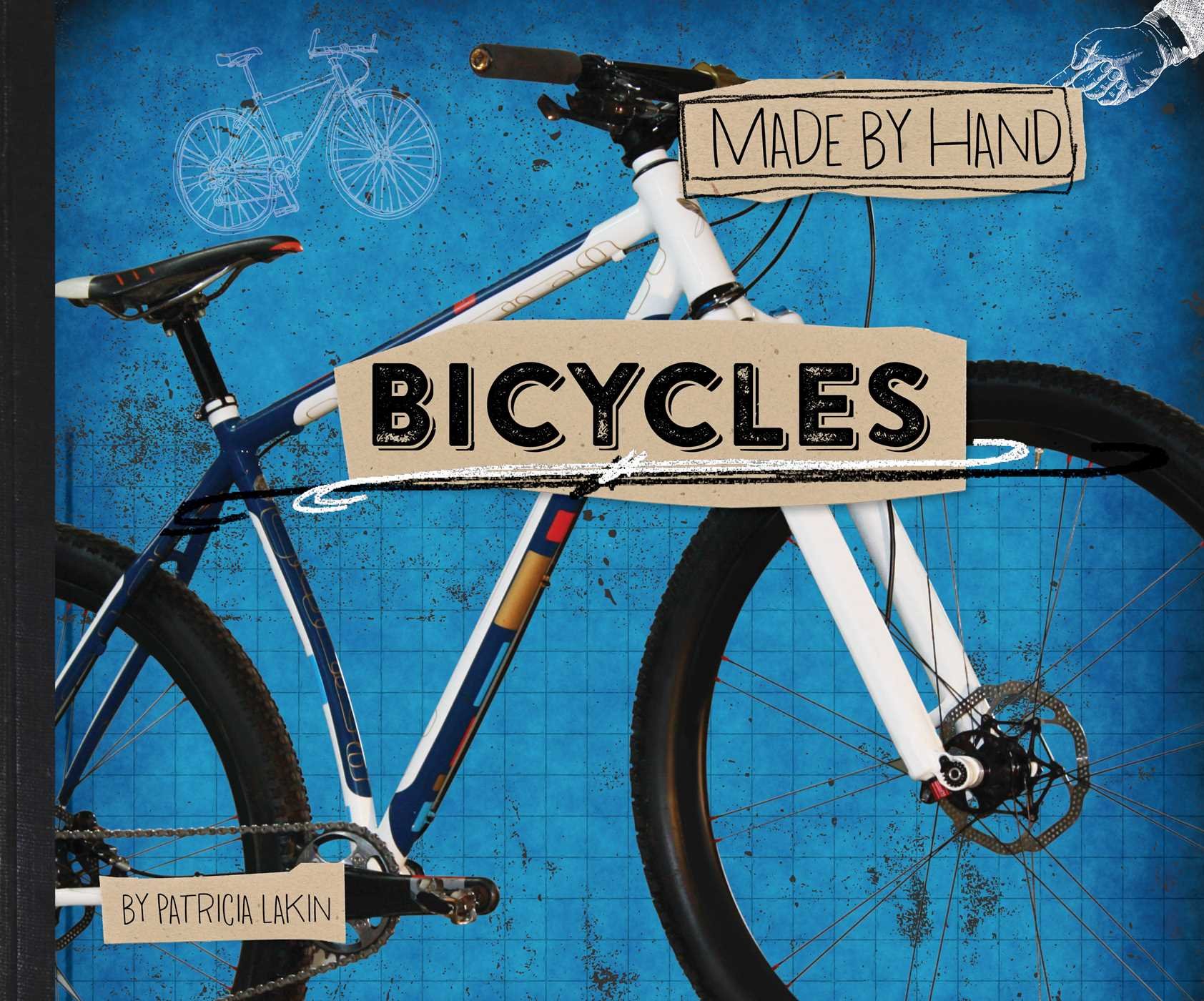
Bicycles by Patricia Lakin

Published by Aladdin

Summary:  Aaron Dykstra is a craftsman who creates handmade bicycles and sells them through his company, Six Eleven Bicycle Company (named for the 611 train that was supposedly the best and most beautifully designed).  The first few pages of this book give a history of the bicycle and a brief biography of Dykstra and how he came to be a bicycle maker.  Then the reader is shown the twenty steps of his creation process, from getting the customer’s specifications to the final item rolling out of the shop.  There’s a photo of each step, with a short caption explaining the process.  The next two pages tell about Aaron’s program for middle school students, The Making Foundation, and invite readers to try creating by hand.  Finally, there is a four-page timeline of the bicycle, followed by a glossary and resources (books and websites).  32 pages; grades 3-7.

Pros:  A perfect complement to any makerspace program.  A second book in the series, Skateboards was published simultaneously.  The book’s design has the feel of a blueprint or how-to manual, and the photos and biographical information about Aaron make the creation process appealing.

Cons:  I looked at Aaron’s website, and he requires a $1500 deposit before starting on a bike.

Ivy by Katherine Coville

Published by Knopf Books for Young Readers

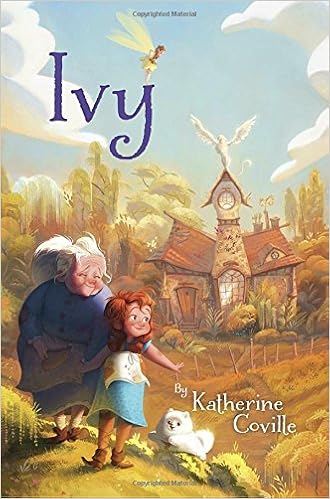
Summary:  Ivy and her grandmother live in the messiest cottage in Broomsweep…messy, because her grandmother is Meg the Healer, whose large garden and knowledge of plant medicines have made her a famous doctor of humans and animals.  Rumor has it that the new queen is traveling through her kingdom to find the best town.  Ivy and Grandmother are under pressure from the mayor’s wife to get their property up to the standards of the rest of Broomsweep.  When an injured griffin, a dragon with a severe head cold, and a flock of pixies arrive, cleaning up seems like an impossible task.  But Grandmother assures Ivy it will all work out.  And when four trolls invade the village at the same time the queen shows up unexpectedly, it all (eventually) does.  144 pages; grades 2-4.

Pros:  A cozy fantasy with a fairy-tale feel and a happily-ever-after ending.  A large font and plenty of illustrations make this a good choice for early chapter book readers who are ready to move on from the Magic Tree House.

Cons:  Not too many surprises in this fairly predictable tale.

Math Lab for Kids: Fun, Hands-On Activities for Learning with Shapes, Puzzles, and Games by Rebecca Rapoport and J. A. Yoder

Published by Quarry Books

Summary:  37 labs in nine chapters introduce a wide variety of mathematical topics, such as geometry, topology, fractals, and graph theory.  Each chapter begins with a “Think About It” question to be considered before diving into the labs.  Each lab includes a materials list, a boxed math fact, instructions, and diagrams.  The activities seem like simple games, puzzles, and craft projects, but don’t be fooled, constructing with toothpicks and gumdrops can lead to a greater understanding of antiprisms and Platonic solids.  In the authors’ introduction, they state that the activities have been tested on kids ages 6-10, but can be enjoyed by middle school students, high school students, and adults.  Back matter includes pull-outs to use with a few of the labs, hints and solutions for many of the labs, and an index. 144 pages; grades 2+

Pros:  “Mathematicians play,” the authors state in their introduction.  If you think you hate math, or you know a child who hates math, this book may be just the remedy.  Every activity looks like fun and is simple to set up, yet leads to a mathematical way of looking at the world.  The colorful photos of kids engaged in the activities and the simple, clear diagrams add to the fun.

Cons:  My neighbors may call for reinforcements when I head outside with five feet of string, two broomsticks, and some chalk to draw a giant ellipse in my driveway.

Anywhere Farm by Phyllis Root, illustrated by G. Brian Karas

Published by Candlewick

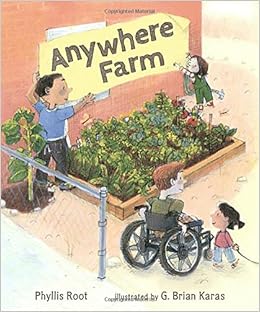
Summary:  A celebration of gardening and plants, told in rhyming text.  Gardens can be anywhere: “An old empty lot/makes a good growing plot. But a pan or a bucket,/a pot or a shoe,/a bin or a tin, or a window will do.”  You just need seeds, dirt, water and sunlight to grow all kinds of things.  The landscapes shown are mostly urban, and the gardens range in size from small containers to large plots.  If enough people in your community get inspired, the anywhere farm might just turn into an everywhere farm.  32 pages; ages 2-7.

Pros:  Perfect for springtime, the rhymes are extra catchy and would be fun to read aloud.  The gardeners come in all shapes, sizes, ages, and colors, and the gardens are equally diverse.

Cons:  The whole gardening process is a bit oversimplified.

Well, That Was Awkward by Rachel Vail

Published by Viking Books for Young Readers

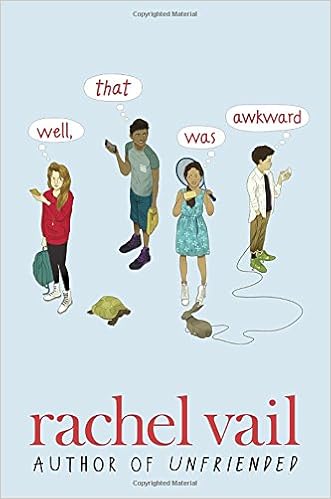
Summary:  In this modern-day middle school retelling of Cyrano de Bergerac, Gracie discovers quite unexpectedly that she has a crush on her friend A.J.  When A.J. is asked in a convoluted series of maneuvers which girl he likes, it turns out to be Sienna, Gracie’s pretty, sporty best friend.  Gracie has grown up with parents who lost their first daughter at a young age, so she knows it’s important to keep people happy and never let on when you’re feeling upset.  When Sienna feels awkward about texting A.J., Gracie takes over as the voice of Sienna, pleasantly surprised by how witty A.J.’s texts are.  She’s able to comfortably report all this to Emmett, the vertically-challenged boy next door who has been her best friend since preschool.  Secret identities are revealed, feelings are hurt, and relationships shift cataclysmically at a single eighth grade party, as Gracie realizes that being 14 is way harder than being 13 ever was, but maybe more rewarding as well.  320 pages; grades 5-8.

Pros:  Middle schoolers will zip through this fresh and funny novel.  There are no big surprises about who ends up with whom, but the realistic characters and settings, as well as Gracie’s  slightly sarcastic but caring voice will keep them hooked until the end.

Cons:  Gracie’s and Emmett’s constant quipping Got. Kinda. Old.