Don’t Call Me Grandma by Vaunda Micheaux Nelson, illustrated by Elizabeth Zunon

Published by Carolrhoda Books 

Summary: Great-Grandmother Nell is 96 years old, and prickly enough to be kind of scary. Yet clearly her great-granddaughter, who narrates this book, loves her and is fascinated by her.  Great Grandmother insists on being called Great Grandmother.  She may be old, but she is still stylish, occasionally inviting her great granddaughter into her room for a little practice applying lipstick and wearing perfume.  Great Grandmother claims to remember every day of her 96 years, including the day her heart was broken when her best friend said they couldn’t be friends anymore because of Nell’s brown skin.  A wordless two-page spread shows some of her other memories, like the March on Washington and a performance by the Alvin Ailey dance company.  At the end, the narrator sneaks into her great grandmother’s room for a good night kiss while Great Grandmother is sleeping.  32 pages; grades 1-3.

Pros:  This is a great mentor text for characterization.  So many interesting details about Great Grandmother Nell really make her come alive for the reader, and also reveal a bit about the narrator.  The bold, colorful illustrations help flesh out both characters as well.

Cons: Some adult readers may be offended by the “glass with something that looks like apple juice” that Nell sips during the day and once offers to her great granddaughter.

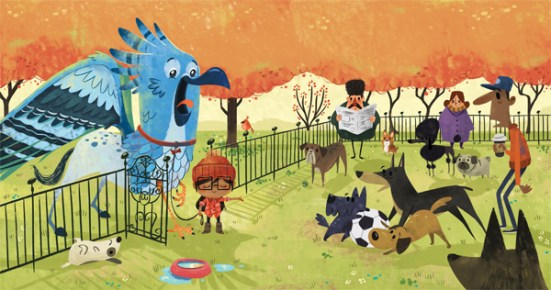
If I Had a Gryphon by Vikki VanSickle, illustrated by Cale Atkinson

Published by Tundra Books 

Summary: When the narrator of the story gets a pet hamster, she thinks it’s kind of boring—it only eats, sleeps, hides, and gets its shavings wet. Her imagination takes off as she starts to imagine the mythical creatures that might make really exciting pets.  The more she thinks about each one, though, the more she realizes it has a down side.  Unicorns are shy, a hippogriff could be disruptive at the dog park, a gryphon has to be flown every day without fail.  In the end, she concludes the hamster might not be so bad after all.  The final page clues the reader in that this may not be your ordinary hamster.  32 pages; ages 3-7.

Pros:  The rhyming text and colorful illustrations provide a fun introduction to a variety of mythical creatures.

Cons:  You might want to confirm the pronunciation of words like gryphon, kraken, and kirin before attempting this as a read-aloud.

Beatrix Potter & the Unfortunate Tale of a Borrowed Guinea Pig by Deborah Hopkinson, illustrated by Charlotte Voake

Published by Schwartz & Wade Books


Summary:  Told as a story letter (“My Dear Reader”) in a style similar to one Beatrix Potter used to use, this tale features a young Beatrix.  Not surprisingly, she enjoyed keeping numerous pets, and even borrowing others’ pets, mostly for the purpose of drawing and painting them.  She could be careless, though, and on one occasion, she forgot about a borrowed guinea pig, who proceeded to eat up most of her art supplies.  Unfortunately, these proved fatal for the cute little animal, and Beatrix was forced to go confess her mistake.  In an attempt at compensation, Miss Potter offered a watercolor drawing of the guinea pig, which was not received too graciously.  Although the story is about a young girl, the author’s note reveals that this incident happened when Beatrix Potter was 26 years old.

Pros:  This humorous tale includes quite a bit of historical information about Beatrix Potter’s life and how she got her start writing and illustrating her famous books.  The watercolor illustrations are clearly inspired by the Potter books.

Cons:  The whole killing the guinea pig thing is a little less of a chuckle when one finds out it was committed by a 26-year-old woman.


Oona Finds an Egg (Oodlethunks Book 1) by Adele Griffin illustrated by Mike Wu

Published by Scholastic 

Book trailer: https://www.youtube.com/watch?v=dVhK8kZN5w0

Summary:  Oona lives in a cave with her high-powered mother (she’s trying to market the newly-invented wheel), her father (he’s a laid-back hunter-gatherer who likes to cook), and younger brother, Bonk.  When Oona discovers a large egg, she hopes it will hatch into something that Bonk’s not allergic to. And that it won’t be interested in eating her and her family.  When she and Bonk have a fight, the egg mysteriously disappears, and Oona is heartbroken.  Using her wits and ingenuity, she figures out what happened and tracks down her unhatched pet just as the egg is starting to rock and crack a bit.  It breaks open, and out steps a baby…well, I can’t give everything away.  Book #2 comes out in September.  160 pages; grades 2-4.

Pros:  The Oodlethunks are a modern Stone-Age family, and 21st century kids will chuckle over the up-to-date reinventions of prehistoric life.  The author’s note at the end separates fact from fiction, explaining that much of the Oodlethunks’ village is based on ancient Colorado.  Fun illustrations.

Cons:  The geologic ages are a bit mixed up.

Pax by Sara Pennypacker, illustrated by Jon Klassen

 Published by Balzer + Bray 

Book trailer: https://www.youtube.com/watch?v=E8ErVnRt40I

Summary: When Peter’s father goes to war, Peter is sent to live with his grandfather. His father says that Peter’s pet fox, Pax, must be returned to the wild.  We see this happening from Pax’s point of view, and the story of what happens after that is told in chapters that alternate between Peter’s and Pax’s stories.  Peter realizes he has done a terrible thing, and runs away to try to rescue Pax.  A few days out, he breaks a bone in his foot, and is taken in by Vona, a woman whose own war experiences left her so scarred, both physically and emotionally, that she has withdrawn from the human race.  Meanwhile, Pax meets up with some foxes in the woods, and slowly, still desperately hoping for Peter’s return, starts to make a life for himself in the wild.  While Peter and Pax are on their journeys, the war is slowly encroaching into both of their lives, leading up to a climactic finale.  288 pages; ages 8-12.

Pros:  This beautifully written and illustrated story will undoubtedly be a 2016 awards contender.  Filled with love, hope, friendship, and healing, Pax is a book to savor and discuss.

Cons:  This sometimes felt a bit too much like a Book With A Message (see somewhat self-congratulatory book trailer).  A little infusion of humor wouldn’t have made the story any less powerful.

The Cat Who Came In Off the Roof by Annie M. G. Schmidt, translated by David Colmer

Published by Delacorte Books for Young Readers 

Summary:  Tibbles is feeling down after being scolded by his newspaper editor for his inability to write about anything but cats.  He’s distracted by his worries when he comes across a young woman who’s been chased up a tree by a dog.  After rescuing her, Tibbles invites her back to his house, where she proceeds to purr, rub her head on his shoulder, and finally settle down to sleep in a cardboard box lined with newspaper.  It comes as little surprise to learn that Miss Minou began life as a cat, and an unfortunate accident has turned her into a human.  She can still talk with cats, thought, and their little town has plenty of those, each one a source of news from the humans they live with.  When Miss Minou starts sharing her stories with Mr. Tibbles, his newspaper career takes off; that is, until he writes an article accusing the wealthiest man in town of some pretty dastardly deeds, witnessed only by cats.  No one believes his story, and his career is once again in jeopardy.  Meanwhile, Miss Minou has a one-time-only chance to return to her feline form.  Will the cats of the town be able to give this unlikely couple a happily-ever-after ending?  160 pages; grades 3-6.

Pros:  This charming story is a classic in the Netherlands, where the original, entitled Minoes, has been loved by children since 1970.  With a quirky but lovable cast of both feline and human characters, this would make a great read-aloud for kids from the primary grades on up.

Cons:  The wealthy villain bore an unfortunate resemblance to a certain billionaire presidential candidate.

Soar by Joan Bauer

Published by Viking Books for Young Readers

Book trailer: https://www.youtube.com/watch?v=C2meh6h7BaE


Summary:  Jeremiah has been through more than his share of difficulties, starting when he was abandoned by his mother at the age of nine months and continuing through a series of heart problems that ultimately resulted in a transplant.  Lucky for him, his mother left him in an office building where he was discovered by nerdy but loving Walter, who adopted him and has been by his side ever since.  Jeremiah’s greatest love is baseball, but his heart hasn’t gotten healthy enough for him to play.  When Walter and Jeremiah move to Hillcrest, Ohio, they look forward to cheering on the town’s championship baseball team.  Within days of their arrival, though, scandal has swept through the town, shutting down the team.  When Jeremiah discovers a few kids at his middle school who still love to play, he gets the idea to become their coach.  Step by inching step, the kids work together to build a middle school team and to repair the damage done to Hillcrest.  With Jeremiah leading them on, the Hillcrest Eagles prove there’s more than one way to have a winning team, and that talent isn’t nearly as important as heart.  304 pages; grades 4-7.

Pros:  “You’re weird…but I like you,” says one of Jeremiah’s teammates, perfectly capturing Jeremiah’s voice as he narrates this story.  Quirky, humorous, and refusing to be kept down, Jeremiah gives the people of Hillcrest and the readers of Soar plenty to cheer about.

Cons:  Occasionally Jeremiah seems a bit unbelievably wise and mature for a sixth-grader.


Shape Shift by Joyce Hesselberth

Published by Henry Holt and Company

Summary:  A boy and a girl introduce nine shapes: triangle, semicircle, crescent, trapezoid, rectangle, circle, oval, diamond, and square.  Then they start putting the shapes together to see what they look like.  A triangle on top of a semicircle can look like a ballerina or an elephant with a thousand balloons on his back.  A crescent on top of a trapezoid?  A bull ready to charge or a fish jumping in the sea.  The final two pages show twelve shape combinations and ask readers what they see.  32 pages; ages 2-6.

Pros:  A fun introduction to shapes that will have kids looking for geometry in their everyday lives.

Cons:  According to other reviews, the author has created two apps to explore shapes and colors, but they’re not mentioned anywhere in the book.

Bear is Not Tired by Ciara Gavin

Published by Knopf 

Summary: Bear is an enthusiastic member of a household of ducks. When the weather starts getting colder, Bear is determined to stay awake all winter so as not to miss out on anything.  But nature takes its course, and before long Bear is dozing off at meals and in the middle of games.  Mama Duck convinces him that he can’t fight who he is, and that, awake or asleep, he is still part of the family.  Finally, Bear settles into hibernation mode.  The ducks eat meals near him, and the baby duck snuggles up to sleep with Bear at naptime.  When spring comes, Bear awakens and enjoys sharing the pictures of what happened all winter long.  32 pages; ages 2-6.

Pros:  Cute watercolor illustrations enliven this gentle tale that would make a perfect bedtime story.

Cons:  There sure are a lot of picture books that feature cute bears hibernating.

First Step: How One Girl Put Segregation on Trial by Susan E. Goodman, illustrated by E. B. Lewis

Published by Bloomsbury 

Summary: In 1847, at the age of four, Sarah Roberts started at the Otis School in Boston, just a few blocks from her home. Soon, though, she was told by the police that she had to leave. The Otis was for white children, and Sarah was African American.  The school she could attend was further from her house, had no place to play, and owned a single book.  Sarah’s parents decided to fight the decision.  They took their case to the Massachusetts Supreme Court, where it became the first case in the nation in which a white lawyer and an African American lawyer worked together, and the first in which an African American lawyer argued a case in a supreme court.  They lost the case, but Sarah’s father didn’t give up.  He traveled around the state to gain support, and in 1855, Massachusetts became the first state to outlaw school segregation.  Goodman writes that the fight for justice is often like that, a few steps backward, then a few more forward. She concludes with the story of Linda Brown and how her experience with segregated schools, similar to Sarah Roberts’, led to the 1954 Supreme Court decision banning all segregated schools in the U.S.  Back matter includes a timeline, a follow-up on some of the people in the story, resources, and how a nonfiction book is researched and written.  40 pages; grades 1-4.

Pros:  This little-known story is an important and inspirational part of American history.  It’s told well, with beautiful illustrations.  The last two pages do a fabulous job of outlining the work and research that go into the creation of a nonfiction book.

Cons:  The coloring in the illustrations sometimes make it difficult to differentiate skin tones.  Maybe that was intentional, but I found it a little confusing.