Fuzzy Mud by Louis Sachar

Published by Delacorte Books for Young Readers 

Summary: Fifth-grader Tamaya and her seventh-grade neighbor Marshall always walk home from school together. One day Marshall, fearing he is about to be beat up by classroom bully Chad, tells Tamaya he knows a shortcut through the woods. Chad finds them anyway, and when he attacks Marshall, Tamaya scoops up some mud and throws it in Chad’s face. Unbeknownst to any of them, it’s “fuzzy mud” crawling with ergonyms created by an eccentric inventor looking to create a biofuel to replace gasoline for cars. The microscopic creatures multiply, slowly eating away the flesh on Tamaya’s hand and Chad’s face, and before long, an epidemic threatens their town. Sachar inserts Senate testimony on the disaster to give a larger perspective on the issue. Grades 4-8.

Pros: Michael Crichton for kids.  A real page-turning adventure, with several different layers, including questions about overpopulation, dangerous science, and doing the right thing. Readers will enjoy the fast-paced story and also find plenty to discuss.

Cons: While I love a happy ending, the denouement felt a little too quick and easy. On the plus side, I  got to use the word “denouement”.

It’s Tough to Lose Your Balloon by Jarrett J. Krosoczka

Published by Alfred A. Knopf

Summary: It’s tough to lose your balloon…but it’ll make Grandma smile when it floats past her airplane. It’s sad to drop your sandwich in the sand…but it’ll make some seagulls very happy. Jarrett Krosoczka looks at some tough childhood situations, and then turns them around to find the silver lining. His final advice? When life gives you rain…look for the rainbow! Ages 3-7.

Pros:  A good lesson in resiliency, something modern children are said to lack. It could be used as a writing prompt: think of a time something difficult happened and how you turned it into something positive.

Cons: As a child, the idea of my balloon floating up to the sky freaked me out. The cover of this book brought that all back.

Monkey Not Ready for Kindergarten by Marc Brown

Published by Alfred A. Knopf

Summary: Is Monkey ready for kindergarten? Well, he knows the alphabet and he can count to 12, but he’s still not sure. His parents take him shopping for a lunchbox and new sneakers, and his brother assures him that kindergarten is so much better than preschool. A few days before school starts, Monkey has a playdate with some of the kids from school, and it’s pretty fun. But the questions remain: what if his teacher doesn’t like him? What if there are no red crayons? What if he can’t find the bathroom? Finally, the big day arrives, and Monkey’s parents drop him off. Ready or not, Monkey is off to kindergarten. The last two wordless pages show a happy Monkey at work and at play in kindergarten. Ages 3-6.

Pros: This simple story will be reassuring to kids starting school. The illustrations and text look like they were done by a young child.

Cons: Mom and Dad Monkey are flirting a bit with the “helicopter parent” line.

Emu by Claire Saxby, illustrated by Graham Byrne

Published by Candlewick

Summary: After a female emu helps build a nest and lays eggs, her responsibilities are done. It’s up to the male to sit on the eggs for eight weeks, not even leaving to eat or drink, then to take care of the young hatchlings for over a year until they are ready to look for mates of their own. The Australian author-illustrator team that produced last year’s Red Kangaroo follows the life of a male emu as he waits on the nest, welcomes the new babies, and teaches them to fend for themselves. The text is written in two different fonts; one could be read aloud while the other gives additional related facts and information. A brief author’s note and index are included at the end. Grades K-3.

Pros: Sure “emu” is a good Scrabble or Boggle word, but there’s lots more to the world’s second largest bird.  One of the lesser-known Australian animals, it is nonetheless fascinating, and Emu has a lot of information for a picture book. The illustrations are unusual but striking and complement the text well.

Cons: I wasn’t crazy about the color pallet used for the illustrations.

The Not-So-Itty-Bitty Spiders (Olive & Beatrix) by Amy Marie Stadelmann

Published by Scholastic

Summary: Olive and Beatrix are twins, but not quite identical. Beatrix was born at exactly midnight when there was a full moon, so naturally, she’s a witch. Olive, the narrator of this story, was born a few minutes later, so is just an ordinary girl. One day Olive and her friend Eddie, a budding scientist, decide to play a trick on Beatrix involving a large number of spiders. Unfortunately, the spiders get into Beatrix’s growing potion, then head outside. The three kids have to round up the oversized spiders and use Beatrix’s magic to get them back to the normal size before they’re discovered by their parents. Ages 5-8.

Pros: Another entry from Scholastic’s Branches books. The sisters have a close bond, with the witchy magic twist adding a bit of extra interest. Much of the dialog is in the form of cartoon bubbles which, combined with plentiful illustrations, make this a manageable first chapter book.

Cons: Magically enhanced spiders.

Wrap-Up Wednesday: Girl-Powered Graphic Novels

Inspired by the success of Cece Bell’s El Deafo and Raina Telgemeier’s Smile and Sisters, there are some great graphic novels featuring girls this year.

Awkward by Svetlana Chmakova.  Published by Yen Press.

The title says it all.  Peppi and Jaime literally run into each other on the first day of middle school, then spend the first half of the book agonizing over how to become friends.  Perfectly captures those tough middle school emotions, with a realistically happy ending.

The Underground Abductor by Nathan Hale. Published by Harry N. Abrams

Nathan Hale’s latest Hazardous Tale is girl-powered by Harriet Tubman.  The compelling story of the Underground Railroad’s most famous conductor.

Sunny Side Up by Jennifer Holm, illustrated by Matthew Holm.  Published by Graphix.

It’s 1976, and Sunny’s unhappy to be suddenly forced to spend the month of August with her grandfather in Florida.  Flashback scenes reveal the family crisis that has led to her trip. Brother-and-sister team Jennifer and Matthew Holm team up for this family drama/comedy based on their own childhood experiences.

Roller Girl by Victoria Jamieson.  Published by Dial Books.

Astrid’s having best friend problems as she gets ready to middle school, but a summer of roller derby camp gives her new friends, increased self-confidence, and about a thousand bumps and bruises.  My personal favorite

.

Baba Yaga’s Assistant by Marika McCoola, illustrated by Emily Carroll

When Masha sees an ad for Baba Yaga’s assistant, she recalls her grandmother’s old stories about the witch and decides to apply.  Through skill, luck, and a little magical talent, she manages to prove herself worthy of the job while at the same time healing some of her difficult family relationships.

Walking Home to Rosie Lee by A. LaFaye, illustrated by Keith D. Shepherd

Published by Cinco Puntos Press

Summary: The Civil War is over, and Gabe wants to find his mama. She was sold by his master when Gabe was so young that all he can remember of her is her smell of jasmine, her good cooking, and the scarf she wore to cover up a scar she received as a punishment for trying to escape. For the first time in his life, Gabe is free to travel away from the plantation where he was a slave, and he sets off to find Mama. For months, he travels through the south, meeting other newly-freed slaves, following leads, and enduring crushing disappointments. One day, he sees a woman setting pies on the windowsill of a hotel, her long scarf trailing behind her. That night, he sleeps snuggled against his mama, hoping other boys will be as fortunate as he has been. Ages 8-12.

Pros: Told in Gabe’s distinctive voice (“Had me thinner than a leaf with the sorrow of it”), this story fills a gap in historical fiction picture books with its narrative about Reconstruction. The author’s note tells how Gabe’s story is representative of many newly freed slaves who sought to reunite with loved ones.

Cons: The history of the Civil War and the Emancipation Proclamation aren’t told here, so kids will need some background to understand Gabe’s story.

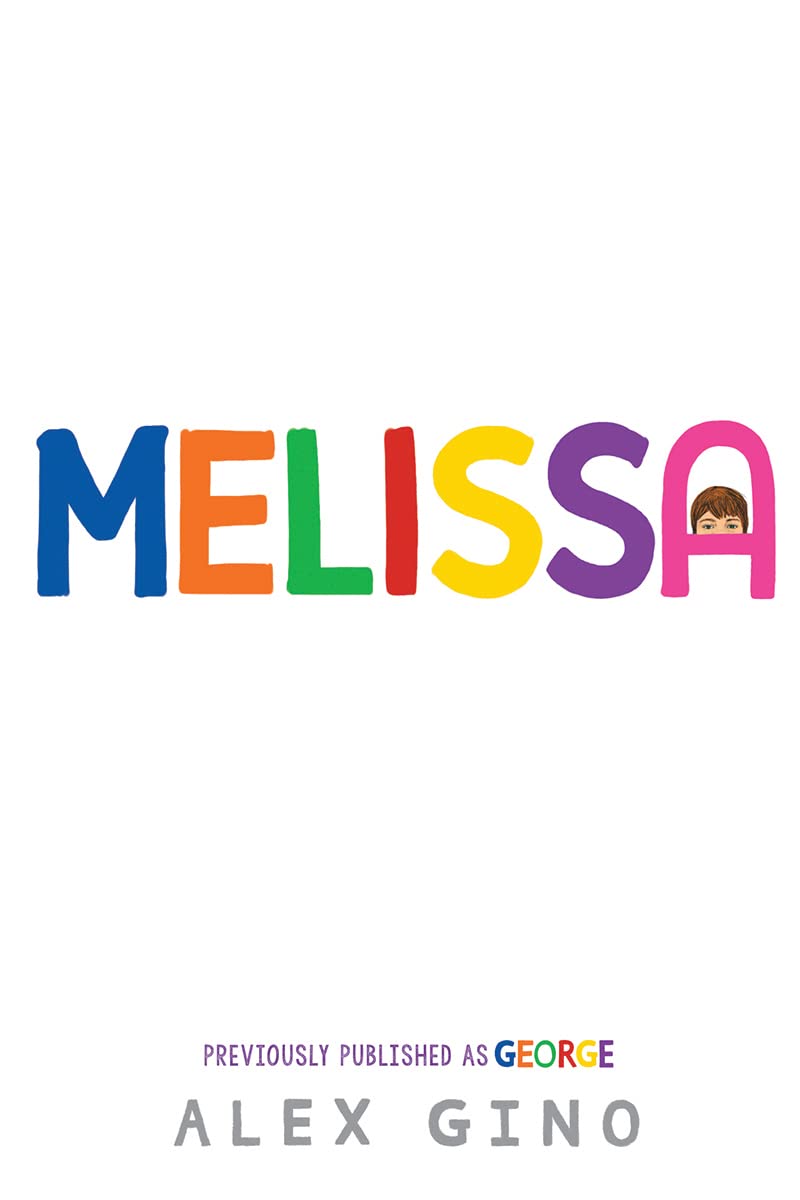
Melissa by Alex Gino

Published by Scholastic Press 

Amazon.com: Melissa (previously published as GEORGE): 9781338843408: Gino,  Alex: Books

Summary: George has a boy’s body, but she’s always felt she is a girl. She has a secret stash of magazines like Seventeen that she pores over to learn more about girls’ clothes, makeup, and lifestyles. Her fourth grade class is doing a play of Charlotte’s Web, and more than anything, George wants the part of Charlotte. Coached by her best friend Kelly, George decides to try out for Charlotte, but her teacher takes her audition as a joke and instead gives the part to Kelly. As a result of this painful experience, George finally comes out to Kelly, who hatches a plan to allow George to be Charlotte in one of the performances. Reactions to George in this clearly feminine role are mixed, but strong, and ultimately lead to a greater understanding of George by her mother and older brother. While there are no easy answers for George, the book ends on a hopeful note. Grades 4-7.

Pros: Whatever a reader’s views on transgender kids, this book makes a powerful statement about the importance of gender to personal identity, and how narrow society’s definition is on what is masculine and feminine. George would make an interesting read for educators  trying to create schools that are safe and comfortable for all students.

Cons: George addresses a controversial topic, and there will undoubtedly be those who feel it doesn’t belong in an elementary classroom or library.

The Fun Book of Scary Stuff by Emily Jenkins, pictures by Hyewon Yum

Published by Farrar Straus Giroux Books for Young Readers

Summary: A boy makes a list of his fears: monsters, ghosts, witches, and trolls. While reluctant to tell them to his two dogs at first, eventually he shares them one by one. For each, one of the dogs attempts to debunk the fear (ghosts are scared of dogs; how bad can witches be if they’re cooking food in their cauldron?). Eventually, the boy moves beyond his list to his cousin, the school crossing guard, and the ultimate: the dark. Even the dogs are afraid of the dark, but the boy reassures them and finds a simple solution for handling that fear. In the end, the list is put to rest, and everyone goes off for a dog biscuit or two. Ages 3-7.

Pros: Readers will relate to many of these fears, and appreciate the light-hearted ways they are dealt with. Most of the story is told in appealing cartoon-bubble dialog.

Cons: Despite the dog’s claims, I’m pretty sure trolls do exist.

Ruby on the Outside by Nora Raleigh Baskin

Published by Simon and Schuster Books for Young Readers 

Summary: Ruby has kept a big secret for many years: when she was five, her mother was arrested and sentenced to 20-25 years in jail. Since then, Ruby has lived with her aunt and gone to visit her mother in prison every weekend. She’s kept her distance from other kids because she doesn’t want them to know about her mom. The summer before middle school, Margalit moves into Ruby’s condo complex, and the two girls quickly become friends. Just as Ruby is about to reveal the truth to Margalit, she learns that Margalit’s brother may have been the victim of Ruby’s mother’s crime. Can Ruby risk being honest with her friend?  Grades 4-6.

Pros: This book takes a sensitive look at an issue not often addressed in children’s literature. Readers will take Ruby to heart as she navigates the difficult issues life has dealt her. Her mother is portrayed sympathetically, but Ruby still struggles with anger, hurt, and a sense of loss. The realities of life in prison and what it’s like to visit a loved one there are described unflinchingly.

Cons: The emotional issues occasionally slow down the action a bit.