Small Wonders: Jean-Henri Fabre & His World of Insects by Matthew Clark Smith, illustrated by Giuliano Ferri


Published by Two Lions

Summary:  Back in the early 1900’s, an eccentric old man lived in a village in France.  His neighbors observed him squatting in the sun for hours to watch beetles, and marveled that he would pay children to gather dead moles and lizards to attract flies.  Imagine their surprise when a procession of cars arrived at their quiet village one day, and out of one of them stepped the President of France!  Turns out the old man was Jean-Henri Fabre, a scientist whose lifelong passion was studying insects.  Other scientists had written about dead insects from faraway places, but Fabre was more interested in the bugs he saw in the fields and woods around him.  He liked to study the live ones to learn about their behavior.  Then he wrote about them in books so beautiful that the President of France came to his house to let him know he had been nominated for a Nobel Prize in Literature.  While Fabre is little known today outside of France, his work influenced Darwin and inspired generations of naturalists.  Grades 2-5.

Pros:  This is an engaging biography of a little-known scientist, which includes a lot of interesting information about insects.  The illustrations capture the amazing creatures Fabre loved as well as his wide-eyed wonder of them throughout the nine decades of life.

Cons:  This is long for a picture book; probably best suited to older elementary students.

A Penguin Named Patience: A Hurricane Katrina Rescue Story by Suzanne Lewis, illustrated by Lisa Anchin

Published by Sleeping Bear Press 

Summary:  When Hurricane Katrina hit New Orleans in 2008 many of the animals at the Audubon Aquarium of the Americas did not survive.  Patience was the oldest of a group of 19 penguins who were rescued and sent to the Monterey Aquarium in California.  This book tells the story from Patience’s perspective, from the day she senses something is wrong to the grand re-opening of the aquarium when the penguins strut down a purple carpet to the sound of “When the Saints Go Marching In”.  The author’s note at the end provides interesting additional information.  Grades K-4.

Pros:  This is a great introduction to Hurricane Katrina and ways that people across the country reached out to help the city of New Orleans.  The large, cheerful illustrations add an upbeat note.

Cons:  The story mentions 19 penguins, and the author’s note talks about a group of 18 penguins.

Completely Clementine by Sara Pennypacker, illustrated by Marla Frazee

Published by Disney-Hyperion

Summary:  Changes are afoot for Clementine as she finishes up third grade and gets ready for a new baby sister or brother.  There are typical Clementine struggles, as she avoids saying goodbye to her third grade teacher because she is too sad and stops talking to her father because he refuses to give up meat.  Margaret’s mother is getting remarried, and Margaret and her father and brother invite Clementine to join them for an overnight at the Boston Park Plaza.  Being away for the night gives Clementine some perspective on her disagreement with her father, and in the morning, she finds there’s a surprise waiting that brings the family together again.  Grades 1-4.

Pros:  I haven’t read many of the Clementine books…okay, fine, I’ve only read the first one, but they are a fantastic series, perfect for beginning chapter book readers.  Clementine is a force to be reckoned with, a worthy successor to Ramona Quimby and Junie B. Jones.  Marla Frazee’s illustrations add to the delight.

Cons:  Rumor has it that this book, the seventh in the series, is the final one.

Lost in NYC: A Subway Adventure by Nadja Spiegelman and Sergio Garcia Sanchez

Published by TOON Graphics

Summary:  It’s the first day at a new school for Pablo; his sixth, and he’s decided it’s just too hard to keep trying to make new friends.  Alicia has other ideas, though, and volunteers to be his partner on the field trip to the Empire State Building.  Before they leave, their teacher, Mr. Bartle, gives them an engaging lesson on the history and layout of New York’s subway system.  In spite of this, Pablo and Alicia manage to get themselves on the wrong train, and eventually the two of them get separated.  Armed with his new knowledge, Pablo manages to negotiate the subway system to get to the Empire State Building, where he’s reunited with the rest of the class and his new friend Alicia.  Grades 3-6.

Pros:  This is an engaging story of friendship with a lot of interesting information about NYC and its subway woven in.  But the real treasure of this book is the artwork.  When Mr. Bartle teaches about the subway, a map springs to life in their classroom, allowing kids to perch on New Jersey and Queens, surrounded by historical photos.  When the kids are lost in NYC, readers could spend an hour poring over the details of each page, with its dozens of diverse characters. There’s even a Where’s Waldo-type challenge, as Mr. Sanchez included pictures of himself and a police officer in every spread.  You will definitely want to visit New York and ride the subway after seeing these marvelous illustrations.

Cons:  There may be a bit too much technical detail for non-engineering types.

Lost in the Sun by Lisa Graff

Published by Philomel Books

Summary:  Trent is about to start sixth grade, but he can’t get past an event that happened to him six months previously: while playing hockey, he a puck off his stick hit a boy in the chest, killing him.  The boy had an undiagnosed heart condition, but Trent is burdened by the guilt that he killed someone.  His guilt manifests itself as anger, at his divorced parents, his new stepmother, his teachers, and his classmates.  His only friend is Fallon, a girl with a scar slashed across her entire face.  As the school year progresses, Trent grows increasingly convinced that he is unlovable and worthless, and his behavior starts to escalate out of control.  But Fallon and a few understanding adults in his life refuse to give up on him, and he begins to understand that others around him are dealing with difficult emotions as well. Grades 4-7

Pros:  Mature elementary school students will find Trent’s story compelling.  All the characters are realistically drawn and sympathetic in their own individual ways.  Discussing this book could help readers understand that behavior is not always an accurate reflection of a person’s character, and that sometimes those who seem most unlikeable are the ones who need the most compassion.

Cons:  There’s a little PG language.

Book Categories

I’ve recently finished adding categories to all the book review posts.  You can see the categories on the right-hand side of the screen (you may need to scroll down).  If you click on a category, you will get all the books I’ve reviewed from that genre.  This suggestion came from a reader.  Please let me know if there are other ways I can make this blog more helpful or easier to use!

Billy’s Booger: A Memoir (Sorta) by William Joyce and his younger self

Published by Atheneum Books for Young Readers

Summary:  Back in the days of black-and-white TV and color Sunday comics, Billy has trouble fitting in at school.  Dubbed “my most challenging student” by his principal, Billy’s creative attempts at making math and P.E. more fun are not appreciated by his teachers.  When the school librarian announces a book-writing contest, Billy gets right to work, researching meteors, mythology, and…mucus.  The latter topic wins out, and Billy creates a book about a super booger, which is included in its entirety as an insert to this book.  When prizes are announced, Billy’s entry is overlooked, and he’s discouraged for the next several days.  Finally, whe goes to the library to return all the books he used for his research, he hears laughter.  A group of kids is gathered around a table, and they’re all reading his book!  The librarian tells him that she put all the contest books in the library, and his has been checked out the most.  Billy’s career is launched.  Grades K-4.

Pros:  This would be a great mentor text for memoir writing.  And of course, every 7-year-old boy will be clamoring to read a book entitled “Billy’s Booger”.

Cons:  The “be yourself” message is a bit heavy-handed.

How to Speak Dolphin by Ginny Rorby

Published by Scholastic Press

Summary:  Since her mother died suddenly two years ago, Lily has had far too much responsibility for her four-year-old autistic half-brother, Adam.  Her stepfather, Don, is a doctor and is overwhelmed by responsibility as well, causing him to make unreasonable demands upon Lily.  When the family discovers a dolphin at the local aquarium that seems to help Adam, Don is determined to keep the dolphin in captivity.  Lily and her new friend Zoe, who is blind, realize that the dolphin belongs in the wild.  Will Lily be able to speak up for what is right for the dolphin, even if it may mean hurting Adam?

Pros:  Fans of Cynthia Lord’s books, particularly Rules, will enjoy this book which looks at how a child with autism affects the whole family.  The dolphin story will appeal to animal lovers.

Cons:  The message that keeping dolphins in captivity is evil was hammered home a little too thoroughly.

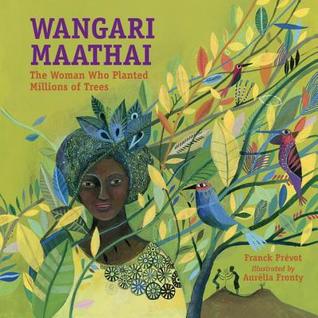
Wangari Maathi: The Woman Who Planted Millions of Trees by Franck Prevot, illustrated by Aurelia Fronty

Published by Charlesbridge

Summary:  While other picture book biographies about Wangari Maathi have focused on her tree planting, this book takes a broader look at her political activism.  She was fortunate to get a high school education in Kenya at a time when most girls didn’t go to school at all, and did so well that she was part of a group selected by President Kennedy to study in America.  Upon her return to Kenya, she observed how ravaged the land was from deforestation, and began her work to plant trees.  This work was in opposition to some of the plans of President Daniel arap Moi, and Maathai was imprisoned more than once.  In 2002, Moi was defeated, and Wangari Maathai was appointed assistant minister of the environment, natural resources, and wildlife.  In 2004, she was awarded the Nobel Peace Prize.  She died in 2011 at the age of 71.  End pages include an extensive timeline, information on Kenya today, quotes from Wangari Maathi, and further resources.  Grades 2-6.

Pros:  This French import is more extensive than other Maathi biographies, and would be appropriate for an older audience looking for more in-depth information.  The illustrations are striking, each one painted against a boldly colored background that fills the whole page.

Cons:  This is the fifth picture book biography of Wangari Maathi published since 2008, so some libraries may pass on purchasing this one, which would be too bad.

Daisy Saves the Day by Shirley Hughes

Published by Candlewick

Summary:  Even though Daisy loves her family and does well at school, times are tough, and she is sent out to live in a grand house and work as a scullery maid.  Her work is difficult and exhausting, but she works hard and tries to do what’s expected of her.  The two old ladies who own the house like her well enough, and when their niece comes from America, she encourages Daisy to read some of the books in the house.  All three women leave the house one day, to go see the coronation of a new king, George V.  Daisy’s left behind by herself, and decides to decorate the outside of the house with red, white, and blue clothing.  The only red she can find is the red flannel bloomers the ladies wear in the winter.  When they come home, they are horrified, and Daisy is in disgrace.  A few weeks later, though, she wakes up to the smell of smoke, and is able to put out a kitchen fire before it can do much damage, saving the house and its occupants.  As a reward, she is given enough money to be able to return home and go back to school.  Grades 1-4.

Pros:  This is a charming story about a winning cast of characters, particularly Daisy.  It has an old-fashioned feel to it, and illustrations reminiscent of Tasha Tudor.

Cons:  I looked for an historical note at the end, and was disappointed not to find one.