The Skunk by Mac Barnett, illustrated by Patrick McDonnell

Published by Roaring Brook Press

Summary:  A man tells the story of being stalked by a skunk.  After the skunk appears on his doorstep one morning, it begins to follow him everywhere—in a cab, to the opera, in the car right behind him on the Ferris wheel.  When the skunk corners him in an alley, the man escapes through a manhole cover and into the sewers.  He comes up in a different part of the city, buys himself a new house (where the illustrations become much more colorful), and is finally free of the skunk.  But in the middle of his own housewarming party, he finds himself wondering what has happened to the skunk.  He goes on a search, and on the final page, the tables are turned, and he is following the skunk.

Pros:  Why is the skunk following the man?  This book could be a springboard for a writing assignment.  It had a retro feel to it, Alfred Hitchcock illustrated by Roy McKie.

Cons:  I just didn’t get it.

Fire Birds: Valuing Natural Wildfires and Burned Forests by Sneed B. Collard III

Published by Bucking Horse Books

Summary:  Sneed B. Collard takes the reader to forests after major fires to show how birds thrive in the burned trees.  For instance, certain woodpeckers are almost never found outside of burned forests.  The wood boring beetles that lay eggs in the trees provide food for them, and the trees are perfect for the birds to make nests.  Collard profiles University of Montana professor Dick Hutto as he observes the birds, explaining how his research has helped scientists understand more about fire ecology.  More scientists are now supporting the idea that it’s better to let naturally occurring forest fires burn.  A glossary, index, and full page of additional resources are included at the end.

Pros:  This would make a great mentor text for demonstrating informational writing.  Illustrated with many photographs, the text is engaging and packed with information.

Cons:  Was Smokey the Bear really wrong about forest fires?

Ratscalibur by Josh Lieb

Published by Razorbill

Summary:  Joey isn’t very excited about moving to the city, and isn’t much comforted when Uncle Patrick shows up with a gift—a new pet rat.  That night, though, the rat talks to Joey, and the next thing Joey knows, he has turned into a rat himself.  The rat sends him on a quest, and Joey the rat discovers the Lower Realm, a kingdom of rats and other creatures that lives throughout the city.  Joey notices that most of the rats are armed, so he decides to grab a plastic spork he sees stuck in a stale biscuit.  He pulls it out, and all the rats fall silent.  It turns out that spork is Excalibur, the Spork in the Scone, and the fact that Joey has pulled it out means he is destined to be a hero.  And the adventure begins….  Recommended for grades 3-6.

Pros:  I’ll admit, my expectations of a book called Ratscalibur penned by a TV writer were pretty low.  I was happily surprised by this exciting adventure story peopled (ratted?) with a cast of interesting characters.  The magic (or ragic, as it’s called in the rat world) has a complicated set of rules which were fun to learn about, and there’s a surprising twist near the end which seems to lay the groundwork for a sequel.

Cons:  Many of the Arthurian allusions will be lost on young readers.  Indeed, I have a feeling quite a few were lost on this older reader.

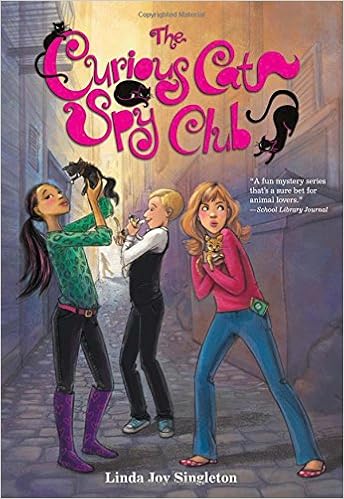
The Curious Cat Spy Club by Linda Joy Singleton

Published by Albert Whitman & Company

Summary:  When Kelsey helps stop a runaway zorse (a cross between a horse and a zebra), she gets more than she bargained for.  The zorse belongs to Becca, one of the most popular girls in school.  Ducking into an alley to avoid a boy from school, the two girls discover a bag of kittens in a dumpster.  A third member, Leo, gets involved in the rescue, and the unlikely trio decides to form a club to protect the kittens until they can find them homes.  Kelsey has always dreamed of being a detective, and now she has a real mystery on her hands…who put the kittens in the dumpster?  As the Curious Cat Spy Club works to solve it, they uncover a whole pet-napping ring right in their neighborhood.  Recommended for grades 4-6.

Pros:  This well-paced mystery will keep readers guessing right up to the end.  In Nancy Drew-like fashion, the last few chapters involve an exciting run-in with the villain and more than one narrow escape.  There are interesting subplots that give the characters more depth, such as Kelsey’s and Leo’s family issues and Becca’s thwarted romance.

Cons:  Kelsey didn’t get to keep her kitten.  But the cover says this is an exciting new mystery series, so there may yet be hope.

Wandering Whale Sharks by Susumu Shingu

Published by Owlkids Books

Summary:  What is the largest fish in the sea?  The whale shark, measuring up to 60 feet long and weighing in at over 40 tons.  In contrast to its great white cousin, this shark is a gentle giant, gliding slowly through the sea and allowing divers to hold onto their fins and swimming with them for miles.  Susumu Shingu poetically describes these animals in just a dozen sentences, all illustrated in the blue and black colors of the ocean.  An end note gives more information.

Pros:  There’s quite a bit of information in this brief book.  A few sentences could be used to teach similes and metaphors.  The illustrations strikingly capture the way the light reflects off the ocean.

Cons:  Kids who usually like shark books might find the whale shark a bit of a yawn.  No blood was shed in the creation of these illustrations.

Monkey and Duck Quack Up! By Jennifer Hamburg, illustrated by Edwin Fotheringham

Published by Scholastic Press

Summary:  Monkey is excited to enter the rhyming contest with the grand prize of a three-day cruise.  All he needs is to get Duck to create a rhyme with him.  Unfortunately, Duck will only say, “Quack!”  Finally, Monkey comes up with a solution—make a rhyme with words that rhyme with quack.  The two friends perform flawlessly, and a week later, they are headed out to sea.  Monkey tells Duck he knew they’d win.  “The two of us, we have a knack.  Don’t you agree?  And Duck said (turn the page) ‘Let’s get some ice cream.’”

Pros:  A quick-moving story full of fun rhymes, and the humor of Duck constantly blowing it by saying “Quack”…until that final page when he surprises everyone!

Cons:  You can’t really win a three-day cruise by winning a rhyming contest.

Lumberjanes: Beware the Kitten Holy by Noelle Stevenson and Grace Ellis

Published by BOOM! Box

Summary:  April, Jo, Ripley, Molly, and Mal are five very different girls enjoying summer camp.  And what a camp!  In the first few pages, the girls ward off a pack of talking foxes who deliver a cryptic message, “Beware the kitten holy”.  They return home to a very angry camp counselor, Jo, and a more lenient camp director, Rosie, who seems to know more than she’s telling.  Originally four comic books, each section is introduced with a page from the Lumberjanes Field Manual, describing a merit badge (“Up All Night Badge”, “Robyn Hood Badge”).  Filled with friendship and Girl Power, there are sure to be more Lumberjanes adventures.

Pros:  Holy Mae Jemison (she and other female heroes are frequently used in exclamatory contexts)!  Each girl has a strong and distinctive personality, and there’s a new adventure on every page.  The Lumberjanes are sure to popular with those ready to move on from Raina Telgemeier.

Cons:  The portrayal of boys is not very flattering (they’re cookie-baking, housecleaning simpletons until they transform into evil monsters).

Egg: Nature’s Perfect Package by Steve Jenkins and Robin Page

Published by HMH Books for Young Readers

Summary:  From the royal albatross, which lays one egg every two years and watches over it for almost three months, to the fish tapeworm, which lays over seven billion eggs in its 20-year life, many animals lay eggs.  This book takes a look at where and how animals lay eggs, carry and protect them, and get out of the eggs when it’s time for them to hatch.  Egg sizes are compared with pictures showing actual sizes of all kinds of eggs, and cutaway pictures show how a chicken and alligator develop over the entire incubation period.  The information is given in short snippets, several on a page, with each accompanied by a cut-paper illustration.

Pros:  This husband-and-wife team may be my favorite nonfiction author and illustrator.  They have a real knack for finding fascinating facts about the animal world and presenting them in a way that sustains interest throughout the book.  And the illustrations are phenomenal.  It’s almost incomprehensible how Steve Jenkins is able to get the level of detail into each picture using cut and torn paper.  Check out “A Look Inside How This Book Was Made” on Amazon and the short video on Jenkins’ webpage (http://www.stevejenkinsbooks.com/making_books.html) to learn more about his artistic process.

Cons:  Reading this book right before breakfast kind of put me off my scrambled eggs.

The Rat with the Human Face by Tom Angleberger

Published by Harry N. Abrams

Summary:  This is the second of the Qwikpick Papers, three sets of papers supposedly found by Tom Angleberger in an old Qwikpick gas station in Crickenburg, Virginia.  It reports the escapades of Lyle, Dave, and Marilla, the three 11-year-old members of the Qwikpick Adventure Society.  In the first book, they searched for and found a poop fountain.  This adventure begins when the three friends overhear an electrician at the Qwikpick (where Lyle’s parents work) talking about his encounter with a rat with a human face in the basement of an old research lab.  The kids decide finding this rat will be their next escapade.  Of course, just about everything goes wrong, and in the end Marilla’s father bans her from Qwikpick membership.  There are a few glimmers of hope, though…the kids actually see the rat, and could that be a romance beginning between Lyle and Marilla?  A sequel is all but guaranteed.  Grades 3-6.

Pros:  The kids’ voices are so genuine, it is hard to believe they didn’t really write this report.  Tom Angleberger, author of the Origami Yoda series, is a master of quirky details that seem just odd enough to be true, like the stuffed Andrew Jackson doll in the Qwikpick crane game.

Cons:  I read this book when I had jury duty, hoping that the title would convince the judge I was unfit to serve.  Unfortunately, we were all dismissed before I could test my hypothesis.

It’s Only Stanley by Jon Agee

Published by Dreamscape Media

Summary:  One by one, family members are awoken by loud noises and strange smells.  Each time, it turns out to be the family dog Stanley, fixing the bathtub, making catfish stew, and repairing the TV.  Finally, just as the father is about to put his foot down and send Stanley to bed, there’s a loud explosion.  The final pages show the house rocketing to the moon, where Stanley apparently has a hot date with a pink poodle.  Ages 3-8.

Pros:  Readers will the funny rhyming story and seeing what Stanley the wonder dog is up to next.

Cons:  I’m pretty sure the moon’s atmosphere wouldn’t support a pink poodle.