Freestyle by Gale Galligan

Published by Graphix
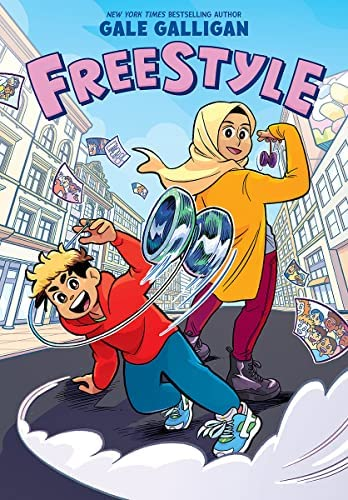
Summary:  Cory’s part of Eight Bitz, a dance team getting ready for the annual Bronx Kids Battle dance competition.  When progress reports come out, though, his straight C’s upset his parents, who insist that he cut back on dance and get a tutor.  That tutor winds up being Sunna, his science lab partner who Cory has dismissed as a nerd.  But when he accidentally discovers her passion for yo-yo’ing, he changes his mind completely.  Sunna proves to be a good tutor of both the yo-yo and the more academic subjects, and before long Cory has come a long way with both and earned his way back into Eight Bitz.  There are rifts within the team, including Cory’s new friendship with Sunna, and the eight kids have to work hard and compromise to keep the group together.  A yo-yo competition and the Bronx Kids Battle wrap things up, with realistic successes for everyone.  272 pages; grades 3-7.

Pros:  It’s graphic novels week after a bunch of them arrived for me at the library all at once. This one, from Baby-Sitters Club alum Galligan, is a high-energy middle school story with plenty of action and early teen angst.  The artwork beautifully captures the dance and yo-yo moves, and the kids do an admirable job of working out their differences pretty much without parental assistance

Cons:  There’s a good review on Amazon by a Muslim parent who mentions some of the ways Sunna is not accurately portrayed, including being alone with Cory in her bedroom and holding his hand when they dance together.
Frizzy by Claribel A. Ortega, illustrated by Rose Bousamra

Published by First Second

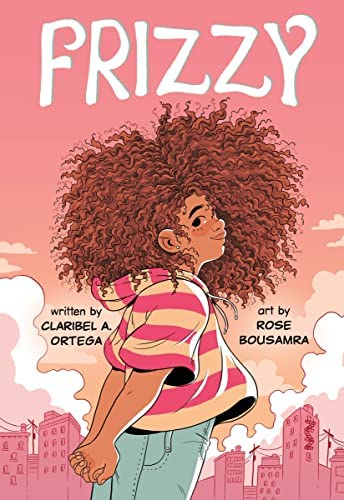
Summary:  Marlene’s curly hair has been the bane of her existence for the last several years, as her mother insists on the two of them making weekly visits to the salon to have their hair straightened.  Not only is this physically painful, but it makes Marlene feel like her natural look isn’t beautiful.  After a few disastrous attempts to style her hair on her own, Marlene gets into trouble and is sent to her tía Ruby for a weekend of gardening.  Ruby has fully embraced her Dominican heritage, including her hair, and she shows Marlene how to manage her curls and make them beautiful.  Marlene is nervous to show her new look to her mom, but it serves as a catalyst to a much-needed conversation that brings them closer together.  224 pages; grades 3-7.

Pros:  Marlene is a character many tweens will relate to, torn between wanting to fit in, wanting to please a parent, and wanting to be herself.  This graphic novel also has a great message about the Eurocentric standard of beauty and embracing beauty from all cultures.  

Cons:  I always enjoy a good subplot or two, but this story stuck pretty closely to the main hair-related plot.

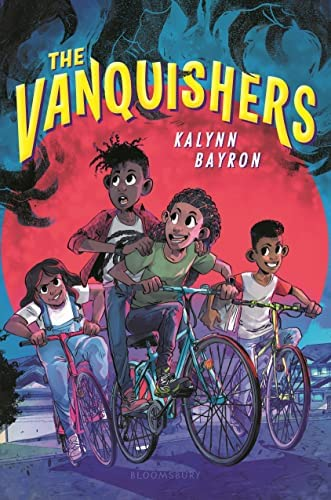
The Vanquishers by Kalynn Bayron

Published by Bloomsbury Children’s Books

Summary:  Malika, nicknamed Boog, lives in a San Antonio neighborhood near her best friends Jules and Cedric.  They all agree that their parents are way too overprotective, acting as though vampires were not all wiped out during the Reaping that took place before they were born.  A new neighbor named Aaron seems to fit into their group perfectly, but his mysterious disappearance turns their lives upside down.  When Boog learns that Aaron’s been bitten by a vampire, she and her friends take matters into their own hands, trying to discover the monster that is most likely living among them.  The new school guidance counselor is the obvious choice, but some surprise revelations at the end change everything about the kids’ lives and seem to set the stage for a sequel.  288 pages; grades 4-7.

Pros:  I have a few books with heavier topics waiting to be read, but I opted for the vampire tale this week and am so glad I did!  I had trouble putting this book down, with its diverse cast of characters, excellent blend of middle school humor, and delicious creepiness that kept me turning the pages.  As a side note, I finally was grateful that my daughter urged me to join her watching several seasons of Buffy, which gave me some background knowledge of vampire lore.

Cons:  This made me break my vow, made many years ago, to never read another vampire story after finishing Stephen King’s ‘Salem’s Lot

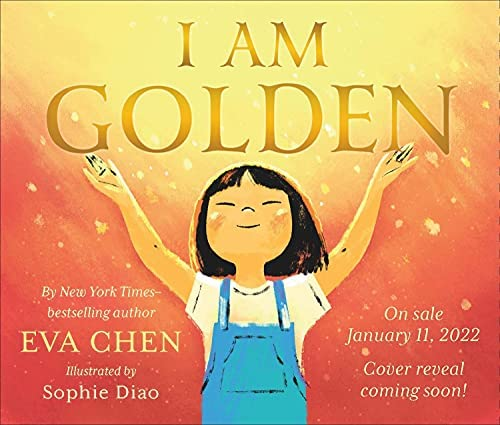
I Am Golden by Eva Chen, illustrated by Sophie Diao

Published by Feiwel and Friends

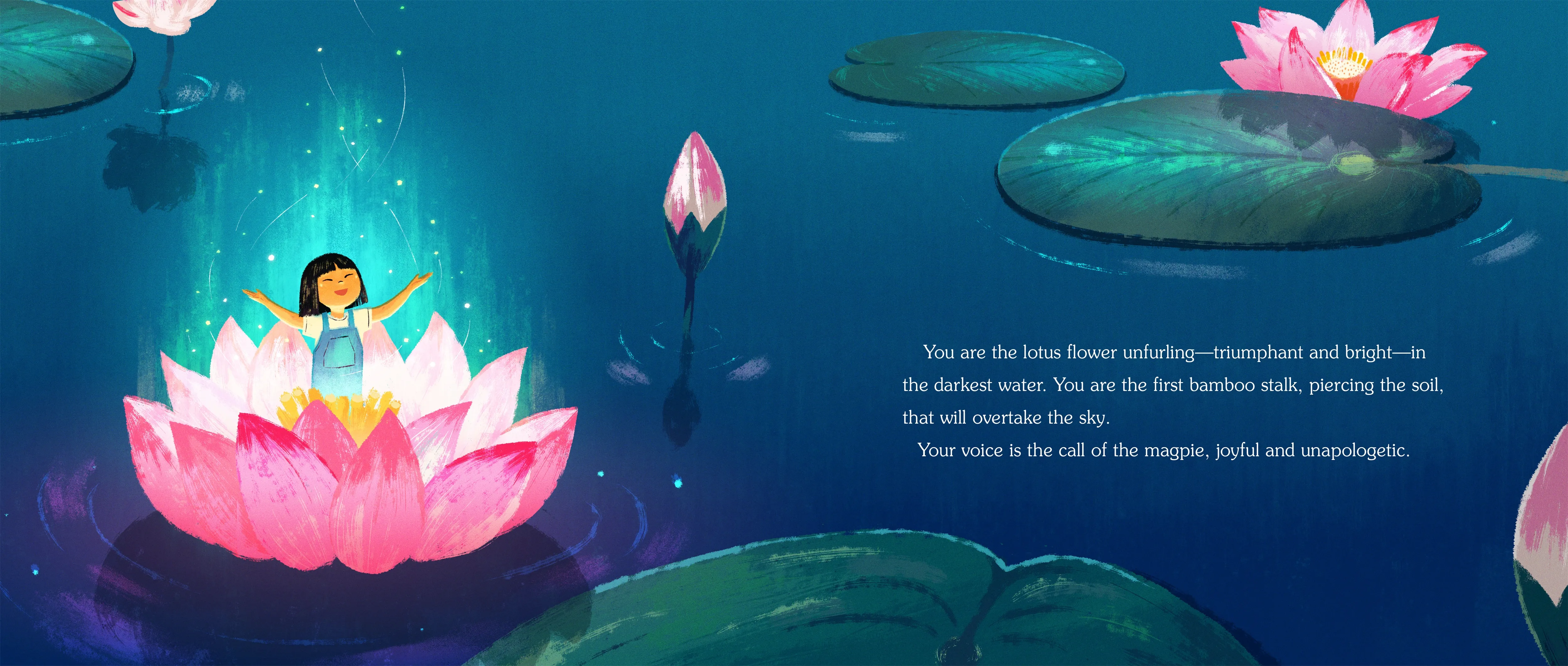
Summary:  Chinese parents address their beloved child, Mei, a name that means beautiful, telling her all the beautiful things they see when they look at her.  Not only are her physical features beautiful, but the hopes and dreams that they see when they look at her, hopes and dreams that their ancestors had and that sent them to America.  They acknowledge that people may be mean to her and treat her as though she’s different but encourage her to remember her heritage which gives her strength and power to be golden.  40 pages; ages 4-8.

Pros:  Beautiful illustrations and an empowering message make this a book that may be considered for some awards.

Cons:  Feels like a book that will appeal more to adults than to kids.

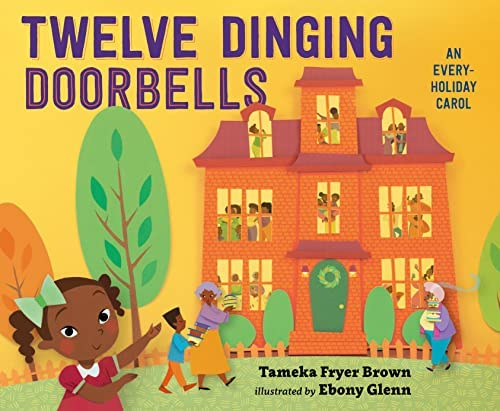
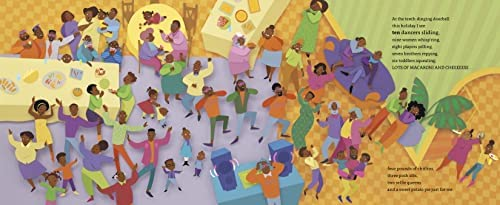
Twelve Dinging Doorbells: An Every-Holiday Carol by Tameka Fryer Brown, illustrated by Ebony Glenn

Published by Kokila

Summary:  As the subtitle suggests, this is a book that could be used for any large family gathering, although it’s based on “The Twelve Days of Christmas”.  The cumulative text begins with “a sweet potato pie just for me,” then goes on to two selfie queens, three posh sibs, all the way to eleven stinky sides (side dishes) and twelve crowded steps as an extended family gathers for a holiday meal.  Macaroni and cheese replace five golden rings with different variations as the day goes on (lots of mac and cheese, where’s my mac and cheese, and finally, who needs mac and cheese?).  The narrator and her grandmother share the sweet potato pie–just for her–on the final page.  32 pages; ages 3-8.

Pros:  A great holiday choice that features a joyful Black family’s gathering with colorful illustrations, all kinds of people, and plenty of yummy food.

Cons:  While I enjoyed the macaroni and cheese humor, I kind of missed the number five.

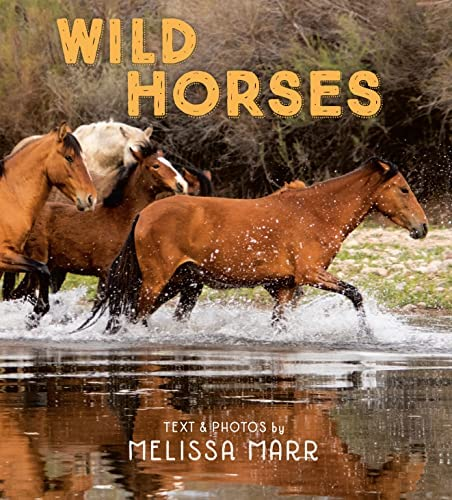
Wild Horses by Melissa Marr

Published by Nancy Paulsen Books

Summary:  Photographs and action words show the Salt River wild horses of Tonto National Forest in Arizona who quickly appear and disappear from the sight of humans.  In between, they are seen eating, drinking, playing or fighting (not sure which, and the text doesn’t make it clear), running, splashing, and standing with their families.  An author’s note tells a little bit about her personal contact with these horses and urges readers to preserve nature for these and all animals.  32 pages; ages 3-8.

Pros:  There really aren’t enough horse books in the world, and this one has striking photos that will appeal to the youngest equine fans.

Cons:  No additional resources or specific suggestions for preserving nature.

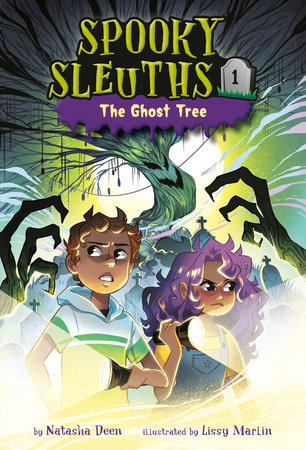
The Ghost Tree (Spooky Sleuths #1) by Natasha Deen, illustrated by Lissy Martin

Published by Random House Books for Young Readers

Summary:  Asim is new in the island town of Lion’s Gate, Washington, where both of his parents work at the island’s somewhat mysterious lab.  On his first day of school, Asim discovers a mysterious tree in the cemetery that grows unusually fast and seems to be destroying other life around it.  He witnesses a construction worker touch the tree and undergo a complete personality change.  Later, he befriends Rokshar, a girl in his class who aspires to be a scientist and takes a more skeptical view of events that Asim interprets as supernatural.  When their teacher, Mx Hudson, is also negatively affected by the tree, Asim, Rokshar, and some of their friends have to figure out a way to destroy the tree–even if it puts them in danger.  Includes an author’s note about the Guyanese folklore that inspired the story and a sneak peek at book #2.  95 pages; grades 2-4.

Pros:  This illustrated chapter book will appeal to the many kids who like scary stories, but who may not be ready for horror.  It’s a promising series starter with interesting characters and just the right amount of spookiness mixed with scientific skepticism.

Cons:  It’s unclear how Rokshar’s brothers go from being bullies to allies so quickly.

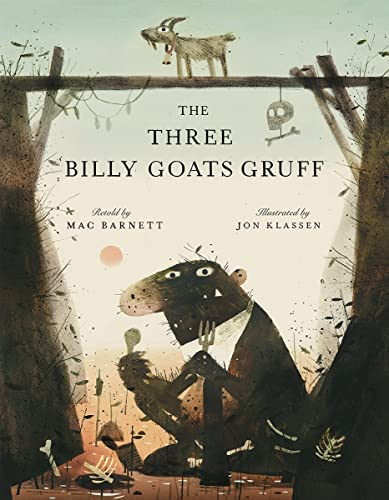
The Three Billy Goats Gruff retold by Mac Barnett, illustrated by Jon Klassen

Published by Orchard Books

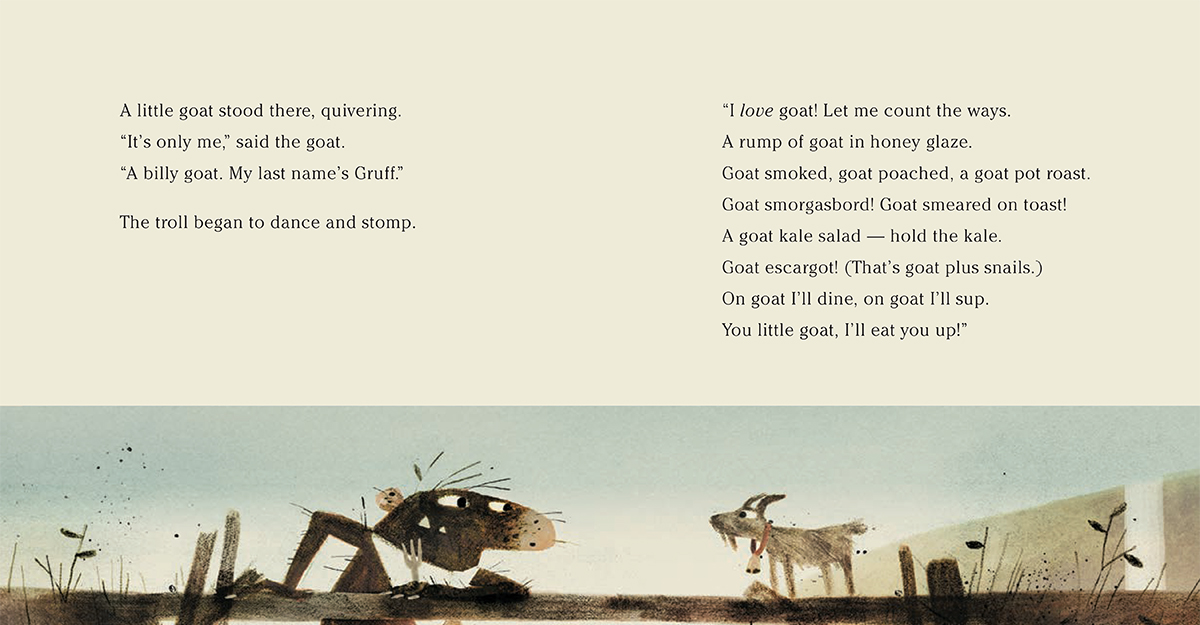
Summary:  Rumor has it that this is the first in a series of fairy tale retellings by the popular Barnett-Klassen duo.  The troll living under the bridge is nearly starving, living on earwax and belly button goop while waiting for the goats to cross over.  He’s a poetic sort of fellow, making up all sorts of rhymes to capture his excitement about the goats (“I love goat! Let me count the ways/A rump of goat in honey glaze.”)  The small and medium goats talk their way out of being eaten, and the big goat…well, readers are in for a surprise and will also enjoy seeing the fate of the troll.  48 pages; ages 4-8.

Pros:  One can never rule out a Caldecott for Jon Klassen, and I love how the illustrations grow from a small strip at the bottom of the first page to a full-page spread when the big goat does his thing.  Kids will love the story, too, with its funny troll and just enough disgusting details thrown in.

Cons:  Barnett and Klassen’s books never really grab me until I read them to actual children, which I haven’t had a chance to do with this one yet.  The kids’ delight makes me appreciate each book much more than when I read it on my own.

The Prisoner of Shiverstone by Linette Moore

Published by Harry N. Abrams

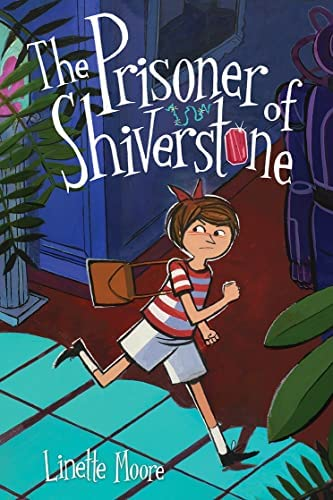
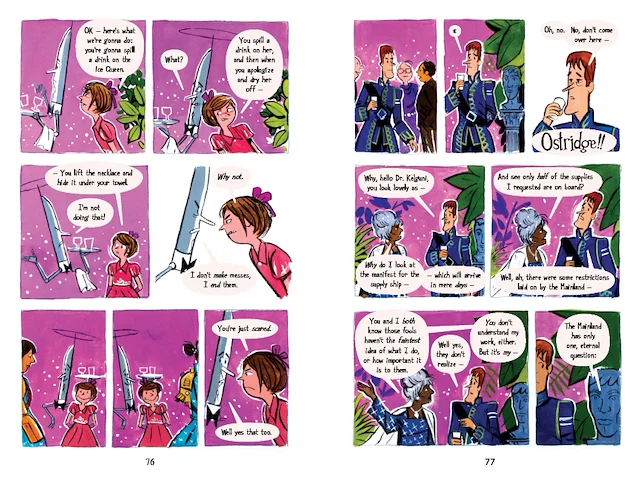
Summary:  Helga Sharp, an 11-year-old inventor, accidentally makes contact with Erasmus Lope, who’s been trapped on an island where “mad scientists” are exiled away from the mainland.  When Helga is found unconscious on the island, she’s housed with a brother and sister who work as island guards, but who have a few secrets of their own.  With the help of the sister’s robot butler, Helga gets to work trying to free Erasmus.  The secrets of both Helga and the island characters are gradually revealed, as Helga carries out her mission and ultimately finds a new home on the island.  160 pages; grades 3-7.

Pros:  A fast-paced graphic novel with lots of fun characters and plenty of adventure.  The end is somewhat open-ended, and readers will no doubt hope for a sequel to learn about what’s next for the plucky Helga.

Cons:  There was a lot of world-building and plot to cram into 160 pages.

Aviva vs. the Dybbuk by Mari Lowe

Published by Levine Querido

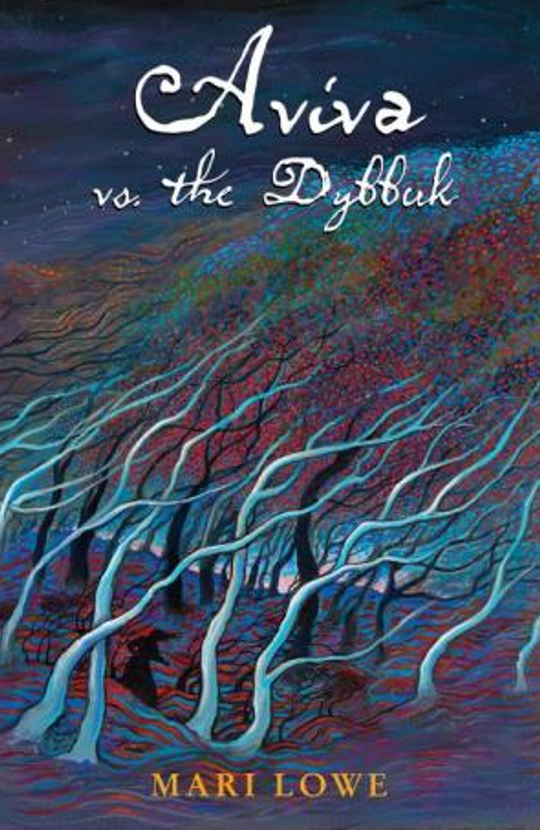
Summary:  Aviva is an introverted 11-year-old whose mother, Ema, struggles with depression, but her life hasn’t always been that way.  Before her father’s accidental death, both she and Ema were a lively part of their Orthodox Jewish community.  Now the two of them live in a tiny apartment above the mikvah, a women’s ritual bathing house that her mother takes care of.  The mikvah is also home to a dybbuk, a mischievous spirit that only Aviva can see.  While Aviva and Ema have been immersed in grief for the last five years, things begin to change when Aviva starts sixth grade, as a renewed friendship with Kayla and her mother opens up new possibilities.  A final, frightening showdown with the dybbuk helps Aviva to come to terms with her grief, allowing her and her mother to begin to move forward.  171 pages; grades 4-7.

Pros:  This debut novel is beautifully written, exploring the emotions of grief and trauma, as well as the antisemitism directed at the Orthodox Jewish community.  This strong community, especially the women, makes for an inspiring cast of characters with language, rituals, and traditions expertly woven into the story.  I’ve seen this book on a few Newbery prediction lists.

Cons:  This book reminded me of last year’s Newbery honor book Too Bright to See: in both cases, the first few chapters felt so depressing that I almost gave up.  I was ultimately glad I stuck with both books, but kids might need some extra encouragement to keep reading.