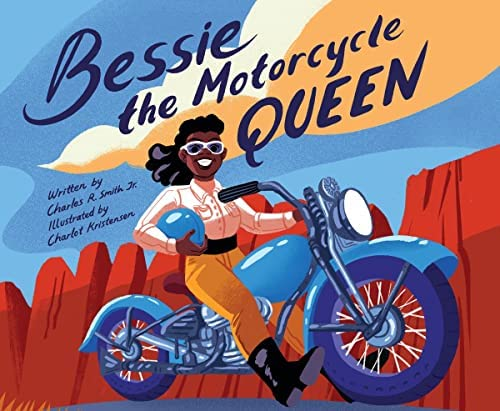
Bessie the Motorcycle Queen by Charles R. Smith, Jr., illustrated by Charlot Kristensen

Published by Orchard Books

Summary:  A daredevil motorcycle rider named Bessie takes the challenge to ride the Wall of Death, fearlessly showing off with no hands and riding sidesaddle.  When she takes off her helmet, the audience is surprised by her “hidden brown face.”  The year is 1929, and a Black woman riding her motorcycle alone across the country faces potentially dangerous situations, especially in the Jim Crow south, where she outruns a truck full of angry KKK members.  But Bessie is undeterred, choosing her destinations by flipping a penny onto a US map, repairing her bike herself, and sleeping on it when she can’t get a room.  The word VROOM is repeated throughout the story as Bessie zooms off to her next location.  Includes additional information about Bessie Stringfield and a bibliography.  40 pages; grades 1-4.

Pros:  The bouncy rhyming text and beautiful illustrations tell an inspiring story about this little-known woman. Although kids may need some explanations about Jim Crow laws and the KKK, this would be a good Black history read-aloud for primary grades.

Cons:  Unfortunately, not much is known about Bessie, so facts about her life like her birthdate and hometown are uncertain.


Maya’s Song by Renée Watson, illustrated by Bryan Collier

Published by HarperCollins

Summary:  Maya Angelou’s story is told in a collection of free verse poems, illustrated with watercolor and collage illustrations.  The story begins with her birth in 1928 and continues through her childhood spent in California, Arkansas, and Missouri, where “her mother’s boyfriend hurt her body, hurt her soul,” leading Maya to stop speaking for five years.  Her love of poetry helped her to recover her voice, and she went on to become a singer and then a poet, befriending James Baldwin, Martin Luther King, Jr., and Malcolm X.  Her memoir I Know Why the Caged Bird Sings brought her to national prominence; the story ends with her reading a poem at Bill Clinton’s presidential inauguration, fulfilling her grandmother’s prophecy that she would be a preacher and a teacher.  Includes a timeline and notes from the author and illustrator.  48 pages; grades 2-6.

Pros:  This amazing poetry biography is sure to be considered for multiple awards for both the writing and the illustrations.  I was immediately drawn into Maya Angelou’s story; Renée Watson is a masterful poet who tells the most difficult aspects of that story in a way that can be shared with young children.  The illustrations are gorgeous, layered with colors and patterns.

Cons:  No additional resources are given.

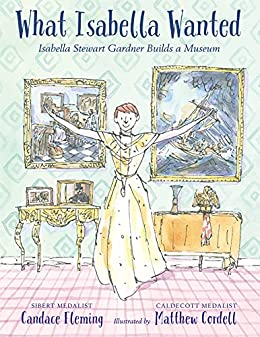
What Isabella Wanted: Isabella Stewart Gardner Builds a Museum by Candace Fleming, illustrated by Matthew Cordell

Published by Neal Porter Books

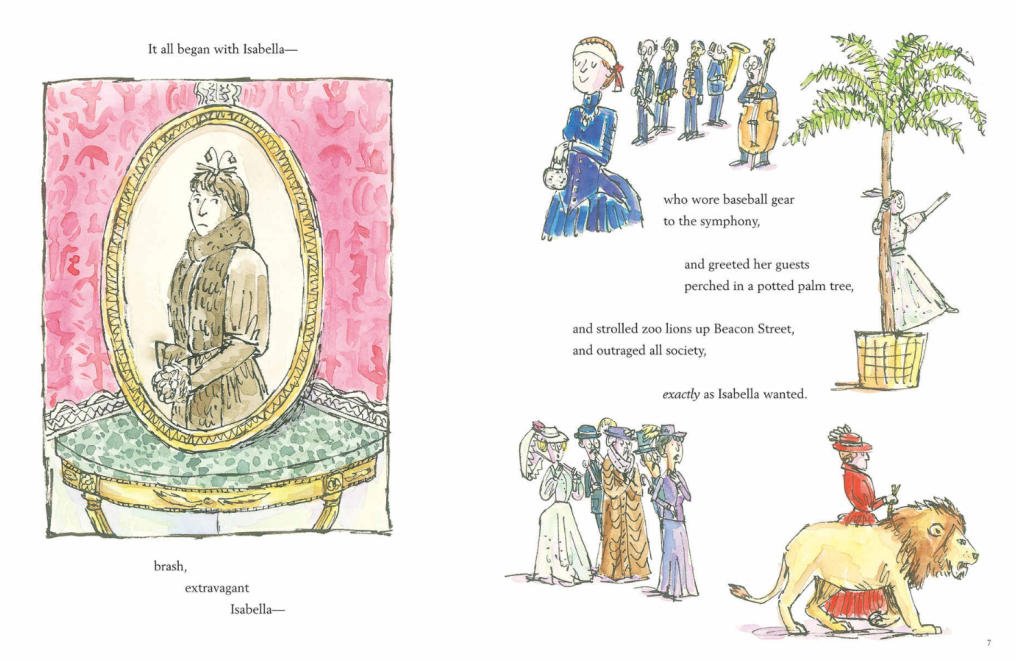
Summary:  The story begins and ends with the empty picture frames hanging in the Isabella Stewart Gardner Museum following the 1990 robbery of thirteen works of art worth $500 million.  In between, the reader learns of the eccentric Isabella who knew exactly what she wanted and wasn’t afraid to do what she needed to do to get it–even if it meant breaking some laws to obtain European and Asian artworks.  She built the museum herself, living on the top floor and displaying the art on the other three.  When it was done, she opened it to the public twenty days a year for more than twenty years.  Today, the museum is still a highlight to visit in Boston.  Includes an extensive author’s note with more information about Isabella (including her unethical collection practices) and a bibliography.  40 pages; ages 4-8.

Pros:  The lively free verse text and illustrations by Caldecott Medalist Matthew Cordell bring Isabella and her museum to life and pose intriguing questions about the art theft.

Cons:  This is another New England Book Award finalist (the winner was Keepunumuk by Danielle Greendeer in case you’re interested) and may not be of as much interest to those living outside of New England.

I Am Ruby Bridges by Ruby Bridges, illustrated by Nikkolas Smith

Published by Orchard Books

Summary:  Ruby Bridges tells her story of integrating William Frantz Elementary School in 1960 at the age of six.  While she has heard of Brown v. Board of Education, she is more interested in making friends and who her teacher will be.  She is surprised to be driven to school by four white men, to have a white principal, and most of all, to discover that she is the only student in her classroom.  Seeing that empty classroom makes her finally realize what is going on: she is the first Black child to attend the school, and that will allow other Black students to go there too.  “And that’s a good thing, for Black kids.  For white kids, too…for all the kids, once they finally get here!”  Includes a glossary and notes from the author and illustrator.  48 pages; ages 4-8.

Pros:  An inspiring autobiography with bold illustrations that capture young Ruby’s humor and courage.  If you’re looking for a Black history read-aloud for primary grades, this is a perfect choice that shows kids the powerful difference one six-year-old made in a way that they will relate to.

Cons:  You will probably want to supplement this with additional material to explain to kids exactly what it was Ruby did.

Finding My Dance by Ria Thundercloud, illustrated by Kalila J. Fuller

Published by Penguin Workshop

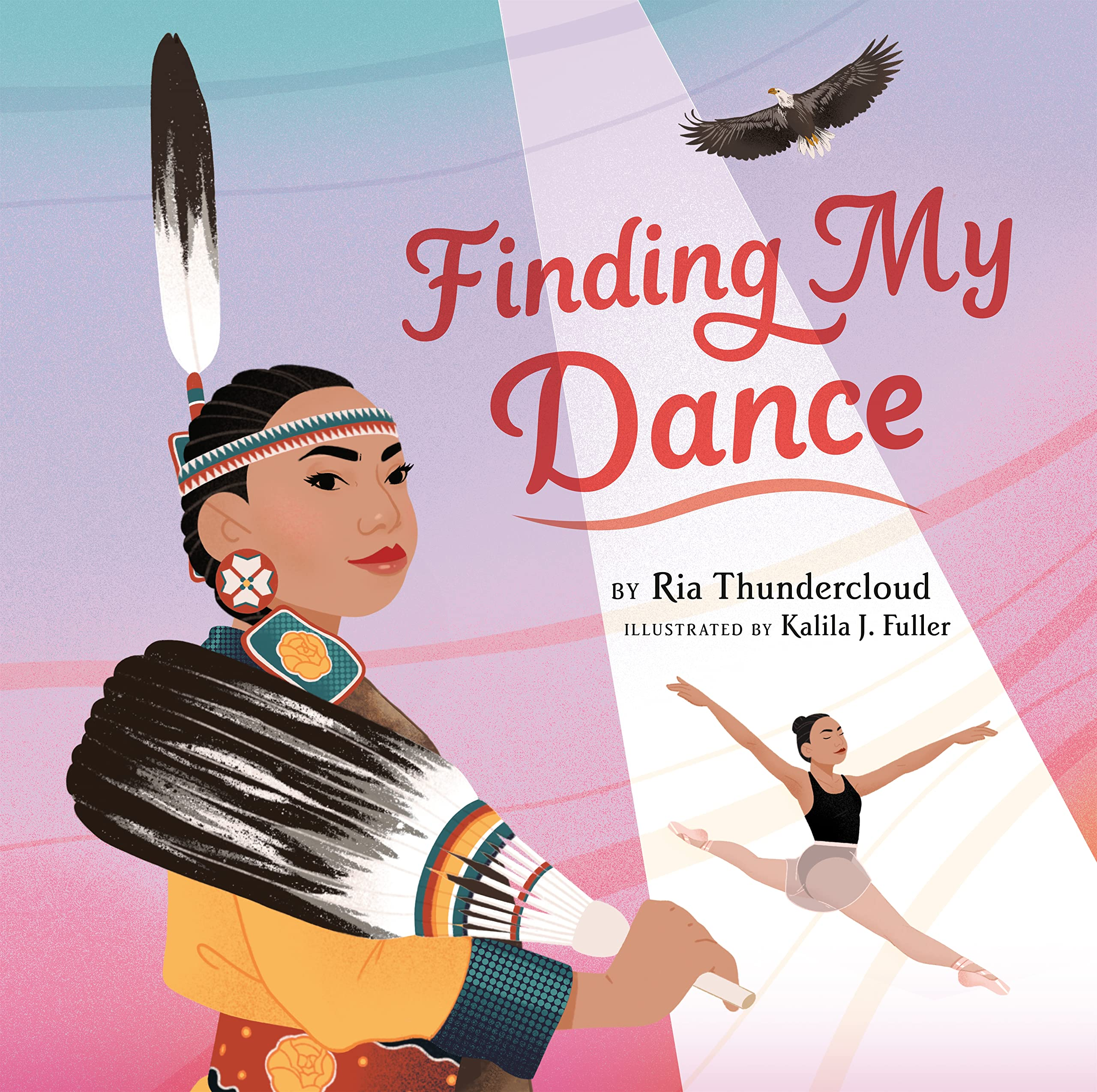
Summary:  The author introduces herself on the first page as Wakaja haja piiwiga, meaning “Beautiful Thunder Woman” from the Ho-Chunk Nation in Wisconsin and the Sandia Pueblo in New Mexico.  She loved dance from the time she received her first jingle dress and began dancing in the powwow at the age of 4.  At 13, she started learning other forms of dance–modern, tap, jazz, ballet–and became a professional dancer after graduating from high school.  Sometimes the restraints of classical dance felt wrong to her, though, and she felt like an outsider.  She has returned to her roots, dancing the eagle dance with a set of eagle wings and now has a daughter of her own.  Remembering how people used to say her name wrong, she corrects those who mispronounce her daughter’s: “Every time someone says our names, they are speaking a language that still exists, and a culture that we still honor, despite many attempts to wipe it out forever.”  40 pages; grades 1-5.

Pros:  This beautiful story will resonate with anyone who is trying to find their place in the world.  It celebrates both dance and indigenous cultures, with lovely illustrations filled with gorgeous colors that play with light, shadows, and patterns.

Cons:  No back matter.

Choosing Brave: How Mamie Till-Mobley and Emmett Till Sparked the Civil Rights Movement by Angela Joy, illustrated by Janelle Washington

Published by Roaring Brook Press

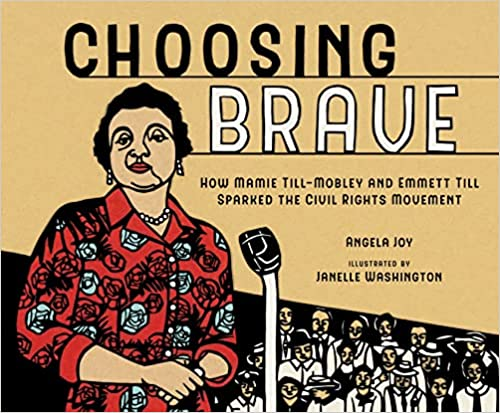
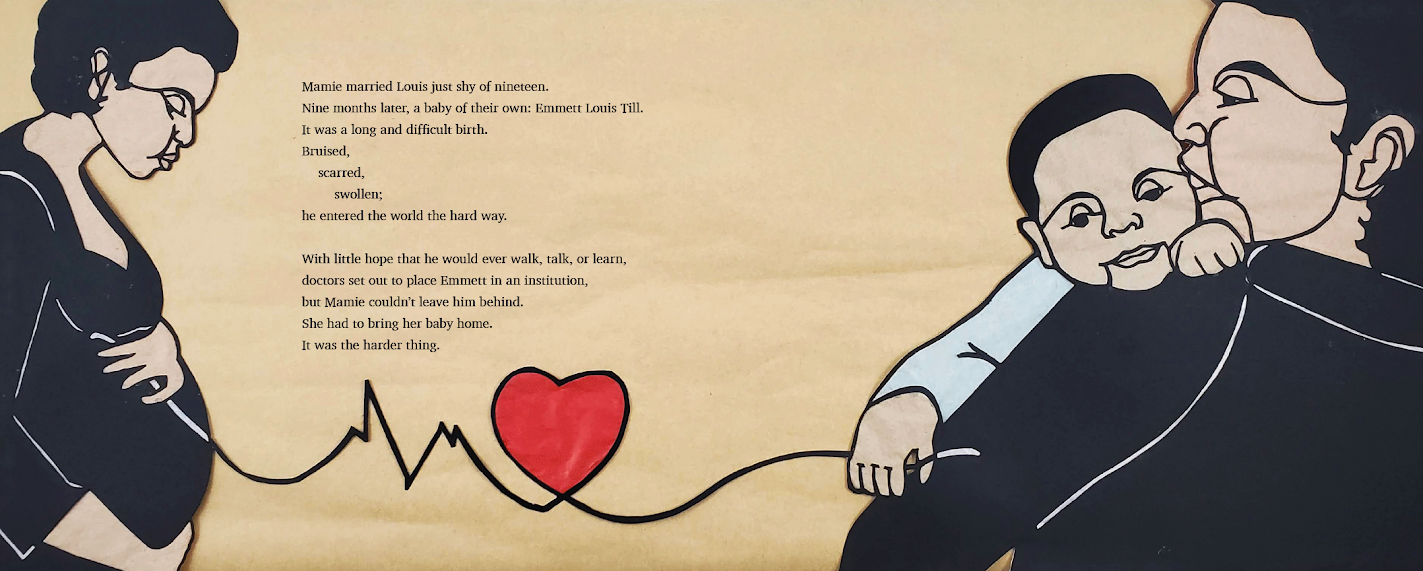
Summary:  Beginning with Mamie Till’s decision to bring her son Emmett’s body home to Illinois after his horrific murder in Mississippi, the story goes back to trace Mamie’s life to that point.  A smart, hardworking girl who graduated at the top of her high school class, Mamie married an abusive man, escaping the marriage with her son.  Emmett was visiting family in Mississippi when he was murdered by white men who believed he had violated Jim Crow laws when interacting with the wife of one of the men at a store.  The sheriff planned to quietly bury Emmett’s body, but Mamie insisted on bringing him home and having an open casket funeral.  Photos were widely published, giving impetus to the civil rights movement.  After Emmett’s death, Mamie remarried, went to college, became a teacher, and continued to work for civil rights until her death in 2003 at the age of 81.  Includes notes from the author and illustrator, a playlist, a glossary, a timeline, and a list of sources.  64 pages; grades 3-7.

Pros:  This is a powerful book, both the free verse text and the cut paper illustrations.  The tone is appropriately somber, but also inspiring, showing Mamie’s love for her son, her grief, and her incredible resilience.  A Coretta Scott King Award contender for sure. 

Cons:  The narrative may be somewhat confusing to readers who aren’t familiar with Emmett Till’s story.  They might want to start with the back matter.

Hope Is an Arrow: The Story of Lebanese-American Poet Kahlil Gibran by Cory McCarthy, illustrated by Ekua Holmes

Published by Candlewick

Summary:  Gibran Khalil Gibran was a shy boy growing up in Lebanon.  He loved his country, but there was unrest there, and he often escaped into nature, hiking in the woods or swimming in the ocean.  After his father was jailed, he and his mother and three siblings left for America.  They settled in Boston’s South End, where a teacher changed his name to Kahlil Gibran, and where he often saw his mother treated disrespectfully despite her hard work as a shopkeeper.  Kahlil often felt divided between his American self and his Lebanese self and began expressing himself through his poetry and art.  Studying in Beirut and losing his mother, sister, and brother in a short period of time deepened and intensified his art, and in 1923, he published his most famous work, The Prophet.  Includes source notes and additional stories from Kahlil Gibran’s life.  40 pages; grades 2-5.

Pros:  The lyrical text and beautiful illustrations capture Kahlil Gibran’s spirit.  Many of his quotes are included (including my favorite, “Work is love made visible”) which are helpful in introducing his writing.  As usual, Ekua Holmes’s art is worthy of award consideration.

Cons:  I wasn’t crazy about the format of the source notes and additional stories, which did not seem particularly kid friendly.

Lola Out Loud: Inspired by the Childhood of Activist Dolores Huerta by Jennifer Torres, illustrated by Sara Palacios

Published by Little, Brown Books for Young Readers

Summary:  Lola loves helping out at the hotel where she lives with her mother and grandfather.  Her mother is always ready to help guests; if they don’t have money to pay, she’ll accept food or even just a handshake and a promise.  Lola is an enthusiastic worker, but she sometimes gets in trouble for talking too much.  “Lolita Siete Lenguas (seven tongues)” her grandfather calls her teasingly, reminding her that sometimes it’s good to be quiet but other times “one strong voice is just what we need.”  Lola remembers this lesson when she’s the only one who sees a woman and girl thrown off the streetcar in front of her house because they can’t pay the fare.  She stays quiet about the two at first, but, remembering Grandpa’s words, she rallies her family and the other hotel guests to help them, using words that she would later become famous for, “¡SÍ se puede!”  Includes additional information about the labor leader Lola grew up to be: Dolores Huerta.  32 pages; ages 4-8.

Pros:  Keep this book in mind for the upcoming Hispanic Heritage Month, especially if you’re looking for something for younger readers.  They’ll enjoy the story of young Lola, learn a little about Dolores Huerta, and take away an empowering message about using your voice to speak up about injustice. The illustrations add just the right touch of fun and energy.

Cons:  It would have been nice to have a list of additional resources for older kids to dive into.


Star Child: A Biographical Constellation of Octavia Estelle Butler by Ibi Zoboi

Published by Dutton Books for Young Readers

Summary:  This biography of science fiction writer Octavia Butler is told through a collection of poetry, photographs, and quotations from Butler.  Starting with her early life as a solitary child growing up in 1950’s Pasadena, readers get to see how Octavia’s struggles in school, her introverted nature, and her love of books combined to lead to her a life as a writer.  She was fascinated by science fiction, although almost all of the writers and heroes of the stories were white men.  After years of rejection, she finally began selling her stories and eventually wrote books that earned her Nebula and Hugo awards as well as a MacArthur fellowship.  Includes a final chapter on Ibi Zoboi’s connection to Octavia Butler (they shared a birthday and met in person several times, including a science fiction writing workshop) and a list of Butler’s books.  128 pages; grades 7-12.

Pros:  This unique biography is a pretty quick read but gives an intimate look at Octavia Butler’s life and writing.  Readers who are not familiar with Butler’s work (like me) may be motivated to seek it out after getting this introduction.

Cons:  I saw some recommendations for this book starting in fifth grade, but I think it would be better appreciated by middle school and high school students, since Butler’s books are for young adults and adults.

Sanctuary: Kip Tiernan and Rosie’s Place, the Nation’s First Shelter for Women by Christine McDonnell, illustrated by Victoria Tentler-Krylov

Published by Candlewick

Summary:  Kip Tiernan learned about helping others as a child growing up during the Great Depression.  Her grandmother used to keep a pot of soup on the stove and would feed anyone who came to the door for a meal.  In the 1960’s Kip gave up her advertising business to help the poor.  While working in shelters, she saw that women had to disguise themselves as men to get a meal and a bed.  Noticing how many homeless women there were on the streets, she became determined to find a way to help them.  In 1974, she opened Rosie’s Place, the first homeless shelter in the country just for women.  Over the years she expanded the services offered there to help women become self-sufficient.  The book concludes with a story of Kip riding on a bus many years after starting Rosie’s Place.  The bus driver pulled over to thank her, stating that he would not have had food to eat as a child if it hadn’t been for her.  Includes additional information about Kip Tiernan and a list of quotations from her.  40 pages; grades 1-5.

Pros:  An inspiring story of a woman who worked tirelessly to provide the services she envisioned, and who truly saw the humanity of every individual.

Cons:  The story is a bit long to use as a read-aloud for younger kids.