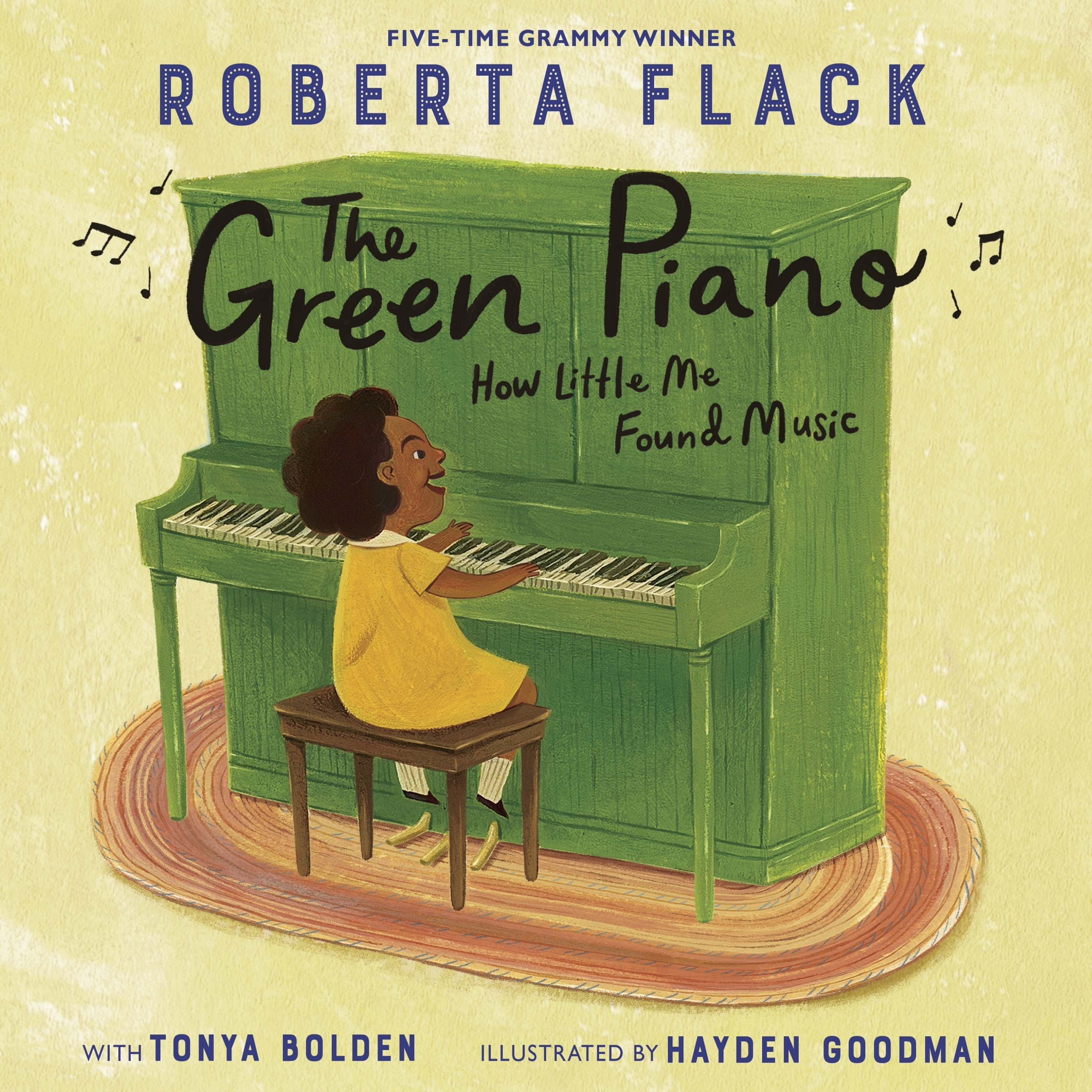
The Green Piano: How Little Me Found Music by Roberta Flack and Tonya Bolden, illustrated by Hayden Goodman

Published by Anne Schwartz Books

Summary:  Roberta Flack’s family didn’t have a lot of money, but they had plenty of love–for each other and for music.  From the time she was three, Roberta played the piano at church, and she started lessons at the age of six.  Her most fervent wish was to have a piano of her own, and her father was able to grant that wish when he found an old piano in a junkyard.  He hauled it home, cleaned it, tuned it, and painted it green.  She practiced for hours, dreaming of a life of a musician, a dream that is shown coming true on the last page.  Includes a timeline of Flack’s career highlights and an author’s note describing her training as a classical musician, which led to her career as a pop singer.  40 pages; grades K-4.

Pros:  A great story to share with early elementary kids, because so much of it is focused on Roberta’s early life.  I love the message of the author’s note, summarized in the last line: “Find your own ‘green piano’ and practice relentlessly until you find your voice, and a way to put that beautiful music into the world.”

Cons:  Kids may need an introduction to Roberta Flack’s music.

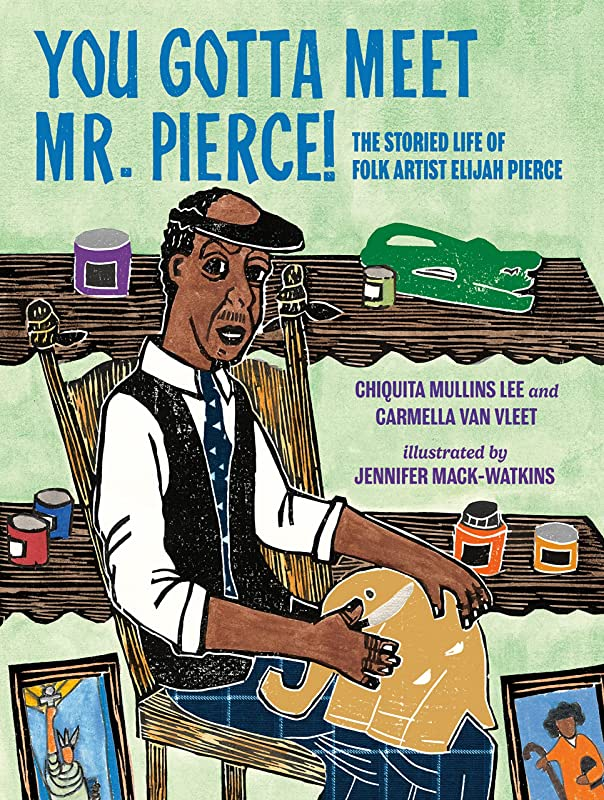
You Gotta Meet Mr. Pierce! The Storied Life of Folk Artist Elijah Pierce by Chiquita Mullins Lee and Carmella Van Vleet, illustrated by Jennifer Mack-Watkins

Published by Kokila

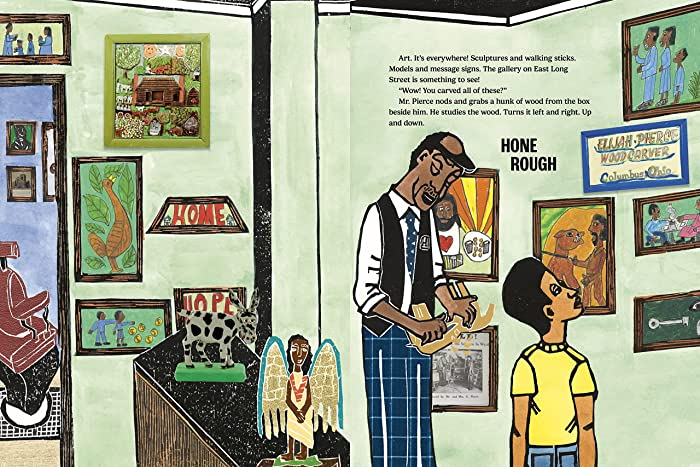
Summary:  In this fictionalized story about real-life artist Elijah Pierce, a boy and his dad enter Mr. Pierce’s barbershop.  The shop is full of wood carvings, and Mr. Pierce is happy to share stories about his life and art.  The boy has some new colored pencils and is trying to get an idea for a picture.  Mr. Pierce tells him how his art often came from stories, whether they were from his own life, the Bible, or something someone told him.  After the haircut and the stories are finished, Mr. Pierce gives the boy a carved elephant.  “I think I know what I want to draw…” he says as he and his dad leave the shop.  The final page shows a father and son (I think the father is the boy who is now grown up) about to enter a museum with an exhibit of Elijah Pierce’s work.  Just like the dad at the beginning of the story, the man tells his son, “You gotta meet Mr. Pierce!”  Includes a timeline of Elijah Pierce’s honors, additional information about the exhibit at the Corcoran Gallery in Washington, D.C., places to see Elijah’s work, and notes from the author and illustrator with additional information about Elijah Pierce, the book, and the illustrations.  40 pages; grades 1-5.

Pros:  A charming story about a little-known artist who will get some well-deserved recognition with this book.  The fictional format is engaging, and the folk-art inspired illustrations are the perfect complement.

Cons:  I found the ending a little confusing, as I couldn’t figure out what the boy had decided to draw, and I wasn’t sure who was pictured on the last page. 

To Boldly Go: How Nichelle Nichols and Star Trek Helped Advance Civil Rights by Angela Dalton, illustrated by Lauren Semmer

Published by HarperCollins

Summary:  The story begins with the author recounting how her family loved watching the original Star Trek, particularly because of Lieutenant Uhuru, acted by Nichelle Nichols, a Black woman who played the communications officer on the Enterprise.  The narrative then goes back to Nichelle’s childhood where she was encouraged by her parents to do whatever she wanted.  She loved performing, first as a ballet dancer and later as a singer and actress.  This gave her confidence when she got the part on Star Trek, but that confidence began to wane when she experienced racism on the show.  She told Gene Rodenberry that she was quitting, but changed her mind when she met a fan–Martin Luther King, Jr. who told her Star Trek was the only show he and his wife let the kids stay up late to watch.  He convinced her to stay on the show and serve as a role model to Black children.  Includes information on Nichelle’s role with NASA helping to recruit a more diverse workforce, including Mae Jemison and Guion Bluford; also an author’s note.  40 pages; grades 1-5.

Pros:  I’m excited to read this book to several of my classes beginning today.  The subject matter, the engaging writing style, and the colorful illustrations make it an excellent choice for sharing Black history…and the cameo by MLK was a fun surprise!

Cons:  No additional resources listed.

Black Swans by Laurel van de Linde, illustrated by Sawyer Cloud

Published by Sunbird Books

Summary:  Six Black dancers, three men and three women, are profiled, each one given a few pages describing his or her career and the racism each one encountered and overcame to achieve groundbreaking success.  The six are listed in chronological order, beginning with Essie Marie Dorsey, who lived from 1893-1967, and finishing with Michaela DePrince, born in 1995 and currently dancing with the Boston Ballet.  The author’s note at the end lists eight other Black ballet dancers, with the years they lived and the companies they danced with.  40 pages; grades 1-5.

Pros:  Dancers will find plenty to inspire them in these stories, timed perfectly to celebrate Black History Month.  The illustrations capture the grace, strength, and beauty of the ballerinas.

Cons:  I wish there was more historical context for the biographies.

Milloo’s Mind: The Story of Maryam Faruqi, Trailblazer for Women’s Education by Reem Faruqi, illustrated by Hoda Hadadi

Published by HarperCollins

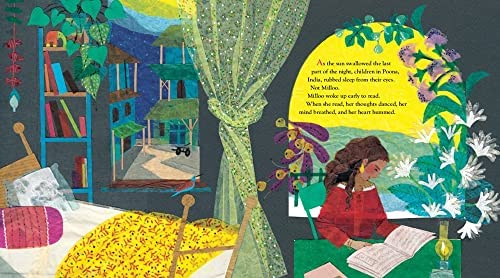
Summary:  The author of Unsettled tells the story of her grandmother, Milloo, who grew up in India in the early 20th century.  Milloo loved school, but her parents told her at the end of fifth grade that she was done with education.  Milloo launched a campaign all summer long and finally got her parents’ permission to enter sixth grade.  She went on to finish high school and college at the top of her class, then became a teacher herself.  After getting married, she tried staying at home as her husband wanted, but found that cooking and sewing were not her thing.  She started a girls’ school in her home, and when classes outgrew that space, she founded a series of schools.  The author’s note tells that the Happy Home Schools in Karachi, Pakistan are still thriving.  40 pages; grades K-4.

Pros:  Both the text and the collage illustrations exude a bright energy that reflects Milloo’s enthusiasm and passion for education.  File this away to read for Women’s History Month next month.

Cons:  I was a bit confused by Milloo being referred to as Maryam in the subtitle, which was not explained until the author’s note (Milloo was her father’s nickname for her, and she’s referred to by that name throughout the story).

Courage in Her Cleats: The Story of Soccer Star Abby Wambach by Kim Chaffee, illustrated by Alexandra Badiu

Published by Page Street Kids

Summary:  As the youngest of seven children, Abby Wambach learned to be tough, especially on the soccer field.  After a successful high school career that ended with a crushing state championship loss, Abby played at the University of Florida where she was recruited for the U.S. Women’s National Soccer Team.  She toughened up even more with a personal trainer to become part of the team that won the gold medal at the 2004 Olympics.  She was on track to win another medal when she broke her leg shortly before the 2008 Olympics, but her encouragement from the sidelines helped her team win gold again.  After a year of rehab, she was back, scoring her 100th career goal in 2009.  Includes additional information about Abby’s childhood and her post-2009 soccer career, a list of soccer terms with definitions, and a bibliography.  32 pages; grades K-4.

Pros:  A lively introduction to Abby Wambach’s life with colorful illustrations and an eye-catching cover that will grab the interest of sports fans.

Cons:  I wish there had been some information on Abby’s activism on behalf of the LGBTQ+ community and women in sports.

Holding Her Own: The Exceptional Life of Jackie Ormes by Traci N. Todd, illustrated by Shannon Wright

Published by Orchard Books

Summary:  Zelda Jackson was an artist, poet, and storyteller who dreamed of working for the Black newspaper, the Pittsburgh Courier.  She got her break writing a story about boxing that was published using her childhood nickname, Jackie.  Once she was an established columnist, she tried her hand at art, creating a comic strip character named Torchy Brown, a young woman who moved from her home in Mississippi to New York City.  After marriage and a move to Chicago, Jackie worked for the Chicago Defender, creating a new comic called Patty-Jo ‘n’ Ginger, which she used to comment on civil rights and other issues important to Black people.  Jackie became a community activist, using the money she made from her comics to fund causes she believed in, and drawing the attention of the FBI, who spied on her for a decade.  After retiring Patty-Jo, Jackie gave up comics, pursuing other forms of art until her death in 1985.  Includes notes from the author and artist, photos, and a bibliography.  48 pages; grades 2-5.

Pros:  This fascinating biography with striking comic-style artwork will inspire graphic novel fans who may want to try creating comics of their own and shows them how comics can be used for both fun and communicating a more serious message.

Cons:  I wish there had been a bit more information on Jackie’s post-comics art career.

Mae Makes A Way: The True Story of Mae Reeves, Hat & History Maker by Olugbemisola Rhuday-Perkovich, illustrated by Andrea Pippins

Published by Crown Books for Young Readers

Summary:  Published in collaboration with the Smithsonian National Museum of African American History and Culture, this book traces the story of Mae Reeves, a Black woman who left Georgia in the 1930’s to become a milliner.  She eventually opened her own shop in Philadelphia, creating hats for celebrities like Marian Anderson, Lena Horne, and Ella Fitzgerald.  She kept her business going while raising three children and being active in her community, helping other Black businesses.  Mae lived to be 104, long enough to see artifacts from her shop included in the Smithsonian’s National Museum of African American History and Culture.  Includes interviews with Mae’s daughter Donna and with Dr. Reneé Anderson, Head of Collections at NMAAHC, as well as information about the museum and a list of sources.  48 pages; grades 2-5.

Pros:  A fascinating biography of a woman who never became famous but who lived a full life, following her own dreams and helping others.  Readers will be inspired to head to Washington, D.C. to see Mae’s hats in the museum.

Cons:  It’s a long picture book for reading aloud.

Only the Best: The Exceptional Life and Fashion of Ann Lowe by Kate Messner and Margaret E. Powell, illustrated by Erin K. Robinson

Published by Chronicle Books

Summary:  Ann Lowe learned her first lessons about sewing and design from her grandmother, who had been an enslaved seamstress, and her mother, who owned a dress shop.  Ann’s work ethic showed itself early; when her mother died, young Ann put aside her grief and finished the dresses that had been ordered for New Year’s Eve.  A year later, she got a job in Tampa, Florida, sewing for a wealthy family.  Her ambitions took her to New York City, where she found success despite the racism she encountered there.  Jacqueline Bouvier hired Ann and her assistants to design and sew her gown and bridesmaid’s dresses for her wedding to Senator John F. Kennedy.  When a leaky ceiling flooded Ann’s workroom and destroyed all the dresses ten days before the wedding, she and her seamstresses recreated every one.  Ann capped her career by opening her own store with her own label on Madison Avenue.  Includes an author’s note with two photos, quotations, and a bibliography.  56 pages; grades 1-5.

Pros:  I loved Fancy Party Gowns by Deborah Blumenthal (2017), but I love this book at least as much.  There’s a bit more detail about Ann’s career, the writing style is engaging, and the illustrations are stunning.

Cons:  At 56 pages, it’s a bit long for a picture book.

Strong by Rob Kearney and Eric Rosswood, illustrated by Nidhi Chanani

Published by Little, Brown Books for Young Readers

Summary:  Rob Kearney was a strong kid who excelled at football and cheerleading, but his favorite sport was weightlifting.  It made him feel like a superhero.  At the age of 17, Rob learned about the Strongman competition and decided to become a weightlifting champion.  Competition events involved lifting heavy logs, stones, and tires, so Rob got to work, running, swimming, and lifting the heaviest weights he could.  Rob loved wearing bright, colorful clothing, but other competitors wore plain, dark colors, so Rob did, too.  When he came in last at his first competition, he felt as dark and gloomy as his clothes.  Falling in love with Joey, a fellow weightlifter, encouraged Rob to be himself, and before long he was dressing exactly the way he wanted to.  Joey’s support and encouragement helped Rob in other ways, and he eventually won the North American Strongman championship.  Includes a letter to readers from Rob, additional resources, and descriptions of all the Strongman events.  40 pages; ages 4-8.

Pros:  The empowering be-yourself message will especially speak to LGBQT+ readers, as Rob defies stereotypes with his rainbow mohawk and unconventional clothing in a sport that is often associated with more traditional masculinity.  The colorful illustrations bring the weightlifting events to life.

Cons:  Although Joey offers to wear the same colorful clothes as Rob, he’s shown on the last page in blue pants and a plain white t-shirt.