Hidden Figures: The True Story of Four Black Women and the Space Race by Margot Lee Shetterly with Winifred Conkling, illustrated by Laura Freeman

Published by HarperCollins

Summary:  In case you haven’t read the original book, the young readers’ edition, and/or seen the movie, this picture book tells the story of four women who worked for NASA between 1943 and 2007.  Dorothy Vaughn, Mary Jackson, Katherine Johnson, and Christine Darden were all good at math.  Very good.  This refrain is repeated throughout the story, as each one is shown overcoming the barriers in place for them at school and later on at NASA.  But they succeeded, and their work helped launch the space program and eventually send men to the moon.  As they looked to their careers after that dream had been fulfilled, “Dorothy, Mary, Katherine, and Christine knew one thing: with hard work, perseverance, and a love of math, anything was possible.”  Includes a timeline, additional biographical information about each woman, a glossary, and an author’s note.  40 pages; grades 1-5.

Pros:  Many kids will recognize these women from the movies.  All are inspiring, and emphasize the importance of hard work and the exciting adventures to be found in STEM careers.  Laura Freeman illustrated Fancy Party Gowns, one of my favorite biographies of last year, and does an excellent job here portraying the four women, NASA, and outer space.

Cons:  The story of Christine Darden (who wasn’t portrayed in the movie) didn’t seem as well integrated to the rest of the book as the other three.
If you would like to buy this book on Amazon, click here.

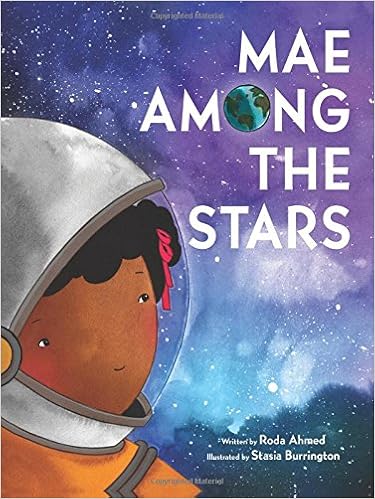
Mae Among the Stars by Roda Ahmed, illustrated by Stasia Burrington

Published by HarperCollins

Summary:  From an early age, Mae Jemison dreamed of becoming an astronaut.  Her mother told her what becomes a repeating refrain in this book: “If you can dream it, if you believe it and work hard for it, anything is possible.”  At school, some kids laughed at her aspiration, and a teacher told her nursing would be a more appropriate profession.  Fortunately, her mother didn’t let her believe this, and Mae promised that one day she would wave to her parents from a spaceship.  The last page shows the adult Mae in her orange space suit and reveals that she did become an astronaut and wave to her mom and dad on Earth.  Includes a page with additional biographical information.  40 pages; ages 4-8.

Pros:  An inspiring story of following your dream, illustrated with engaging round-faced characters and plenty of color.

Cons:  The biographical information is pretty thin.

If you would like to buy this book on Amazon, click here.

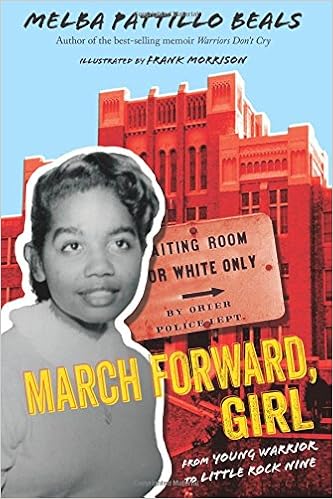
March Forward Girl: From Young Warrior to Little Rock Nine by Melba Beals, illustrated by Frank Morrison

Published by Houghton Mifflin Harcourt

Summary:  Melba Beals, who told her story of helping to integrate Little Rock’s Central High School in Warriors Don’t Cry, recounts her early days, growing up in Jim Crow Arkansas.  At the age of three, she observed her family making the house quiet and dark each night, hoping the Ku Klux Klan would leave them alone.  She raged at seeing her beloved parents and grandmother slighted and scolded whenever they went into town, and at having to use inferior facilities everywhere, while white people got the best of everything.  As she grew up, her fear and anger turned into a determination to change things and to get out of Arkansas.  She jumped at the chance to go to Central High School, a huge, beautiful school that she had admired for years.  The main part of the book ends right before she starts high school; an epilogue describes the violent and frightening experience of integration.  The text is illustrated with drawings and a few photographs.  224 pages; grades 6-9.

Pros:  Readers will gain a better understanding of what it was like for African Americans living in the South in the 1940’s.  Beals’ conversational tone draws the reader in, and her story is so powerful and compelling (and at times, horrifying) that the book is hard to put down.

Cons:  This book is recommended for grade 5 or age 10 and up.  Be aware that there is a scene in which the KKK storms into a prayer meeting, and 5-year-old Melba witnesses a lynching from the church rafters; at age 11, she gets lost on a dark, isolated road and narrowly escapes being raped and/or murdered by a group of Klansmen.

If you would like to buy this book on Amazon, click here.

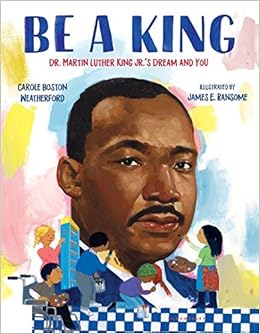
Be A King: Dr. Martin Luther King Jr.’s Dream and You by Carole Boston Weatherford, illustrated by James Ransome

Published by Bloomsbury

Summary:  “Everybody can be great, because everybody can serve….You only need a heart full of grace, a soul generated by love.”  Martin Luther King Jr.’s words speak to children in this book showing how anyone can “be a King.”  Illustrations portraying scenes from King’s life are interspersed with others in a different style showing kids working together to paint an MLK mural.  Ideas for how to be a King include standing for peace, having a dream, and doing your very best at whatever you do.  The last page shows the kids gathered around the mural with the advice, “You can be a King.  Set your sights on the mountaintop.  Climb a little higher every day.”  An author’s note gives biographical information.  40 pages; ages 4-9.

Pros:  I liked how this book connected the sometimes abstract concepts of King’s work and speeches with concrete actions that kids can take to make the world a better place.  This would be an excellent book to use in conjunction with the day of service aspect of the Martin Luther King Jr. holiday.  There is a lot to look at in the illustrations, with two stories interwoven.

Cons:  Having biographical information on the pages with the pictures of King–even just a sentence or two–would have made this even more useful in helping kids understand his life.

If you would like to buy this book on Amazon, click here.

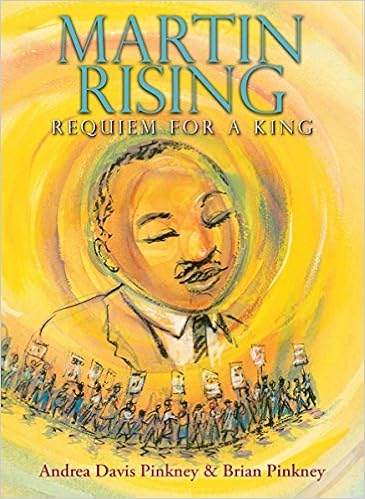
Martin Rising: Requiem for a King by Andrea Davis Pinkney, illustrated by Brian Pinkney

Published by Scholastic Press

Summary:  The Pinkneys relate the story of Martin Luther King, Jr.’s assassination, beginning with a “Henny Penny Prelude”, in which the fairy tale hen tries to warn of the bitter events ahead.  The remaining poems are in three sections: “Daylight”, “Darkness”, and “Dawn”, in which King’s work is described, particularly the sanitation workers’ strike that brought him to Memphis, Tennessee in March and April of 1968.  The assassination occurs part way through “Darkness”, and includes poems about Coretta Scott King, the Kings’ four children, and James Earl Ray.  “Dawn” is made up of just three poems, concluding with “Rejoice the Legacy” which celebrates MLK’s legacy, including the holiday celebrating his birth.  Back matter includes author’s and artist’s reflections, four pages of text describing the events from the poems called “Now Is the Time” (with several photographs), a timeline, and sources.  128 pages; grades 4-8.

Pros:  Both the poetry and the illustrations are majestic and give the reader much to think about.  The author’s note suggests that the poems could be performed with the “Now Is the Time” section as narration and adding poems to the appropriate parts of the story.

Cons:  The Henny Penny motif was a bit confusing to me.

If you would like to buy this book on Amazon, click here.

Five favorite biographies

Lots of amazing women this year!


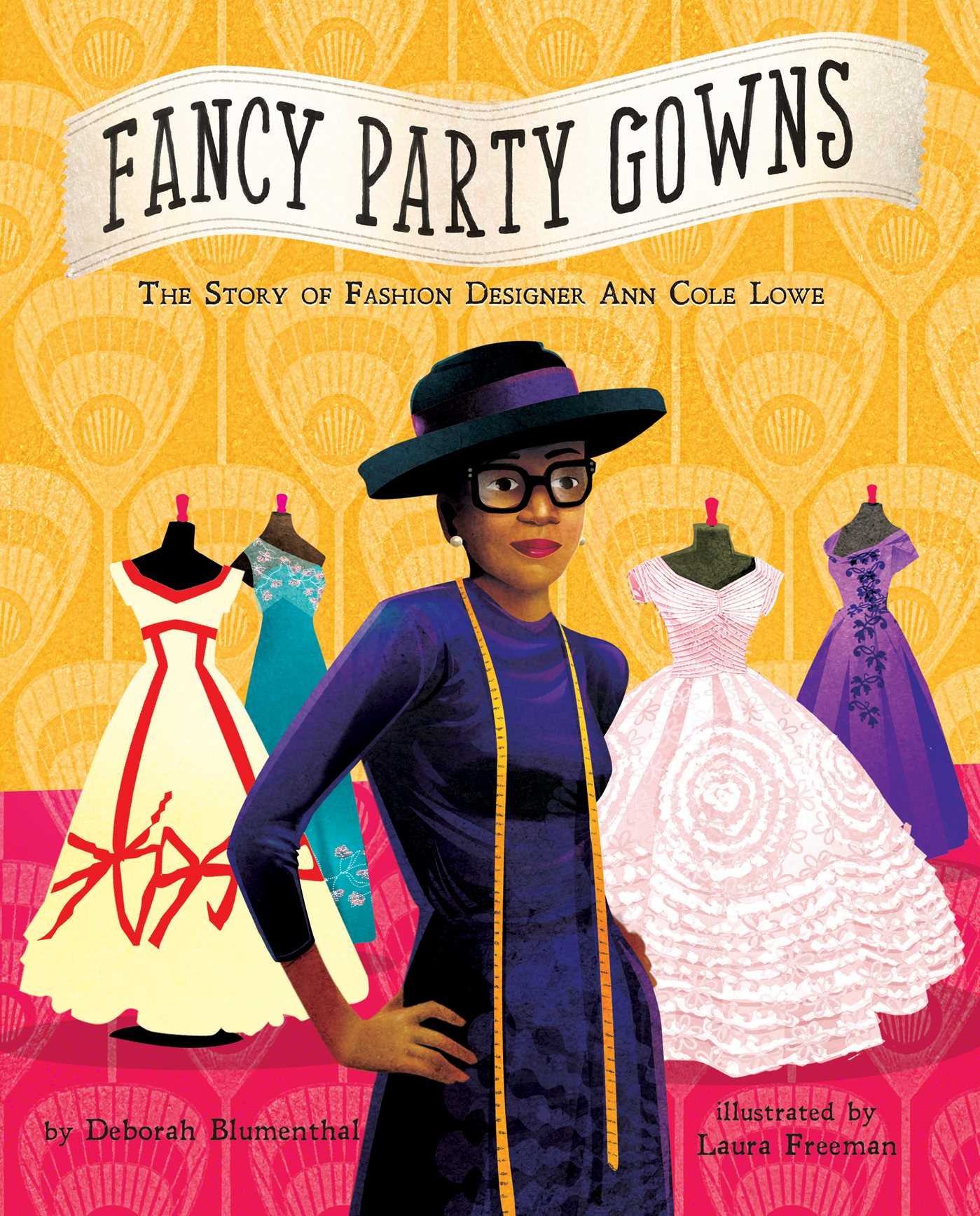
Fancy Party Gowns: The Story of Fashion Designer Ann Cole Lowe by Deborah Blumenthal.  Published by Bonnier Publishing.

“Ann thought about what she could do, not about what she couldn’t change.”  This repeating refrain provides words to live by in this gorgeously illustrated biography about the pioneering African-American dress designer who created Jackie Kennedy’s wedding gown.  Link to Amazon.


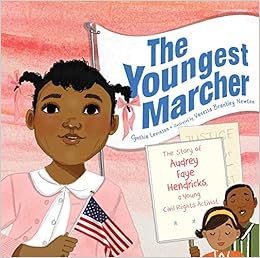
The Youngest Marcher: The Story of Audrey Faye Hendricks, A Young Civil Rights Activist by Cynthia Levinson.  Published by Atheneum Books for Young Readers.

Yes, kids, this nine-year-old girl spent a week in jail in 1963 for participating in the civil rights movement.  Link to Amazon.


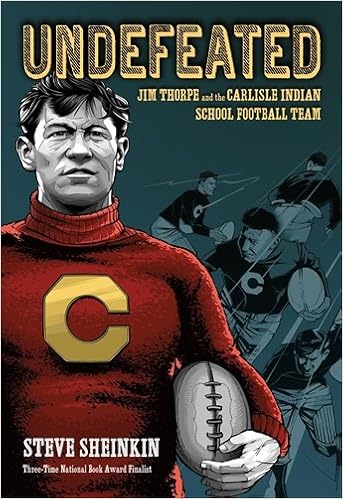
Undefeated: Jim Thorpe and the Carlisle Indian School Football Team by Steve Sheinkin.  Published by Roaring Brook Press.

Jim Thorpe, Pop Warner, the Carlisle Indian School, Olympics controversy…so much is covered here, all of it in Sheinkin’s inimitable style.  Here’s hoping this is on the Newbery Committee’s short list, as well as those deciding on the Sibert awards.  Link to Amazon.


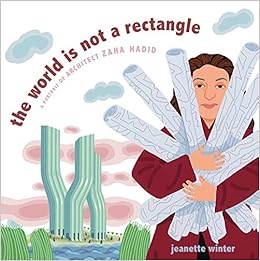
The World Is Not a Rectangle by Jeannette Winter.  Published by Beach Lane Books.

Whatever the fate of The Secret Project, Jeannette Winter should also be considered for this gorgeous biography of Iraqi architect Zaha Hadid.  Link to Amazon.


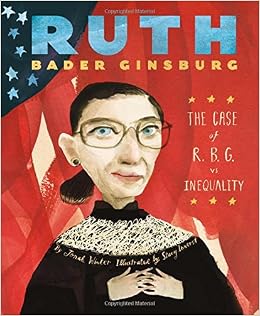
Ruth Bader Ginsburg: The Case of R.B.G. vs. Inequality by Jonah Winter. Published by Harry N. Abrams.

There were  two excellent picture book biographies of Ruth Bader Ginsburg this year, but I only reviewed one on the blog.  This one just caught up with me this week.  Written as a legal argument, it lays out a compelling case for Ginsburg defeating the discrimination she has faced throughout her life.  And it’s by The Secret Project author Jonah Winter, who is Jeannette Winter’s son.  Link to Amazon.


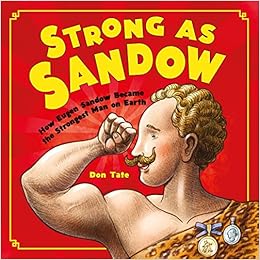
Strong as Sandow: How Eugen Sandow Became the Strongest Man on Earth by Don Tate

Published by Charlesbridge

Summary:  As a skinny, frail child, Friedrich Mueller loved athletics, but frequently was too sick to play.  Although he was a good student, he left university to join a circus where his career as an acrobat helped him get stronger.  When the circus folded, Friedrich worked as an artists’ model and learned more about bodybuilding.  At the age of 20, he changed his name to Eugen Sandow and launched his career as a showman.  When he beat famous strongmen Sampson and Cyclops on a London stage, he became an overnight sensation, eventually traveling to America, where his performance at the Chicago World’s Fair increased his celebrity status.  Back in London, he focused on helping others become physically strong and healthy.  He held the Great Competition, the first organized bodybuilding contest, awarding a gold statue with his likeness, a version of which is still used today.  Includes an afterword with more information, four exercises for kids to try, an author’s note about his own bodybuilding experiences, and an extensive bibliography.  40 pages; grades 1-4.

Pros:  Humorous illustrations and lighthearted text combine to make this a fun biographical read.

Cons:  The fact that Sandow died at age 58 makes me question his health advice.

If you’d like to order this book through Amazon, click here.

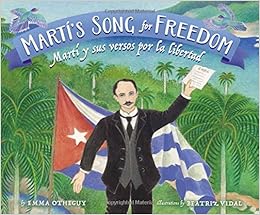
Marti’s Song for Freedom/Marti y Sus Versos por la Libertad by Emma Otheguy, illustrated by Beatriz Vidal

Published by Children’s Book Press

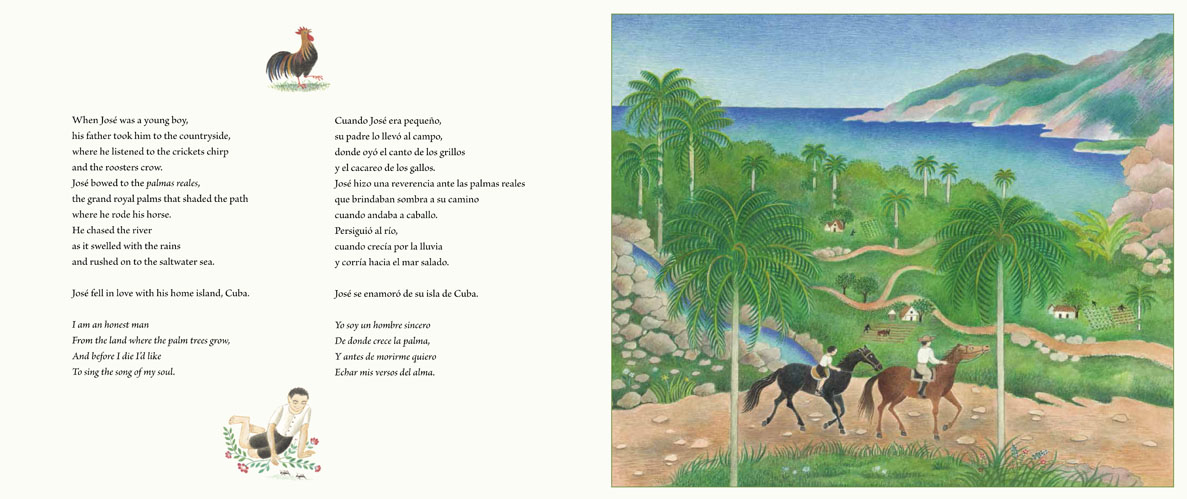
Summary:  Growing up in Cuba, Jose Marti was outraged that some of his fellow countrymen were slaves.  As he grew older, he learned that the key to ending slavery was Cuba’s independence from Spain.  In 1868, the Cuban people started a war for independence.  Marti’s newspaper articles and pamphlets about it landed him in jail.  At age 17, he was released by the Spanish government on the condition that he leave Cuba forever.  He traveled around the world, advocating for Cuban independence, and finally settled in New York.  He loved the city, but sometimes found it oppressive.  He would retreat to the Catskills, where he wrote poetry and stories for children that are still read today. In 1895, Jose went back to Cuba, where he died a few weeks later in a battle for independence.  Seven  years later, in 1902, Cuba finally gained independence from Spain.  32 pages; grades 2-6.

Pros:  Told in both English and Spanish, this is an inspiring biography of a man who never stopped fighting against the injustices he saw.  The illustrations may make it a Caldecott contender.

Cons:  Why is New York consistently referred to as Nuevo York in the English version of the story?

If you would like to buy this book on Amazon, click here.

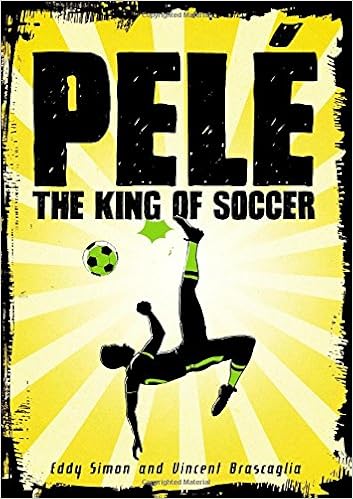
Pele: The King of Soccer by Eddy Simon, illustrated by Vincent Bascaglia

Published by First Second

Summary:  Edson Arantes de Nascimento grew up poor in Brazil, tutored in soccer by his father who had missed out on a professional career because of a knee injury.  From a young age, Edson adopted the nickname Pele, and that was how he was known to millions of fans as he rose to the top in the soccer world.  As a member of the Santos team, he became unstoppable, becoming the only player to ever win three World Cups.  He retired from Brazilian soccer in 1974, but financial difficulties led him to sign with the New York Cosmos two years later, causing a brief rise in the popularity of the game in the U.S.  Since his final retirement, he has traveled the world as a goodwill ambassador and worked with the Brazilian government to improve sports in his own country.  144 pages; grades 4-8.

Pros:  A fast-paced graphic novel that will grab the attention of sports fans.  There’s plenty of soccer action, as well as biographical information that doesn’t shy away from some of Pele’s less admirable traits, including adultery, but ultimately portrays him as a positive role model.

Cons:  The font for some of the footnotes is so tiny as to be almost invisible to the naked eye.

If you would like to buy this book on Amazon, click here.

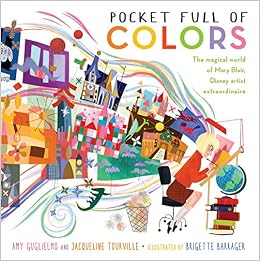
Pocket Full of Colors: The Magical World of Mary Blair, Disney Artist Extraordinaire by Amy Guglielmo and Jacqueline Tourville, illustrated by Brigitte Barrager

Published by Atheneum Books for Young Readers

Summary:  From the time she was a child, Mary Blair loved colors of all hues.  She used them at art school, and they led her to a job at Disney Studios, one of the first women to be hired by them.  Once there, though, a group of older men rejected her colorful drawings, preferring to stick with mostly black and white.  She did succeed in catching the attention of one man, Walt Disney himself, who invited her on a tour of South America to create art.  Upon her return, under the South American influence, her art grew even more eye-popping, and some of her ideas were finally accepted, including Cinderella’s pumpkin coach and Alice in Wonderland’s caterpillar.  But too many of her ideas were turned down, and Mary went off on her own, where she created children’s book illustrations and theater sets.  A few years later, Walt Disney approached her with a new plan, and Mary became the chief designer for his “It’s a Small World” ride.  At last, her colors could flow freely, and the world could finally see Mary’s world as she had always imagined it.  Includes an author’s note with biographical information.  48 pages; ages 4-8.

Pros:  A colorful biography of a little-known artist with a connection most kids will recognize and a “be yourself” message about creativity.

Cons:  Now we will all have “It’s a Small World” stuck in our heads for the rest of the day.

If you would like to purchase this book on Amazon, click here.