Strong as Sandow: How Eugen Sandow Became the Strongest Man on Earth by Don Tate

Published by Charlesbridge

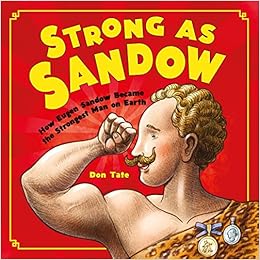
Summary:  As a skinny, frail child, Friedrich Mueller loved athletics, but frequently was too sick to play.  Although he was a good student, he left university to join a circus where his career as an acrobat helped him get stronger.  When the circus folded, Friedrich worked as an artists’ model and learned more about bodybuilding.  At the age of 20, he changed his name to Eugen Sandow and launched his career as a showman.  When he beat famous strongmen Sampson and Cyclops on a London stage, he became an overnight sensation, eventually traveling to America, where his performance at the Chicago World’s Fair increased his celebrity status.  Back in London, he focused on helping others become physically strong and healthy.  He held the Great Competition, the first organized bodybuilding contest, awarding a gold statue with his likeness, a version of which is still used today.  Includes an afterword with more information, four exercises for kids to try, an author’s note about his own bodybuilding experiences, and an extensive bibliography.  40 pages; grades 1-4.

Pros:  Humorous illustrations and lighthearted text combine to make this a fun biographical read.

Cons:  The fact that Sandow died at age 58 makes me question his health advice.

If you’d like to order this book through Amazon, click here.

Marti’s Song for Freedom/Marti y Sus Versos por la Libertad by Emma Otheguy, illustrated by Beatriz Vidal

Published by Children’s Book Press

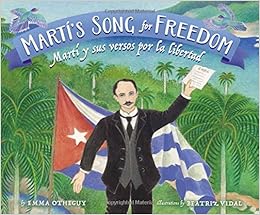
Summary:  Growing up in Cuba, Jose Marti was outraged that some of his fellow countrymen were slaves.  As he grew older, he learned that the key to ending slavery was Cuba’s independence from Spain.  In 1868, the Cuban people started a war for independence.  Marti’s newspaper articles and pamphlets about it landed him in jail.  At age 17, he was released by the Spanish government on the condition that he leave Cuba forever.  He traveled around the world, advocating for Cuban independence, and finally settled in New York.  He loved the city, but sometimes found it oppressive.  He would retreat to the Catskills, where he wrote poetry and stories for children that are still read today. In 1895, Jose went back to Cuba, where he died a few weeks later in a battle for independence.  Seven  years later, in 1902, Cuba finally gained independence from Spain.  32 pages; grades 2-6.

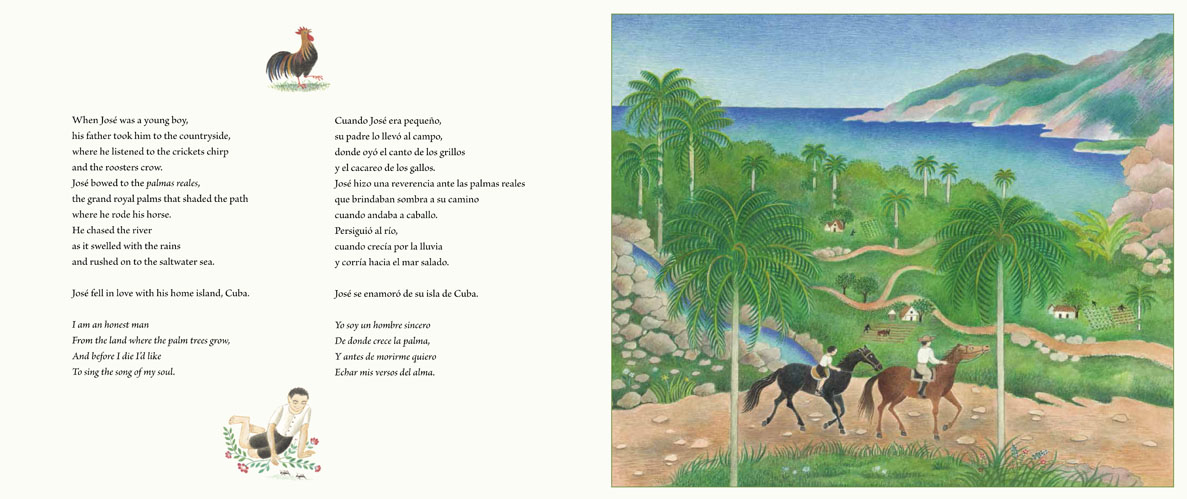
Pros:  Told in both English and Spanish, this is an inspiring biography of a man who never stopped fighting against the injustices he saw.  The illustrations may make it a Caldecott contender.

Cons:  Why is New York consistently referred to as Nuevo York in the English version of the story?

If you would like to buy this book on Amazon, click here.

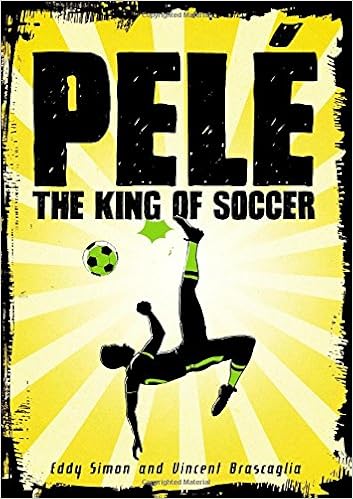
Pele: The King of Soccer by Eddy Simon, illustrated by Vincent Bascaglia

Published by First Second

Summary:  Edson Arantes de Nascimento grew up poor in Brazil, tutored in soccer by his father who had missed out on a professional career because of a knee injury.  From a young age, Edson adopted the nickname Pele, and that was how he was known to millions of fans as he rose to the top in the soccer world.  As a member of the Santos team, he became unstoppable, becoming the only player to ever win three World Cups.  He retired from Brazilian soccer in 1974, but financial difficulties led him to sign with the New York Cosmos two years later, causing a brief rise in the popularity of the game in the U.S.  Since his final retirement, he has traveled the world as a goodwill ambassador and worked with the Brazilian government to improve sports in his own country.  144 pages; grades 4-8.

Pros:  A fast-paced graphic novel that will grab the attention of sports fans.  There’s plenty of soccer action, as well as biographical information that doesn’t shy away from some of Pele’s less admirable traits, including adultery, but ultimately portrays him as a positive role model.

Cons:  The font for some of the footnotes is so tiny as to be almost invisible to the naked eye.

If you would like to buy this book on Amazon, click here.

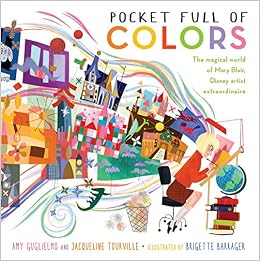
Pocket Full of Colors: The Magical World of Mary Blair, Disney Artist Extraordinaire by Amy Guglielmo and Jacqueline Tourville, illustrated by Brigitte Barrager

Published by Atheneum Books for Young Readers

Summary:  From the time she was a child, Mary Blair loved colors of all hues.  She used them at art school, and they led her to a job at Disney Studios, one of the first women to be hired by them.  Once there, though, a group of older men rejected her colorful drawings, preferring to stick with mostly black and white.  She did succeed in catching the attention of one man, Walt Disney himself, who invited her on a tour of South America to create art.  Upon her return, under the South American influence, her art grew even more eye-popping, and some of her ideas were finally accepted, including Cinderella’s pumpkin coach and Alice in Wonderland’s caterpillar.  But too many of her ideas were turned down, and Mary went off on her own, where she created children’s book illustrations and theater sets.  A few years later, Walt Disney approached her with a new plan, and Mary became the chief designer for his “It’s a Small World” ride.  At last, her colors could flow freely, and the world could finally see Mary’s world as she had always imagined it.  Includes an author’s note with biographical information.  48 pages; ages 4-8.

Pros:  A colorful biography of a little-known artist with a connection most kids will recognize and a “be yourself” message about creativity.

Cons:  Now we will all have “It’s a Small World” stuck in our heads for the rest of the day.

If you would like to purchase this book on Amazon, click here.

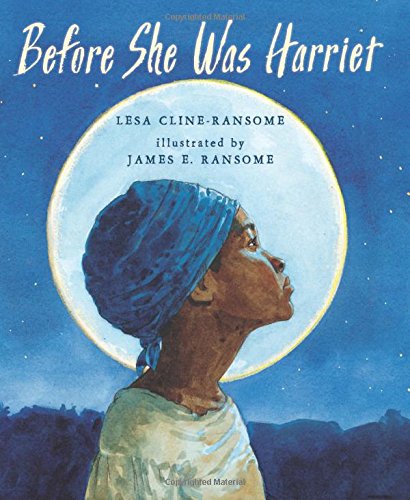
Before She Was Harriet by Lesa Cline-Ransome, illustrated by James E. Ransome

Published by Holiday House

Summary:  Harriet Tubman’s story is told in reverse, beginning when she is “an old woman/tired and worn/her legs stiff/her back achy”.  Before that, she was a suffragist, and before that, a Union spy.  The narrative continues back in time, showing Harriet as Moses, conducting slaves to freedom on the Underground Railroad, and finally, all the way back to a child named Araminta, “who dreamed/of living long enough/to one day/be old/stiff and achy/tired and worn and wrinkled/and free”.  32 pages; grades 1-4.

Pros: A brief, poetic look at Harriet Tubman’s life and many achievements, beautifully illustrated by Coretta Scott King medalist James Ransome.

Cons:  I was disappointed that there was no back matter giving more biographical information.

If you would like to buy this book on Amazon, click here.

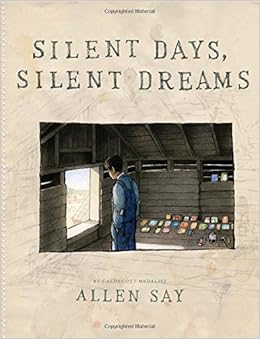
Silent Days, Silent Dreams by Allen Say

Published by Arthur A. Levine Books

Summary:  James Castle was deaf, mute, and autistic.  He never learned to read or speak.  He spent a good portion of his childhood in the loft of an unused icehouse, and later lived in an abandoned chicken coop.  His parents and teachers actively discouraged him from art, but he kept creating it any way he could.  He would collect scrap paper, and use a burned match and saliva to draw.  The people and animals he created from cast-off cardboard became his friends.  His nephew, Cort Conley, loved to watch him draw.  When Cort went to art school, he showed one of his teachers his Uncle Jimmy’s work.  The professor was so excited, he drove to Boise, Idaho to meet James, and later organized an exhibit in Portland, Oregon.  Other exhibits and sales followed, and when James Castle died, he left behind over 15,000 pieces of art.  An author’s note explains how Allen Say came to write this book after being asked by his friend Cort to create a portrait of his uncle.  64 pages; grades 3-7.

Pros:  A sad but fascinating story of a man who was pretty much treated like trash by everyone who knew him, including his own family, yet continued to create art whenever and wherever he could.  Much of Allen Say’s art is done in the style of Castle’s, and may very well be considered for a Caldecott.

Cons:  I wasn’t sure if the illustrations were done by Castle, or by Say in Castle’s style.  If they were the originals, some captions would have been helpful; if they weren’t, I would have liked to see some of the originals at the end of the book.

If you’d like to buy this book on Amazon, click here.

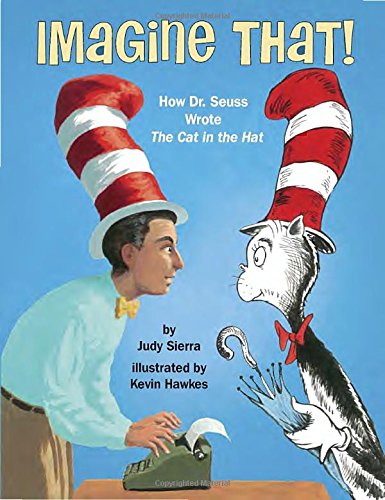
Imagine That: How Dr. Seuss Wrote the Cat in the Hat by Judy Sierra, illustrated by Kevin Hawkes

Published by Random House

Summary:  In 1954, there were lots of great new books for kids like Charlotte’s Web and Horton Hears a Who!.  Good books for those who already knew how to read; for children just learning, there wasn’t much.  Ted Geisel, a.k.a. Dr. Seuss, was hired to write a fun and interesting book for beginning readers, using an “official” list of approved words.  He thought it would take him a week or two, but he ended up spending over a year getting it just right.  The result, of course, was The Cat in the Hat, and it became an instant hit, leading Ted to write more books for beginning readers like The Cat in the Hat Comes Back and Hop on Pop.  When his friend Bennett Cerf challenged him to write a book with just 50 different words (The Cat in the Hat had 236), Geisel rose to the occasion once again with Green Eggs and Ham.  Includes writing and illustrating tips from Dr. Seuss, notes from the author and illustrator, and a list of books by Dr. Seuss. 48 pages; grades K-3.

Pros:  A fun look at creative genius, with a few pages of Seuss-inspired rhyming text and plenty of Seuss-inspired illustrations.  Messages about perseverance and hard work are subtly woven into the story.

Cons:  A brief biography or timeline at the end would have been a nice addition.

If you would like to buy this book on Amazon, click here.

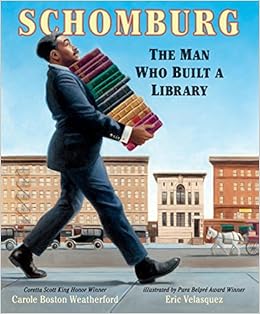
Schomburg: The Man Who Built a Library by Carole Boston Weatherford, illustrated by Eric Velasquez

Published by Candlewick

Summary:  Arturo Schomburg grew up in Puerto Rico, where he loved reading and history.  When his fifth grade teacher told him that people from Africa had no history, he began a lifelong quest to prove her wrong.  At age 17, he moved to New York and became a bank clerk, but his real passion was collecting books, papers, and pamphlets having to do with African and African-American history.  Eventually, his collection grew to such a size that his wife said she was leaving if he didn’t sell it.  The New York Public Library purchased it, and it became the cornerstone of their Negro History, Literature, and Prints collection.  Schomburg also served as curator for the Negro Collection at Fisk University Library in Tennessee.  Includes a timeline and bibliography. 38 pages; grades 3-6.

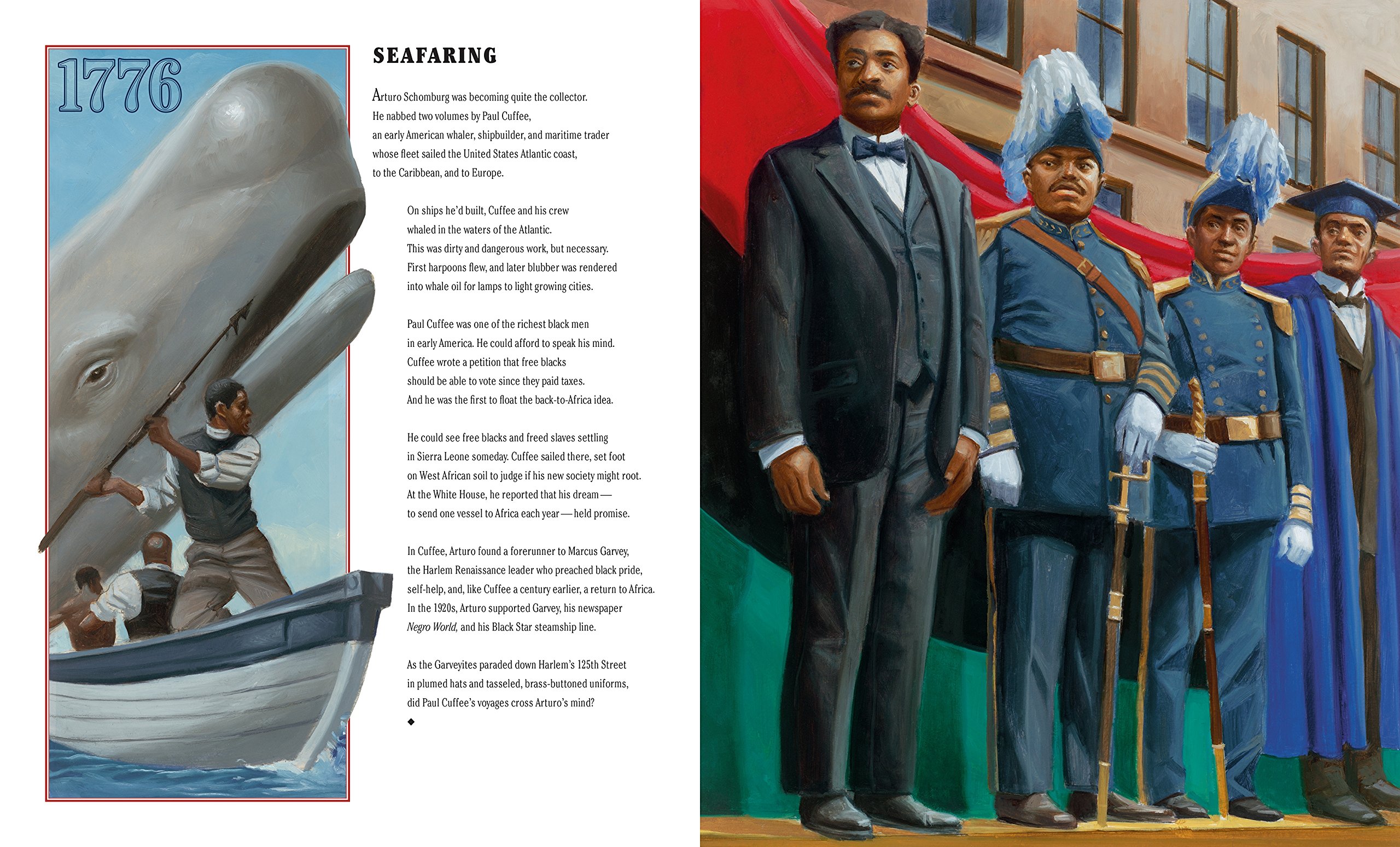
Pros:  The free verse poems that make up the text tell the story of Arturo Schomburg, but also of many of the people whose stories he collected, including Phillis Wheatley, Frederick Douglass, and Toussaint Louverture.  A poem called “Whitewash” explores the African heritage, mostly ignored, of such famous people as John James Audubon, Alexandre Dumas, and Beethoven.  The large oil paintings that illustrate this oversized book bring all these subjects to life.

Cons:  From the outside, this looks like a picture book biography of Arturo Schomberg, but there is much more to it.  It would be doing a disservice to try to get through it all in a single sitting.

If you’d like to buy this book on Amazon, click here.

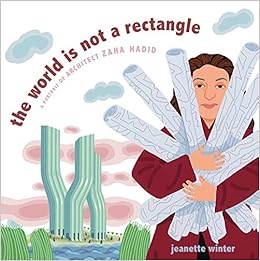
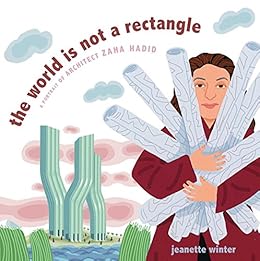
The World Is Not a Rectangle: A Portrait of Architect Zaha Hadid by Jeanette Winter

Published by Beach Lane Books

Summary:  Growing up in Iraq, Zaha Hadid loved to see patterns in nature and in her surroundings, and dreamed of turning those patterns into buildings.  She moved to London to study architecture, then, with a few friends, opened her own firm called Studio 9.  Her designs were so unusual that she had trouble convincing others that they could be built.  But she knew that the world is not a rectangle, and had the confidence to persevere.  Her determination paid off, and her unique buildings are now in cities around the world.  Zaha died in 2016, but Studio 9 lives on, continuing to make her dreams reality.  Back matter includes two pages of thumbnail sketches of the buildings mentioned in the text, identifying where they are located, a bit more biographical information, and a page of sources.  56 pages; grades K-4.

Pros:  This would be useful as a biography or an art book, maybe inspiring kids to design their own buildings from nature.  I really love Jeannette Winter’s style of art (she also illustrated The Secret Project), and am hoping that the Caldecott committee takes a look at both of her books this year.

Cons:  There were no photos of the buildings.

Maya Lin: Artist-Architect of Light and Lines by Jeanne Walker Harvey, illustrated by Dow Phumiruk

Published by Henry Holt

Summary:  Maya Lin grew up surrounded by nature, books, and parents “who never told her what to be or how to think”, having left China to escape that kind of doctrine.  Maya loved to create, inspired by her artist father and poet mother.  In college, she decided to study architecture, combining her love of art, science, and math.  When she was a senior, she entered a contest to design a memorial for the Vietnam War.  Her entry was selected from 1,421 others.  When the judges found out how young she was, they were shocked, and many felt that another design should be chosen.  Maya persisted, however, and her dream of a beautiful black wall with the names of those who died in the Vietnam War became a reality. It was the first of many art-architecture installations that Maya continues to create today.  Includes an author’s note with additional information about Maya Lin and the memorial.  32 pages; grades K-4.

Pros:  A quiet, beautiful work about a talented artist who persisted in bringing her creation to fruition.  The digital watercolors by first-time illustrator Phumiruk perfectly capture tone of the book and the Vietnam Veterans Memorial.

Cons:  This only touches on details of Lin’s life, and is not a complete biography.