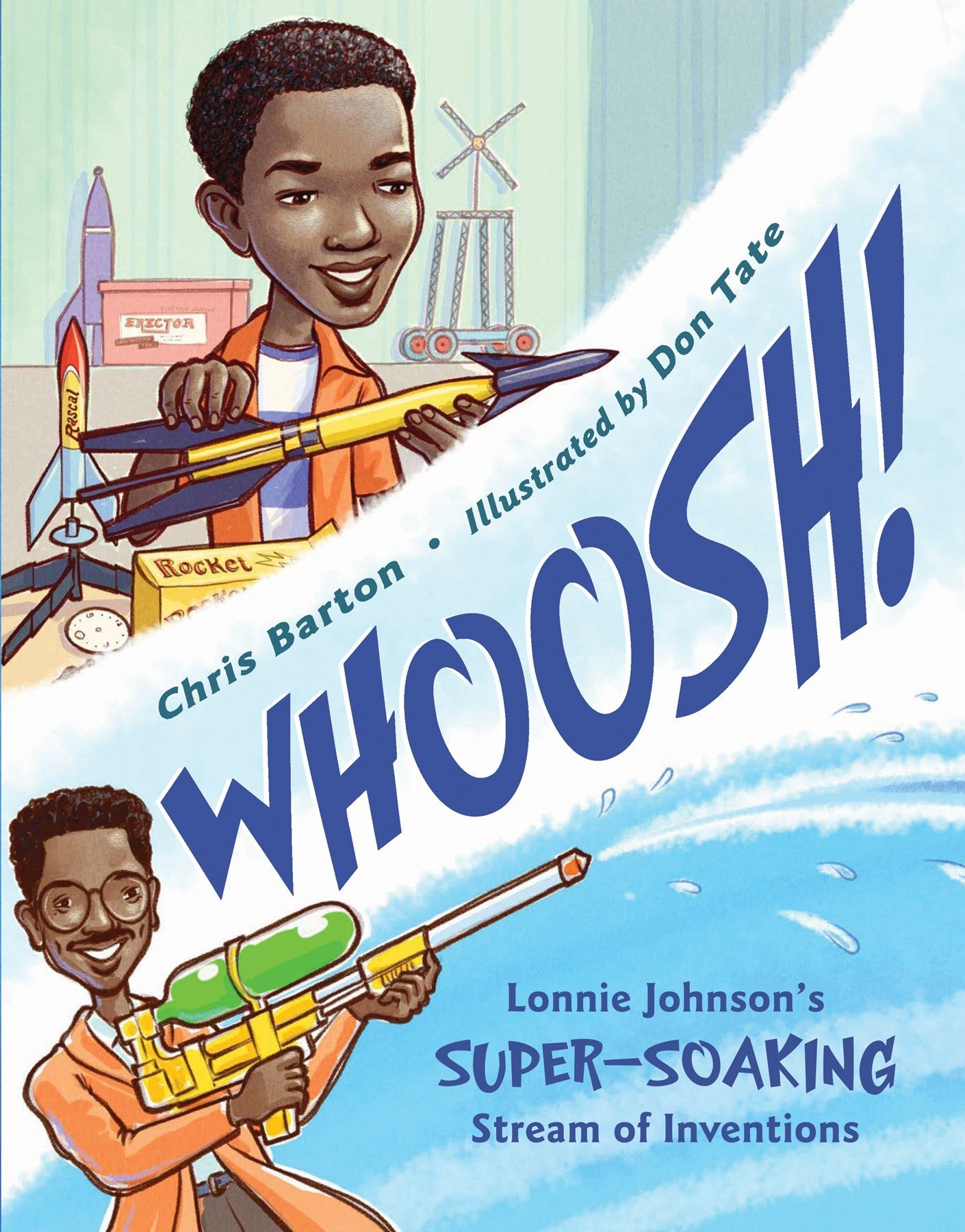
Whoosh! Lonnie Johnson’s Super-Soaking Stream of Inventions by Chris Barton, illustrated by Don Tate

Published by Charlesbridge

Whoosh!: Lonnie Johnson's Super-Soaking Stream of Inventions: Barton,  Chris, Tate, Don: 9781580892971: Amazon.com: Books

Summary:  When Lonnie Johnson was growing up in Alabama, his small house and large family didn’t leave him with much space to do what he loved best…invent.  Still, he had supportive parents (when his rocket fuel caught fire in the kitchen, his mom just sent him outside) and a lot of perseverance.  His hard work paid off in high school, when his robot won first place at a science fair at the University of Alabama—a school that African-American students like Lonnie hadn’t been allowed to attend just a few years before.  Lonnie graduated from Tuskegee, then went on to work for NASA, but he kept inventing in his spare time.  While testing an environmentally-friendly cooling system, he serendipitously invented the Super Soaker water gun.  This hit toy has given Lonnie enough income to allow him to continue working on his inventions full-time.  The author’s note explains how he learned about kids’ stereotypical ideas about scientists, leading him to write a biography of a man who doesn’t fit those stereotypes. 32 pages; grades 1-5.

Pros:  Kids will connect with this hard-working, but fun-loving scientist who invented a much-loved toy; teachers will make connections to science and African-American history curriculum; and librarians will enjoy using this book to tie in with their maker spaces.

Cons:  It seemed to me that Lonnie Johnson was a bit hasty in disregarding the advice, “Don’t quit your day job”.

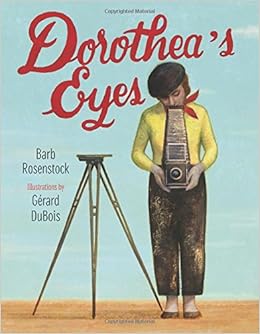
Dorothea’s Eyes by Barb Rosenstock, illustrated by Gerard DuBois

Published by Calkins Creek 

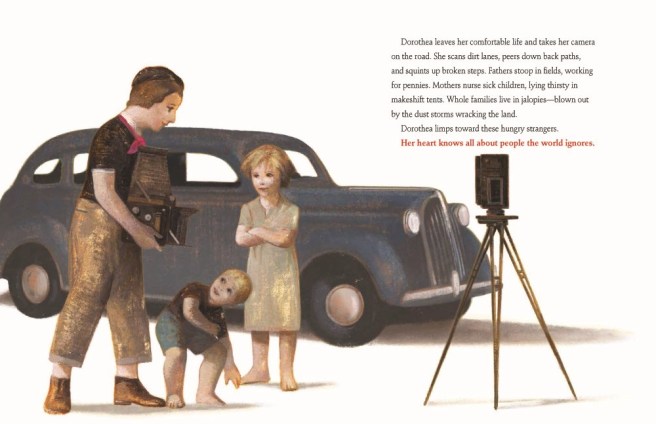
Summary:  Young Dorothea was a keen observer, often feeling like an outsider after a childhood bout of polio left her with a limp.  At the age of 18 she decided to become a photographer, even though she had never handled a camera.  She worked in a number of studios, first in New York, then in California, where she learned the art of taking pictures, eventually setting up her own portrait studio in San Francisco.  But she felt unfulfilled taking photos of wealthy people.  In the midst of the Great Depression, she took to the streets, photographing the poor and neglected, traveling across the country, and waking people up to the poverty that was sweeping the nation.  Although she was plagued with ill health for many years, Dorothea continued to be a crusader with her camera, both in the United States and abroad.  End matter includes several of Lange’s photographs, an author’s note, a timeline, and resources for further research.  40 pages; grades 1-5.

Pros:  An interesting biography of an inspiring woman who followed her heart to do work that made a difference.  The unique illustrations have an appropriately vintage feel to them.

Cons:  I really liked Dorothea Lange’s quote on the bibliography page.  Too bad it couldn’t have been worked into the text.

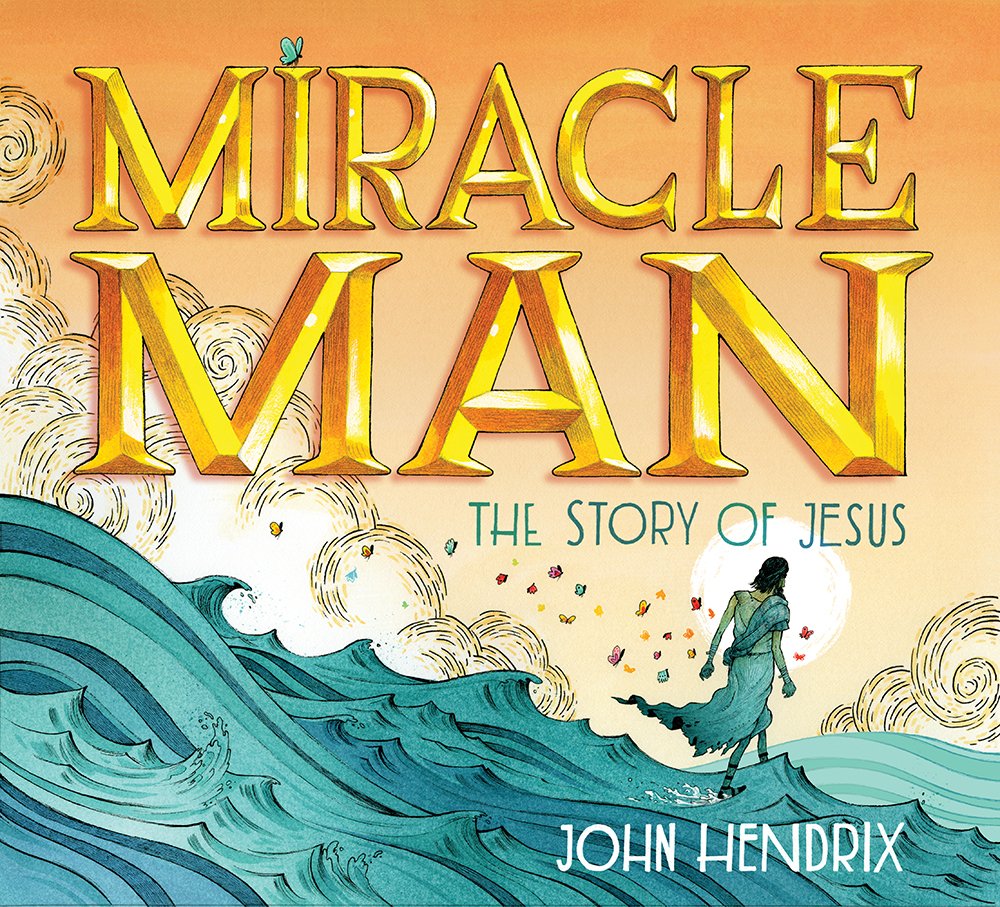
Miracle Man: The Story of Jesus by John Hendrix

Published by Abrams Books for Young Readers

Amazon.com: Miracle Man: The Story of Jesus (9781613758717): John ...


Summary:  The story of Jesus’ life is told from a Christian perspective, with an emphasis on miracles he performed.  The narrative begins with him calling his disciples from among the fishermen, then continues with various healings, Jesus calming the waves and walking on the water, and the miracle of the loaves and fishes.  His last supper is recounted, followed by his crucifixion, which is alluded to, but not shown in the pictures (something this reader, who was traumatized as a child by a book called The Easter Story for Children, appreciated).  The resurrection is covered in two pages, one showing a wrapped body lying in a tomb, the next showing Jesus in white, standing outside the tomb, and the sentence, “But God’s Son, Jesus, the Miracle Man, had in store one last glorious miracle…”  An author’s note explains how he came to create this book, and the process of choosing from among the stories of Jesus in the Bible, which necessarily left out some of the story.  40 pages; grades K-4.

Pros:  The beautifully designed illustrations, incorporating some of Jesus’ words into the pictures, are worthy of Caldecott consideration (would a group of 21st-century librarians recognize a book that is clearly written from a Christian perspective?).  The simple text is a good introduction to Jesus’ miracles and many aspects of his life.

Cons:  As noted by the author, this is a selection of stories, and some key parts of Jesus’ life (birth, John the Baptist, Sermon on the Mount, Mary Magdalene) are excluded.

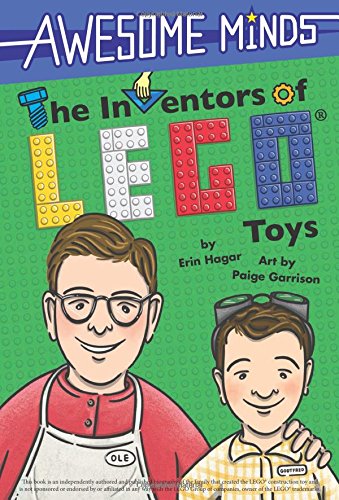
Awesome Minds: The Inventors of Lego Toys by Erin Hagar, art by Paige Garrison

Published by Duo Press 

Summary:  When Ole Kirk Christiansen made the decision to change careers from carpenter to toymaker, he couldn’t have predicted the impact he would ultimately have on the world.  His family-owned business became the LEGO company.  After World War II, Ole Kirk decided to switch from wooden toys to plastic.  His son Godtfred took over the business, and ultimately made the fateful decision to focus on one toy—the sets of LEGO bricks the company had begun manufacturing in 1949.  Of course, this expanded to the LEGO empire we know today.  The story goes up to the present, with a couple pages devoted to the development of LEGOLAND and some of the amazing ideas that have come out of the LEGO company.  Includes a glossary, index, and book list of other books about inventors.  48 pages; grades 2-5.

Pros:  Filled with colorful illustrations and interesting sidebars on almost every page, this engagingly written biography/history will entertain and education LEGO fans everywhere.

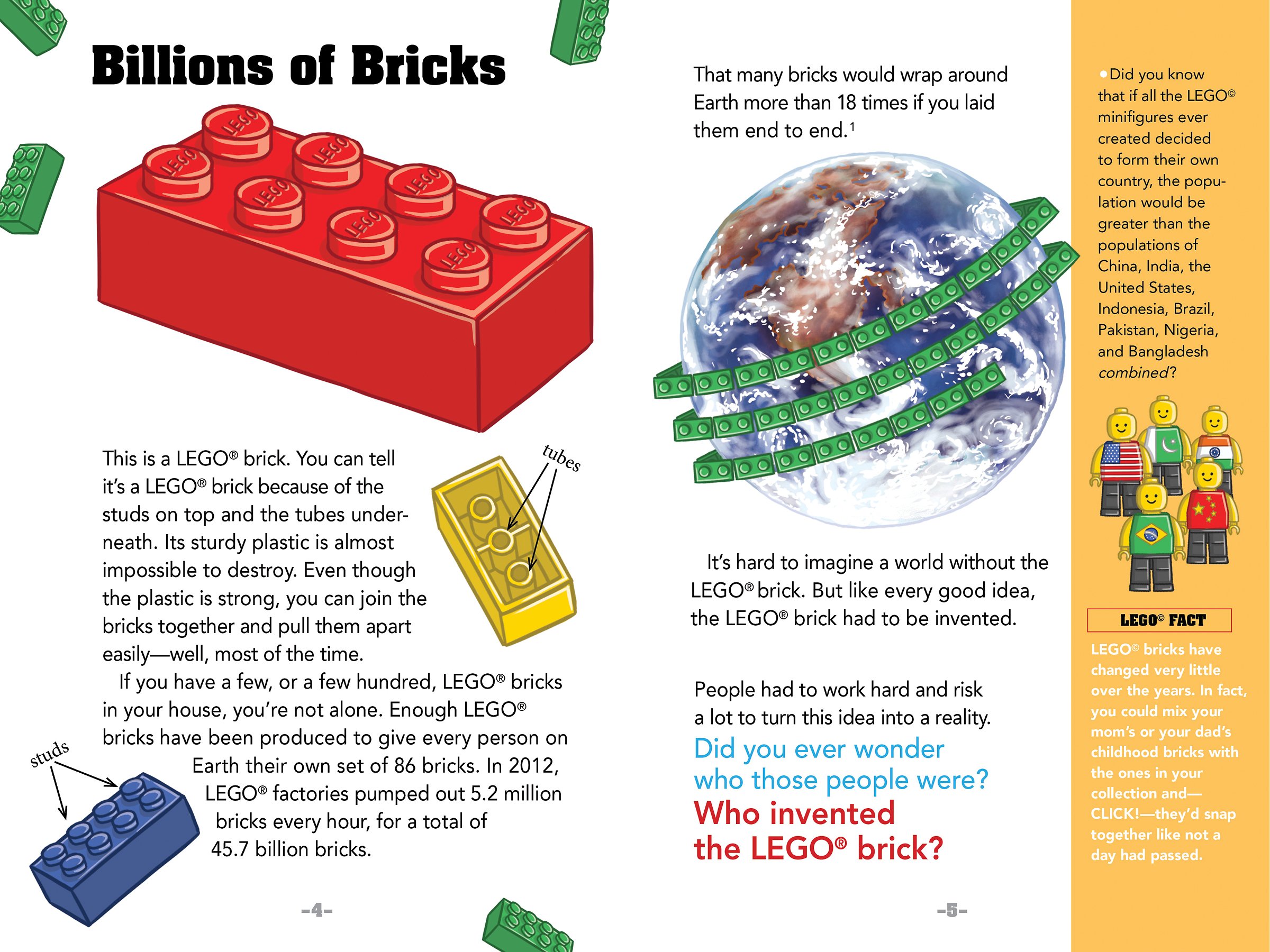
Cons:  Should we be afraid that if minifigs got together to form their own country, it would be greater than the population of the United States, China, India, Indonesia, Brazil, Pakistan, Nigeria, and Bangladesh combined?

Nadia: The Girl Who Couldn’t Sit Still by Karlin Gray, illustrated by Christine Davenier

Published by Houghton Mifflin Harcourt


Summary: Readers of a certain age will remember Romanian gymnast Nadia Comaneci,  one of the stars of the 1976 Summer Olympics. This picture book looks at Nadia’s life leading up to those Olympic performances. From an early age, Nadia was a daredevil, and her high energy level led her parents to enroll her in gymnastics. She was spotted by now-legendary coach Bela Karolyi who recruited Nadia to join the new gymnastics school he had opened with his wife Marta. Motivated by a disappointing performance at her first National Junior Championship, Nadia worked hard for many hours a day to make it to the Montreal Olympics when she was only 14. There she became the first female gymnast to earn a perfect 10…and went on to earn six more! The book ends there, but an afterword and timeline give more information about Nadia’s performance in the 1980 Olympics and her defection from Romania in 1989. 40 pages; Grades K-4.

Pros: An inspiring story of an amazing athlete, perfect for summer reading during this year’s Olympics. Nadia always seemed to me to be more serious than her predecessor Olga Korbut, but she comes across as ebullient and energetic in the illustrations here.

Cons: Because of the brevity of the story, making it to the Olympics comes across as about as difficult as snagging a spot on the high school gymnastics team.

The Hole Story of the Doughnut by Pat Miller, illustrated by Vincent X. Kirsch

Published by Houghton Mifflin Harcourt 

Summary:  Hanson Gregory left his family’s farm for a life at sea in 1844 at the age of 13.  He quickly rose from cook’s assistant to become captain of a clipper ship.  By all accounts, he became an excellent commander, even receiving a medal for heroism from the queen of Spain after rescuing seven Spanish sailors.  But what Hanson Gregory is remembered for today is inventing the doughnut.  As cook’s assistant, he was charged with making breakfast cakes of fried dough.  Because the centers of these cakes remained raw and heavy, they were called sinkers.  One day Gregory had the brilliant idea to cut out the centers with the top of the pepper shaker.  The rest is baking history.  Over the years, legends arose about the genesis of the doughnut, and others even claimed to have invented it, but this book lays these rumors to rest once and for all.  An author’s note gives a bit more information about Gregory.  A timeline and bibliography are also included.  32 pages; grades K-3.

Pros:  An excellent introduction to the invention of ordinary items, told with plenty of humor in both the text and the illustrations.

Cons:  Does not really address the question, Dunkin’ or Krispy Kreme?


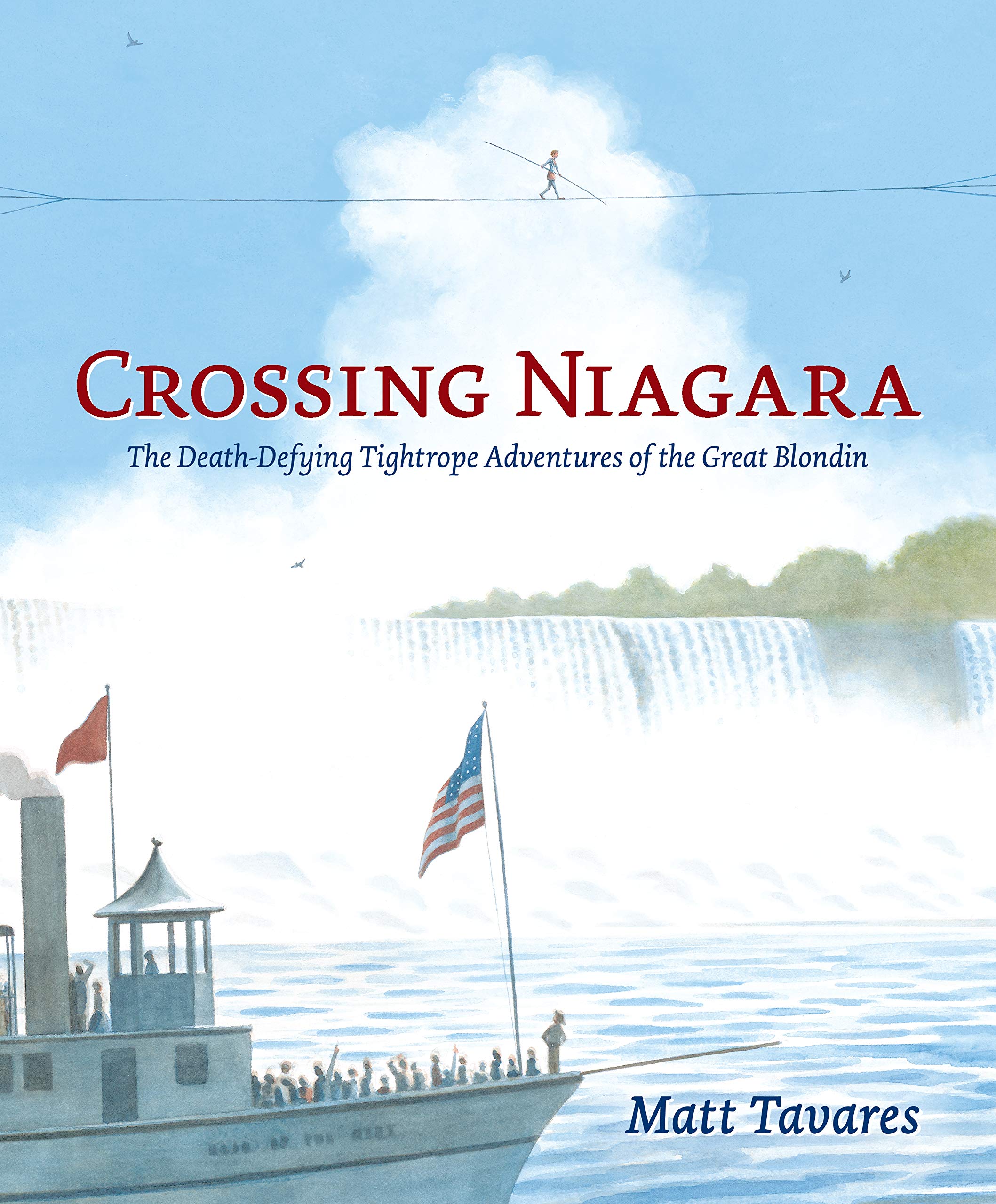
Crossing Niagara: The Death-Defying Tightrope Adventures of the Great Blondin by Matt Tavares

Published by Candlewick Press

Crossing Niagara: The Death-Defying Tightrope Adventures of the Great  Blondin: Tavares, Matt, Tavares, Matt: 9780763668235: Amazon.com: Books

Summary:  Jean Francois Gravelet, a.k.a. The Great Blondin was just five years old when he first performed on the tightrope.  Although he loved his circus career, he longed to do something even more daring.  When he first laid eyes on Niagara Falls, he knew what he wanted to do.  He set up a rope, contacted the newspapers, and on June 30, 1859, he made his first successful crossing, stopping along the way to perform a few tricks, including retrieving a bottle from the Maid of the Mist below and toasting the crowd.  He promised to return on July 4, and this time, he crossed the falls blindfolded.  Over the next two summers, he made many crossings, trying all kinds of stunts.  His ultimate challenge was carrying his manager across on his back (a trick his manager wasn’t terribly enthusiastic about).  When the crowds began to thin, The Great Blondin moved on, but he was forever remembered for his Niagara Falls crossings.  End matter includes a brief author’s note and a bibliography.  36 pages; grades 1-5.

Pros:  The storytelling and large, detailed illustrations combine to make a pulse-pounding tale of daring.

Cons:  I could have enjoyed a little more biographical detail about The Great Blondin.

Cloth Lullaby: The Woven Life of Louise Bourgeois by Amy Novesky, pictures by Isabelle Aresenault

Published by Abrams Books for Young Readers 

Summary:  Louise Bourgeois (1911-2010) spent her childhood along the banks of a river in France.  Her mother repaired tapestries, and Louise learned the art of weaving from her.  Although she studied math at the Sorbonne, Louise ultimately became an artist.  After her mother died, she made a giant sculpture of a spider, famous for its weaving, and spiders appeared in a lot of her other works.  Later in life, she gathered fabric from many different people and places in her past and created works of art with the different textiles.  She continued to create art right up until the time of her death at age 98.  End matter includes additional biographical information.  40 pages; grades 2-6.

Pros:  The illustrations are exquisite and really capture Louise’s life and art.  The text is almost poetic.

Cons:  This is not a straightforward biography, and kids may find some of the text difficult to understand.  The biographical information at the end is helpful; it may be useful to present it before reading the story.

Anything But Ordinary Addie: The True Story of Adelaide Herrmann Queen of Magic written by Mara Rockliff, illustrated by Iacopo Bruno

Published by Candlewick

Summary: Adele Scarsez never wanted to be ordinary. As a young woman she tried dancing and acrobatics, but they didn’t quite satisfy her desire to entertain and thrill audiences. Traveling to America, she met a young magician named Alexander Herrmann and asked him to marry her. He agreed, and Addie found her true calling as Adelaide Herrmann, magician. She performed as his assistant for many years. When he died, she knew she needed a way to keep the show going. Addie decided to learn the bullet-catching trick, a bit of magic so dangerous that magicians had been killed performing it. However, Addie succeeded, and her show continued for many years. An author’s note at the end tells a bit more about Addie, as well as how Mara Rockliff uncovered her story. 48 pages; grades 1-4.

Pros: The team that produced last year’s Mesmerized returns with another tour de force. The story is fascinating, and the illustrations and overall design of the book, with text in a variety of fonts woven in among the pictures, make this a visual feast.

Cons: I would have liked to have understood the bullet-catching trick while reading the story instead of having to go to the website given on the last page to get a description of what it was.

Clean Sweep! Frank Zamboni’s Ice Machine by Monica Kulling, illustrated by Renne Benoit

Published by Tundra Books


Summary:  Anyone who’s ever gone ice skating, or watched a sports event that took place on ice, has observed the giant Zamboni machine that drives around the rink and quickly resurfaces the ice.  But 70 years ago, there was no machine, and it took several men 90 minutes or more for that ice treatment.  And for Frank Zamboni, owner of the Iceland rink in California, that was too many man hours.  Fortunately, Frank was a tinkerer who knew a lot about machinery.  He had come up with an innovative way to design Iceland that resulted in smoother ice than other rinks.  Nine years passed, as Frank got busy raising a family and was shut down from working on his machine during World War II.  Many people said what he was trying to do was impossible, but he persevered.  In 1949, his machine took to the ice, and did in minutes what had previously taken over an hour.  Frank named his new machine after himself, which is good, because it’s so much fun to say “Zamboni”.  Today, Zamboni machines are on every continent…except the ice-covered continent of Antarctica.  32 pages; grades K-4.

Pros:  The story of an ordinary man who saw a problem, persevered, and succeeded in solving it.  This would be a great book to include in a unit on inventors and inventions.

Cons:  The poem at the beginning about ice skating is cute but seems sort of unnecessary.