The House That Jane Built: A Story about Jane Addams by Tanya Lee Stone, illustrated by Kathryn Brown

Published by Henry Holt and Company 

Summary: Growing up in a wealthy Illinois family, Jane Addams felt strongly that she wanted to help poor people. As a young woman, she visited Toynbee Hall in London. It was called a settlement house because wealthy people “settled” or lived among the poor. Upon returning home, Jane decided to start a settlement house in Chicago, Hull House. She devoted the rest of her life to Hull House, providing services and teaching skills to help people have better lives. Her model helped shape modern community centers. An author’s note tells more about Addams’ work for peace that included membership on the boards of the NAACP and the ACLU, and which was recognized with a Nobel Peace Prize in 1931. Grades 1-5.

Pros: An inspiring story of a woman who was one of the most famous American women of her time, but who is little known today.

Cons: Reading about Jane Addams on Wikipedia, I realized how much this brief picture book had to cut out of her rich and interesting life story.

Funny Bones: Posada and his Day of the Dead Calaveras by Duncan Tonatiuh

Published by Abrams Books for Young Readers 

Summary: In late nineteenth century Mexico, Jose Guadalupe Posada (Lupe) was a prolific artist who owned his own print shop. He became well-known, first for his satirical political illustrations, and later for his prints of Calaveras, or skeletons, that were extremely popular around Dia de los Muertos (Day of the Dead) celebrations. This book tells the story of Posada’s life, and also details the steps of his various printmaking techniques and looks at possible meanings behind some of his more enigmatic works. Back matter includes a lengthy author’s note about Posada and the history of Dia de los Muertos celebrations; a glossary and bibliography; and a list of U.S. locations where Posada’s works can be viewed. Grades 1-5.

Pros: This book could be used for many subjects: history, art, and Mexican culture. The illustrations are done in a Mexican folk art style and include several of Posada’s works.

Cons: Some may find the Calaveras a bit creepy.

Wrap-Up Wednesday: Listen to the Music!

Is it just me, or are there a lot of picture book biographies of musicians this year? Here are a few books to share with those kids coming home with their first band instruments:

Trombone Shorty by Troy Andrews, illustrated by Bryan Collier.  Published by Harry N. Abrams.Troy “Trombone Shorty” Andrews tells how he started his musical career as a young child in New Orleans.  He and his friends made their own instruments from castoffs, and he got his big break when he started playing along at a jazz festival.  Beautifully illustrated by Caldecott medalist Collier.

Elvis: The Story of the Rock and Roll King by Bonnie Christensen.  Published by Henry Holt and Company.Can’t help falling in love with the story of how a poor boy from Mississippi became the king of rock and roll.

Swing Sisters: The Story of the International Sweethearts of Rhythm by Karen Deans, illustrated by Joe Cepeda.  Published by Holiday House.

The inspiring story of the all-female, almost all African-American jazz band that traveled around the United States and Europe in the 1940’s.  Breaking racial and gender boundaries, the group was a true sisterhood of talented musicians.

Drum Dream Girl: How One Girl’s Courage Changed Music by Margarita Engle, illustrated by Rafael Lopez.  Published by HMH Books for Young Readers.

Another barrier-breaking musician, Millo Castro Zaldarriaga, became a drummer in Cuba when girls and women weren’t allowed to play drums.  More than one blogger has picked this book as a potential Caldecott winner.

Fab Four Friends: The Boys Who Became the Beatles by Susanna Reich, illustrated by Adam Gustavson.  Published by Henry Holt and Company.

Once upon a time, there were four boys growing up in postwar Liverpool named John, Paul, George, and Richard.  This book looks at the stories of those four, and how they intersected and eventually connected to become the Beatles.

Fab Four Friends: The Boys Who Became the Beatles by Susanna Reich, illustrated by Adam Gustavson

.Published by Henry Holt and Co.

Summary: Most kids today have heard of the Beatles, but many would be hard-pressed to come up with the names John, Paul, George, and Ringo, let alone give any details about the Fab Four. This book goes back to the early days of the four lads growing up in post-war Liverpool. Each band member is given a few pages for his own story, with all the tales eventually coming together with the formation of the Beatles. The book ends in the fall of 1963, just as Beatlemania was beginning to sweep the globe. Back matter includes an author’s note telling of her love of the Beatles that began in childhood, a glossary, notes on the many quotes in the text, and additional resources. Grades 2-5.

Pros: The Beatles are such a phenomenon, it was interesting to read each boy’s story and see them as struggling teenagers, deeply devoted to music. The illustrations perfectly capture the various personalities of John, Paul, George, and Ringo.

Cons: Kids with grandfathers younger than Paul and Ringo may not appreciate the Beatles enough to persevere through this somewhat lengthy picture book.

Emmanuel’s Dream: The True Story of Emmanuel Ofosu Yeboah by Laurie Ann Thompson, illustrated by Sean Qualls

Published by Random House Children’s Books 

Summary: “In this world, we are not perfect. We can only do our best,” says Emmanuel Ofosu Yeboah. When Emmanuel was born, his right leg was deformed. Growing up in Ghana, he learned to use his left leg well enough that he could hop the two miles to school, play soccer on crutches, and ride a bike. His mother was his biggest supporter, and when she died, her final words to him were, “Don’t give up.” Emmanuel used these words to inspire himself to pursue his dream…riding a bicycle from one end of Ghana to the other. Wearing a shirt reading “The Pozo” (meaning “the disabled person”), he completed his ride of over 400 miles. He’s continued to raise awareness about the disabled in his country, and was instrumental in the 2006 passage of the Ghanaian Persons With Disabilities Act. Grades 1-6.

Pros: An inspiring read for anyone to pursue their dreams, no matter what the odds.

Cons: Four miles of hopping a day.

Untamed: The Wild Life of Jane Goodall by Anita Silvey, foreword by Jane Goodall

Published by National Geographic Children’s Books


Summary:  Many may be familiar with Jane Goodall, who is said to be the most recognized living scientist in the western world.  But her familiar story will still appeal to young readers, and it is particularly well told in this book.  It begins with her childhood in England, then covers her move to Kenya as a young woman, and her groundbreaking studies of chimpanzees.  As she grew older, she became passionate about the conservation of chimpanzees and other animals around the globe.  Her organization, Roots and Shoots, provides opportunities for kids to get involved in the issues she is working on.  The final few pages offer facts about chimpanzees, a timeline of Goodall’s life, a family scrapbook of the chimps she studied, maps, and additional resources.

Pros:  The writing is engaging, the story fascinating, and photos of top National Geographic quality.

Cons:  The font is small throughout the text, and even smaller for photo captions.  The captions written in tiny lime green print on a white page are just ridiculous.

Small Wonders: Jean-Henri Fabre & His World of Insects by Matthew Clark Smith, illustrated by Giuliano Ferri


Published by Two Lions

Summary:  Back in the early 1900’s, an eccentric old man lived in a village in France.  His neighbors observed him squatting in the sun for hours to watch beetles, and marveled that he would pay children to gather dead moles and lizards to attract flies.  Imagine their surprise when a procession of cars arrived at their quiet village one day, and out of one of them stepped the President of France!  Turns out the old man was Jean-Henri Fabre, a scientist whose lifelong passion was studying insects.  Other scientists had written about dead insects from faraway places, but Fabre was more interested in the bugs he saw in the fields and woods around him.  He liked to study the live ones to learn about their behavior.  Then he wrote about them in books so beautiful that the President of France came to his house to let him know he had been nominated for a Nobel Prize in Literature.  While Fabre is little known today outside of France, his work influenced Darwin and inspired generations of naturalists.  Grades 2-5.

Pros:  This is an engaging biography of a little-known scientist, which includes a lot of interesting information about insects.  The illustrations capture the amazing creatures Fabre loved as well as his wide-eyed wonder of them throughout the nine decades of life.

Cons:  This is long for a picture book; probably best suited to older elementary students.

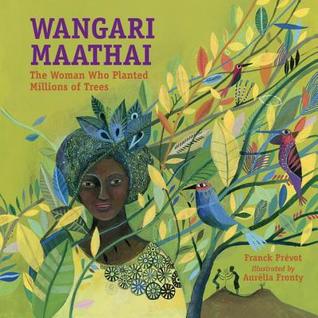
Wangari Maathi: The Woman Who Planted Millions of Trees by Franck Prevot, illustrated by Aurelia Fronty

Published by Charlesbridge

Summary:  While other picture book biographies about Wangari Maathi have focused on her tree planting, this book takes a broader look at her political activism.  She was fortunate to get a high school education in Kenya at a time when most girls didn’t go to school at all, and did so well that she was part of a group selected by President Kennedy to study in America.  Upon her return to Kenya, she observed how ravaged the land was from deforestation, and began her work to plant trees.  This work was in opposition to some of the plans of President Daniel arap Moi, and Maathai was imprisoned more than once.  In 2002, Moi was defeated, and Wangari Maathai was appointed assistant minister of the environment, natural resources, and wildlife.  In 2004, she was awarded the Nobel Peace Prize.  She died in 2011 at the age of 71.  End pages include an extensive timeline, information on Kenya today, quotes from Wangari Maathi, and further resources.  Grades 2-6.

Pros:  This French import is more extensive than other Maathi biographies, and would be appropriate for an older audience looking for more in-depth information.  The illustrations are striking, each one painted against a boldly colored background that fills the whole page.

Cons:  This is the fifth picture book biography of Wangari Maathi published since 2008, so some libraries may pass on purchasing this one, which would be too bad.

Dolley Madison: Parties Can Be Patriotic! By Kathleen Krull

Published by Bloomsbury USA Childrens

Summary:  When Dolley Madison died, her funeral was the largest ever seen in Washington, D.C. at that time.  It closed down the government, because so many people wanted to attend, including some of the twelve U.S. presidents she had known in her lifetime.  After a simple Quaker childhood and an arranged first marriage, Dolley, a widow at age 25, married James Madison, who later became the fourth U.S. President.  Dolley threw large parties every week, redecorated the White House, and famously rescued the portrait of George Washington just hours before the British burned down the White House during the War of 1812.  When Zachary Taylor referred to her as the First Lady, he coined a term that Dolley defined during her long, eventful life.  Ages 7-10.

Pros:  Veteran biographer Kathleen Krull has a new series, “Women Who Broke the Rules”.  This entry is fun, breezy, and informative.  At 46 pages, with illustrations on almost every page, it’s just the right length to give an enticing introduction to the life of a famous woman.

Cons:  The cover could be a bit more enticing.

Trombone Shorty by Troy “Trombone Shorty” Andrews, illustrated by Bryan Collier

Published by Harry N. Abrams

Summary:  Bryan Collier has illustrated books by famous African Americans such as Martin Luther King, Jr., Rosa Parks, and Langston Hughes.  Now he has collaborated with musician Troy Andrews to tell the story of Troy’s early life.  From a very young age, Troy looked up to his musician brother James and made music with whatever he could find.  When he was four, he found a broken-down trombone and taught himself to play, taking it with him wherever he went, and earning himself the nickname Trombone Shorty.  When his mother took him to the New Orleans Jazz & Heritage Festival, he took his trombone and played along with Bo Diddley.  Bo stopped and asked who was playing.  The crowd passed young Troy up to the stage and the two played together.  Now Trombone Shorty has his own band, as well as a foundation to help other young musicians in New Orleans.

Pros:  Troy tells his story with a distinctive voice influenced by his New Orleans childhood.  Collier’s watercolor collage illustrations really capture the feel of New Orleans jazz.  Back matter includes more information about Andrews’ life and a note on how the illustrations were created.

Cons:  A person born the year I graduated college is an award-winning musician with his own foundation.