Memories of China

Growing Up Under a Red Flag: A Memoir of Surviving the Chinese Cultural Revolution by Ying Chang Compestine, illustrated by Xinmei Liu (Rocky Pond Books, 40 pages, grades 2-6). Ying grew up during China’s Cultural Revolution, with parents, both doctors, who were targeted for being part of the educated class. Her father taught her English and told her stories of his days studying in San Francisco, and the Golden Gate Bridge became a symbol of that life. Ying recalls the day her dad was forced to burn all his English books and papers, hiding his ties to the west from the government. Shortly after that, he was arrested, and life grew increasingly difficult for Ying and her mother, with food shortages and worries about the future. After Mao’s death in 1976, the family was reunited. Ying eventually moved to the U.S. to study, and the final picture shows the family eating with her father’s teacher, Dr. Smith, the Golden Gate Bridge in the background.

Born Naughty: My Childhood in China by Jin Wang with Tony Johnston, illustrated by Anisi Baigude (Anne Schwartz Books, 112 pages, grades 2-5). Imagine Ramona Quimby living in 1980’s Mongolia, and you’ll have a good idea of the vibe of Jin Wang’s lively childhood memoir. Living in a one-room mud hut with her parents and two younger brothers, Jin embraces all of life experiences, whether it’s traveling with her father to fetch the family’s precious water supply, beating the boys at tree-climbing, harvesting mushrooms and potatoes, or learning calligraphy. Real dangers are never far away, and her story of being attacked by a potentially rabid dog is harrowing. The last chapter shows the family taking a break from their demanding lives to celebrate the new year together. In the authors’ notes, Jin Wang shares more details of her life, including a 2019 trip back home that affirmed her happy childhood memories, and she and Tony Johnston relate how they met in yoga class and created this book together.

These two very different memoirs offer contrasting views of Chinese childhoods just a decade apart, one of a middle-class family dealing with government persecution and hardship, the other of a much poorer rural family facing different hardships but able to lead a freer life. Jin Wang’s memoir would make a great book club choice for second or third graders. There are plenty of similar stories for this age group that would make an interesting contrast to Jin’s childhood. While Ying’s story is a picture book, it may appeal to older students up into middle school, who might have a better understanding of the Cultural Revolution and what it meant to the people living through it.

A picture book potpourri

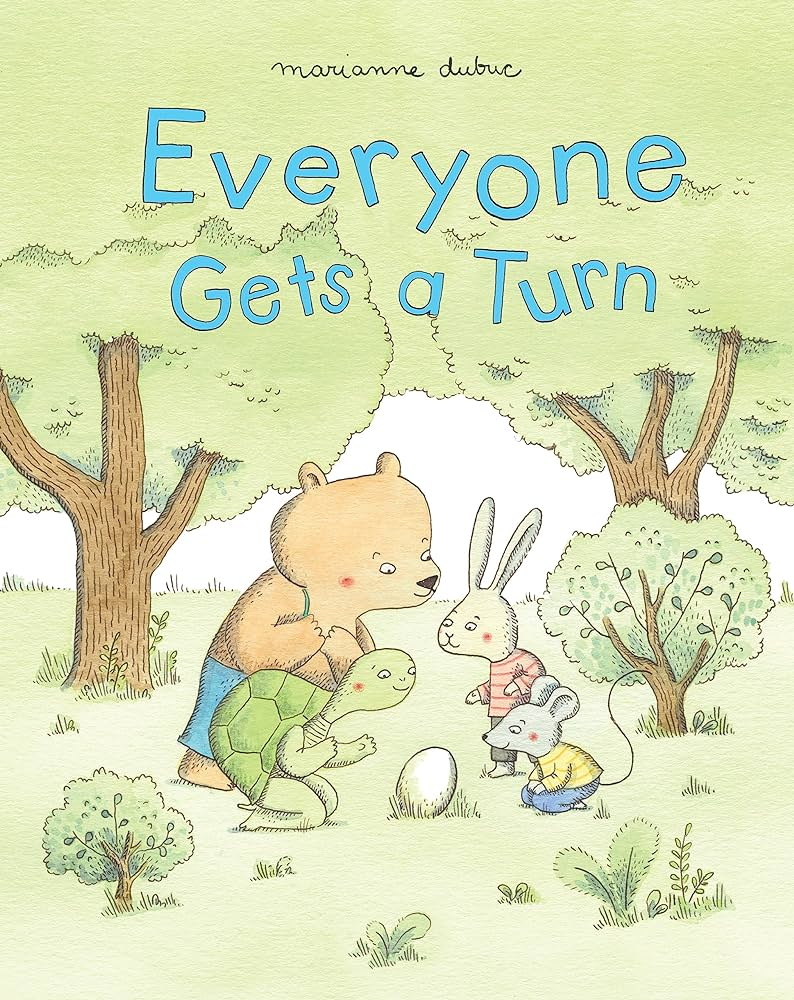
Everyone Gets a Turn by Marianne Dubuc (Princeton Architectural Press, 60 pages, ages 4-9). When friends Bear, Mouse, Turtle, and Hare discover an egg, each one wants to take it home. The egg provides the answer: “Everyone gets a turn!” Mouse found the egg, so he brings it home first, getting to know the egg and learning how to keep it comfortable. Next is Bear, who gets a surprise: the egg hatches, and Little Bird arrives. Hare and Turtle figure out how to feed and care for a young bird, and by the time the visit with Turtle ends, Little Bird has built her own home and is ready to take care of herself. There’s a housewarming party, at which time Little Bird declares she will henceforth be known as Clara, and the five friends and neighbors “continue to grow, each in their own way.” The story could hardly be any cozier or more heartwarming, and the longer page count and graphic novel format will make it appealing to older readers as well as younger kids. I’d love to know the story of how this came to be published by the Princeton Architectural Press.

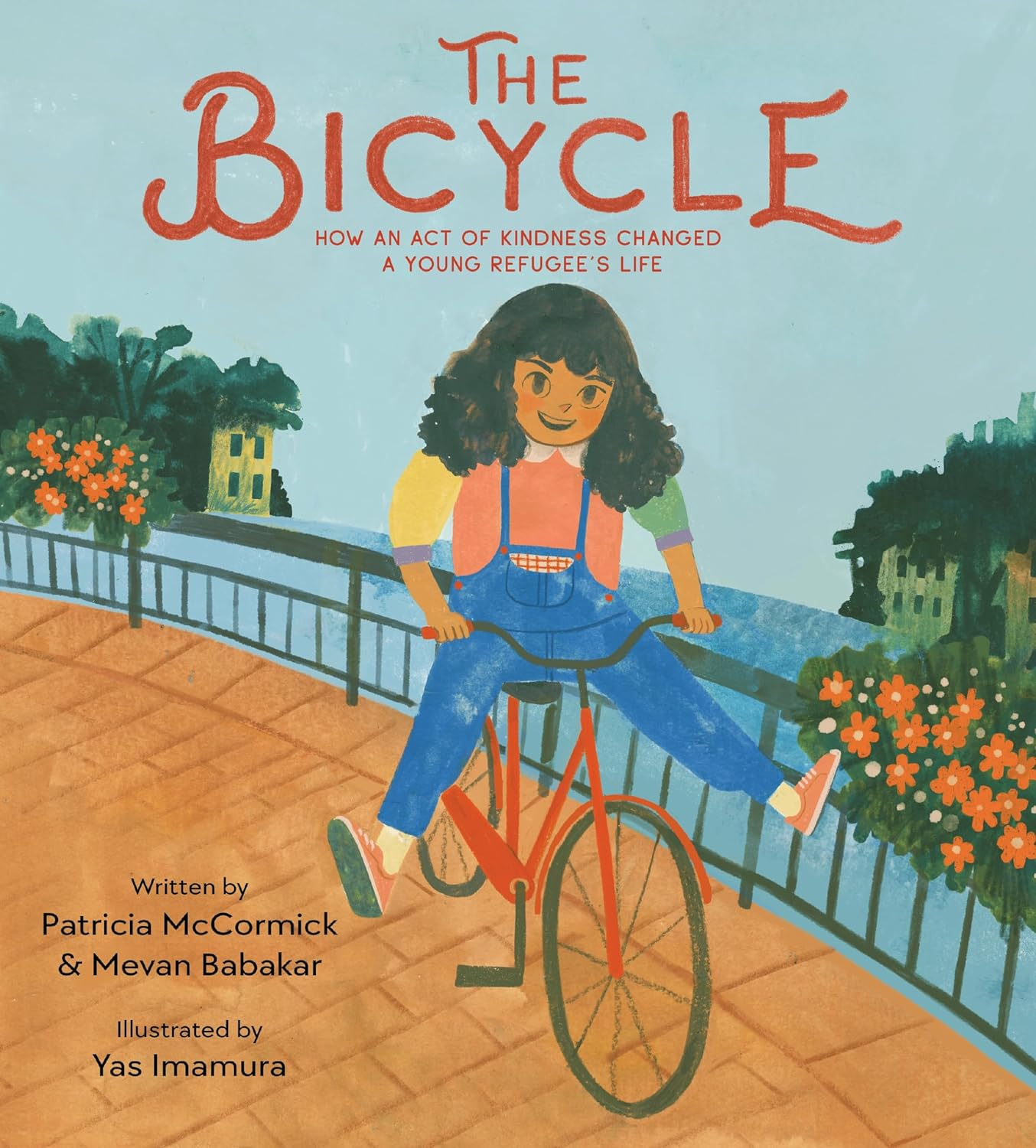
The Bicycle: How an Act of Kindness Changed a Young Refugee’s Life by Patricia McCormick and Mevan Babakar, illustrated by Yas Imamura (Balzer + Bray, 40 pages, grades 1-4). Mevan tells the story of her childhood, beginning with idyllic early years surrounded by family in Kurdistan. When the Iraqi government begins persecuting the Kurdish people, Mevan and her family are forced to flee, first to Turkey, then to Russia, and finally to the Netherlands. Mevan learns to make herself as invisible as she can. In the Netherlands, she watches people outside her window riding bicycles, but she rarely leaves the apartment herself. It feels like no one sees her, but it turns out that Egbert, the building’s handyman, has noticed her, and one day he brings her a red bicycle. His gift makes Mevan feel “a hundred feet tall,” and before long, she’s outside riding with the rest of her neighbors. An epilogue describes the miraculous reunion she had with Egbert as an adult, including a photo of the two of them, and an author’s note describes her life as a refugee, how it has made her feel like an outsider, and the miraculous power of kindness. This is a touching if bittersweet memoir with an emphasis on the power of one person’s kindness to make a difference. I like how the epilogue ends, describing the ripple effect of her story of finding Egbert: “In a world where there are many people running from war, from hunger, from hatred, people everywhere, of every age, asked themselves: What’s one kind thing I can do?”

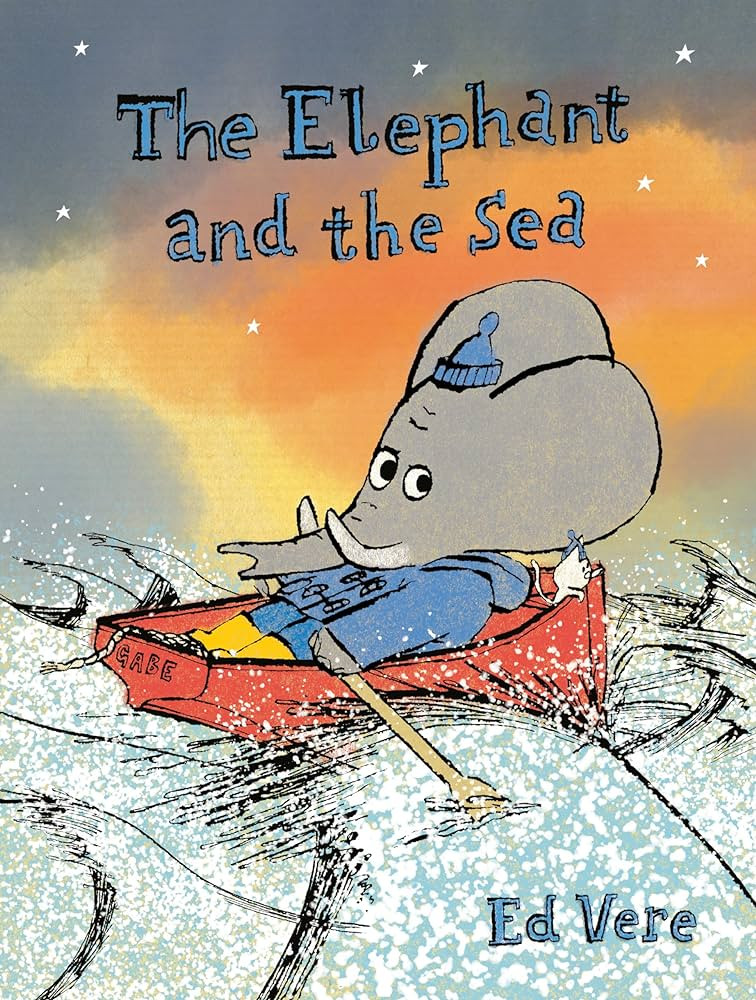
The Elephant and the Sea by Ed Vere (Doubleday Books for Young Readers, 32 pages, ages 4-8). Gabriel is an old elephant when we meet him on the first page, sitting in the harbor and remembering his younger days. Back then, he loved to visit the lifeboat crew and dreamed of helping sailors at sea, singing “Heave away, haul away, heave-HO!” But then Gabriel grows…and grows, and the other animals say he’s too big for the lifeboat. He refuses to give up his dream, though, and spends his days collecting driftwood and building. When a storm hits that’s too strong for the lifeboat crew, Gabriel is ready with his own boat that he uses to haul in the entire fleet. “Brave Gabriel, our hero!” the animals hail him. “Can we join you?” “Of course,” Gabriel replies. “But we might need a bigger boat.” And Gabriel enjoys a career of lifesaving, bringing us back to the old elephant remembering. It’s a cute story with a nice theme of perseverance and determination, with a fun “Heave away” repeating refrain. This would make a nice companion to read with Swashby and the Sea.

In which we learn what some Caldecott artists have been up to

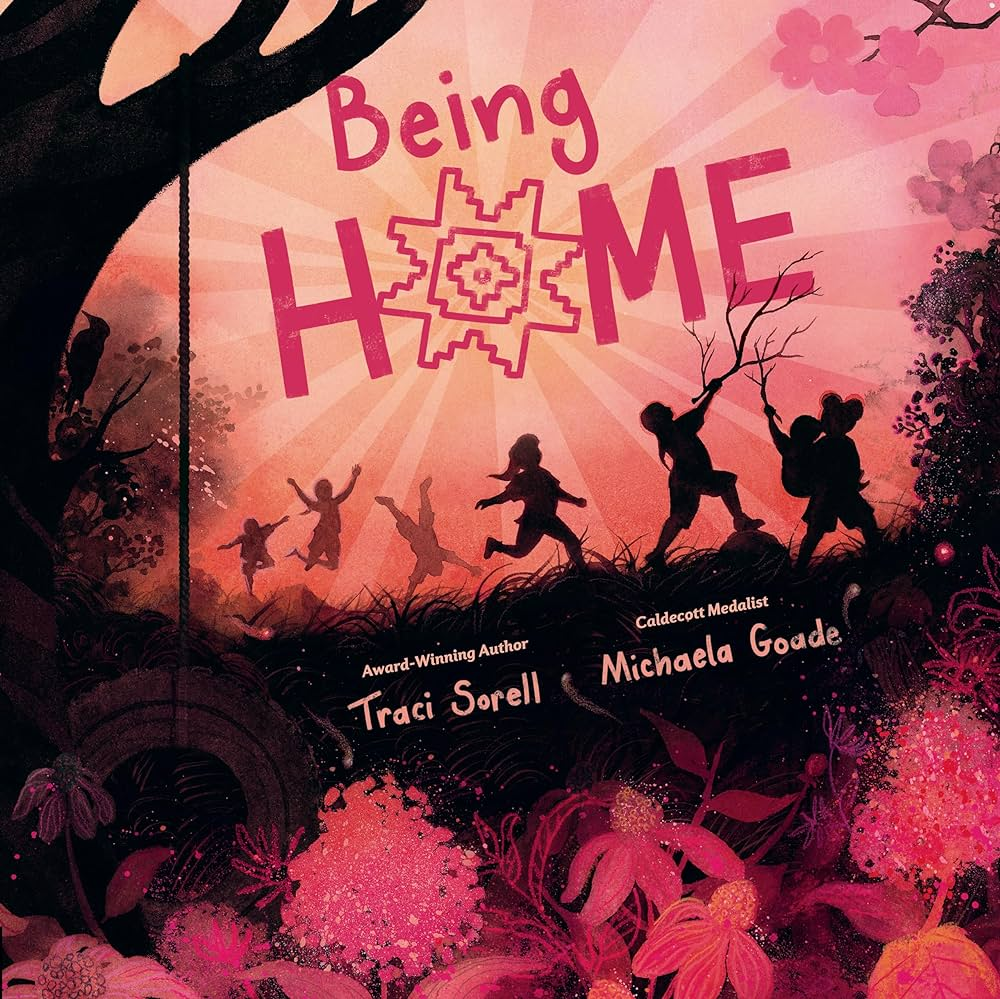
Being Home by Traci Sorell, illustrated by Michaela Goade (Kokila, 32 pages, ages 4-8). A family decides to move from the crowded city to the Cherokee reservation, where they can be close to nature, family, and community. The narrative begins on moving day in the city, continues through their journey, and finishes up in their new home, where they’re greeted with a feast and lots of children for the young narrator to play with. There are kid-drawn pictures showing a map of their trip, while other illustrations incorporate people, animals and symbols from the Cherokee Nation. Pink is the main color used to celebrate this family’s new life.

Both Traci Sorell’s (Cherokee) beautiful poetry and Michaela Goade’s (Tlingit) gorgeous illustrations celebrate indigenous communities that honor nature and help each other out through their connection. There’s always so much to see in Goade’s art, so be sure to take your time to appreciate how the colors she uses and shapes and figures she weaves into the main illustrations help tell the story.

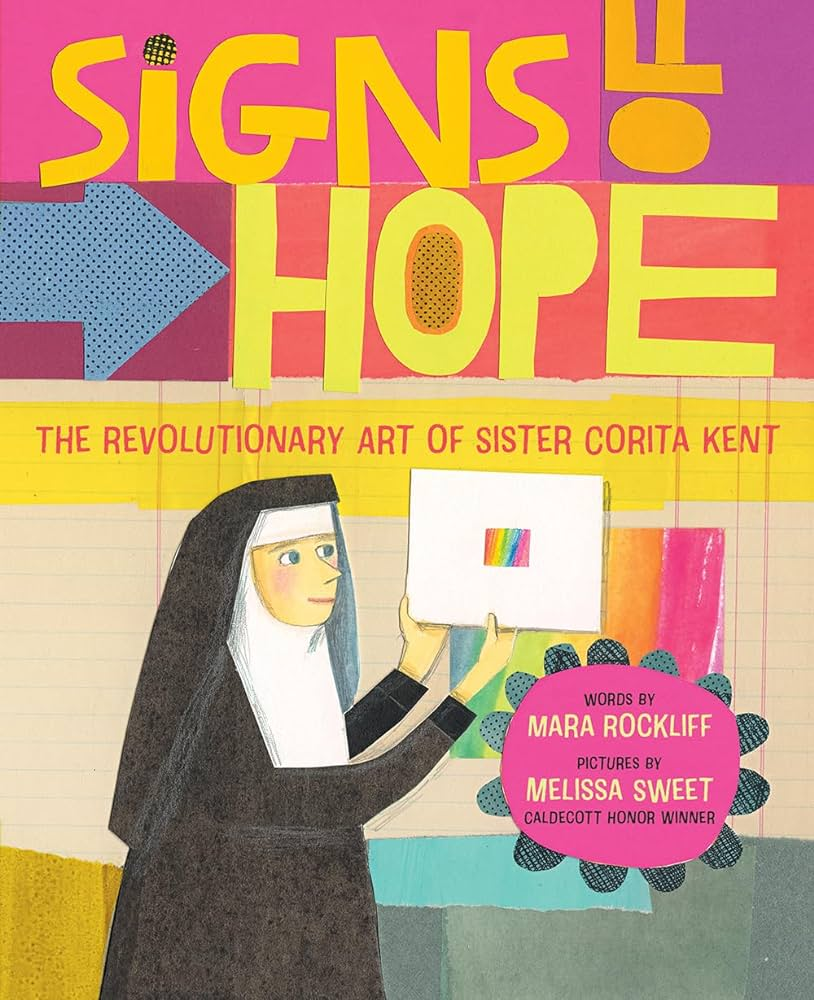
Signs of Hope: The Revolutionary Art of Sister Corita Kent by Mara Rockliff, illustrated by Melissa Sweet (Harry N. Abrams, 40 pages, grades 2-5). A student narrator describes what it was like to study art with Sister Corita Kent, learning to pay attention, breaking the rules, making prints inspired by words and pictures from magazines. Sometimes the students would take field trips to museums to learn about Pop Art, or to protests, where Sister Corita’s signs spoke out about peace and justice. After studying with Sister Corita, her students were ready to go into the world to express themselves through their own art. Includes an author’s note with biographical information about Sister Corita Kent, an illustrator’s note, a timeline, and additional resources.

Melissa Stewart’s style is a natural fit to celebrate Sister Corita’s joyful, playful art. The first-person present-tense narration brings an immediacy to the story that’s as vibrant as the illustrations. The text may be a bit confusing to a reader not familiar with Sister Corita Kent, but the author’s note adds helpful details about her life. I was disappointed that Matthew Burgess’s excellent Make Meatballs Sing: The Life and Art of Corita Kent wasn’t included on the resource list.

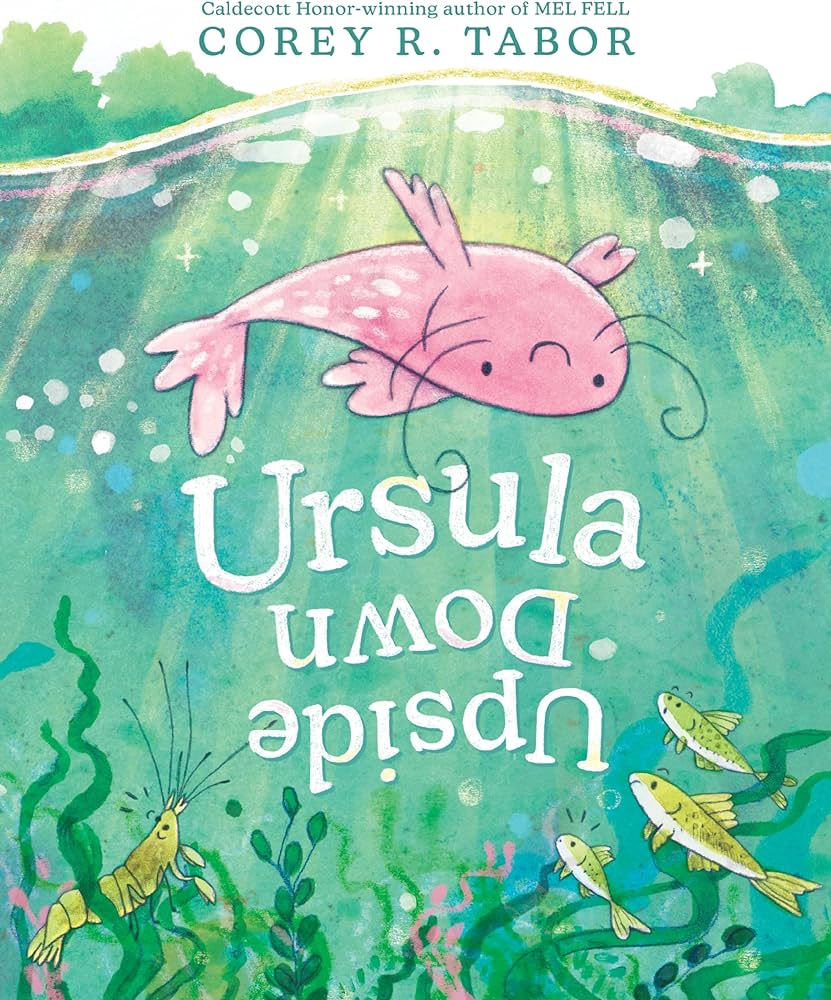
Ursula Upside Down by Corey R. Tabor (Balzer + Bray, 40 pages, ages 4-8). Ursula is a catfish who happily enjoys the beauty of her undersea world. But her view gets flipped when a fish asks her why she’s upside-down. “Just look around,” says the fish, and when she does, Ursula realizes she’s the only creature swimming her way. She tries turning over but gets so disoriented that she leaves the water altogether. A bat comes along and rescues her, and back in the water, Ursula observes the bat hanging upside down from a tree. “Upside down?” says the bat. “Says who?” This gives Ursula the confidence to go back to her old ways, and she’s happy once again, seeing things her own way. An author’s note introduces the upside-down catfish of the Congo River Basin and asks readers to consider that we might be the ones who are upside down.

Another cute picture book by Corey Tabor that involves flipping the book around a couple of times like some of his other works. My favorite is still the Caldecott honor book Mel Fell, but I’m sure kids will enjoy getting to know Ursula (and Vern the bat), and the story delivers a nice message about doing your own thing.

A trio of musical picture books

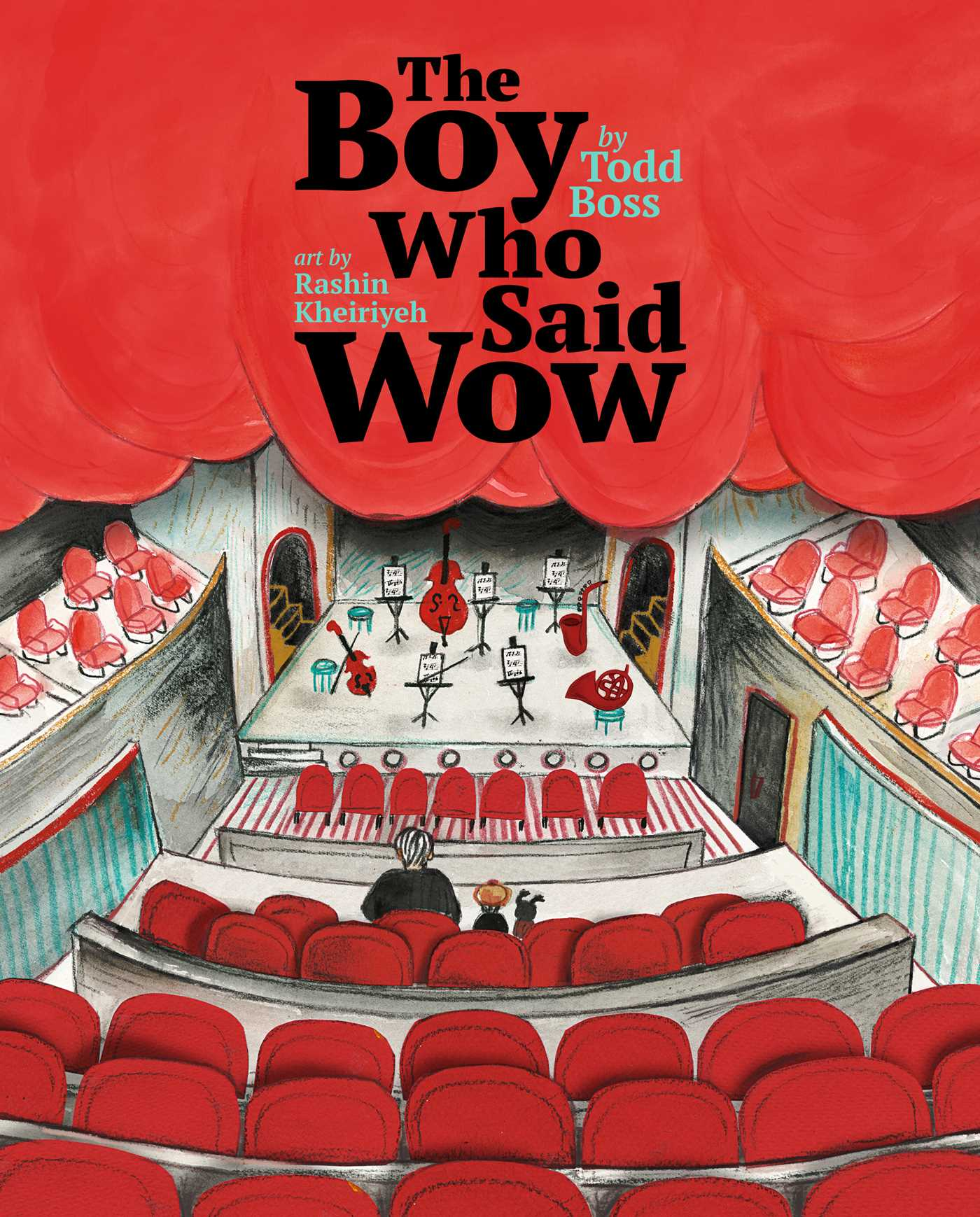
The Boy Who Said Wow by Todd Boss, illustrated by Rashin Kheiriyeh (Beach Lane Books, 40 pages, ages 4-8). Ronan is a boy who rarely speaks, and when Grandfather proposes a trip to the symphony, his parents are a bit skeptical. But Grandfather persists, and the two of them drive to the concert hall and find their seats. The lights go down, the music begins, and Ronan is swept away. In the moment of silence when the music ends, Ronan opens his mouth, and utters a loud, “Wow!” The audience laughs and claps, both for the orchestra and for Ronan. An author’s note shares that the story is based on an actual event that happened at Boston’s Symphony Hall in 2019. The illustrations look more like the 1950’s than 2019, but it’s a fun and interesting story with a sympathetic nonverbal main character.

Nothing: John Cage and 4′ 33″ by Nicholas Day, illustrated by Chris Raschka (Neal Porter Books, 40 pages, grades 1-5). The story opens with a 1952 performance at the Maverick Concert Hall in Woodstock, NY, where a pianist named David Tudor sits down at a piano and proceeds to do nothing for just over four and a half minutes. The word “nothing” is repeated a few times as the audience sits and wonders what is happening. The narrative then goes back 40 years to the birth of John Cage, a boy with unusually large ears and a penchant for inventing. Of all his radical compositions, his 4′ 33″ may be both the most unusual and the best-known. He wanted people to listen in the absence of sound to create their own music from what they heard around them. There’s an extensive author’s note, along with photos and a bibliography at the end.

The idea of this silent piece is fascinating and thought-provoking, stretching the boundaries of what can be considered music, and the subject is brought to life by Chris Raschka’s illustrations. The back matter seems more geared for older readers, and the concepts introduced may be a bit over the heads of the intended audience. Also, John Cage’s ears are described in a way that makes them sound freakishly large, but when I saw photos of him that seemed like an unnecessary exaggeration.

Piper Chen Sings by Philippa Soo and Maris Pasquale Doran, illustrated by Qin Leng (Random House Studio, 40 pages, ages 4-8). Piper loves to sing whenever she can, whether it’s joining the birds outside her bedroom window or performing for her stuffed animals. At school, she loves chorus, and when the teacher asks her to sing a solo in the spring concert, Piper offers an unequivocal “Yes!” But when it comes time to practice the solo, Piper gets stage fright and can’t do it. At home, she’s sad, no longer singing, until her grandmother Nai Nai has a talk with her, explaining that scary experiences can produce butterflies in the stomach, but so can exciting ones. Nai Nai is a pianist, and she tells Piper that the butterflies before a recital always settled once she started to play. Piper decides she will do the solo, and on the night of the concert, she welcomes the butterflies and feels them settle as she starts to sing. A lovely story by the Grammy-winning Hamilton actress that will show kids the importance of recognizing that fear and excitement often feel the same.

Three books about immigration

Finding Home: Words from Kids Seeking Sanctuary by Gwen Agna and Shelley Rotner, photographed by Shelley Rotner (Clarion Books, 32 pages, ages 4-8). Children and their families from around the world come to the United States seeking sanctuary from war, famine, natural disasters, and other dangers. Many of the photos have cartoon bubbles with kids describing in their own words how they felt when they had to leave their countries, what they miss, and the difficulties and joys in their new homes. There’s additional narrative at the end about how some of the families got to the United States, as well as resources for kids, adults, and parents, caregivers, and educators about how to make families feel welcome.

This book has some personal connections to me, because: 1. the author and photographer live near me, and I have met Shelley Rotner, 2. my Quaker meeting is part of a Circle of Care for one of the families in this book, and 3. my school in Springfield has three classes of refugee kids who have missed at least two years of school due to their circumstances. This book is at just the right level for helping kids (and adults) understand what these families have gone through and to help make them welcome in the U.S.

The Circuit: Graphic Novel by Francisco Jiménez, illustrated by Celia Jacobs (Clarion Books, 240 pages, grades 4-8). Francisco Jiménez’s memoir has been adapted as a graphic novel, telling the story of Francisco as a child, moving with his family from Mexico to California, where they became migrant workers, traveling from one farm to the next to pick cotton, strawberries, grapes, and other crops. Francisco loves to learn, but school is sandwiched between jobs, and his story is a series of losses, as he befriends kids he’ll never see again and loses his precious journal in a fire. There’s enough humor and joy to prevent the story from getting too bleak, and the story feels somewhat timeless, although I think it takes place in the 1940’s. The heart stopping cliffhanger on the last few pages will leave readers like me fervently hoping that more of Jiménez’s books will be published in graphic format.

Lost & Found: Based on a True Story by Mei Yu (Union Square Kids, 128 pages, grades 2-5). Mei Yu recounts her memories of moving from China to Canada at a young age (probably six or seven). With English words in a green font, readers can see how few words she understands at school and the scary situations that ensue: using the wrong bathroom, thinking kids are laughing at her, losing her beloved sketchbook. Mei eventually uses the sketchbook to create a collection of English words, and before long, she is able to communicate and begin to make friends. An author’s note gives more information about her experience, as well as a simple glossary of Chinese words. There’s a funny bonus story about how Mei got her beloved toy cat, who appears real to her, a la Calvin and Hobbes.

It’s a pretty simple story, but the difficulties of immigration are presented in a way that beginning readers will be able to understand, and everyone is sure to love the manga-style artwork.

Parks for everyone

Cactus Queen: Minerva Hoy Establishes Joshua Tree National Park by Lori Alexander, illustrated by Jenn Ely (Calkins Creek, 40 pages, grades 1-4). Minerva Hoyt grew up in Mississippi, where she loved to play outside and was not afraid to speak her mind. She grew up, got married, and moved to Pasadena, California with her husband. When Minerva needed a break from the city, her favorite place to visit was the Mojave Desert.

Over the years, Minerva watched as people from Los Angeles slowly stripped the Mojave of its cacti, yucca, and Joshua trees to transplant (usually unsuccessfully) to their gardens. To try to preserve this ecosystem, Minerva did something similar, but for a different purpose–she gathered plants from the desert and created an exhibit at the 1928 International Flower Show to raise awareness. Later, she worked to turn some of the Mojave into a national park. There was quite a bit of resistance to this idea from those who thought the desert was a barren wasteland, but Minerva never gave up. In 1936, President Franklin D. Roosevelt signed the law that created Joshua Tree National Monument. Almost 50 years after Minerva’s death in 1945, President Bill Clinton established Joshua Tree National Park. There’s more information about Minerva, Joshua Tree, and national parks, as well as environmental tips and a bibliography in the back.

Tasha’s Voice by Carmen Bogan, illustrated by Floyd Cooper and Daria Peoples (Yosemite Conservancy, 38 pages, grades K-3). In this companion to Carmen Bogan’s Where’s Rodney? a young girl has a transformative experience in nature, just as Rodney does in his story. Tasha is a new girl in Rodney’s class, so shy that she can’t speak when the teacher calls on her or talk to the other kids in the class. When the class takes a field trip to the park, a ranger shows them around, then lets them explore on their own. An encounter with a small turtle helps Tasha to make two new friends and to finally find her own voice.

Be sure to read the last two pages, which include an interview with Daria Peoples who completed the artwork after Floyd Cooper passed away in 2021. There’s also a brief note about parks that includes websites for Outdoor-Afro and Latino Outdoors.

Enjoy these two books for the last part of Women’s History Month! (Although Tasha’s Voice won’t be out until April). They are a celebration of national parks, the healing power of nature, and making outdoor experiences available to groups, like women and people of color, who may not have always felt welcome there.

A train station, a cooking vocation, and news for a new nation

A Grand Idea: How William J. Wilgus Created Grand Central Terminal by Megan Hoyt, illustrated by Dav Szalay (Quill Tree Books, 48 pages, grades 1-5). At the turn of the (previous) century, Manhattan was filled with the smoke of trains, not to mention the snarl of traffic they caused, at one point resulting in a crash that killed 15 people and injured dozens more. Chief engineer William J. Wilgus struggled to find a solution, finally proposing the revolutionary idea of moving the trains underground, electrifying them, and building a bigger station.

Another country might have invested some government funding, but in the U.S., the project was taken on by robber baron Cornelius Vanderbilt. Although the winning design was submitted by architectural firm Reed and Stern, Vanderbilt’s cousin owned another company that he insisted be part of the design process. This resulted in 18 months of feuding, but the new design finally emerged. The rest of the book traces the magnificent station, with its amenities that over the years included a movie theater, a hospital, and a ski slope. As planes replaced trains, Grand Central Station was used less. Demolition was on the table, until a group of citizens led by Jacqueline Kennedy Onassis campaigned to save and restore it to its present glory. Includes additional information about Wingus and Grand Central Station, along with a timeline and a list of sources.

A Plate of Hope: The Inspiring Story of José Andrés by Erin Frankel, illustrated by Paola Escobar (Random House Studio, 48 pages, grades 1-5). As a child, José Andrés loved to help his parents cook for big gatherings at their home in Spain. Cooking school, a stint on a Navy ship, and a job at a Spanish restaurant prepared him for a move to the U.S., where he quickly rose to become a star chef. But he wanted his cooking to be for everyone, not just for those who could afford to eat in his restaurants.

When he was invited to help after the 2010 earthquake in Haiti, José learned to prepare large quantities of local cuisine for people who desperately needed food. This experience gave birth to World Central Kitchen, an organization that travels around the world offering humanitarian food aid. When Huracán María hit Puerto Rico in 2017, José and World Central Kitchen spent three months serving almost four million meals all around the island. They continue to travel around the world, as described in the author’s note at the end, doing work that earned José a Nobel Peace Prize nomination in 2019. There’s also a bibliography.

Amazing Abe: How Abraham Cahan’s Newspaper Gave a Voice to Jewish Immigrants by Norman H. Finkelstein, illustrated by Vesper Stamper (Holiday House, 40 pages, grades 1-5). Growing up in Lithuania, Abraham Cahan loved languages, learning Hebrew, Russian, and Yiddish. He became a teacher and political activist, which eventually forced him to flee to the United States. He added English to the list of languages he spoke, and gradually became fluent enough to begin writing about the experience of Jewish immigrants for American newspapers.

His first love was Yiddish, though, and in 1897, Abe founded Forverts, a Yiddish newspaper which grew to become the largest foreign-language newspaper in the country. In addition to news, the paper helped immigrants adjust to their new home, providing them with detailed instructions about baseball, how Americans set a table, and explanations of democracy and the importance of voting. The author’s note describes how the paper evolved over time, continuing as an online publication to this day. There’s also additional information about Abe and the Yiddish language, as well as a timeline and a bibliography.

I know, I know, March is Women’s History Month! But these three picture book biographies all landed on the library hold shelf for me at approximately the same time, all of them telling inspiring stories about men I knew nothing about who made significant contributions to their communities that continue to this day. All three have excellent illustrations; I particularly liked the endpapers of Amazing Abe that show laundry day in a busy NYC tenement, and the full-circle beginning and ending illustrations of A Plate of Hope that portray José Andrés as a child and an adult cooking large meals over an open fire. Readers will find plenty of additional resources in all three books to continue their research about these men.

Some brave girls

Small Shoes, Great Strides: How Three Brave Girls Opened Doors to School Equality by Vaunda Micheaux Nelson, illustrated by Alex Bostic (Carolrhoda, 40 pages, grades 2-5). Ten minutes before Ruby Bridges entered William Frantz Elementary School on November 14, 1960, three other six-year-old girls, Leona Tate, Tessie Provost, and Gail Etienne, started school across town at McDonogh 19 Public School. Escorted by U. S. Marshals, the girls were in a first-grade class taught by Miss Florence Meyers. Although there were other white students at school that day, they quickly left, leaving the girls as the only three students in the building for the rest of the year.

The girls were heroic, as were their parents, Miss Meyers, and the marshals, who helped them find the courage to keep going and made their first-grade year as normal as possible. Second grade proved a bit easier; after Christmas, about twenty-five new students arrived, and the kids were allowed to go outside for recess. Unfortunately, the girls were sent to a different school the following year, where they experienced bullying, racism, and occasional physical violence from students and even some of the teachers. In the end, the girls “survived and helped change our nation.”

This fascinating book will appeal to kids who are familiar with Ruby Bridges’s story. Leona, Tessie, and Gail were all interviewed for the book, as was one of the surviving U.S. Marshals. The text is quite long, and there’s a ton of back matter: more about school desegregation in New Orleans and Norman Rockwell’s painting based on it, what happened to the three girls when they grew up (two opted for all-Black schools in sixth grade, but all graduated high school, and two finished college.) There are also photos, a glossary, a bibliography, and websites with additional information.

Do You Know Them? Families Lost and Found After the Civil War by Shana Keller, illustrated by Laura Freeman (Atheneum Books for Young Readers, 40 pages, grades 1-4). After the Civil War, Lettie and her Uncle Charlie are searching for lost family members. The newspapers are filled with ads, mostly people seeking information about their families, but occasionally someone reporting that a loved one has been found. Lettie holds on to this hope as she saves her pennies and reads the ads aloud to the congregation at church. Finally, she and Uncle Charlie have saved the fifty cents needed for an ad. Weeks go by, until one Sunday, Lettie is able to share the ad from a woman saying she knows their family. “Hallelujah!” rings out through the church, celebrating with Lettie.

This moving historical fiction story of the post-Civil War years weaves some of the real ads into the narrative (the author’s note at the end tells more about them) and doesn’t shy away from stories that don’t end as happily as Lettie’s. The illustrations are beautiful, incorporating the ads and the pennies Lettie saves into the main pictures.

Two artists from Harlem

Jimmy’s Rhythm and Blues: The Extraordinary Life of James Baldwin by Michelle Meadows, illustrated by Jamiel Law (HarperCollins, 48 pages, grades 2-5). Growing up in Depression-era Harlem, the oldest of nine children, James “Jimmy” Baldwin had plenty to do to help support the family. But he always loved words and found time to read everything he could get his hands on. His love of writing and art eventually led him to Paris, where he published his first novel, Go Tell It on the Mountain. Jimmy divided his time between France and the U.S., working for civil rights and interviewing Southerners for his essay collection The Fire Next Time. In 1971, devastated by the assassinations of Malcolm X, Medgar Evers, and Dr. Martin Luther King, Jr., he moved to an idyllic village in the south of France, creating a home that became a gathering place for friends and family from around the world. Includes an author’s note, James Baldwin’s oeuvre, a timeline, and photos on the endpapers.

This is a captivating biography of James Baldwin, with striking art by debut illustrator Jamiel Law. I’m ashamed to admit that I’ve never read anything by James Baldwin, but this book piqued my curiosity about his novels and essays. I do find it difficult to figure out the niche for picture books like this. Many reviewers recommend it for ages 4-8, but in my opinion, there’s not much here that would hold the interest of that age group. I would almost save it for middle school or high school, where it could serve as an introduction to Baldwin’s writing.

Everywhere Beauty Is Harlem: The Vision of Photographer Roy DeCarava by Gary Golio, illustrated by E. B. Lewis (Calkins Creek, 48 pages, grades 2-5). The narrative follows photographer Roy DeCarava as he wanders through Harlem after work on a summer evening, taking pictures as he goes. Most of his subjects are people, although one is a close-up of a crumpled soda can. The narrative, interspersed with quotes from Roy, is like a snapshot from his life. Readers will learn more about him through the additional information, photos, and timeline at the end, with resources provided to do more research.

The text and illustrations feel impressionistic, with just enough of a story to whet readers’ appetites. It would make a great introduction to photography, encouraging kids to look around their own neighborhoods for interesting subjects. Although there’s a list of museums featuring Roy’s photographs, it would have been nice to include a few in the book.

New Black history picture books

With Martin Luther King, Jr. Day in January and Black History Month in February there are always new books about Black history to start the year off. Today, I bring you three nonfiction picture books, but there’s more to come! Stay tuned for some historical fiction and longer nonfiction–even a YA book, as I expand my horizons in the new year.

Fighting With Love: The Legacy of John Lewis by Lesa Cline-Ransome, illustrated by James Ransome (Simon and Schuster/Paula Wiseman Books). This comprehensive look at Lewis’s life begins with John’s Alabama childhood, surrounded by the love of family and church, and continues through his early years of activism, particularly with the Freedom Riders, ending with him about to lead the march across the Edmund Pettus bridge. 

The back matter gives some additional information about Lewis’s life, including a timeline, sources, a bibliography, and photos of the author and illustrator with John Lewis. At 48 pages, each with a pretty good chunk of text, it’s a great and thorough biography, although perhaps a tad long for younger listeners. (48 pages, grades 2-5)

When the Schools Shut Down by Yolanda Gladden, as told to Dr. Tamara Pizzoli, illustrated by Keisha Morris (HarperCollins). When Yolanda Gladden was ready to start school, the public schools in her town of Farmville, Virginia were closed. From 1959-1963, Prince Edward County closed its schools to avoid integration, opening a private academy for white children. Black parents scrambled to find ways to educate their children, and Yolanda went to school at First Baptist Church until she was 10 years old, when the public schools finally re-opened. She was at the top of her class and kept the lessons she had learned in resiliency and pride in her heritage. Includes authors’ notes, photos, a timeline, and sources for further reading.

This is an inspiring story about an important–and shocking–chapter of U.S. history that has often been neglected. However, having just finished a longer book on this topic (coming soon in another blog post), I found Yolanda’s story a bit too rosy. The real story is more complicated and didn’t have this happy of an ending for many kids. (40 pages; grades 1-4)

We Dream a World by Yolanda Renee King, illustrated by Nicole Tadgell (Orchard Books). Yolanda Renee King, the only grandchild of Dr. Martin Luther King, Jr. and Coretta Scott King, expresses gratitude to her grandparents for their vision and hard work. She then shares her own dreams for the future, inviting others of her generation to create a better world. Yolanda has been an activist from a young age, as her parents explain in the back matter, describing the 2018 March for Our Lives where she was asked to address the crowd and made an excellent impromptu speech (watch it here). There are plenty of photos in the back matter, too, as well as some information about Martin Luther King, Jr.

It’s an inspiring read that encourages kids to dream and to speak up for what they think is right, all beautifully illustrated with soft watercolors. It would be easy to get some writing prompts from the text, and I can imagine kids being extremely interested in the backmatter with the photos and description of Yolanda’s activism. A little more editing would have served the book well, giving it a sharper focus. (40 pages; grades K-5)

Please note, I’ve updated my Black History book list, adding books from last year.