Life during wartime

The Enemy’s Daughter by Anne Blankman (Viking Books for Young Readers, 288 pages, grades 4-7). Marta and her papa are traveling aboard the Lusitania, trying to get back to Germany with falsified documents. Just as her father’s true identity is discovered, the Lusitania is torpedoed, and the two must fight for their lives. Although they both survive, Papa is arrested immediately upon their arrival in England, while Marta manages to slip away. Hiding in a barn, she’s befriended by an Irish girl named Claire, whose family is poor but manages to find food and shelter for Marta. Marta’s talent for acting and imitating accents comes in handy to conceal her German identity and impersonate a Dutch girl. The two girls work together in a chocolate factory, and Marta saves her earnings for a train ticket to Amsterdam, where she hopes she can book passage back to Berlin. Despite having been taught to hate the British, Marta can’t help but respond to Claire’s friendship and the loving kindness of her family. When Marta’s true identity is discovered by a factory employee, Claire is horrified at first, but eventually she too realizes that their friendship is real and helps Marta escape. The last pages see Marta getting ready to travel to Amsterdam, worried but hopeful that her family will be reunited at last in Germany.

Readers will be drawn into this book right away with the tragic sinking of the Lusitania in the early chapters, followed by Marta’s struggle to survive and find her way home. I was hoping for a bit more resolution to her story, as well as finding out what happened to her father, but it’s a realistic ending given the time and place. The reflections on humanity and who is an enemy occasionally felt a little didactic but could definitely engender some interesting discussions.

Revolutionary Mary: The True Story of One Woman, The Declaration of Independence, and America’s Fight for Freedom by Karen Blumenthal and Jen McCartney, illustrated by Elizabeth Baddeley (Roaring Brook Press, 40 pages, grades 2-5). Mary Katharine Goddard didn’t get to go to school like her younger brother William did, but her mother taught her reading and math at home. When William decided to pursue bigger ambitions, Mary and her mother took over his print shop. After her mother died, Mary took charge, running a successful business until her brother asked her to move to Baltimore to help him with another shop. Once again, he left to pursue other interests, and Mary took over. As news of a revolution made its way through the colonies, Mary engaged in the risky business of publishing news and opinions about independence. After the Declaration of Independence was signed, the Continental Congress moved from Philadelphia to Baltimore, where they made the bold decision to send a copy of the document to each of the thirteen colonies. Mary was chosen as the printer, and she included her name on the declaration, using her full name, Mary Katharine Goddard instead of her usual M. K. Goddard signature. Includes additional information about Mary Katharine Goddard, the Declaration of Independence, and printing and publishing in colonial times; also a bibliography and an author’s note from Jen McCartney that tells how she completed this book after her mother (Karen Blumenthal) died in 2020.

This engaging story of a courageous woman deserves a place in any study of the American Revolution. The text and illustrations are lively, with action words like crank, whoosh, pound, and revolution woven into the pictures. The author’s note about completing the book after her mother passed away unexpectedly at the age of 61 adds a poignant note to the story of a woman who was inspired by her own strong mother.

Mathemagical

Zero! The Number That Almost Wasn’t by Sarah Albee, illustrated by Chris Hu (Charlesbridge, 40 pages, grades 3 and up). It’s hard to imagine a world without zero, but for much of human history, calculations were made without it. This book begins with a look at some of the earliest people to use the concept that came to be zero: Babylonians, Mayans, and Indians. Zero came to be accepted in the Arabic world, and European traders to that area brought the idea back to Europe, where it was met with…derision and scorn. While some mathematicians enthusiastically embraced zero, other Europeans mistrusted something that came from a different part of the world and continued to use Roman numerals. The invention of the printing press helped spread the word about zero, and when it was finally universally accepted, it opened the door up up to the complex ideas of modern calculus and physics. Includes additional information about zero and some of the other words we use for the concept, a map of places mentioned in the book, a bibliography, a list of math books for younger readers, a “blurry” timeline of zero, and some notes about the art.

This is a fascinating story of something most of us don’t think about, but which has been a key to scientific and technological advancement. The history of its evolution shows the dangers of not being open to the contributions of other cultures. There’s a lot of information and a huge span of history covered, making me wonder exactly what ages to recommend it for. I can see some older elementary students finding it interesting, but I think it could also be used in middle school or high school STEM classes.

The Five Sides of Marjorie Rice: How to Discover a Shape by Amy Alznauer, illustrated by Anna Bron (Candlewick, 40 pages, grades 2-5). As a child, Marjorie Rice was fascinated by shapes and arts. She learned to read at an early age, starting second grade at the age of five. Despite her interests and intelligence, her parents encouraged her to pursue a career as a secretary, and she didn’t go to college. Marjorie married and had five children. As they grew up, she started reading her son’s Scientific American and particularly enjoyed Martin Gardner’s “Mathematical Games” column. She was intrigued by one column about the problem of finding pentagons that could be tessellated infinitely without gaps. Gardner stated that all such pentagons had been discovered, but a month later, a reader discovered a new one. This inspired Marjorie to look for new ones on her own, and she eventually found four more. In 1995, she was recognized at a Mathematical Association of America meeting with a standing ovation, a true amateur who was motivated solely by her own interests and passion for shapes and art. Includes an author’s note about her personal connections to Marjorie Rice; additional information about the problem Marjorie worked on; information on how to discover a shape; a bibliography; and a couple of photos.

This engaging biography is an inspiration to follow your passions, no matter where you are in life. The storytelling is lively, and I particularly enjoyed the illustrations that do a great job of bringing Marjorie’s work to life. I struggled a little to understand exactly what she was working on, and like the previous book, this is one that may be enjoyed more by older readers with more of a mathematical background.

Feminism, past and present

Tear This Down by Barbara Dee (Aladdin, 304 pages, grades 4-7). Freya has always liked asking lots of questions and having strong opinions, but as she’s gotten older, she’s learned to stay quiet rather than risk being made fun of. A school project leads her to the discovery that town founder Benjamin Wellstone, an outspoken abolitionist, opposed giving women the vote. Teaming up with new friend Callie, Freya embarks on a series of actions to tear down Wellstone’s statue and replace it with one of a local suffragist Octavia Padgett. After the girls sneak out of the house for some late-night statue vandalism before a big town festival, they are both grounded and forced to reconsider their tactics. Freya’s activist grandmother helps her to see that there’s room for both Benjamin and Octavia in town and leads her to come up with an idea of creating a quilt celebrating the suffragists that unites people rather than tearing them apart.

A good choice for Women’s History Month, the latest by Barbara Dee portrays an idealistic, outspoken protagonist who sometimes feels like her strong opinions need to be silenced. I always enjoy Dee’s books that tackle difficult issues with a light touch. Thanks to Aladdin Books for providing me with a free copy.

One Girl’s Vote: How Lucy Stone Helped Change the Law of the Land by Vivian Kirkfield, illustrated by Rebecca Gibbon (Calkins Creek, 40 pages, grades 2-5). From an early age, Lucy Stone felt the unfairness of the ways she and other girls were treated as inferior to boys. Her teacher called on the boys before Lucy, even though Lucy’s hand was raised first, and her father dictated family policy, including the decision that Lucy would not attend college like her brothers. Lucy was determined, though, and earned enough money to pay her tuition at Oberlin College, the first American college to accept women. But even at Oberlin, there was inequality, and Lucy fought back, organizing a secret women’s debate society and striking for equal wages to men’s for her campus jobs. After graduation, she was hired by William Lloyd Garrison to work for the New England Anti-Slavery Society. She soon became well-known as a passionate speaker, and her work evolved to include women’s rights. The work and travel was exhausting, but Lucy Stone’s voice helped pass the Thirteenth Amendment, abolishing slavery, and paved the way for women to get full voting rights 27 years after her death. Includes a timeline for Lucy Stone and the fight for women’s rights and equality for all, a couple photos, fun facts, and a bibliography.

In my experience, Lucy Stone is lesser known than fellow suffragists Elizabeth Cady Stanton and Susan B. Anthony, so I’m happy to see this delightful picture book that emphasizes Lucy’s early days but gives a nod to her tireless work for abolition and women’s rights. The timeline offers quite a few milestones in women’s history. I did not know that Lucy Stone was married to Elizabeth Blackwell’s brother, and that women who kept their maiden names, as Lucy did, were sometimes called Lucy Stoners.

Black History for younger kids

Greatness by Regis and Kahran Bethencourt (Little Brown Books for Young Readers, 40 pages, ages 4-8). When Nasir and Imani visit Grandma, she pulls out a special photo album handed down to her from her mother. Inside are photos of great people from Black history. The kids get out dress-up clothes and pretend to be Bessie Coleman, a Tuskegee Airmen, and business people from Black Wall Street. Then some magic happens, and they are pulled into the album, where they become the famous people in the photos, like Katherine Johnson, Barack Obama, Colin Kaepernick, and Ruby Bridges. For Grandma, though, nothing compares to the greatness she saw in the two babies pictured at the end–and after spending so much time imagining themselves among greatness, Imani and Nasir feel like nothing is impossible. Includes some photos and additional information about all the people from the photo album.

Every year, I gather books for our big Black History read-aloud, where community members come to our school and read to all the classes. It can be challenging to find books for the younger grades, and this one would make a great introduction to a wide variety of historical figures, encouraging kids to think about their own dreams. The photos of the kids dressed up are fun and inspiring, although I wish there had been photographs of all the famous people at the end.

Sharing the Dream by Shelia P. Moses, illustrated by Keith Mallett (Nancy Paulsen Books, 32 pages, ages 4-8). Agnes is excited to be on a bus with her parents, traveling from Birmingham, Alabama to Washington, D.C. in August, 1963 to attend the March on Washington. There’s a stop at Frederick Douglass’s house, where Agnes is amazed to see Black and white people drinking from the same water fountain. Then it’s on to the March, where Agnes sits on Daddy’s shoulders to hear John Lewis and Josephine Baker speak, and Mahalia Jackson sing. Finally, Dr. Martin Luther King, Jr. steps up to the podium. “Tell ’em about the dream,” Agnes hears Mahalia Jackson say, and Dr. King delivers his now-famous words about his dream. Afterwards, Agnes sees Black and white people sitting side by side, soaking their tired feet in the reflecting pool, before she and her parents get back on the bus heading home to Birmingham. Includes an author’s note and thumbnail profiles of six people at the March who are mentioned in the story.

I’m so happy to see this book describing the 1963 March on Washington from a young child’s perspective. Agnes is probably about six years old, telling about events in a way that primary students will understand. There’s plenty of information packed into her story, though, with an introduction to such celebrities of the time as Lena Horne, Sidney Poitier, and Jackie Robinson. The straightforward story and illustrations make this a perfect introduction to this important event from Black history.

Poetry to celebrate Black History

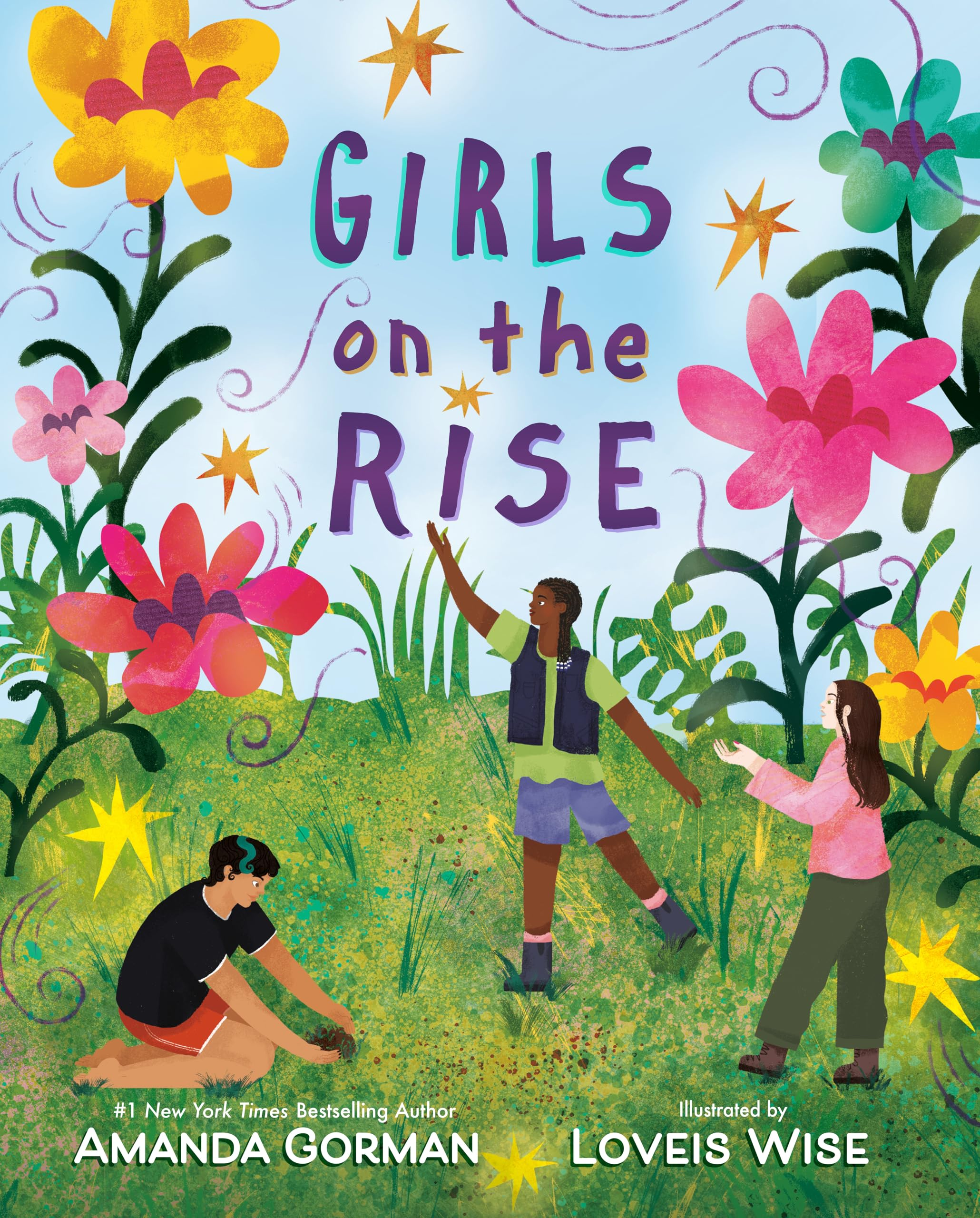
Girls on the Rise by Amanda Gorman, illustrated by Loveis Wise (Viking Books for Young Readers, 32 pages, ages 5-9). “We are girls on the rise./Today, everyone’s eyes/Are on us as we make waves/Pave the way, and save the day. Today, we finally have a say.” With simple rhymes and lush illustrations, this book celebrates girls of all types, encouraging them to support and empower each other through difficult times. Girls are celebrated for being strong and brave enough to right wrongs in the world. “Because when one girl is on the rise,/It means everyone else is, too.”

Dream a Dress, Dream a Poem: Dressmaker and Poet Myra Viola Wilds by Nancy Johnson James, illustrated by Diana Ejaita (Harry N. Abrams, 32 pages, ages 5-8). This book-length poem encourages readers to dream, citing the dreams of Myra Viola Wilds, a Black woman who grew up in Kentucky before moving to the city to get an education. She became an accomplished dressmaker until the close work damaged her eyes. Myra didn’t give up on her creative dreams, though, turning from sewing to poetry and publishing a book of her poems in 1915. The back matter includes additional biographical information and a photo, and the book begins and ends with two of Myra’s poems.

Both of these poetry books celebrate following dreams and lifting each other up. Amanda Gorman’s work speaks to these themes in general terms, while Nancy Johnson James offers a story of a woman who succeeded despite multiple hardships and was supported by the Black community that helped publish her work.

Both of these books would be excellent for celebrating Black History Month; if you’re looking for more resources, I have recently updated my Black History book list.

Get ready for Presidents’ Day

The Painter and the President: Gilbert Stuart’s Brush with George Washington by Sarah Albee, illustrated by Stacy Innerst (Calkins Creek, 40 pages, grades 2-5). George Washington was a man of action who preferred sitting astride a horse to posing for a portrait. Gilbert Stuart was a portrait painter with a knack for capturing his subjects while making the process fun for them. But Washington had him stumped. Not only did he show up with his face swollen from his ill-fitting false teeth, but he refused to engage with Stuart in any of the topics the painter tried desperately to introduce. Finally, he noticed Washington gazing happily at a horse out the window and started talking about horse racing. It worked! He invited George to bring family and friends to their next appointment, and that worked too. Today we see the happy (or not) results of Gilbert Stuart’s hard work every time we look at a dollar bill. Includes replicas of all six presidential portraits that Stuart completed, a time line, additional information about Washington’s teeth, how the painting was used to create the engraving for the dollar bill, and a bibliography.

This lighthearted introduction to Gilbert Stuart’s portraits would make a great addition to an art class. GW may not come off as a barrel of laughs, but readers will wince sympathetically when learning of his dental issues (although there’s no mention of the fact that he bought human teeth from enslaved people). Full disclosure, this book was published in 2024, but I thought it warranted a place in the Presidents’ Day post.

Hiding In Plain Sight: Kate Warne and the Race to Save Abraham Lincoln by Beth Anderson, illustrated by Sally Wern Comport (Calkins Creek, 48 pages, grades 2-5). When newly-elected U.S. President Abraham Lincoln traveled from his home in Illinois to Washington, DC in February, 1861, rumors of assassination were swirling. A plot was uncovered in Baltimore, and members of Allan Pinkerton’s detective agency took immediate steps to foil it. Central to their work was Kate Warne, the first female detective in the agency, whose undercover work as a lady from Alabama helped discover the Baltimore plot. Later, she posed as Lincoln’s sister, helping her “sick brother” board a train in Philadelphia that traveled in secret through Baltimore and on to Washington. When the supposed inaugural train arrived, word got out that Lincoln had already arrived, and Kate Warne faded into the cheering crowd, ready to take on her next assignment. Includes a six-page afterword with photos and additional information about Lincoln and Kate Warne, as well as a bibliography and illustrator’s note.

This exciting detective story would make an excellent read-aloud for both Presidents’ Day and Women’s History Month, with the mysterious Kate Warne playing a central role in preventing what could have been a national tragedy. The illustrations resemble period photographs and the whole book has kind of a scrapbook feel (the illustrator describes the scrapbooks that inspired her work in the note at the end). The additional information in the afterword provides some thought-provoking ideas and observations that could lead to some interesting discussions. Considering how little we know about Warne, there are quite a few children’s books about her: How Kate Warne Saved President Lincoln, The Eye That Never Sleeps: How Detective Pinkerton Saved President Lincoln, and the fictional The Detective’s Assistant.

George Washington’s Spectacular Spectacles: The Glasses That Saved America by Selene Castrovilla, illustrated by Jenn Harney (Calkins Creek, 32 pages, grades 2-5). By the end of the American Revolution, George Washington needed glasses, but he refused to let anyone see him wearing them. When he needed to read something, he would go into his office and slam the door. Everyone thought he was grouchy, but in March of 1783, it was his army officers who were the grouchy ones, after not getting paid for all the years of the war. They were threatening to storm Congress and demand their pay. Washington consulted a congressman about the issue, who wrote a reassuring letter that George thought would appease the officers. But when it came time to read it to them, he realized he needed his spectacles. He finally put them on, and his men, realizing what their beloved leader had sacrificed during the years of war, and agreed to wait on their pay. Includes additional information about this incident, an author’s note about her research and creative process in writing this story, and a bibliography.

Truth really is stranger than fiction, I thought as I read this quirky tale which ends unexpectedly with the army officers wiping away tears as they agree to continue to work without pay. All because George Washington put on his glasses, which, according to the back matter, is exactly how it happened. It’s an interesting story that will undoubtedly prompt some discussion, which could be seen as an example of Washington’s inspirational leadership or what happens when you’re willing to be vulnerable in front of your employees, but personally it kind of made me question the wisdom of those army officers.

Beloved authors

Go Tell It: How James Baldwin Became a Writer by Quartez Harris, illustrated by Gordon C. James (Little, Brown Books for Young Readers, 40 pages, grades 2-5). Books were a lifeline to young James Baldwin, growing up in Depression-era Harlem with a mother, stepfather, and eight siblings. Reading and writing helped him escape from his strict preacher stepfather and the racism he encountered all around him, particularly from the police. Words led Jimmy to preach his own sermons about love and acceptance, and they gained him admission to a prestigious high school, where he got to explore literature, film, and theater. The story follows Jimmy to Paris and ends with the publication of Go Tell It on the Mountain. Includes additional information about Baldwin, notes from the author and illustrator, and a list of sources.

And She Was Loved: Toni Morrison’s Life In Stories by Andrea Davis Pinkney, illustrated by Daniel Mintner (Little, Brown Books for Young Readers, 48 pages, grades 2-5). The author’s note begins, “This narrative is a love letter to an outspoken sparrow who transformed lives through her storytelling.” Her ode to Toni Morrison weaves biographical information into a celebration of the writer’s life and work. The phrase “And she was loved” appears in many illustrations, as the text describes the love given to her by her parents, her children, and her readers, in a narrative that moves from her childhood in Ohio to her college days at Howard University to her life as an editor, writer, and mother to a celebrated winner of the Pulitzer and Nobel Prizes and the Presidential Medal. In addition to the author’s note, the back matter includes an illustrator’s note, a photo of Morrison, a timeline, a list of selected works (including children’s books), and a list of sources.

Both of these biographies celebrate the lives and contributions of Black authors and offer inspiration to young writers. The illustrations in the books are striking, both by Caldecott honorees, with the potential for more awards consideration. These are books that may need a fair amount of introduction, as kids are unlikely to be familiar with either author.

Celebrating teacher-activists

Ruby Bridges: A Talk With My Teacher by Ruby Bridges, illustrated by Trudy Tran (Orchard Books, 48 pages, grades K-3). Ruby tells the story of her second-grade year, returning to the school where she and her teacher Mrs. Henry spent first grade alone in their classroom. Ruby is happy to be getting a ride with a neighbor instead of U.S. Marshals, not facing angry crowds at the front door, and seeing other kids in the school, some of whom look like her. But she’s heartbroken to learn that Mrs. Henry is no longer teaching there. The story then moves forward to 1995, when a book about Ruby has just been published. She’s excited to learn that Mrs. Henry has seen the book, which leads to a reunion. She finds out that Mrs. Henry left to have a baby, and the two of them reminisce about incidents only they remember, like when Ruby stashed her uneaten sandwiches in a supply cabinet until a mouse infestation led Mrs. Henry to discover them. The book ends with the question, “Teachers–who would we be without them?” and the author’s note celebrates teachers and encourages kids to think of special memories with their own teachers. A glossary lists 25 well-known teachers with a sentence or two about each one.

Early elementary students will relate to Ruby’s experiences and enjoy recalling their own teacher memories. Ruby’s tone is warm and relatable for kids without talking down to them. An introduction to her life would make the story more interesting, and I was surprised that the title of her 1995 book (I assume it’s The Story of Ruby Bridges) doesn’t appear anywhere in this book, including in the author information.

Make a Pretty Sound: A Story of Ella Jenkins–The First Lady of Children’s Music by Traci N. Todd, illustrated by Eleanor Davis (Chronicle Books, 60 pages, grades 1-4). Ella Jenkins grew up in a segregated Chicago neighborhood, surrounded by a loving family and all kinds of music and rhythms. As an adult she moved to San Francisco, where she became a teacher, community organizer, and civil rights activist. Ella particularly loved sharing music with children, using it to introduce them to cultures around the world. The story of her full 100-year life (she died on November 9, 2024) features cameos by a number of celebrities such as Cab Calloway, Billie Holiday, Dr. Martin Luther King, Jr., and Mister Rogers. Includes three pages of additional information, a timeline, and a bibliography.

I feel for Traci N. Todd trying to contain Ella Jenkins’s long, eventful, and fascinating life in a single picture book. She does an excellent job, using text with plenty of rhythm, reflecting the music that was always an important part of Ella’s life. The back matter paints an even more complete picture of that life, and it could be fun to supplement the book with recordings or YouTube videos of some of Ella’s performances. I wish that Bernadelle Richter, Ella’s partner and manager for more than 60 years, had made it into the story, instead of only getting a mention on the timeline.

Nonfiction that will make you question humanity

Glenn Burke, Game Changer: The Man Who Invented the High Five by Phil Bildner, illustrated by Daniel J. O’Brien (Farrar, Straus, and Giroux, 32 pages, grades 2-5). As a kid, Glenn Burke was a five-tool talent: fast runner, powerful and accurate hitter, good catcher, and strong pitcher. So it was no surprise that he got called up to play for the Los Angeles Dodgers. He made a name for himself there, and was an enthusiastic teammate, greeting runners at home plate by putting up his right hand, which the player would then smack. The high-fiving team made it to the World Series in 1977, but the next year Glenn was traded to the Oakland Athletics, a team at the bottom of the baseball standing. Why? Glenn Burke was gay, and homophobic manager Tommy Lasorda didn’t want him on the team. The trade led Glenn to quit baseball altogether. He enjoyed success playing in the San Francisco Gay Softball League and winning gold in the Gay Olympics, but struggled with drug use and unemployment, shattering his leg in a car accident and dying of AIDS at the age of 42. He lived long enough to see his high five become a universal greeting, but not to see the open acceptance of gay players in the MLB. Includes an author’s note, bibliography, and timeline.

Phil Bildner writes in the author’s note how he originally envisioned Glenn Burke’s story as a picture book, but his editor wanted a middle grade novel, which became A High Five for Glenn Burke, published in 2020. While the origin story of the high five may seem like a perfect choice for younger readers, the MLB’s homophobia and Burke’s death from AIDS may make this a better choice for older kids. It’s a moving and well-told story, ending on a note that is both sad and hopeful.

It Happened in Salem by Jonah Winter, illustrated by Brad Holland (Creative Editions, 32 pages, grades 6 and up). “You know what I’m talking about. You start whispering things about a person–hurtful things you know will get that person in trouble, untrue things you may have convinced yourself are actually true.” This second-person introduction to the Salem Witch Trials situates readers right in the middle of the action. The text is spare, relating the basic events and facts, and illustrated with haunting paintings of people in stocks and hanging from nooses. An author’s note gives more information, including the fact that it took 325 years–until 2017–for Salem to put up a plaque commemorating the individuals who were executed.

I found this book disturbing from the cover to the author’s note, which seems appropriate for the subject. You can generally count on Jonah Winter to put a unique and relevant spin on history that will have readers thinking about their own lives. I saw recommendations for this book starting in fourth grade, but I personally would not get this for an elementary library. It would be an excellent supplement for middle school or high school students learning about this period of American history, no doubt initiating some interesting conversations on gossip and bullying. I wish there had been some additional resources given at the end.

Works of art

Time to Make Art by Jeff Mack (Henry Holt and Co., 48 pages, grades K-5). A girl poses a variety of questions about art to artist. “Does it have to be perfect?” she asks Michelangelo, as he puts the finishing touches on the Sistine Chapel. “You can make your art any way you want,” he replies. “What if I can only draw stick figures?” she wants to know, to which a Paleolithic cave artist answers, “Then draw stick figures!” Colors, feelings, art materials, and subjects are all covered in a way that opens up art to everyone, with reinforcement from famous artists. Those artists all get thumbnail descriptions in the back, listed in the order they appear in the book.

This is both an excellent introduction to art history and an inspiring invitation to create art. The illustrations are cute, and it’s fun to try to identify the artists and their works. A few more resources for further exploration would have made a nice addition.

The Sunflowers: Vincent van Gogh’s Search for Beauty by Zahra Marwan (Feiwel and Friends, 40 pages, grades K-4). Vincent van Gogh’s favorite things to paint are sunflowers, which seem like happy spots of color in the gray city of Paris, even if they’re considered an inelegant subject for art. When he meets fellow artist Paul Gauguin, the two bond over the vibrant colors of each other’s paintings. Vincent moves from the city to a little yellow house in Arles, France, where he finds happiness that’s reflected in brighter, more colorful art. Some of his art finds its way onto the walls of his house, as he prepares for a joyful reunion with his friend Paul. When Paul arrives, he feels welcomed by the powerful paintings of sunflowers, and “He could feel the way it is to have a real friend.” Includes an author’s note with some additional information about Vincent and some thoughts about how art can be a powerful bond in creating friendships. This is a lovely celebration of art, friendship, and following your own heart, illuminated with van Gogh-inspired illustrations. It’s definitely not a biography, and I was sorry there wasn’t more biographical information in the back matter.

I heard about this book at the same time I learned of another biography about Vincent van Gogh, The Vincent van Gogh Atlas by Nienke Denekamp and René van Blerk, illustrated by Geert Gratama, Thames and Hudson, 160 pages, grades 5-8). I don’t know if it’s because this book was originally published in Europe, but I have struggled (unsuccessfully so far) to get it through interlibrary loan. From what I’ve read about it, it sounds like a real work of art filled with maps, letters, and reproductions of van Gogh paintings. I hope you will have greater success obtaining it than I have!