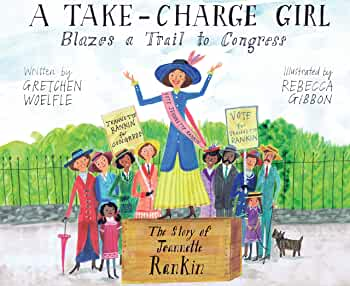
A Take-Charge Girl Blazes a Trail to Congress: The Story of Jeannette Rankin by Gretchen Woelfle, illustrated by Rebecca Gibbon

Published by Calkins Creek

Summary:  Jeannette Rankin was a take-charge girl from the start, helping out on her Montana ranch wherever she could.  Traditional female roles didn’t appeal to her, but social justice did, and she moved from working at a settlement house to campaigning for women’s suffrage.  After a victory for the cause in Montana, Jeannette decided to expand her influence by running for Congress.  On November 7, 1916, Jeannette won the election, becoming the first U.S. Congresswoman.  Five months later, she took her seat in the House of Representatives as a representative from Montana, declaring, “I may be the first woman member of Congress, but I won’t be the last.”  40 pages; grades 1-5.  Includes additional information about Jeannette Rankin, a timeline of her life, and additional resources.

Pros:  I’ve been working on a picture book biography of Jeannette Rankin off and on for the last few years, and this book is far better than anything I’ve been able to come up with.  The writing and illustrations are lively and capture Jeannette’s can-do spirit.

Cons:  To me, one of the most interesting things about Jeannette is that she voted against both World War I and World War II (the only member of Congress to do so for WWII), which was political suicide but supported her pacifist beliefs.  This part of her career is relegated to the back matter.

All Rise: The Story of Ketanji Brown Jackson by Carole Boston Weatherford, illustrated by Ashley Evans

Published by Crown Books for Young Readers

Summary:  Our newest Supreme Court Justice gets her own picture book biography with the repeating refrain of “she rose.”  Ketanji rose from a childhood filled with the love and support of parents and grandparents who took pride in their heritage and valued education.  She rose to overcome teachers who made fun of her name and discouraged her from applying to Harvard to follow her dream of becoming a lawyer and then a judge.  And ultimately, she rose to the challenge of four days of tough questions by the Senate Judiciary Committee to become the first Black woman Supreme Court justice.  Includes a letter from the author to her granddaughter and “all our daughters” and a timeline of Ketanji Brown Jackson’s life.  40 pages; grades K-4.

Pros:  This inspiring biography will help kids get to know Ketanji Brown Jackson.  Her own quotes are sprinkled throughout the text, adding her voice to her story. 

Cons:  No photos.

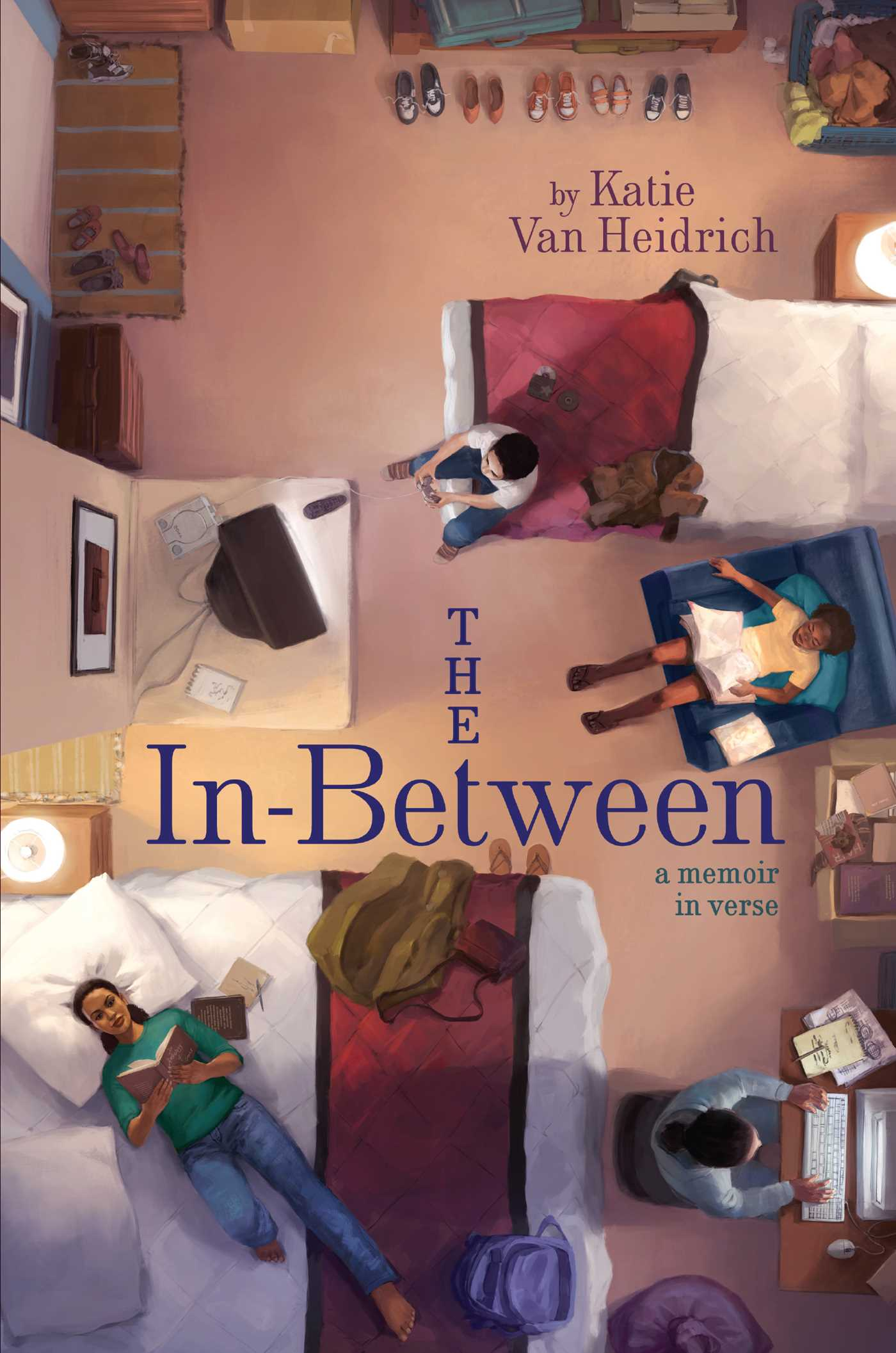
The In-Between: A Memoir in Verse by Katie Van Heidrich

Published by Aladdin

Summary:  In this debut memoir in verse, Katie Van Heidrich writes about a six-week period when she lived with her mother and two younger siblings in a motel room.  It’s an “in-between” time when her mom is between jobs and unable to keep their apartment.  As Katie tries to adjust to her circumstances while pretending everything is normal to her seventh-grade classmates and teachers, she reflects on the past and her relationship with the members of her family.  Her Black mother and white father have always worked to be in her life, even after they divorced, and she recognizes how her dad has provided structure while her mom has allowed her to dream.  The kids spend weekends with their dad, who’s recently remarried and living in the suburbs, but Katie slowly learns the reasons why they can’t live there all the time.  By the time a tenuous happy ending arrives, Katie’s learned that she can’t always please her parents and that her voice is an important part of the family.  Includes seven pages of photos.  304 pages; grades 5-8.

Pros:  Katie Van Heidrich has a masterful debut with verse that is both expressive and concise and beautiful pacing that slowly reveals each family member’s personality and how the past has brought them to the present moment.

Cons:  While there’s nothing in this book that makes it inappropriate for upper elementary, the emotions are so pitch-perfect for middle schoolers that it might be better appreciated by older readers.

Cut! How Lotte Reiniger and a Pair of Scissors Revolutionized Animation by C. E. Winters, illustrated by Matt Schu

Published by Greenwillow Books

Summary:  Who created the first full-length animated film, inventing the multiplane camera and storyboarding in the process?  If you answered Walt Disney, it’s time for you to pick up this book and learn about Lotte Reiniger, a German artist who developed a love of shadow puppetry as a child and became renowned for her creations.  After studying filmmaking and stop-motion animation with director Paul Wegener, she started making short animated films but didn’t think any audience would be interested in a feature-length one.  A friend convinced her to try, though, and she spent the next three years creating The Adventures of Prince Achmed. When it was finally completed in 1926, she had trouble finding a theater that would show it, but it eventually became a big success.  Lotte went on to make approximately sixty films, including one in a basement during the bombing of Berlin before she emigrated to England.  Includes a timeline, a list of sources, and an author’s note with additional information about Lotte.  40 pages; grades 1-5.

Pros:  Don’t forget, March is Women’s History Month, and this would make a fascinating read-aloud, maybe shown with the Prince Achmed trailer.  The story is well-told, and the illustrations capture the feel of Lotte’s work with film and silhouettes.

Cons:  The thought of making a film like this makes me want to lose my mind.  Lotte must have had incredible patience.

Just Jerry: How Drawing Shaped My Life by Jerry Pinkney

Published by Little, Brown Books for Young Readers

Summary:  Award-winning illustrator Jerry Pinkney was working on this memoir at the time of his death in 2021.  He writes of his childhood, growing up in the Germantown section of Philadelphia in the 1940’s and 1950’s, surrounded by a chaotic but loving family and neighborhood.  Due to dyslexia (the book is written in a font created for those with dyslexia), he struggled in school, but always found solace in sketching and art.  His memories of home, school, and summers at the Jersey shore describe the racism he and his family had to deal with but also the support he got from his family, friends, and members of the community. Thanks to hard work and a little luck, he finds his way to beginning an art career by the end of the book. The epilogue describes how his early life led to his success as an illustrator. 160 pages; grades 3-7.

Pros:  Jerry Pinkney has created a wonderful memoir, showing what it was like to grow up in a loving family that also struggled with racism; with an undiagnosed learning disability; and with a passion and talent for art.  He emphasizes the positives in his childhood without shying away from some of the difficulties.

Cons:  Because Jerry died before this was completed, the illustrations are his rough sketches.  I enjoyed them but couldn’t help feeling wistful about what might have been.

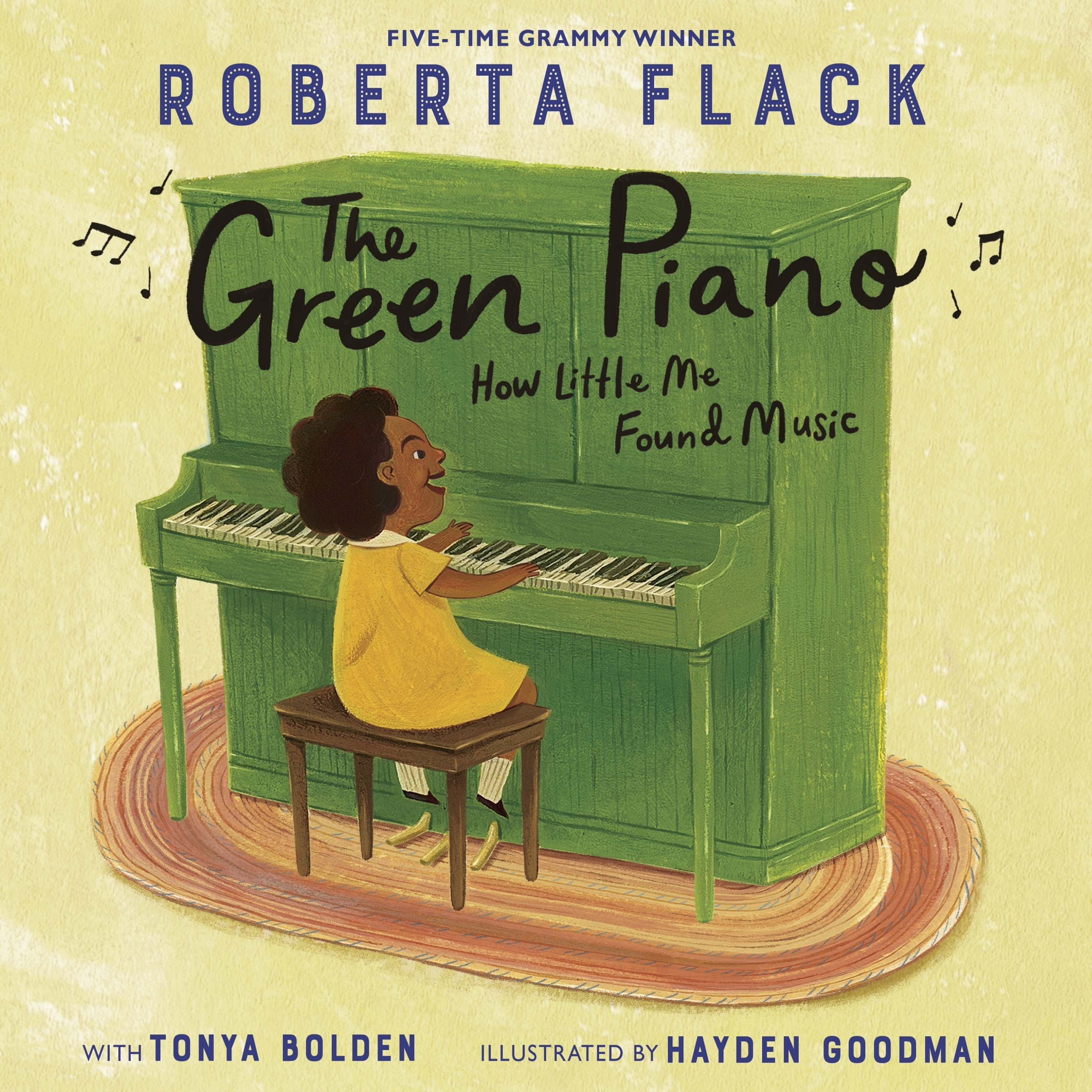
The Green Piano: How Little Me Found Music by Roberta Flack and Tonya Bolden, illustrated by Hayden Goodman

Published by Anne Schwartz Books

Summary:  Roberta Flack’s family didn’t have a lot of money, but they had plenty of love–for each other and for music.  From the time she was three, Roberta played the piano at church, and she started lessons at the age of six.  Her most fervent wish was to have a piano of her own, and her father was able to grant that wish when he found an old piano in a junkyard.  He hauled it home, cleaned it, tuned it, and painted it green.  She practiced for hours, dreaming of a life of a musician, a dream that is shown coming true on the last page.  Includes a timeline of Flack’s career highlights and an author’s note describing her training as a classical musician, which led to her career as a pop singer.  40 pages; grades K-4.

Pros:  A great story to share with early elementary kids, because so much of it is focused on Roberta’s early life.  I love the message of the author’s note, summarized in the last line: “Find your own ‘green piano’ and practice relentlessly until you find your voice, and a way to put that beautiful music into the world.”

Cons:  Kids may need an introduction to Roberta Flack’s music.

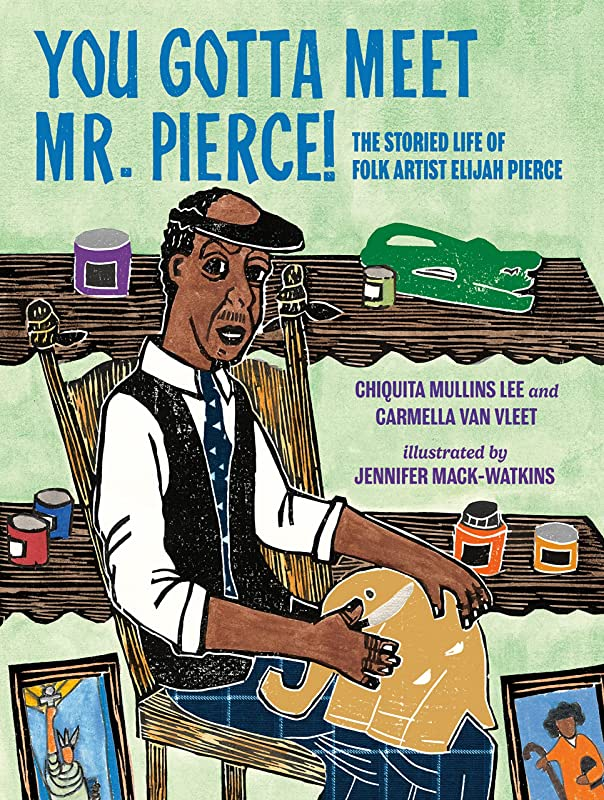
You Gotta Meet Mr. Pierce! The Storied Life of Folk Artist Elijah Pierce by Chiquita Mullins Lee and Carmella Van Vleet, illustrated by Jennifer Mack-Watkins

Published by Kokila

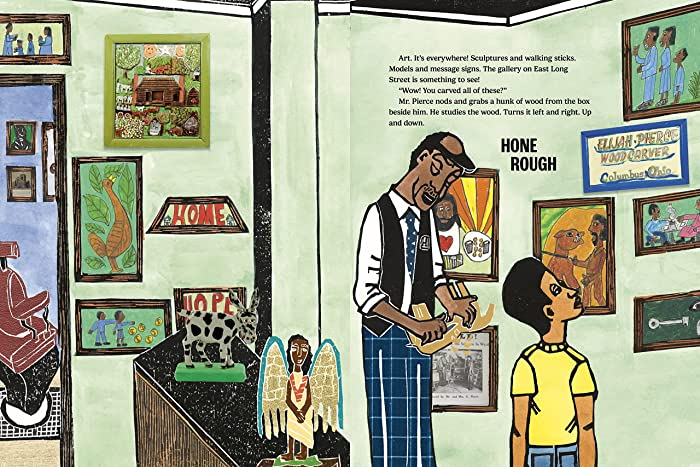
Summary:  In this fictionalized story about real-life artist Elijah Pierce, a boy and his dad enter Mr. Pierce’s barbershop.  The shop is full of wood carvings, and Mr. Pierce is happy to share stories about his life and art.  The boy has some new colored pencils and is trying to get an idea for a picture.  Mr. Pierce tells him how his art often came from stories, whether they were from his own life, the Bible, or something someone told him.  After the haircut and the stories are finished, Mr. Pierce gives the boy a carved elephant.  “I think I know what I want to draw…” he says as he and his dad leave the shop.  The final page shows a father and son (I think the father is the boy who is now grown up) about to enter a museum with an exhibit of Elijah Pierce’s work.  Just like the dad at the beginning of the story, the man tells his son, “You gotta meet Mr. Pierce!”  Includes a timeline of Elijah Pierce’s honors, additional information about the exhibit at the Corcoran Gallery in Washington, D.C., places to see Elijah’s work, and notes from the author and illustrator with additional information about Elijah Pierce, the book, and the illustrations.  40 pages; grades 1-5.

Pros:  A charming story about a little-known artist who will get some well-deserved recognition with this book.  The fictional format is engaging, and the folk-art inspired illustrations are the perfect complement.

Cons:  I found the ending a little confusing, as I couldn’t figure out what the boy had decided to draw, and I wasn’t sure who was pictured on the last page. 

To Boldly Go: How Nichelle Nichols and Star Trek Helped Advance Civil Rights by Angela Dalton, illustrated by Lauren Semmer

Published by HarperCollins

Summary:  The story begins with the author recounting how her family loved watching the original Star Trek, particularly because of Lieutenant Uhuru, acted by Nichelle Nichols, a Black woman who played the communications officer on the Enterprise.  The narrative then goes back to Nichelle’s childhood where she was encouraged by her parents to do whatever she wanted.  She loved performing, first as a ballet dancer and later as a singer and actress.  This gave her confidence when she got the part on Star Trek, but that confidence began to wane when she experienced racism on the show.  She told Gene Rodenberry that she was quitting, but changed her mind when she met a fan–Martin Luther King, Jr. who told her Star Trek was the only show he and his wife let the kids stay up late to watch.  He convinced her to stay on the show and serve as a role model to Black children.  Includes information on Nichelle’s role with NASA helping to recruit a more diverse workforce, including Mae Jemison and Guion Bluford; also an author’s note.  40 pages; grades 1-5.

Pros:  I’m excited to read this book to several of my classes beginning today.  The subject matter, the engaging writing style, and the colorful illustrations make it an excellent choice for sharing Black history…and the cameo by MLK was a fun surprise!

Cons:  No additional resources listed.

Black Swans by Laurel van de Linde, illustrated by Sawyer Cloud

Published by Sunbird Books

Summary:  Six Black dancers, three men and three women, are profiled, each one given a few pages describing his or her career and the racism each one encountered and overcame to achieve groundbreaking success.  The six are listed in chronological order, beginning with Essie Marie Dorsey, who lived from 1893-1967, and finishing with Michaela DePrince, born in 1995 and currently dancing with the Boston Ballet.  The author’s note at the end lists eight other Black ballet dancers, with the years they lived and the companies they danced with.  40 pages; grades 1-5.

Pros:  Dancers will find plenty to inspire them in these stories, timed perfectly to celebrate Black History Month.  The illustrations capture the grace, strength, and beauty of the ballerinas.

Cons:  I wish there was more historical context for the biographies.

Milloo’s Mind: The Story of Maryam Faruqi, Trailblazer for Women’s Education by Reem Faruqi, illustrated by Hoda Hadadi

Published by HarperCollins

Summary:  The author of Unsettled tells the story of her grandmother, Milloo, who grew up in India in the early 20th century.  Milloo loved school, but her parents told her at the end of fifth grade that she was done with education.  Milloo launched a campaign all summer long and finally got her parents’ permission to enter sixth grade.  She went on to finish high school and college at the top of her class, then became a teacher herself.  After getting married, she tried staying at home as her husband wanted, but found that cooking and sewing were not her thing.  She started a girls’ school in her home, and when classes outgrew that space, she founded a series of schools.  The author’s note tells that the Happy Home Schools in Karachi, Pakistan are still thriving.  40 pages; grades K-4.

Pros:  Both the text and the collage illustrations exude a bright energy that reflects Milloo’s enthusiasm and passion for education.  File this away to read for Women’s History Month next month.

Cons:  I was a bit confused by Milloo being referred to as Maryam in the subtitle, which was not explained until the author’s note (Milloo was her father’s nickname for her, and she’s referred to by that name throughout the story).