Marching to the beat of your own drum

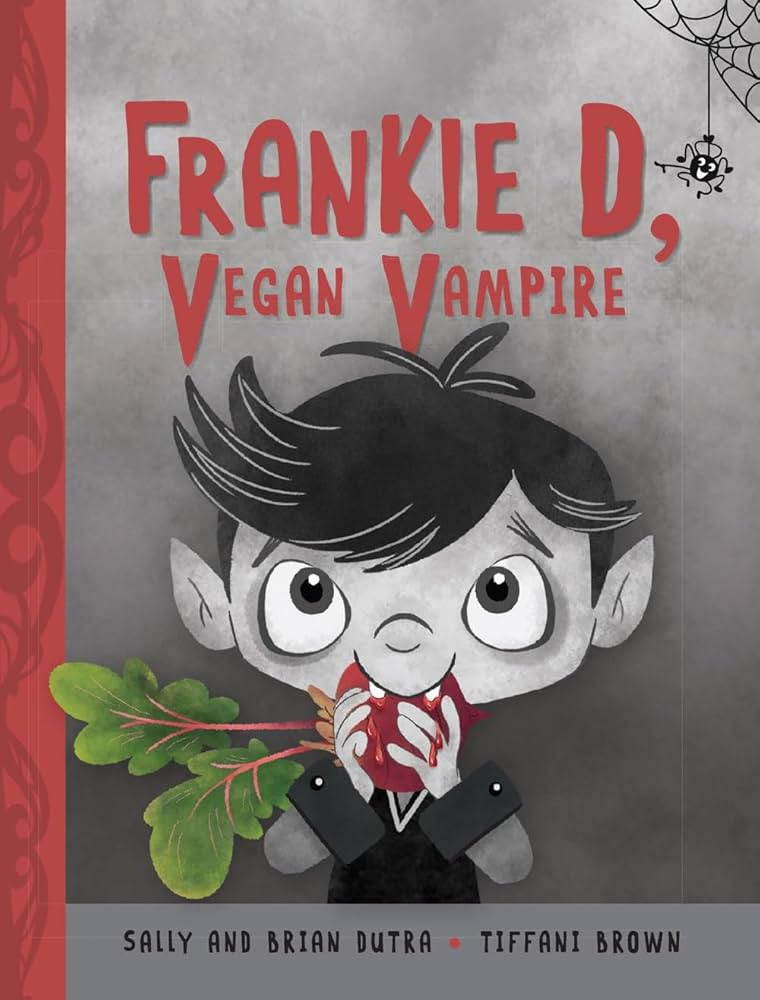
Frankie D., Vegan Vampire by Sally and Brian Dutra (Kids Can Press, 192 pages, grades 2-5). Frankie and his family have moved from Transylvania to the U.S., hoping, like so many immigrants before them, for a better life. In their case, that life is eternal, since they’re a family of vampires. Being immortal is just the beginning, as Frankie and his family struggle to hide their fangs, their ability to turn into bats, and the fact that they’re used to sleeping during the day (and in coffins). Switching to a healthy vegan diet has fortunately dampened their taste for blood, and Frankie enjoys starting fourth grade and making new friends. He suspects that one classmate, Eddie, might be a troll, but as he learns more about Eddie, he comes to realize why he’s such a bully. The family successfully negotiates having one of Frankie’s new friends and his family to dinner, and Frankie has fun at a human birthday party, but the grand finale comes with the school concert, when Frankie and Eddie save the fourth-grade performance. Pumped after this success, Frankie decides to fly home and burn off some of his excess energy, only to realize that Eddie has seen him transform into a bat.

There’s plenty of humor in this de-fanged vampire story, and the last page makes me hopeful that there will be a sequel. It’s an illustrated chapter book, but at close to 200 pages, I wouldn’t exactly call it an early chapter book. Still, I think it could find an audience with fluent readers in the earlier years of elementary school, and maybe older kids who are reading a bit below grade level.

Band Camp #1: All Together Now! by Brian “Smitty” Smith (little bee books, 80 pages, grades 1-4). This early graphic novel gives summer camp a new twist: all the campers are musical instruments. Bunk J, a.k.a. Junk Bunk, the cabin that always loses all the competitions, has four unique residents this summer: Trey the triangle, Kaylee the ukelele, Zook the kazoo, and Cordelia the accordion. Each instrument has a unique personality and well-defined likes and dislikes, but they’re united in their determination to put an end to the Bunk J legacy. In a relay race at the end of this book, they combine their talents for an unexpected victory. Camp’s not over yet, though, and book 2 is due out in September.

As a veteran of eight–yes, eight!–band camps, I love this premise and was amazed at how Smith was able to create instruments with real personalities. Early readers will get a kick out of the story and illustrations. The ending seemed abrupt, and I kind of wish the whole camp session had been included in a single volume.

If you like Junie B. Jones…

Rachel Friedman Breaks the Rules by Sarah Kapit (Henry Holt Books for Young Readers, grades 1-4). Eight-year-old Rachel has plenty of energy and sometimes doesn’t understand the reason for having so many rules in her life–at home, at school, at the temple when she and her dad and brother attend Shabbat services. But when Rachel wants to meet famous gymnast Holly Luna when she comes to town, her dad makes a deal: if Rachel can follow all the rules for a week, he’ll let her go with her best friend Maya to see Holly. Rachel makes it through six days, but then a situation arises where she feels that she must break a rule. She and her dad don’t see eye to eye, and when Rachel stages a rebellion at a Shabbat service, Dad puts his foot down. But a conversation with the rabbi leads to a greater understanding and a compromise that satisfies everyone.

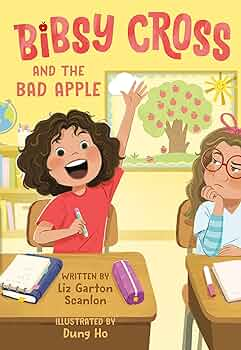
Bibsy Cross and the Bad Apple by Liz Garton Scanlon, illustrated by Dung Ho (Knopf Books for Young Readers, 128 pages, grades 1-4). Bibsy is another eight-year-old who has always loved school and her teachers until she hits third grade. Mrs. Stumper doesn’t seem to like Bibsy, especially the many contributions to class discussions Bibsy loves to make. A bulletin board features each student’s name on an apple that hangs from a tree, but which gets moved to the ground for behavior issues. Bibsy’s apple frequently falls to the ground, but things come to a head one day when Bibsy, defending what she’s sure will be a championship science fair project, goes too far and gets a worm hole punched in her apple. She has to bring the apple home to show her parents, which leads to a good conversation about how to handle her situation. Mrs. Stumper will probably never be Bibsy’s favorite teacher, but they come to an understanding, and Bibsy and her best friend Natia enjoy science fair success.

Both of these series openers feature spunky girls who have strong opinions and are not afraid to share them. Rachel’s book is a conventional chapter book with illustrations, while Bibsy’s is written almost like a book in verse, making it perhaps a more manageable choice for those just transitioning to chapter books. Both feature black and white illustrations, with highlights of apple-red in Bisby’s. While no new ground is broken–there are plenty of early chapter books featuring spunky girls–these are both sure to find an audience among the newly independent reader crowd who enjoy relatable protagonists and situations with plenty of humor.

Memories of China

Growing Up Under a Red Flag: A Memoir of Surviving the Chinese Cultural Revolution by Ying Chang Compestine, illustrated by Xinmei Liu (Rocky Pond Books, 40 pages, grades 2-6). Ying grew up during China’s Cultural Revolution, with parents, both doctors, who were targeted for being part of the educated class. Her father taught her English and told her stories of his days studying in San Francisco, and the Golden Gate Bridge became a symbol of that life. Ying recalls the day her dad was forced to burn all his English books and papers, hiding his ties to the west from the government. Shortly after that, he was arrested, and life grew increasingly difficult for Ying and her mother, with food shortages and worries about the future. After Mao’s death in 1976, the family was reunited. Ying eventually moved to the U.S. to study, and the final picture shows the family eating with her father’s teacher, Dr. Smith, the Golden Gate Bridge in the background.

Born Naughty: My Childhood in China by Jin Wang with Tony Johnston, illustrated by Anisi Baigude (Anne Schwartz Books, 112 pages, grades 2-5). Imagine Ramona Quimby living in 1980’s Mongolia, and you’ll have a good idea of the vibe of Jin Wang’s lively childhood memoir. Living in a one-room mud hut with her parents and two younger brothers, Jin embraces all of life experiences, whether it’s traveling with her father to fetch the family’s precious water supply, beating the boys at tree-climbing, harvesting mushrooms and potatoes, or learning calligraphy. Real dangers are never far away, and her story of being attacked by a potentially rabid dog is harrowing. The last chapter shows the family taking a break from their demanding lives to celebrate the new year together. In the authors’ notes, Jin Wang shares more details of her life, including a 2019 trip back home that affirmed her happy childhood memories, and she and Tony Johnston relate how they met in yoga class and created this book together.

These two very different memoirs offer contrasting views of Chinese childhoods just a decade apart, one of a middle-class family dealing with government persecution and hardship, the other of a much poorer rural family facing different hardships but able to lead a freer life. Jin Wang’s memoir would make a great book club choice for second or third graders. There are plenty of similar stories for this age group that would make an interesting contrast to Jin’s childhood. While Ying’s story is a picture book, it may appeal to older students up into middle school, who might have a better understanding of the Cultural Revolution and what it meant to the people living through it.

Celebrating Asian American and Pacific Islander Heritage Month

Made In Asian America: A History for Young People by Erika Lee and Christina Soontornvat (Quill Tree Books, 320 pages, grades 5-8. This young readers’ adaptation of Erika Lee’s The Making of Asian America (2015) begins with an introduction that details the absence of Asian American history in most schools and some of the kids who have worked to bring attention to that. The main narrative covers American history from Columbus to Covid, relating the stories of people who immigrated to the U.S. from many Asian countries, including China, Japan, Korea, Vietnam, India, the Philippines, and more. Different people had different reasons for coming, depending on their country’s history and political situation, but almost all experienced racism, discrimination, and broken promises when they arrived. Like many other immigrants, they worked hard doing backbreaking labor to survive and to try to build a better future for their children. In more recent times, Asian Americans have become known as the “model minority,” a label which carries its own baggage. The Covid era showed that racism still simmers right beneath the surface of American society, as it exploded with the news that the virus originated in China. Asian Americans have a history of fighting for civil rights, both for themselves and for other groups experiencing discrimination, and that fight continues today, as explained in the last chapter. Includes notes from both authors as well as almost 30 pages of source notes and an index.

I learned so much from this book, which really drove home the point that Asian Americans are largely missing from American history. The writing is clear and engaging, and many of the profiles describe ordinary people whose stories are often both heartbreaking and inspiring. It was fascinating to get a brief history of so many different countries and to learn why different groups immigrated to the United States.

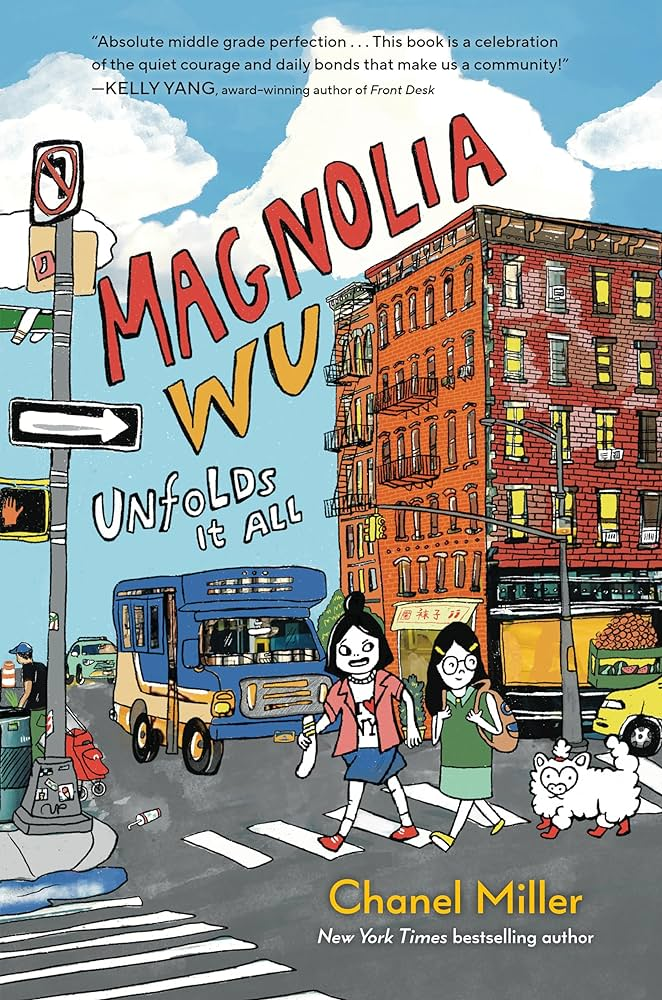
Magnolia Wu Unfolds It All by Chanel Miller (Philomel Books, 160 pages, grades 2-5). While Magnolia is looking forward to turning 10, she’s less excited about the summer ahead, which will mostly be spent at her family’s Bing Qi Ling Laundromat. When her mom’s friend moves to New York City from California, she brings along her daughter Iris, who is just Magnolia’s age. At first the girls feel strange around each other, but soon they bond over the sock board, where Magnolia has displayed all the stray socks that have been left behind at the laundromat. They decide to canvass the neighborhood to find each sock’s owners, using clues from the socks themselves to help them. As they solve each mystery, the girls learn more about their neighbors and hear some interesting stories about Magnolia’s parents, who turn out to have a fun and adventurous side that Magnolia hasn’t been aware of. A major fight threatens to destroy their new friendship, but Magnolia finds a way to repair things and, in the process, gains a deeper understanding of her new best friend.

With a 10-year-old protagonist, a larger font, and plenty of illustrations, this would make a good introductory chapter book. It was interesting to read this right after finishing Made in Asian America, as Magnolia’s and Iris’s families, from China and Vietnam respectively, are working hard to give their kids a better life in America and experience racism at various points in the story. Their resilience and close family ties make this a warm and engaging story with a fun and quirky cast of characters.

Three books about immigration

Finding Home: Words from Kids Seeking Sanctuary by Gwen Agna and Shelley Rotner, photographed by Shelley Rotner (Clarion Books, 32 pages, ages 4-8). Children and their families from around the world come to the United States seeking sanctuary from war, famine, natural disasters, and other dangers. Many of the photos have cartoon bubbles with kids describing in their own words how they felt when they had to leave their countries, what they miss, and the difficulties and joys in their new homes. There’s additional narrative at the end about how some of the families got to the United States, as well as resources for kids, adults, and parents, caregivers, and educators about how to make families feel welcome.

This book has some personal connections to me, because: 1. the author and photographer live near me, and I have met Shelley Rotner, 2. my Quaker meeting is part of a Circle of Care for one of the families in this book, and 3. my school in Springfield has three classes of refugee kids who have missed at least two years of school due to their circumstances. This book is at just the right level for helping kids (and adults) understand what these families have gone through and to help make them welcome in the U.S.

The Circuit: Graphic Novel by Francisco Jiménez, illustrated by Celia Jacobs (Clarion Books, 240 pages, grades 4-8). Francisco Jiménez’s memoir has been adapted as a graphic novel, telling the story of Francisco as a child, moving with his family from Mexico to California, where they became migrant workers, traveling from one farm to the next to pick cotton, strawberries, grapes, and other crops. Francisco loves to learn, but school is sandwiched between jobs, and his story is a series of losses, as he befriends kids he’ll never see again and loses his precious journal in a fire. There’s enough humor and joy to prevent the story from getting too bleak, and the story feels somewhat timeless, although I think it takes place in the 1940’s. The heart stopping cliffhanger on the last few pages will leave readers like me fervently hoping that more of Jiménez’s books will be published in graphic format.

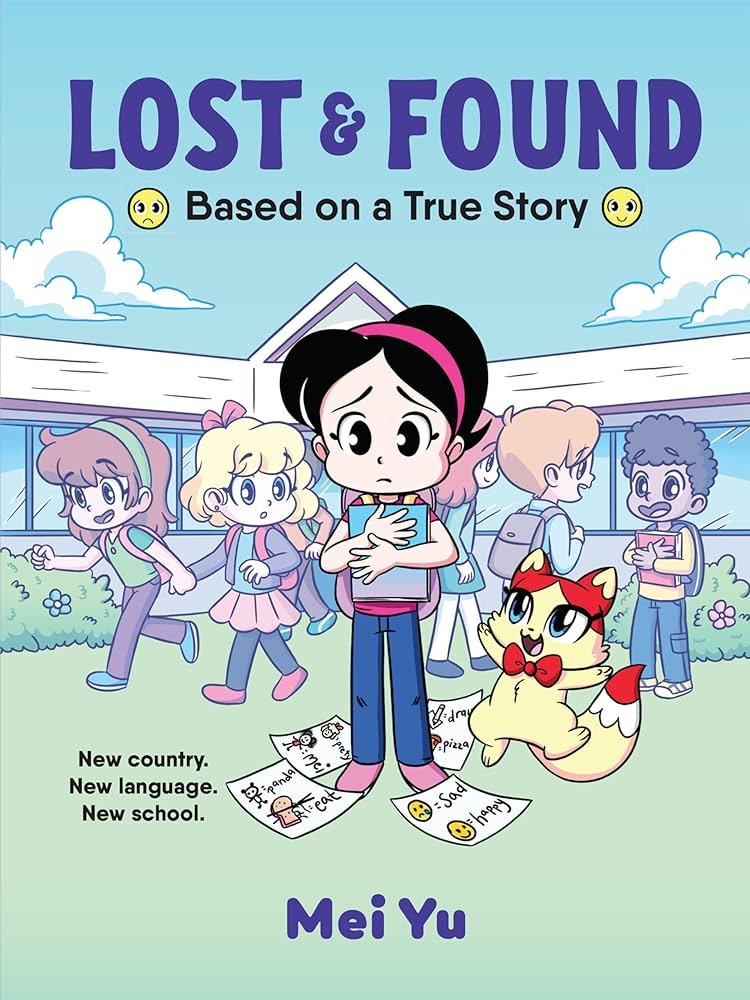
Lost & Found: Based on a True Story by Mei Yu (Union Square Kids, 128 pages, grades 2-5). Mei Yu recounts her memories of moving from China to Canada at a young age (probably six or seven). With English words in a green font, readers can see how few words she understands at school and the scary situations that ensue: using the wrong bathroom, thinking kids are laughing at her, losing her beloved sketchbook. Mei eventually uses the sketchbook to create a collection of English words, and before long, she is able to communicate and begin to make friends. An author’s note gives more information about her experience, as well as a simple glossary of Chinese words. There’s a funny bonus story about how Mei got her beloved toy cat, who appears real to her, a la Calvin and Hobbes.

It’s a pretty simple story, but the difficulties of immigration are presented in a way that beginning readers will be able to understand, and everyone is sure to love the manga-style artwork.

Two graphic novel school stories

Art Club by Rashad Doucet (Little, Brown Ink, 240 pages, grades 4-7). When Vice Principal Ruffin assigns kids to research a career that will give them stability and a good income, Dale is stumped. He wants those things, but he also wants to do something he enjoys. A report on an art career lands him in the principal’s office, where the more lenient Principal Johnson lends a sympathetic ear and agrees to let Dale start an art club…if he can find three other members and figure out a way to generate revenue. The art teacher agrees to sponsor them, recalling her own art club days that were cut short by the same Vice Principal Ruffin. The club provides Dale with ways to learn more about art and to make some new friends as he recruits other kids with a variety of talents. They work together to create art, support each other, and find ways to make money. When Ruffin offers a series of challenges designed to shut down the club, Dale and his friends rise to the occasion, finally convincing him to allow the club to continue for at least the rest of the year. The final pages show how the graphic novel was created, sure to inspire budding artists along with the kids’ own inspiring story.

Spirited 1: Day of the Living Liv by Liv Livingston, illustrated by Glass House Graphics (Little Simon, 144 pages, grades 2-5). Liv is unhappy when her parents decide to move the family from Pleasant Place to Gloomsdale. School proves extra challenging, since the other students are ghosts and other supernatural creatures. Liv is something of a curiosity as the only living student, but she soon makes friend with a werewolf and a vampire, who help her stand up to the bullying ghost Astrid. By the end of the story, Liv has embraced her unusual new home, and the stage is set for further adventures in book 2.

These two titles will undoubtedly be welcomed by fans of the ever-growing library of graphic novel school stories. Spirited is a great introduction to the genre, a quick read for kids ready for short chapter books. The spooky setting and characters will appeal, although Liv’s new school and town are more fun than scary. Art Club, based on the author’s own school experiences, presents readers with four distinctive characters that they will find relatable. The video game subplot dials the art up a notch and is sure to be a draw as well. I’m hoping both books will have at least one sequel.

Two books about the immigration experience

Salma Makes a Home by Danny Ramadan, illustrated by Anna Bron

Published by Annick Press

Mina Belongs Here by Sandra Niebuhr-Siebert, illustrated by Lars Baus

Published by Floris Books

Summary: Two girls navigate their new homes after moving from a different country. Readers may know Salma from her picture book, Salma the Syrian Chef. She and her mom have settled into a new apartment in Vancouver, and when the story opens, her dad is on his way to join them. Although she’s thrilled to have Baby back with the family, Salma worries that he won’t like Canada and will go back to Syria. Some heartfelt conversations resolve the issue, and Salma learns that it’s possible to have two homes–the one where you live and the one you remember in your heart. Includes directions for making lanterns like the ones Salma and her mom create in the story. Book 2, Salma Writes a Book, is also available. 120 pages; grades 1-4.

Mina is scared to start kindergarten, even though her mother assures her that she’ll have fun and that the people will be kind. This turns out to be the case, as her teacher warmly greets her the first day, and Mina makes a friend. Each night, she dreams about her experiences, and each day school gets a little easier. The illustrations slowly change from gray to full color, as Mina learns English and becomes a member of the kindergarten community. When a new boy is introduced to the class, Mina is the first to greet him and invite him to play. 40 pages; ages 4-8.

Pros: Both books show resilient main characters who successfully deal with the difficulties of moving to a new country and learning a new language, serving as excellent mirrors for those going through the same challenges and windows for kids who may be welcoming new students to their classes.

Cons: Neither book had quite the light touch of Young Vo’s Gibberish, which is still my favorite on this topic.

Mehndi Boy by Zain Bandali, illustrated by Jani Balakumar

Published by Annick Press

Summary:  Tehzeeb loves art and fashion, so it seems like a natural fit when he learns how to do mehndi.  He practices on friends and family members and begins to get a reputation for his henna art.  His favorite uncle, Ayaz, is also an artist and has encouraged Tehzeeb’s creativity.  Tehzeeb is crushed when Ayaz Uncle expresses disapproval over his mehndi, telling him that it’s not an appropriate art form for boys.  Reluctantly, Tehzeeb stops doing mehndi until the day before his cousin’s wedding, when he and the bridal party get stuck in traffic.  Tehzeeb ends up saving the day, and Ayaz Uncle has to rethink his gender stereotypes.  Includes a glossary, additional information about mehndi and henna, and directions for drawing a paisley.  100 pages; grades 2-4.

Pros:  Tehzeeb is a great character who learns how to be true to himself, and it was refreshing to see Ayaz Uncle change his ideas and admit to his nephew that he was wrong. The story and the colorful illustrations make this an ideal book for early chapter book readers.

Cons:  I would have liked to know more about the history of this Muslim family with roots in India living in Tanzania.

The Rescues Finding Home by Tommy Greenwald and Charlie Greenwald, illustrated by Shiho Pate

Published by Red Comet Press

Summary:  In three chapters, readers learn about one-eyed Moose and three-legged Bear, two dogs who become friends at a shelter.  A woman named Cathy adopts them at the end of the first chapter, and a stray cat named Tiger joins the family in chapter two.  In the final story, it’s bedtime for the three friends, but Tiger is too anxious to sleep in his new home.  After trying a few unsuccessful solutions, the three pets happily snuggle up together in the dogs’ bed for the night.  40 pages; grades K-2.

Pros:  I would challenge any new reader not to be completely charmed by Moose, Bear, and Tiger.  This is billed as book 1, so here’s hoping there will be more.

Cons:  The first two pages were so heart-rending that I could hardly go on.

Breaking News (Frankie and Friends, book 1) by Christine Platt, illustrated by Alea Marley

Published by Walker Books

Summary:  When Mama has to suddenly leave to cover a breaking news story, Frankie must cope with missing her mom.  Heading to her bedroom, she realizes that she has enough of her mother’s old equipment to start her own news program.  She gathers her doll and stuffed animal friends, assigning them different tasks, and they get to work.  When they hear someone crying in the house, they investigate and find Frankie’s teenage sister Raven, interviewing her to find out what’s wrong.  Frankie is proud to create her own news show and to help her big sister, and she knows Mama will be proud as well when she returns.  Includes several pages of information about the news and journalism.  80 pages; grades 1-4.

Pros:  A fun new early chapter book series that explores the process of gathering and sharing news and introduces a loving family with a hardworking young protagonist and her imaginary friends.

Cons:  Raven seemed unrealistically loving and upbeat for a young teenager interrupted from a crying session by her younger sister looking to broadcast a news story about it.