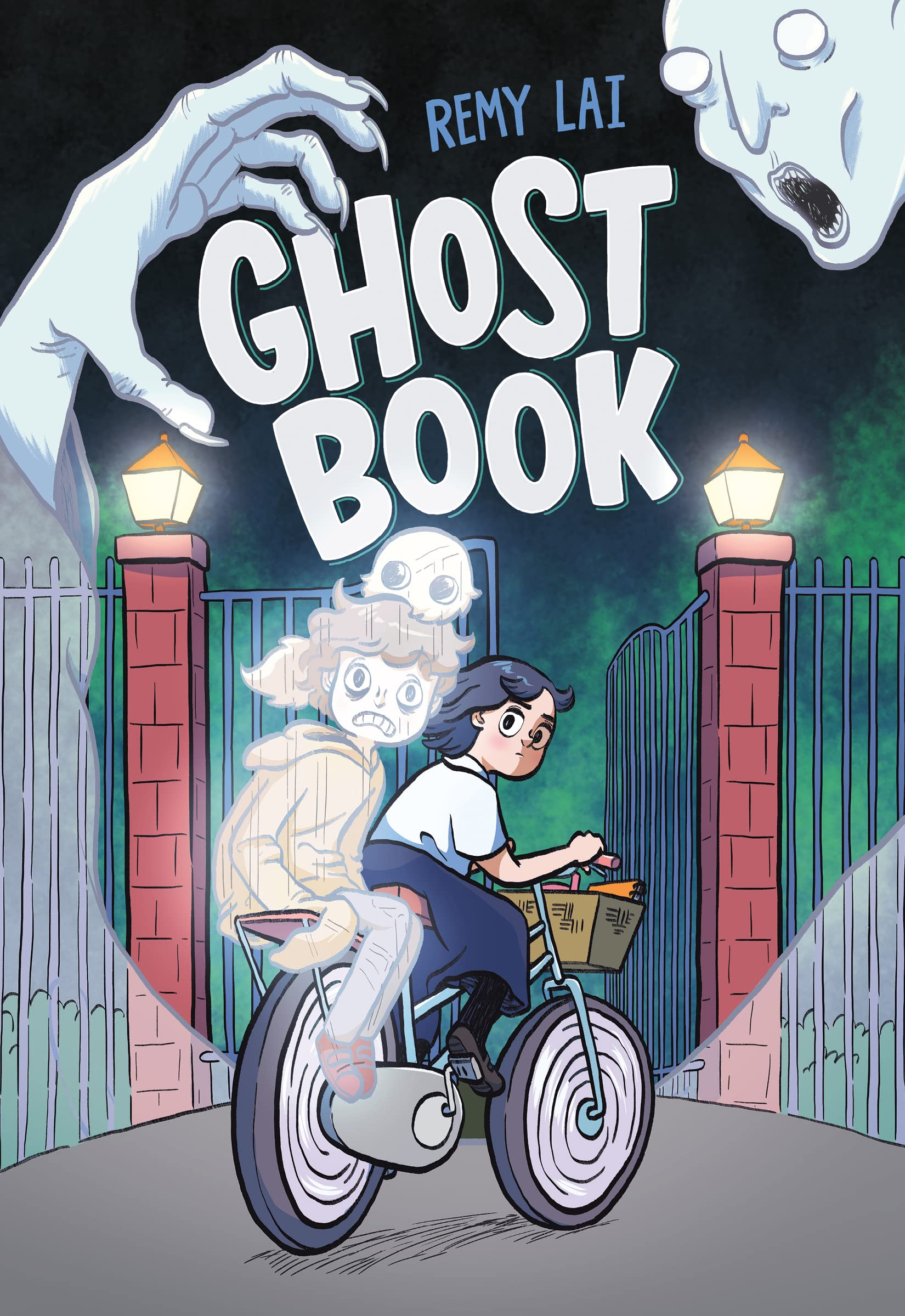
Ghost Book by Remy Lai

Published by Henry Holt

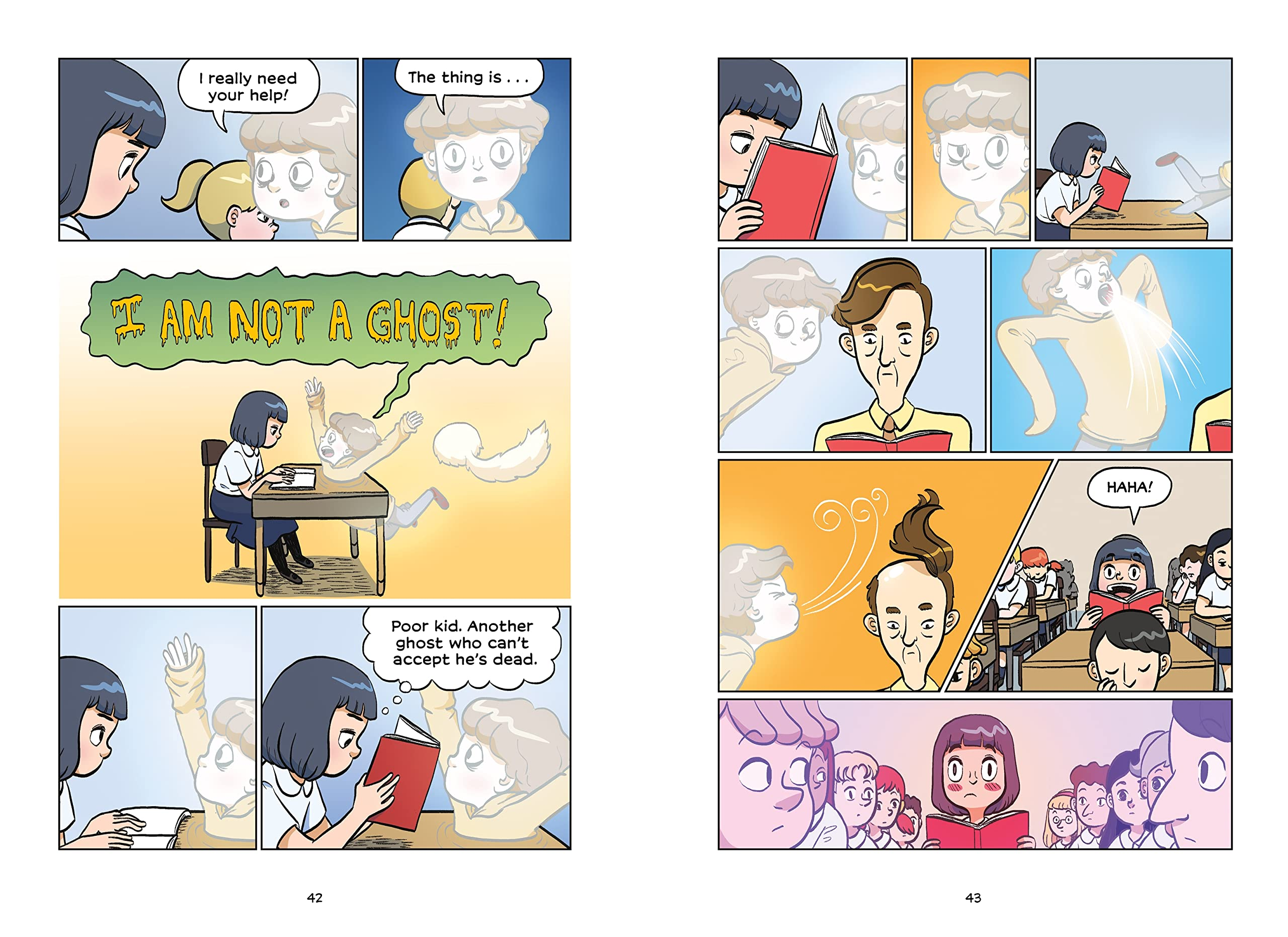
Summary: July has “yin-yang eyes”, meaning that she can see ghosts, but she feels as invisible as a ghost most days.  Her mom died when she was born, her dad is too preoccupied with work to pay much attention to her, and teachers and kids at school often overlook her.  Desperate for a friend, she tries to summon a ghost.  William shows up instead–a boy who is in a coma, and whose spirit is wandering around trying to figure out if he is dead or alive.  As the two kids do some investigating, they discover that they have a life-long connection, and that only one of them is meant to be alive.  Their explorations take them into the underworld, where they hope to change fate so that they can both live.  There, they are pursued by a variety of spirits bent on their destruction, but their friendship saves the day and helps them to figure out a way forward for both of them.  320 pages; grades 3-6.

Pros:  I’m a big fan of Remy Lai’s graphic (and semi-graphic) novels, and her latest one does not disappoint.  Part ghost story, part friendship story, part adventure, this will keep kids turning the pages until the surprising but totally satisfying conclusion.

Cons:  This is a bit darker than Lai’s previous books.

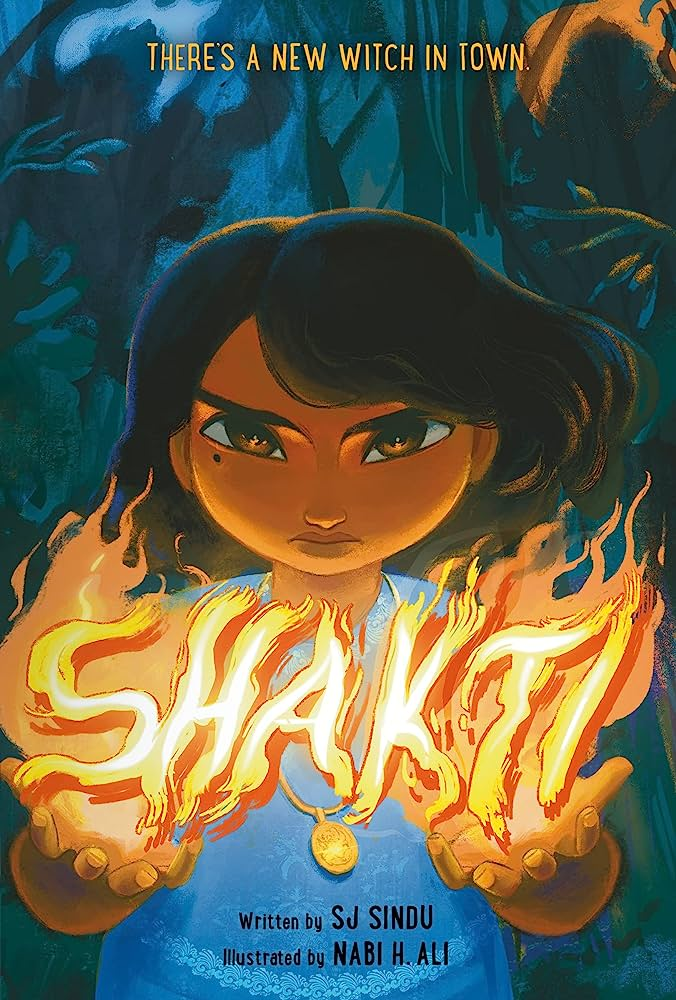
Shakti by SJ Sindu, illustrated by Nabi H. Ali

Published by HarperAlley

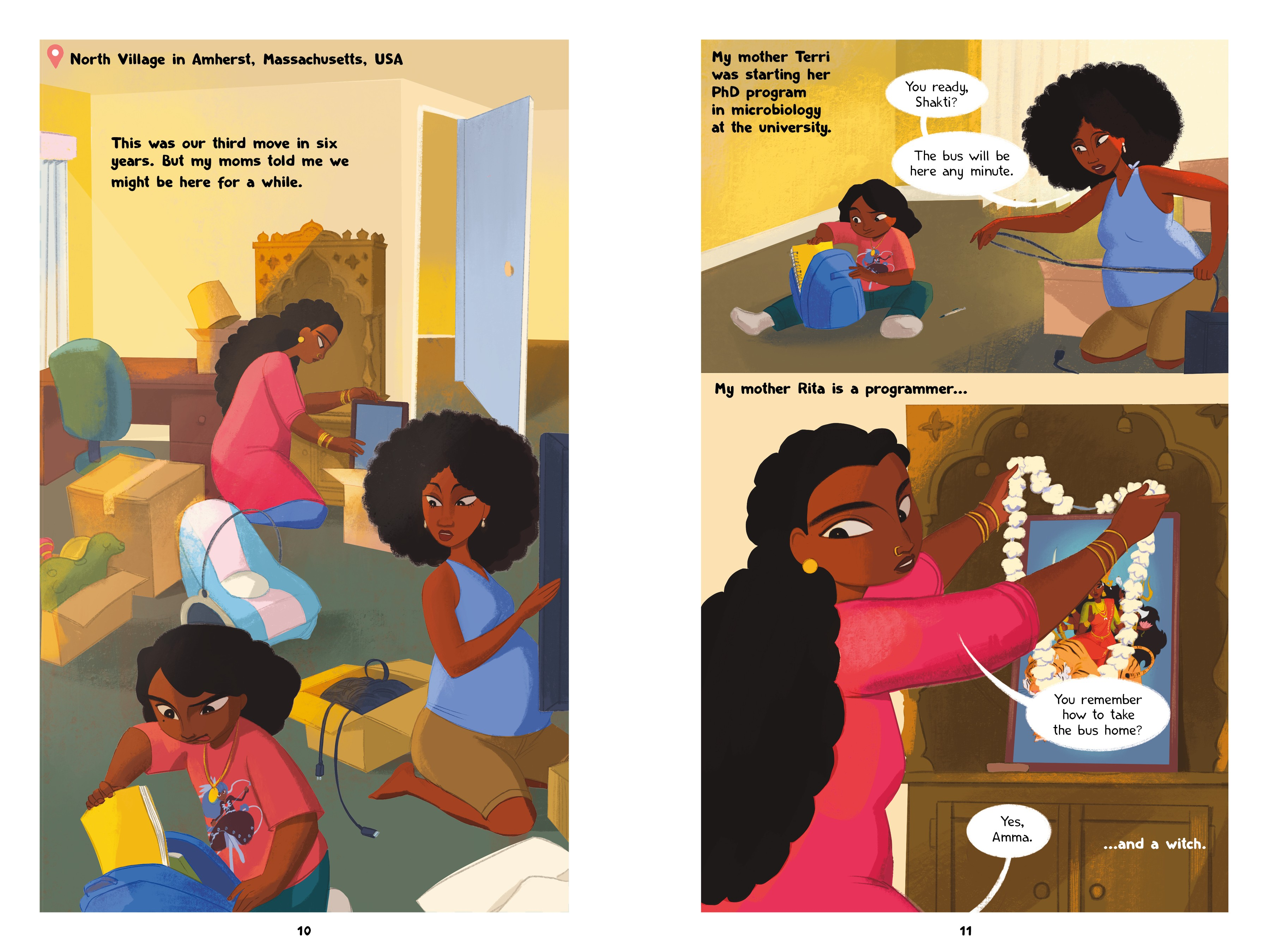
Summary:  Shakti’s family has moved a lot, but her moms promise that the move to Amherst, MA will be the last one for a while.  Her mother Terri is pregnant and working on a PhD at the university, while her other mother Rita is a programmer with a pretty good knowledge of magic.  Shakti has shown an inclination toward magic, but after accidentally burning down the house as a baby, she’s been forbidden from using her powers until she’s older.  Shakti makes some good friends at her new school but discovers that three of the mean girls are practicing witchcraft to bind the school to them, making all the teachers love them while neglecting the rest of the student body.  Determined to break the spell, which threatens to hurt Shakti’s new baby sibling, Shakti and her friends call on the Hindu goddesses Rita has taught her about, unleashing power that they then struggle to contain.  Shakti learns that she has to let go of her anger and focus her powers to save her family, her friends, and her town.  256 pages; grades 4-7.

Pros:  Witchcraft in western Massachusetts?  I knew I had to read this graphic novel as soon as I heard about it, and I thoroughly enjoyed it, from the middle school drama to the concise but detailed introductions to Hindu mythology.  Recommend this to readers looking for something a little more fantasy-oriented than the usual middle school graphic novel.

Cons:  The b-word (represented as b–) is used a few times.

The Remarkable Rescue at Milkweed Meadow by Elaine Dimopoulos, illustrated by Doug Salati

Published by Charlesbridge

Summary:  Butternut is part of a large rabbit family that lives in a burrow in Milkweed Meadow.  The rabbits keep pretty much to themselves, learning storytelling and safety skills from their mother and grandmother.  A chance encounter with a young robin named Piper, however, expands Butternut’s horizons, and she finds herself overcoming her many anxieties to go on adventures with Piper and a young deer named Winsome that they befriend when Winsome breaks her leg in the rabbits’ burrow.  The title’s remarkable rescue involves some orphaned coyote pups, an operation that Butternut advocates for even though they will grow up to become predators, and one that ultimately involves all the animals of the meadow.  Butternut’s newfound courage and sense of connection to other species inspire her mother and grandmother to put aside some of their own fears and to open themselves up to the meadow community.  192 pages; grades 3-6.

Pros:  This beautifully written and illustrated animal story shows the power of storytelling, community, and courage with enough humor to keep the messages light.  It would make an excellent elementary read-aloud or book club selection.

Cons:  I wish there had been more illustrations by Caldecott medalist Doug Salati.

The Eyes and the Impossible by Dave Eggers, illustrated by Shawn Harris

Published by Knopf Books for Young Readers

Summary:  Johannes is a wild dog who lives in a park populated by other animal friends: a brave and loyal seagull, a group of bright raccoons who are proud of their opposable thumbs, a squirrel who sees more with one eye than most animals do with two, and three wise bison.  Johannes can run fast–he estimates that he sometimes surpasses the speed of sound, maybe the speed of light–and he becomes the Eyes of the park, keeping the bison informed about what is going on.  A couple of misadventures including a dognapping and the rescue of a human child bring Johannes to the attention of the park staff, and he begins to fear for his freedom.  To take his mind off of that worry, he begins to formulate a seemingly impossible plan: to free the bison, assisted by a herd of goats that has recently been transported to the island.  All the animals get in on the escape, and all goes off with a minimum of hitches until the crucial moment of boarding the escape boat, when the bison decide they don’t want to be free.  Johannes is invited to escape instead, forcing him to decide between his island family and the chance to start a new life of guaranteed freedom.  256 pages; grades 3-7.

Pros:  I’m not a big animal fantasy reader, but this book has gotten three starred reviews, so I couldn’t ignore it. I forced myself to start reading and was immediately charmed and engaged by Johannes’s voice, which is simultaneously innocent, wise, and funny.  It would be a great choice for an elementary read-aloud or book club, and I certainly hope it will receive some Newbery consideration.  The writing is so, so good, and Shawn Harris’s paintings of Johannes perfectly capture his spirit and island home.

Cons:  I had my fingers crossed that the constantly maligned ducks would have a moment of redemption during the escape, but they remained the butt of all the other animals’ jokes.

Big Tree by Brian Selznick

Published by Scholastic

Summary:  Melvin and Louise are two seeds nestled cozily in a seedpod, secure in the love and wisdom provided by their mother, a giant sycamore tree.  A natural disaster flings them into the world, where they travel over land and sea, meeting all kinds of wise and wonderful creatures.  While their mother sought to give them both roots and wings, imaginative Louise is filled with wonder and hope, while Melvin is bound by his worries and fears.  When the two are separated, Melvin finds himself trapped for many, many years, never forgetting his sister.  Eventually he learns the lessons of the universe that Louise already instinctively knew, and the two meet again in a wondrous reunion.  Includes an afterword that explains some of the scientific references, a bibliography, and an author’s note that tells how the story came to be.  528 pages; grades 3-7.

Pros:  Brian Selznick has created a masterpiece of prose and art in the style of his previous books.  This book was inspired by a movie idea that Steven Spielberg had, looking at the history of the Earth from the perspective of nature itself.  It is a wildly creative and ambitious story that includes dinosaurs, volcanoes, meteors, dinosaurs, mushroom ambassadors, and so much more.  

Cons:  Readers might need some guidance to understand all that is going on during this long period of Earth’s history.  The back matter is a useful guide for this.

The Moth Keeper by K. O’Neill

Published by Random House Graphic

Summary:  Long ago, a community formed in the desert to live their lives at night and keep the Moon Spirit company.  In return, the Spirit gave them a special tree that made their lives easier.  The tree had to be pollinated once a year by Moon-Moths.  Now Anya has become an apprentice Moth Keeper, going out every night into the desert, sometimes with her guardian Yeolen and sometimes alone.  Anya had a tough childhood, seen in flashbacks, and she sometimes fears the dark and longs to spend her days in the daylight.  But when she causes a near-catastrophe with the moths, she realizes the importance of her community and her role in it.  Helped by them, she’s able to correct her mistake and finds new beauty and connection in her nightly work.  272 pages; grades 4-8.

Pros:  The gorgeous illustrations make this fantasy tale one that readers will want to revisit over and over again.  K. O’Neill has created a magical world filled with mystery, beauty, and a tight-knit, loving community.

Cons:  Be sure to spend plenty of time on the wordless pages of the book to fully understand the story. I found myself confused more than once.

Meesh the Bad Demon by Michelle Lam

Published by Knopf Books for Young Readers

Summary:  Meesh struggles with things that come easy for most demons her age, like breathing fire and puking acid, and is often picked on by a bully named Xavier.  She prefers befriending flowers and watching the Princess Nouna TV show with her grandmother.  When a mysterious substance starts turning demons into stone, Meesh realizes it’s up to her to save her community.  She goes off in search of Princess Nouna but is dismayed by the real-life princess when they finally meet.  The two unwittingly wind up going on a series of adventures together, during which Meesh discovers some new powers.  Eventually, they add a couple more kids to their group, including, much to Meesh’s surprise, Xavier.  Working together, the team manages to save the demons, and a surprising twist at the end will have readers eagerly awaiting a sequel.  304 pages; grades 3-7.

Pros:  This manga-style comic is sure to be a big hit, with its gorgeous art, non-stop adventures, creative world-building, and loveable team of misfits that learn to accept each other and work together to do great things.

Cons:  I think this is a “me” problem, but I do struggle in fantasy graphic novels to keep track of the various characters and their worlds.

The Guardian Test (Legends of Lotus Island, book 1) by Christina Soontornvat, illustrated by Kevin Hong

Published by Scholastic

Summary:  Plum has grown up on her grandparents’ small island farm, so when she unexpectedly gets an invitation to attend Guardian Academy, her life changes dramatically.  The Guardians are an elite group of shapeshifters who keep all the islands safe, and Plum joins the other kids who are trying to pass their first test–learning to transform.  With only a month to prepare, Plum is worried that she isn’t progressing as quickly as her classmates and is tempted when she learns that one of the other girls has found a shortcut to passing the test.  But her love of nature and abilities to communicate with animals and plants serve her well and she moves on with most of her classmates in an adventure to be continued when book 2 comes out in July.  160 pages; grades 3-7.

Pros:  Kids not quite ready for Harry Potter will love this Thai-inspired fantasy about a magical school with some pretty intricate world-building.  The short chapters and illustrations keep things moving along, and readers will be eagerly anticipating Plum’s next adventure.

Cons:  The cover gave me a graphic novel vibe; kids might be surprised to discover that this is a chapter book.

Batcat by Meggie Ramm

Published by Harry N. Abrams

Summary:  Batcat is part bat, part cat, and fully annoyed by the ghost that has moved into their treehouse.  They consult a witch about how to get rid of the ghostly invader and get sent on a quest to gather the three ingredients needed for the proper spell.  Along the way, Batcat meets up with some bats and some cats who assure them that they are lacking some of the bat and cat qualities to be either animal.  Batcat gets increasingly despondent about their deficiencies until they meet up with a couple of griffins who assure them that one does not have to be one thing or the other.  After embracing their one-of-a-kind identity, Batcat returns to the witch where they slowly realize that maybe the ghost isn’t so bad after all.  The witch works her magic, and Batcat and the ghost become friends and roomies.  96 pages; grades 2-4.

Pros:  This cute and clever graphic novel has humor, spookiness, and a subtle lesson in self-acceptance that works well with both Batcat’s dual-animal identity and their nonbinary pronouns.  I’m happy to see that this is book 1 and look forward to a sequel soon.

Cons:  I could have enjoyed some how-to-draw-Batcat pages at the end.

Fae and the Moon by Franco Aureliani, illustrated by Catherine Satrun and Sarah Satrun

Published by Yellow Jacket

Summary:  Fae has been alone since her mother mysteriously disappeared, supported only by a bunny friend and a couple of mice.  She dreams about her mom every night and is sure she is still alive somewhere.  Her mother had a strong connection to the moon, and one night Fae decides to remove it to the sky, hoping her mom will notice and return home.  The disappearance of the moon triggers some pretty unsavory animal behavior, and in a series of adventures, Fae learns that not only are a swarm of rats trying to steal the moon from her, but the “bunny” is really a power-hungry monster.  Fae discovers that she has powers of her own and manages to bring about a happy ending for herself and her mother.  Includes four pages showing the creation of the story and illustrations.  144 pages; grades 3-5.

Pros:  Don’t be deceived by the short length of this graphic novel; it’s a pretty elaborate fantasy story that will appeal to a wide range of elementary students.  Readers will be happy with the pretty strong hint at the end that there will be a book 2.

Cons:  No page numbers.