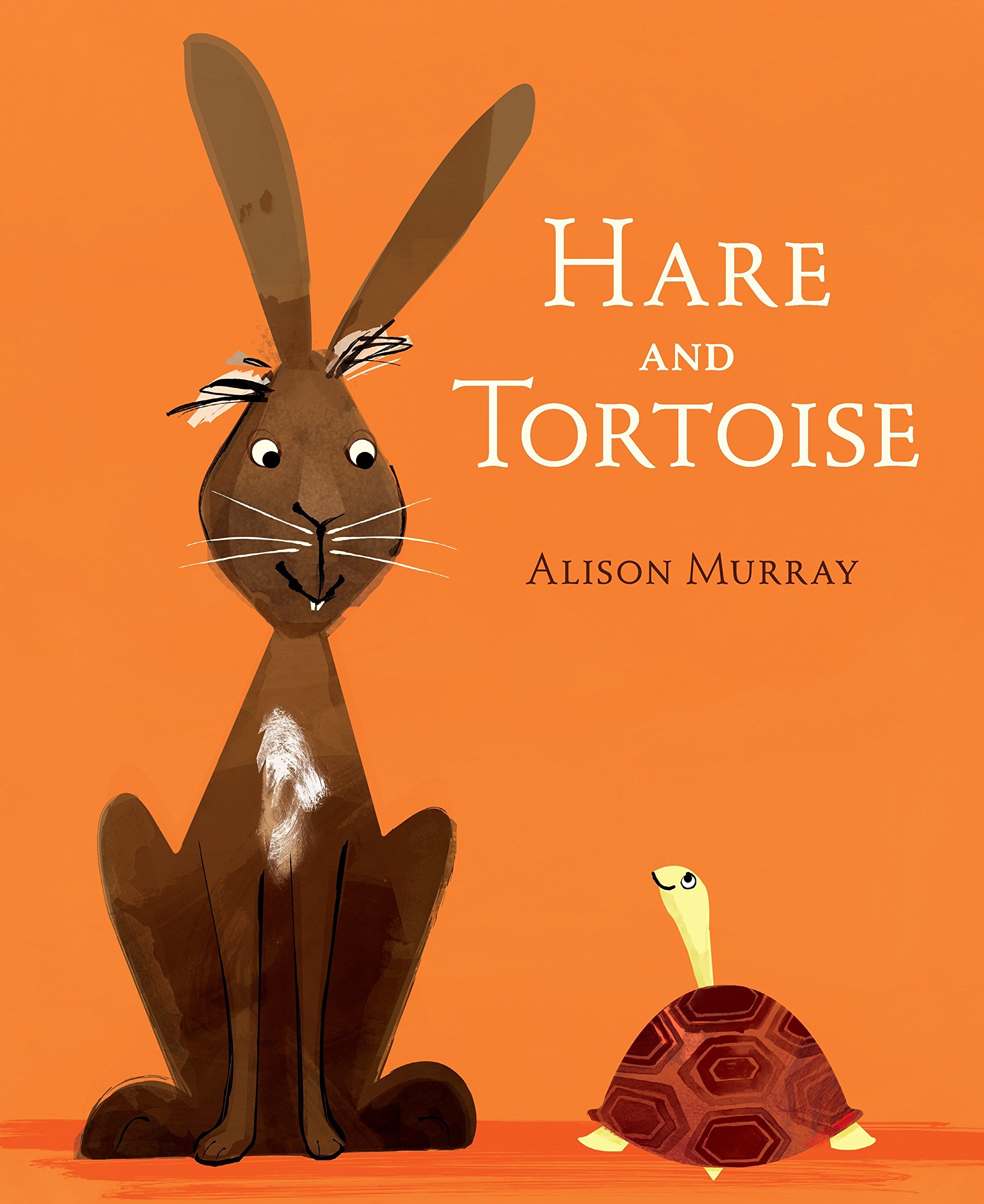
Hare and Tortoise by Alison Murray

Published by Candlewick 

Hare and Tortoise: Murray, Alison, Murray, Alison: 9780763687212:  Amazon.com: Books

Summary:  Hare, a.k.a. Leapus swifticus, and Tortoise (Slow and steadicus) will be racing today.  A brief intro is given to each race participant:  Hare can hardly stand still for his, while Tortoise almost doesn’t show up for hers.  Then the race is on.  The tale is familiar—Hare leaps to the lead while Tortoise plods along far behind until Hare is tempted to eat some carrots and take a nap, certain of victory.  While he snoozes, Tortoise manages to amble across the finish line.  Hare can’t believe it, but Tortoise is a gracious winner.  “Never mind, Hare, you just might win next time.”  32 pages; ages 3-7.

Pros:  Beautiful illustrations provide plenty of action and humor to this fast-paced and funny retelling of Aesop’s fable.

Con:  While “slow and steady” is alluded to, readers will need to infer a good deal to come up with the classic moral to this tale.

Hansel & Gretel by Holly Hobbie

Published by Little, Brown

Summary:  Holly Hobbie (yes, children of the 1970’s, that Holly Hobbie) stays close to the original version of this tale.  In an author’s note, she explains how she grew up listening to a recording of the Great Gildersleeve reading the story and imagined pictures to go with it.  Her illustrations portray blonde Germanic-looking children, a pointy-nosed-and- chinned witch, and a classic gingerbread cottage.  Shadows loom in many of the illustrations until the final page when the children and their father are reunited.  32 pages; ages 3-6.

Pros:  The watercolor illustrations are beautiful and will make this classic fairy tale accessible to a new generation.

Cons:  Some of the details of the fairy tale were left out; I always liked how Hansel tricked the witch into thinking a chicken bone was his finger, but that was excluded from this retelling.


Orpheus in the Underworld by Yvan Pommaux

Published by Toon Books

Summary: Orpheus was the son of the king of Thrace and Calliope, muse of epic poetry. With that gene pool, it came as no surprise that he turned out to be not only musically gifted but pretty good looking as well.  Before long, he fell in love with Eurydice, and the two of them got married.  On their wedding day, Eurydice was bitten by a snake and died.  Overcome with grief, Orpheus tried to rescue her from the underworld.  He was allowed to take her, under the condition that he couldn’t look back.  Of course, right at the last possible moment, he couldn’t help himself, and checked to make sure she was behind him.  She vanished forever, and Orpheus went around singing songs about Eurydice until he was torn apart by jealous women.  (I’m not making this up).  Grades 4-8.

Pros:  The story is compellingly told, particularly the trip to the underworld.  The text is part regular book and part comic; the accompanying illustrations are beautiful.

Cons:  Mythology and comic art is a tricky combination, and some of the comic dialogue seems a bit forced (Orpheus: I couldn’t help myself, I needed to see you again.  Eurydice: I’m glad you left your lyre this time.  Your voice is music enough to my ears.).  Ick.

Hiawatha and the Peacemaker by Robbie Robertson, illustrated by David Shannon

Published by Abrams Books for Young Readers 

Hiawatha and the Peacemaker: Robertson, Robbie, Shannon, David:  9781419712203: Amazon.com: Books

Summary:  Rock and Roll Hall-of-Famer Robbie Robertson teams up with Caldecott honor winner David Shannon to tell the story of how the Six Nations Iroquois Confederacy was formed.  On page one, Hiawatha’s entire family has been killed, and his village burned to the ground.  In the midst of his despair, the Peacemaker approaches him, paddling a mysterious stone canoe, and invites Hiawatha to join him on a mission of peace.  The Peacemaker brings a message of forgiveness and peace to the Iroquois nations, but his voice is soft and he speaks with a stutter.  He needs Hiawatha’s powerful speaking abilities to convince the nations to stop their fighting.  Finally, everyone has joined together except the Mohawk, led by the evil Chief Tadodaho.  Tadodaho is the one responsible for the destruction of Hiawatha’s village.  Hiawatha must look deep within himself to find the forgiveness that is the only way to bring peace to the entire Iroquois nation.  Includes an historical note that tells the history behind this story and an author’s note that adds the personal tale of how Robertson came to write this book.  Grades 3-8.

Pros:  David Shannon’s beautiful paintings illustrate this fascinating blend of history, folklore, and mythology.  Take some time to appreciate the details of the story which has timely messages about peace and forgiveness.

Cons:  I found the story confusing until I read the historical note.  Some sources recommend this book for ages 4-8, but I don’t think audiences much younger than ten would fully appreciate it.

The Grasshopper and the Ants by Jerry Pinkney

Published by Little, Brown Books for Young Readers

Summary:  Why do those ants work so hard?  The Grasshopper can’t understand it, and urges them to enjoy the spring, summer, and fall.  He’s a musician, traveling around with his banjo in his hands and a drum set on his back.  When winter comes, though, he’s out in the cold while the ants enjoy the cozy home they have made.  Finally, the Queen Ant ventures out into the snow to invite him in for a cup of tea.  A gracious guest, the Grasshopper repays her kindness by providing all the ants with music for a cold winter’s night.

Pros:  Jerry Pinkney doesn’t disappoint with another gorgeously illustrated fable that could be a Caldecott contender.  The story is simple, but the pictures are filled with details all rendered in beautiful watercolors. Kids will pore over all the activities in the ants’ winter home.

Cons:  Maybe it is the subject matter (grasshopper versus lion), but for me, this book is a notch below The Lion and the Mouse.