Lights, Camera, Middle School (Babymouse: Tales from the Locker) by Jennifer L. Holm, illustrated by Matthew Holm

Published by Random House

Summary:  Our little girl is growing up:  Babymouse has started middle school, and she finds some of the universal difficulties: bad cafeteria food, mean girls, and difficulties managing her curly whiskers.  Things start to look up, though, when she joins the Film Club and is chosen to direct the club’s first movie.  Backed by a remarkably supportive group of friends, Babymouse dives into the process with her usual enthusiasm, extracting herself from one embarrassing situation after another.  The final screening is an unexpected hit with the middle school crowd, but when Babymouse is introduced as the director, she trips over her new dress and falls on her face as she tries to get onstage.  Typical.  Much of this new series is a regular chapter book, but there are plenty of illustrations, as well as occasional comics.  208 pages; grades 2-6.

Pros:  Babymouse fans will cheer at the advent of a new series, and the format will allow readers to move up a notch from the graphic novels.

Cons:  Librarians will have a tough time deciding whether to shelve this with graphic novels or regular fiction.

Wordplay by Ivan Brunetti

Published by TOON Books

Summary:  What’s a compound word?  When a class of kids gets assigned the task of making a list of compound words for homework (hey, there’s one), imaginations start going wild.  Annemarie (whose name is a compound word!) pictures a couple of houses doing construction work when she hears the word “homework”.  “Mailman” conjures up a picture of a letter delivering the mail, and “football” is accompanied by an image of a boy tossing a foot.  The fun continues when Annemarie goes home and asks her parents for more suggestions.  Finally, it’s bedtime (!), but the next morning she’s still going strong, and can barely tear herself away from the list to turn it in to her teacher.  Then, it’s time for one more compound word…goodbye!  40 pages; ages 4-8.

Pros:  An appealing cartoon introduction to compound words that will have kids creating lists of their own.  The compound words are half red and half black to make them easy to identify.

Cons:  I was hoping there were more language arts books by TOON, but this seems to be the only one.

Hans Christian Andersen’s The Little Mermaid by Metaphrog

Published by Papercutz

Summary:  The littlest mermaid longs to see the world above her ocean home, but she must wait until she’s 15.  One by one her older sisters get to go explore, returning with stories of gorgeous sunsets and great floating icebergs.  Finally, her big day arrives.  Reaching the surface, she sees a ship and watches a handsome prince dance with a succession of beautiful women.  A sudden storm sinks the ship, and the little mermaid rescues the prince, the slips away before he regains consciousness.  More than anything, she wants to be human and to marry him.  She makes a deal with a sea witch, trading in her tail for legs, even though she is in great pain with every step.  In return, she gives up her voice.  She gets her wish to meet the prince, and they become great friends.  But, alas,  he eventually falls in love with another woman, leading to the typical Hans Christian Andersen downer of an ending.  80 pages; grades 3-7.

Pros:  A lyrical, haunting retelling in graphic novel form of one of Andersen’s most famous tales.

Cons:  Disney fans may be dismayed by the ending.

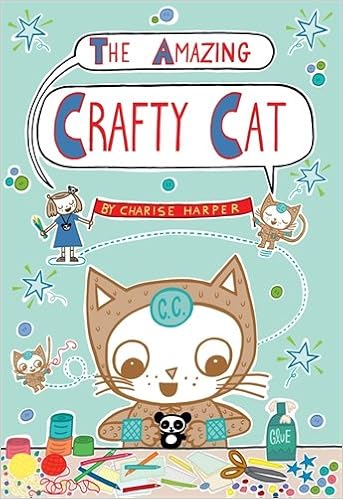
The Amazing Crafty Cat by Charise Mericle Harper

Published by First Second
Summary:  Birdie is an imaginative girl with the alter ego of Crafty Cat, a confident cat who is an amazing crafter and uses her crafts for good.  When Birdie drops her panda cupcakes on the way to school, they are ruined and she has nothing to offer for her classroom birthday celebration.  A call home for more treats is unsuccessful, and Birdie must use her own creativity to find a solution.  Crafty Cat saves the day, with a Panda Pals craft that the whole class loves.  Anya, the mean girl, gets her comeuppance, and Birdie declares it “a great birthday”.  A 10-page section at the end includes directions for four panda crafts and panda cupcakes.  128 pages; grades 1-4.

Pros:  Lots of fun for early graphic novel fans.  Birdie is a strong, resourceful, and funny protagonist, and the extensive crafting directions are an added bonus.

Cons:  The color palette is a little blah.

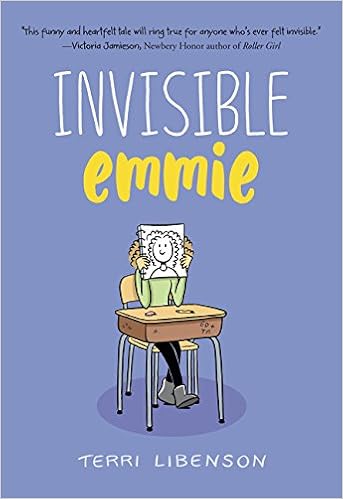
  Invisible Emmie by Terri Libenson


Published by Balzer + Bray

Summary:  Middle school is always difficult for quiet, shy Emmie, who only speaks to her best friend Brianna, walks through the halls with her head down, and hides by drawing whenever she can.  But one day stands out as particularly horrible.  At lunch, she and Brianna amuse themselves by writing over-the-top love notes to their crushes.  Emmie accidentally drops hers, and it’s discovered by insufferable class clown Joe.  He proceeds to tease and torture her for the rest of the afternoon, until Emmie feels like she has been reduced to a puddle of slime.  Interspersed with her story is a comic tale of Katie, a classmate who is pretty, popular, smart, and confident.  The two girls connect in a surprising way late in the day, and Emmie has a good last class that bodes well for the rest of her seventh grade year.  192 pages; grades 4-7.

Pros:  This graphic novel-chapter book hybrid will appeal to fans of Wimpy Kid type books as well as graphic novels Raina Telgemeier, Jennifer Holm, and Victoria Jamieson.

Cons:  There were a few references (like Emmie referring to herself as an “oops baby”) that might raise an eyebrow for parents and/or teachers of younger readers.

Recess Warriors: Hero Is a Four-Letter Word by Marcus Emerson

Published by Roaring Brook Press

Summary:  Bryce and his partners Yoshi and Clinton battle zombies, cooties, and pirates during their recess time on the school playground.  The first few pages show a map of the various yards at the school and portraits of the main characters.  Different characters control different yards.  In the first part of the book, the heroes battle a cooties outbreak that causes kids to turn into zombies.  They finally get that taken care of, then the action shifts to a pirate ship where Bryce and Clinton are held captive.  When the pirate captain reveals herself, though, she also discloses that she was responsible for the cooties outbreak.  There’s a climactic battle which results in a shift in leadership and opens the way for book 2.  144 pages; grades 2-5.

Pros:  Fans of Bone, Amulet, and Doug TenNapel graphic novels will enjoy this new action adventure series in a world populated only by kids.

Cons:  I found the line between what was real and what was in the kids’ imaginations a little confusing, especially in the zombie sequence.


Real Friends by Shannon Hale, illustrated by LeUyen Pham

Published by First Second

Summary:  Shannon Hale recounts her elementary school days, starting with her first friend, Adrienne, whom she met in kindergarten.  Shannon loved creating imaginary games, and Adrienne was an enthusiastic participant.  Adrienne’s family moved away for a year.  When they returned to the neighborhood, things had changed.  Adrienne befriended second-grade ringleader Jen, and Shannon found herself on the outer fringes of the clique, desperately trying secure her position.  Things were pretty rough at home, too, being stuck in the middle of five children and often bullied by a troubled older sister.  Finally, in fifth grade, Shannon declared her independence from the clique and learned to make her own good friends.  Much to her surprise, Jen admired her independence and became a friend as well.  In an author’s note, Shannon Hale tells more about her childhood, and her class pictures from elementary school are included at the end as well.  224 pages; grades 3-6.

Pros:  Brought to you by the creators of the Princess in Black series, this heartfelt memoir with its message of being yourself will be a hit with fans of Smile, El Deafo, and Roller Girl.

Cons:  Shannon’s life got pretty depressing about halfway through the book.  (Don’t worry, it all turns around for a happy ending.)

Fish Girl by Donna Jo Napoli and David Wiesner, pictures by David Wiesner

Published by Clarion Books

Summary:  Neptune welcomes you to Ocean Wonders, a three-story building that houses a giant aquarium.  Along with the octopus, shark, and fish, there lives a mermaid whom you just might catch a glimpse of if you are patient.  After hours, Neptune tells the fish girl the story of how he rescued her when fishermen and sharks killed off all the other mermaids.  Now he protects her, and in return she hides among the sea flora and fauna, revealing just enough of herself to lure humans into Ocean Wonders.  One day, though, she makes a connection with a girl her own age, who names the fish girl Mira.  The two become friends, and Mira’s world begins to change.  She learns that Neptune is really just an ex-fisherman, who creates his “magic” world with machines.  One night she manages to leave the tank, and learns that her tail becomes legs on dry land of water.  Mira sees her chance to escape, but will she be able to leave behind the aquarium world she has known all her life?  192 pages; grades 5-8.

Pros:  Triple Caldecott medalist David Wiesner creates a fairy-tale world reminiscent of his book Flotsam.  Middle school readers will relate to Mira’s struggle to figure out who she is and where her place in the world is.

Cons:  The relationship between Neptune and Mira borders on creepy.

One Trick Pony by Nathan Hale

Published by Amulet Books

Summary:  Nathan Hale takes a break from his Hazardous Tales graphic novels (relax, he has a new one coming out in November) to create a futuristic science fiction story.  Much of Earth has been destroyed, and a small band of humans is trying to preserve what’s left of its culture and history.  They live in a caravan that has to constantly move to avoid the alien Pipers that travel in bubbles and devour any technology they can find.  At the beginning of the story, Strata, Auger, and Inby discover a cave filled with robots, including a robotic horse.  Activating the robots attracts the Pipers, and the three kids barely escape on the horse.  Their adventures have just begun as they struggle to return home, pursued by the aliens.  Meanwhile, the caravan has gotten wind of the new Piper activity.  There is a push to move on, but the parents of the three missing children don’t want to leave without them.  There are encounters with other groups of humans living in more primitive societies, and a final showdown when the aliens capture Strata and her horse.  The action comes to a quick finish, indicating that this is most likely a stand-alone story rather than the first of a series.  128 pages; grades 3-7.

Pros:  Hale’s fans won’t be disappointed with this exciting adventure told with his trademark illustrations.  There is enough action to keep a 13-year-old engaged, yet it is mild enough to be appropriate for an 8-year-old.

Cons:  The defeat of the aliens seemed way too easy, and the ending was a little too pat.

NewsPrints by Ru Xu

Published by Graphix

Summary:  Blue is an orphan who lives at a newspaper office and works as a newsboy…except that she’s really a girl in disguise.  Her country is at war, and only boys are supposed to sell the important newspapers that tell the people what’s going on.  Besides having to keep such a big secret, Blue is happy, enjoying her work and the people she lives for.  Then she meets Jack, a mysterious inventor, and Crow, an even more mysterious boy.  As she slowly learns their secrets, she starts to suspect that the people in her life aren’t always being truthful, and she can’t believe everything she reads in the paper.  By the end of the story, she is ready to reveal the truth about herself and to prepare to take a potentially dangerous trip to help her new friends.  208 pages; grades 4-7.

Pros:  Graphic novel fans will love the latest entry from Scholastic’s popular Graphix imprint.  Blue’s world is filled with intrigue, fascinating characters, and dozens of fairy tale references.  The art will draw readers in; by the end, they will be eagerly anticipating the next installment.

Cons:  There were a lot of characters and storylines to keep track of.