Two books for Ramadan

Almost Sunset by Wahab Algarmi (HarperAlley, 224 pages, grades 4-7). Hassan is fasting for Ramadan in this graphic novel, and, although it’s his third year doing so, this year seems harder than before. He’s going to the mosque for nightly prayers with his father for the first time, and there’s not as much community support as there was when his family was back in Yemen. Not only is Hassan falling asleep in math class, but he’s not performing up to par on the soccer field, getting shown up by teammate and frenemy Rosie. Everywhere he goes, Hassan sees delicious food, and when some cousins talk him into sneaking off for snacks, he’s wracked with guilt. When Hassan finally tells his soccer coach why his performance is off and he’s leaving practices early, he’s happily surprised to learn that Coach is also observing Ramadan with his own fast. Finally, Eid arrives, and Hassan is rewarded for his determination with a joyous celebration that include friends and family who help him to acknowledge his perseverance and to forgive himself for mistakes.

Muslim kids observing Ramadan will relate to Hassan’s struggles and hopefully learn to open up to those around them about what is going on with them for the month; non-Muslims will learn more about Ramadan and how to support their friends. The artwork is excellent, with lots of wordless pages that move the story along at a good clip, and some funny pictures of Hassan imagining food in all kinds of contexts.

The Gift of Eid by Shifa Saltagi Safadi, illustrated by Aaliya Jaleel (Holiday House, 40 pages, ages 4-8). Yasmine and Mama are shopping in Damascus’s Souq Al-Hamidiyeh. They’re both grieving the recent death of Yasmine’s dad, and Yasmine wishes she could find the perfect Eid gift to bring a smile to Mama’s face. When she sees a sign offering money for jewelry, she sells the chain she’s wearing around her neck. At the Masjid Al-Umawi mosque, Mama and Yasmine meet up again for prayers. At the end, they agree to exchange early Eid gifts, but when Yasmine gives Mama the beautiful box she’s bought for Mama to keep her bracelet in, Mama starts to laugh. She sold the bracelet to buy Yasmine a charm to put on her gold chain. They realize that their love for each other is the greatest gift they can give, and head for home with a charm but no chain, a box but no bracelet, and “all the love we need.” Includes an author’s note about how her childhood in Syria inspired this story.

Based on the O. Henry story The Gift of the Magi, this sweet story introduces readers to daily life in Syria, beautifully portrayed in the illustrations. It’s also a tale of grief and healing, as Yasmine and Mama look for ways to help each other through a difficult time.

A collection of mysteries and the mystery of collections

Casey’s Cases by Kay Healy (Neal Porter Books, 160 pages, grades 2-5). Fifth grader Casey aspires to be a detective, and sees a mystery in almost every situation. Who is the new girl? Where is her missing hair band? What did her crush write in his notebook? Who is the owner of the lost cat she found? Some mysteries are solved in a few minutes (the hair band), while others take the whole book to solve (the new girl, Jan, who becomes Casey’s best friend), and some have surprise twists (the stray cat, whose growing belly turns out not to be from eating too much tuna). Here’s hoping that Casey and Jan will team up for another book of mysteries.

The humor, simple story line, and short chapters will make this an appealing choice for beginning and/or reluctant readers, who may also enjoy copying the drawings that employ basic shapes, such as the triangle-headed Casey.

Monti and Leo: A Mystery in Pocketville by Sylvie Kantorovitz (Walker Books, 80 pages, grades 1-4). Monti and Leo enjoy looking at Mrs. Sheep’s collection of small figurines on display at the local library. In fact, Monti is so enchanted with one item in the collection that he’s a prime suspect when it disappears. Leo wrestles with his feelings that Monti might have wanted it enough to take it, but ultimately he believes in his friend’s innocence and sets out to solve the mystery. When he starts hearing about other missing items around town, he discovers a bird he’s never seen before flying overhead with an item in her beak. Leo runs after the bird, climbs a huge tree, and discovers all the missing treasures–including the figurine–in the bird’s nest. In the final chapter, Monti thanks his friend and reveals his new collection: containers, each one holding a mini collection of different small items.

This is book two of a series I missed last year (thank you, Walker Books for sending me a review copy). The animal cast will appeal to fans of Mr. Wolf’s Class, and it would make a good book for those just starting with chapter books. I’m always fascinated by animal stories in which some of the animals act like humans and others are more like animals (like how Marc Brown’s Arthur has a pet dog), so I was intrigued by the fact that one crow was living in a nest acting bird-like, while another one was the local librarian.

A Pocket Full of Rocks by Kristin Mahoney, illustrated by E. B. Goodale (Knopf Books for Young Readers, 40 pages, ages 3-8). Mom may say a pocket full of rocks will make your coat dirty, Dad might ask where your other mitten will go, and your sister will dismiss them as ordinary, but you know those rocks will make excellent chairs for fairies, or let you write on the sidewalk if you don’t have chalk. There are other collections to fill your pockets as the year goes on: petals in the spring, seashells in the winter, and acorns in the fall. Each object fires up your imagination, and at the end of the year, you can use them for presents: a bowl of shells for Dad’s dresser, tiny pictures on the acorns for your sister, and a bag of petals for Mom to put in the drawer with her sweaters. And a pocket full of rocks for you to make sleds for the fairies.

Wow, this book really took me back, as my older daughter–soon to turn 30–was a collector just like the narrator. I don’t remember flower petals, but our house had plenty of rocks, shells, and acorns, with imaginative stories about each collection. This would be a lovely book to begin a conversation about collecting, seasons, or making crafts from your imagination, with illustrations that beautifully capture each season.

Graphic novels with a STEAM theme

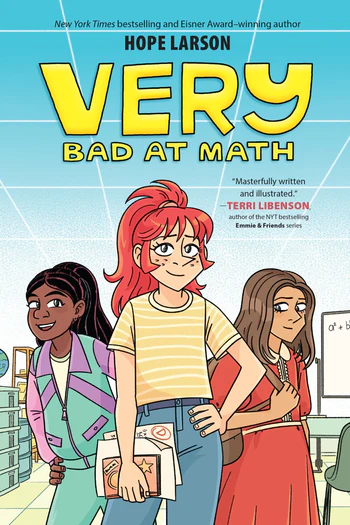
Very Bad at Math by Hope Larson (HarperAlley, 240 pages, grades 4-8). Verity “Very” Nelson is an athlete, musician, popular eighth-grade class president, and ace student…except when it comes to math, which she is failing miserably. When she’s told she has to bring up her math grade to stay on student council, Very starts working with a tutor. Despite her hard work, her progress is slow, and when Very makes a costly mistake at a class fundraiser, her tutor realizes she’s transposed two numbers and diagnoses her with dyscalculia. He starts to work with her on learning strategies to help her with this disability, and by the end of the book, Very’s back on top and on her way to being successful at math. But Very is something of an activist, and she’s determined to make school a better, more just place for students with disabilities, and the last few pages show her talking to her favorite local politician about ideas she has to do just that.

I’m always happy to see a new graphic novel by Hope Larson, especially one for elementary readers, since most of her books are for young adults. This one is sure to be popular with both elementary and middle school, particularly those who are dealing with some sort of learning issue. Very is resilient and persistent in her efforts, but she also has to learn how to deal with setbacks and not making progress even with hard work. I hope we’ll see a second book to find out how she brings her fight for justice to her school.

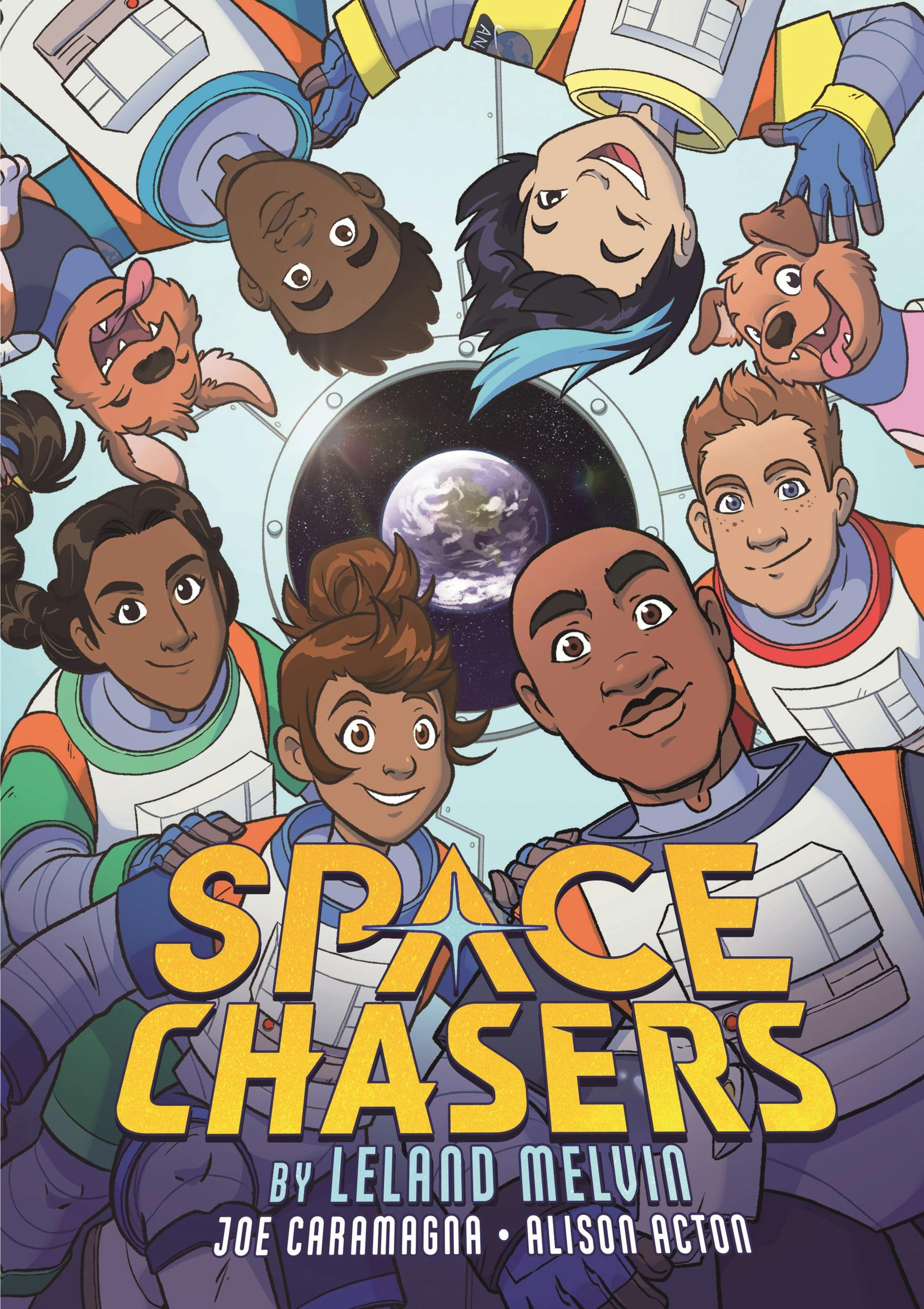
Space Chasers by Leland Melvin and Joe Caramagna, illustrated by Alison Acton (First Second, 240 pages, grades 3-7). Five middle school students are chosen to be part of NASA’s new STEAM team program, undergoing rigorous training to prepare them for a mission into space. When that mission goes awry, three of the kids wind up on a space station with no adult supervision and must figure out what to do to save the mission…and themselves. Each of the participants brings unique skills to the program but also their own insecurities that sometimes get in the way of solving problems, particularly under pressure. When everyone’s safely back on Earth, the powers-that-be deem the program too dangerous, but the kids manage to convince them otherwise, opening the door for book 2. Includes some work-in-progress art and an author’s note.

Former astronaut Leland Melvin has written a fun space adventure with five endearing kids who get the opportunity of a lifetime. I haven’t been so nervous about the outcome of a space adventure since I watched Apollo 13, which made it hard for me to put the book down. I’ll admit it took some suspension of disbelief to believe that NASA would send middle school kids into space, but heck, if you had told me a few months ago that a 19-year-old nicknamed “Big Balls” would be a senior advisor at the State Department, I would have been pretty skeptical of that as well.

Cutting hair and a mixed-up pair

The Snips: A Bad Buzz Day by Raúl the Third, inked by Elenora Bruni and Elaine Bay (Little, Brown Ink, 128 pages, grades 2-5). The Snips are a superhero quintet from Scissors City, who not only give the best haircuts, but also use their powers to create such technology as barber-pole jet packs and and drone barber bots. When the Bad Buzz Boys come to town, threatening to destroy one of the Snips’s record for most haircuts given in one day, our heroes spring into action to save the day. The Bad Buzz Boys are racing through town, randomly giving terrible haircuts, and the Snips are able to not only stop them, but to repair the damage and to remind everyone that working together and valuing community are much more important than setting records. Includes additional information about barber poles, the real-life record holder for haircuts given in a day, and directions for drawing one of the Snips.

Those familiar with Raúl the Third’s zany, high-energy comic art will be thrilled to hear that he has a new graphic novel, which appears to be a series opener. Dog Man fans will enjoy a new set of superheroes, and those that speak Spanish–or aspire to learn–will find plenty of it (with translations) interspersed throughout the text.

Operation: Cover-Up by Tate Godwin (Andrews McMeel Publishing, 192 pages, grades 3-6). New Leaf Elementary has two new kids in the fifth grade: Sy always has a joke to tell, while Nick enjoys sharing his wealth of knowledge and advanced vocabulary. A series of mishaps results in Sy being seen as the braniac and Nick getting the label of class clown. Both try to be who they think their classmates want them to be, and when they meet and realize what’s happened, they decide to help each other keep the cover-up going. A new friend named Violet, who’s a secret comic artist, helps them see the importance of being themselves, and a school talent show allows all three to share their real talents with the rest of their classmates. A sequel, Operation: Make a Splash is promised on the last page.

Share this fun and clever graphic novel with fans of Mr. Wolf’s Class. Readers are sure to get a laugh from Sy and Nick’s mishaps and subsequent bumbling efforts to cover up the truth about themselves and will learn a good lesson or two about being true to yourself.

Struggles at school

Mixed-Up by Kami Garcia, illustrated by Brittney Williams (First Second, 208 pages, grades 3-7). Stella is excited to start fifth grade, but her excitement turns to panic as the homework starts to pile up and she falls further and further behind. She and her two best friends often play a favorite video game, but when a new manual comes out, Stella feels alienated when she can’t keep up with her friends’ reading. And to add to her worries, the big fifth grade project isn’t the art project she was hoping for, but one that features students’ writing. When Stella’s teacher calls home, she’s sure she’s in trouble, but it turns out that the adults in her life want to help. Once she’s gotten a dyslexia diagnosis, Stella’s able to work with special education teachers to develop new skills to help with her reading. This also takes away her shame at feeling like she’s not as smart as everyone else, leading to an honest conversation with her friends that helps them resolve their issues. And Stella’s understanding teacher lets her create a graphic novel for the writing project that allows Stella’s artistic talents to shine.

Speechless by Aron Nels Steinke (Graphix, 256 pages, grades 3-7). Mira’s determined that middle school will be a fresh start for her, but on the first day, she finds that, once again, she can’t bring herself to talk at school. Home is a different story, the place where she can be herself and pursue her passion of stop-motion photography. But this haven is taken away when former-friend-turned-mean girl Chloe comes for an extended stay. A phone call from school alerts Mira’s parents to her selective mutism, and she begins to work on her issues with an understanding therapist. A kind and patient new friend, Alex, also helps her by volunteering to be Mira’s partner with a project and defending her from bullies. Mira learns to take things one step at a time, communicating with notes and whispers. She even finds a way to reach out to Chloe (by letter), opening the way for them to resolve their differences. By the end of the story, Mira’s enjoying sixth grade, learning to succeed in her own way. Includes a note from the author (creator of the Mr. Wolf’s Class series) about his own struggles with social anxiety and difficulties talking in public.

These graphic novels offer stories that will both empower kids who may be dealing with learning differences like Stella’s or social anxieties like Mira’s, and create empathy in kids who may have classmates like them. I loved how the girls got help and support both at school and home but ultimately had to find their own ways. Each was able to discover her own talents and see her struggles as something she could overcome while staying true to herself.

\

Gabby and Abby

Gabby Torres Gets a Billion Followers by Angela Dominguez (Roaring Brook Press, 160 pages, grades 2-5). Gabby is an enthusiastic member of the Sea Musketeers, a club dedicated to preserving the oceans. At 9 years old, Gabby’s the youngest member, and she sometimes feels insecure at the meetings. When she suggests starting a social media account for the group, she’s surprised that everyone not only reacts positively but puts her in charge. At home, her parents tell her she can only go online when they’re supervising, and Mom helps her get the Sea Musketeers’ account up and running. But Gabby can’t help sneaking a peek a few days later to find out how things are going. While she’s delighted to find 100 followers, she’s also dismayed when she sees a comment saying that the club is stupid. Gabby immediately goes into detective mode, and no one is safe from her suspicions, not even her two best friends. When her parents start to receive irate phone calls, the truth comes out, and Gabby is relieved of her social media position and grounded for a week. She realizes that she needs to make amends with her friends, using one of her other budding talents–cookie baking–to do so, and at the next club meeting, she discovers a more age-appropriate way to contribute.

This is a cute series opener by the author of the Stella Diaz books (Stella, now a middle schooler, is the co-president of the Sea Musketeers.) I’m always happy to see a protagonist who’s still in elementary school, and Gabby has the enthusiasms and makes the mistakes that many a fourth-grader will relate to. The social media storyline got a little preachy, and also, what kid uses the term “social media”? I feel like the club would have decided to start an Instagram or TikTok account, or some fictional equivalent.

Chickenpox by Remy Lai (Henry Holt and Co., 240 pages, grades 3-7). Abby Lai is the oldest of five children, and at 12 years old she resents often being call on to supervise the younger kids. When all five get chickenpox at the same time, she knows she’s in for a rough couple of weeks. Compounding her worries are the difficulties she’s having with her two best friends and another friend who’s a boy and maybe a bit of a crush. As the itchy days go by, Abby has her share of frustrating moments, but she and her siblings also manage to have some fun, such as playing a game called Ghost that their mother has forbidden and starting a comic book lending library. When their youngest brother develops some complications and has to go to the hospital, Abby worries and realizes that she really does love her brothers and sisters. A few phone calls straighten out the friendship problems, and when quarantine finally ends, Abby has fading red spots and some interesting stories to tell to commemorate her time with chickenpox. Includes an author’s note with additional information about chickenpox and her family.

I’m glad Remy Lai has veered away (at least for the moment) from horror and back to a more lighthearted genre. In this semi autobiographical tale, she casts herself as the pesky younger sister who often gets in trouble and picks fights with all of her siblings. Older sister Abby is portrayed realistically and sympathetically, and each member of the large family has a distinctive personality. Fans of Squished by Megan Wagner Lloyd will no doubt enjoy this graphic tale of the ups and downs of being part of a large family.

Let’s see what some of the Baby-Sitters Club graphic novel artists have been up to!

Fresh Start by Gale Galligan (Graphix, 288 pages, grades 3-7). Ollie is used to starting over at a new school, since her diplomat father’s career means moving every year or two. She tells herself she doesn’t care, sometimes finding a reason to get mad at a friend before leaving. But this time around, her parents announce that they’ve decided to stay in Chestnut Falls, Virginia. Ollie’s excited to discover a group of girls as devoted to anime and manga as she is, and before long, she’s made some new friends, one of whom shares her Thai heritage. The two of them wind up in a Thai dance group, courtesy of their mothers, despite Ollie’s aversion to both dance and wearing the feminine clothes and make-up that are part of the performance. That’s not the only place Ollie struggles with her parents, who are constantly butting heads with her younger sister Cat. As Ollie learns more about herself through the year, she finds herself regretting the ties she cut with friends after each move and also starts to feel more empathy for Cat, putting her in the role of family negotiator. By the end of the year, she’s realized the importance of her connections to friends and family members and is starting to appreciate the feeling of putting down roots. Includes an author’s note, photos, bonus comics, and additional information about Thai language and traditions.

The many fans of middle grade novels/memoirs will enjoy this latest entry by the author of some of the Baby-Sitters Club graphic novels as well as Freestyle. Gale Galligan addresses the issues of fitting in, family dynamics, and racial, cultural, and gender identities with a story featuring manga-inspired artwork and a spunky protagonist. The back matter about their own childhood makes it even more interesting.

The Cartoonists Club by Raina Telgemeier and Scott McCloud (Graphix, 288 pages, grades 3-7). Makayla and Howard love creating comics: Makayla had endless story ideas, while Howard can draw anything she imagines. Encouraged by their librarian Ms. Fatima, they decide to start a comics club and soon are joined by Art, a maker with all kinds of interests, and Lynda, a talented artist who is shy about sharing her work. Led by Ms. Fatima, they take turns teaching each other about comics, including step-by-step directions for making minicomics and the importance of facial expressions, body language, and combining words and pictures. The newly-named Cartoonists Club is thrilled to be selected for participation in a local comics convention, where they meet one of their favorite artists and soon develop a following of their own. Includes interviews with Raina and Scott, a glossary, a list of comics jobs, the steps involved in making the book, and lists of additional resources and museums for learning more about comics.

I was delighted to receive an advance copy of this book (it comes out in April) and read it in a single sitting. While Raina’s legion of fans may be a little disappointed that it doesn’t have quite the involved storylines of her previous works, they will be excited to get so many interesting and useful tips for making their own comics. While that’s the main emphasis, the four characters still have engaging stories of their own. The two things that struck me the most about this book are: 1. The respect shown to young comic fans and artists that will encourage them to take their work seriously (but not too seriously!), and 2. Raina’s down-to-earth humility and sincere appreciation for other comic artists, even with her enormous success.

A couple last graphic novels from 2024

The Squad by Christina Soontornvat, illustrated by Joanna Cacao. (Graphix, 288 pages, grades 4-8). Christina continues the memoir she began in The Tryout. Now an eighth grader, she feels like her life is good, with close friends, interesting classes, and a fun group of fellow artists who are working on a group project. But she and her friends Megan and Leanne still watch the cheerleaders longingly, and when they learn that there will be spots available in the ninth grade squad, they decide to try out once again. In the midst of their preparations, Christina gets the devastating news that her parents are divorcing. She’s determined to put on a happy face and continue with her cheering, and she and Megan–but not Leanne–make the squad. Her sadness and anger catch up with her eventually, but heart-to-heart talks with her parents and her friends help her to be more honest about how she’s feeling. “I didn’t need my life to be perfect,” Christina concludes. “I just needed my squad.” Includes a three-page author’s note in which Soontornvat talks more about her eighth grade life and several photographs from her and some of the friends and family members in the book.

I’m a big fan of The Tryout, so I was excited to see this sequel, and it did not disappoint. It does feel a bit heavier than the first book, with its explorations of divorce and the emotions it brings, as well as some scenes in which Christina deals with casual racism from her classmates and the way being biracial can make her feel like she doesn’t belong anywhere. Definitely for fans of Raina Telgemeier’s memoirs who may be ready for something a little meatier, as well as, of course, fans of The Tryout.

Warriors Graphic Novel: The Prophecies Begin by Erin Hunter, adapted and illustrated by Natalie Riess and Sara Goetter (HarperAlley, 272 pages, grades 3-7). Anyone who works in a school or children’s library knows that this series about warring cat clans has a devoted fan base, and no doubt the graphic adaptation will add to that. Book 1 tells the story of a young cat who starts life as a domesticated “kittypet” named Rusty but becomes a promising young warrior called Firestar. I only read the first 40 pages, but it’s well done, capturing the spirit of the chapter books with both the storytelling and the art. Book 2 is due out in April.

Five+ favorite graphic novels

Boy vs. Shark by Paul Gilligan. While I personally enjoyed this story for its look back to the summer of 1975 when the movie Jaws happily terrorized every young swimmer, it’s also a timeless tale of growing up and navigating peer pressure and changing friendships. I appreciated seeing this sort of story being written with a boy main character.

The Monster and the Maze (Monkey King and the World of Myths) by Maple Lam. This fun and engaging adventure seamlessly wove together Chinese and Greek mythology, as Sun Wukong the Monkey King traveled to Crete to battle/befriend the Minotaur. I’m happy that Amazon lists book 2 of this series to be released in August.

Lies My Teacher Told Me: A Graphic Adaptation by James W. Loewen, adapted and illustrated by Nate Powell. James Loewen’s book, originally published in 1995, will undoubtedly reach a new audience with this graphic version. While this appears to be a young adult book, all Americans would do well to read it and learn how wrong history textbooks are, skewing our knowledge of our country in a way that affects our decisions to this day. If I may sneak in a sixth favorite, I will say that The Mythmakers: The Remarkable Fellowship of C.S. Lewis and J.R.R. Tolkien by John Hendrix was a close runner-up for my favorite young adult nonfiction graphic novel.

Band Camp #1: All Together Now! by Brian “Smitty” Smith. On a lighter note, I thoroughly enjoyed this story of a bunch of underdog musical instruments enjoying camp together. While the ending felt a little abrupt, you can now find out what happens next in book 2, released in September.

Lunar New Year Love Story by Gene Luen Yang, illustrated by LeUyen Pham. I started the new year by moving out of my middle grade fiction comfort zone to read this well-written, beautifully illustrated young adult graphic novel by an award-winning author-illustrator team. The introduction to lion dancing helped me appreciate another (yikes, a seventh favorite?) graphic novel, Lion Dancers by Cai Tse, when I read it later this year.

A couple of courageous kids

Monster Locker by Jorge Aguirre, illustrated by Andrés Vera Martínez (First Second, 256 pages, grades 4-7). Pablo Ortiz is as about as unlikely a hero as any sixth grader at Garfield Middle School. Basically friendless after an embarrassing incident at his ex-best friend’s house, he winds up with one of the worst lockers, in the school basement. What he doesn’t know is that a dangerous (if slightly goofy) monster named Obie the Evil lurks inside. When Pablo accidentally releases Obie, it sets off a chain events that culminates with Aztec earth goddess Coatlicue setting up her throne on the roof of the school and preparing to destroy humanity, starting with Pablo’s school. Assisted by his fierce abuela, Pablo discovers resources he didn’t know he had, and he and two new friends find a way to not only defeat Coatlicue but befriend her. He and his friends give her a quinceañera, paying their respects by promising to take care of the earth in a variety of ways. Things seem to be getting back to normal, but an appearance by Obie all but guarantees that book 2 is on its way. Includes an introduction to Aztec mythology by Pablo at the end.

With plenty of humor and non-stop adventure, this is sure to be a big hit with upper elementary and middle school readers. Try it out on fans of Rick Riordan and the Last Kids on Earth series. I hope there will be many installments to come, and I could see a Netflix series for Pablo and his friends in the future.

Light and Air by Mindy Nichols Wendell (Holiday House, 208 pages, grades 3-7). Halle has a pretty happy life until Mama is diagnosed with tuberculosis. It’s 1935, when TB means an indefinite stay in a sanatorium. Halle misses her mother terribly, especially when Papa becomes difficult and demanding. One day, Halle decides to walk to the sanatorium to visit her mother, a day’s trip on a route she’s only traveled by car before. As the day goes on, she becomes increasingly exhausted until she finally collapses. After being rescued, she’s diagnosed with pneumonia and sent to the children’s wing of the sanatorium. Although they don’t have symptoms, both Halle and Papa test positive for TB, and it’s decided that it will be easier for both of them to have Halle stay. She’s placed in a room with three other girls, and soon becomes accustomed to the routine of the TB ward: good food, rest, and plenty of fresh air. The death of one of her roommates brings the reality of the disease home, and Halle launches a plan to help her mother get better. Although her good intentions are somewhat misguided, in the end her courage and determination help heal herself and her family, both physically and emotionally. Includes an author’s note with additional information about the J. N. Adam Memorial Hospital in Perrysburg, NY, where the story takes place.

I do enjoy a good hospital story, and it was interesting to learn more about sanatorium life in the 1930’s. The good food, extended periods of rest, and plentiful fresh air honestly sounded a bit like a spa, except for the constant coughing, occasional lung hemorrhages, and possibility of death. Halle’s struggles with family and friends felt genuine, and her perseverance in helping both her parents was inspiring.