Middle school drama

Stand Up! by Tori Sharp (Little, Brown Ink, 336 pages, grades 5-8). Kyle and Clay are best friends who also live together with their moms in an apartment over the local cafe. They’ve both been part of stage crew through middle school, but Clay decides she’s ready for the spotlight and auditions for the last eighth grade show, Gals and Dolls. The performance brings all kinds of new experiences, including Clay’s crush on fellow actress Daria and the creation of a popular podcast by Kyle and Clay. Although Clay enjoys being in the play, her ADHD makes her struggle with focus, and she’s heartbroken when she learns that leading man Nate is asking Daria to the eighth grade dance. But the show must go on, and not only is Gals and Dolls a sold-out hit, but Kyle and Clay’s podcast takes off as well, resulting in them getting to do a live show opening act for their own favorite podcast. Includes an author’s note describing how her own autism (like Kyle) and ADHD (like Clay) influenced the story, and encouraging readers to embrace who they are and find their own people.

Fans of Raina Telgemeier’s Drama will enjoy this graphic novel that offers a behind-the-scenes look at a group of lovable thespians figuring out life, middle school, and how to put on a play. The plot is a bit meandering at times, but the characters carry the story and will have readers turning pages until the end.

Take It From the Top by Claire Swinarski (Quill Tree Books, 256 pages, grades 4-7). For Eowyn and Jules, summers at Lamplighter Lake Summer Camp have always been the best part of the year, a time when they get to live and breathe musical theater. Eowyn’s first summer at camp, when she was 8 years old, was a welcome change of scenery following her mother’s death. There she met Jules, who sees camp as an escape from the poverty of cramped West Virginia apartment and worries about her father’s disability. But their sixth summer, when the girls are 13, is different. Jules has been cool to Eowyn all year, and she remains distant when they get to camp. Eowyn is dealing with crippling stage fright, which has meant smaller parts each year in the big camp production, as well as family issues with her dad and her Broadway star older brother Nick. When it’s announced that this year’s play will be Wicked, a show the girls have always dreamed about co-starring in, Eowyn fears that she will have to put many of her dreams on hold forever.

Told in chapters that alternate between Eowyn’s first-person narrative of the present and Jules’s third-person accounts of past summers, the story slowly reveals the cracks in their friendship, as well as some of the family issues both girls are dealing with. Everything comes to a head during Wicked‘s dress rehearsal week, and some honest communication begins the healing process for everyone. Musical theater fans will love the behind-the-scenes look at putting on a big play, and everyone will enjoy the idyllic summer camp vibes. I was surprised this summer-y book was released in November, but then I realized the release date was well-timed to coordinate with the Wicked movie.

Creature features

Narwhal: Unicorn of the Arctic by Candace Fleming, illustrated by Deena So’Oteh (Anne Schwartz Books, 48 pages, grades 1-5). Narrated in second person (“Scientists call you unicorn of the Arctic”), the text tells the story of a narwhal, starting in the Arctic, where he and another male joust with their tusks before slipping under the ice into the sea. When the weather turns warm, the narwhal pod migrates to summer grounds; by September, it’s time to return to the Arctic. Dangers lurk, with orcas and polar bears hunting the narwhals and a sudden blizzard blocking the air hole in the ice. If the narwhal survives, he will make the journey back and forth for fifty years. Includes two pages of additional information and a bibliography.

As she did in Giant Squid, Honeybee, and Polar Bear, Candace Fleming has crafted an exciting nonfiction narrative that teaches kids a lot about a fascinating animal, while keeping the pages turning with plenty of adventure. I was disappointed at first that Eric Rohmann didn’t do the illustrations, but debut illustrator Deena So’Oteh did a magnificent job that deserves both Caldecott and Sibert consideration.

Beware the Dragon and the Nozzlewock: A Graphic Novel Poetry Collection Full of Suprising Characters! by Vikram Madan (Wordsong, 128 pages, grades 2-5). This madcap collection of poems features a wild and crazy cast of characters, such as ghost guppies, squishosaurs, and the salesmoose. Making multiple appearances throughout the book is the fearsome Nozzlewock, about whom a group of children is repeatedly warned, and from whom they have to ultimately save their teacher. There’s a bunch of crazy science going on, too, from laboratory shenanigans to wormholes, which in the end helps the kids rescue the teacher. Many of the characters reappear from time to time, adding to the fun and continuity of this poetry collection.

This would be a great introduction to poetry for those who may not consider themselves fans of the genre. The poems are hilarious, and the graphic novel format will appeal to all kinds of readers.

Two novels about Indigenous communities

The Ribbon Skirt: A Graphic Novel by Cameron Mukwa (Graphix, 192 pages, grades 4-7). Anang is a two-spirit (non-binary) 10-year-old, who wishes to make a ribbon skirt to wear for powwow. Because Anang is perceived as a boy, they have had bullying issues at school, resulting in a decision to homeschool. When Sherry, a former friend turned mean girl, comes to stay at Anang’s house, there’s some tension between the two kids. Anang is afraid they’ll be made fun of for wearing a ribbon skirt, but their kind grandmother offers support and advises them to consult with spirits. Various animals assist Anang in their quest for skirt materials, and as the items seem to magically appear one by one, Anang and Sherry are also able to work out their differences. The skirt is complete in time for powwow day, and Anang joyfully participates in the dancing before inviting Sherry to join them. Includes a glossary of Ojibwe words and additional information about ribbon skirts, two-spirit, powwows, and a recipe for manoomin, a wild rice and berry salad.

This fairly short graphic novel covers a wide range of topics, with a main character who has struggled with others’ acceptance of their gender identity but seems to have emerged stronger from the experience. I loved the supportive community Anang is part of, and readers will enjoy the helper animals who all seem to have pretty healthy senses of humor.

Find Her by Ginger Reno (Holiday House, 224 pages, grades 5-8).  Wren’s Cherokee mother has been missing for the last five years, ever since Wren was seven years old.  Her white father, the local police chief, is a stickler for protocol, frustrating Wren who wants to know all the details of the investigation.  Her grandmother Elisi has lived with the family since Mom’s disappearance, taking care of Wren and her dad, and instilling in Wren pride in her Cherokee heritage.  Wren has a natural instinct for finding lost things, especially animals, and when pets are found dead or tortured, she wants to find out what is going on.  With a new friend Brantley, she starts to investigate the animal crimes and eventually makes a discovery that turns her and Brantley’s worlds upside down.  While Wren and Brantley are able to solve the mystery, her mom remains missing at the end of the book, strengthening Wren’s resolve to find out what has happened.  Includes information on the Missing or Murdered Indigenous Women and Girls database and Fort Gibson, Oklahoma, the town in Cherokee Nation where the story takes place.

This is a riveting mystery by debut author Ginger Reno (Cherokee), which shines a light on the issue of missing and murdered indigenous women.  There are some pretty heavy issues in the story, including bullying, child abuse, and animal abuse, making it perhaps a better choice for middle school readers.

Oh boy!

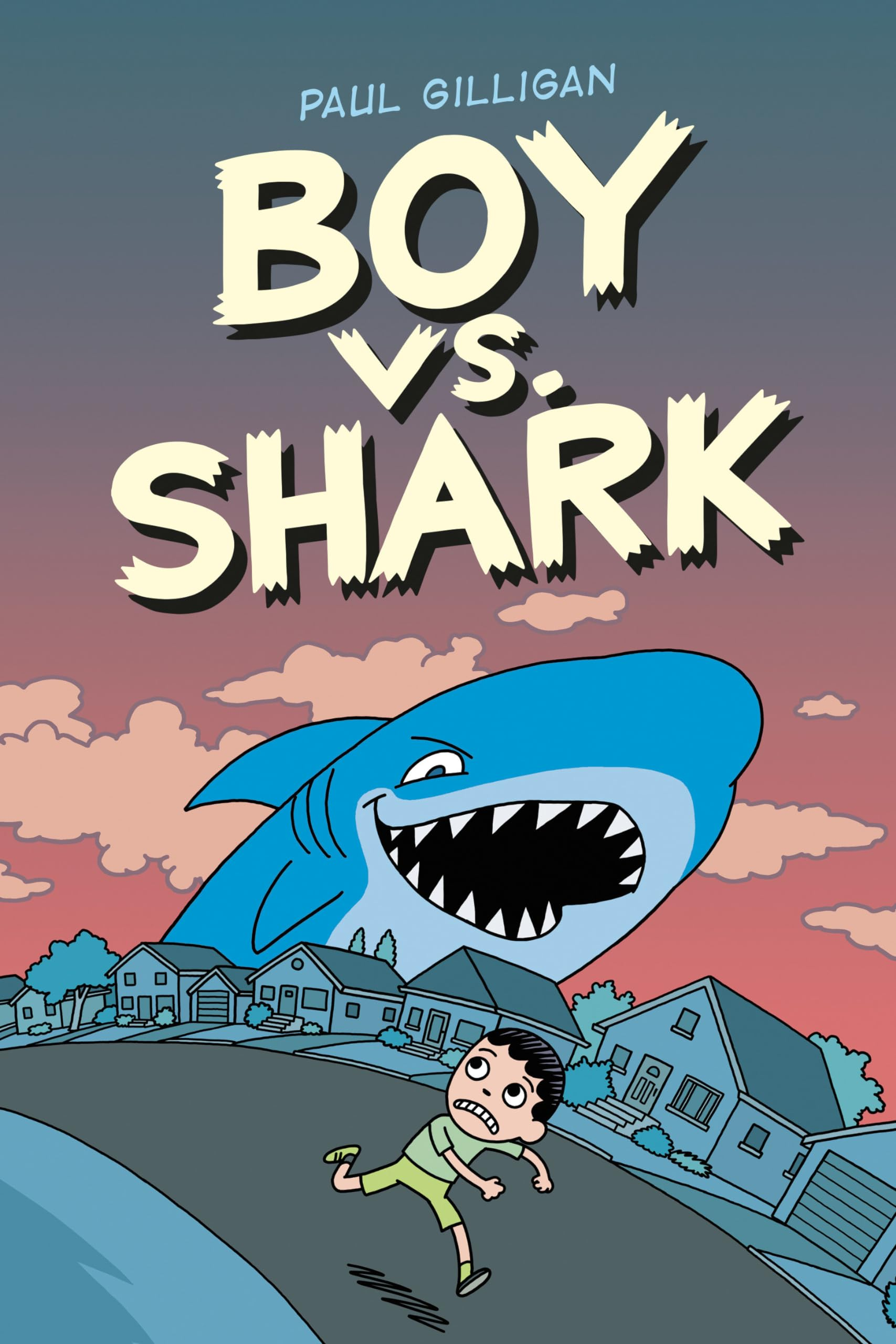
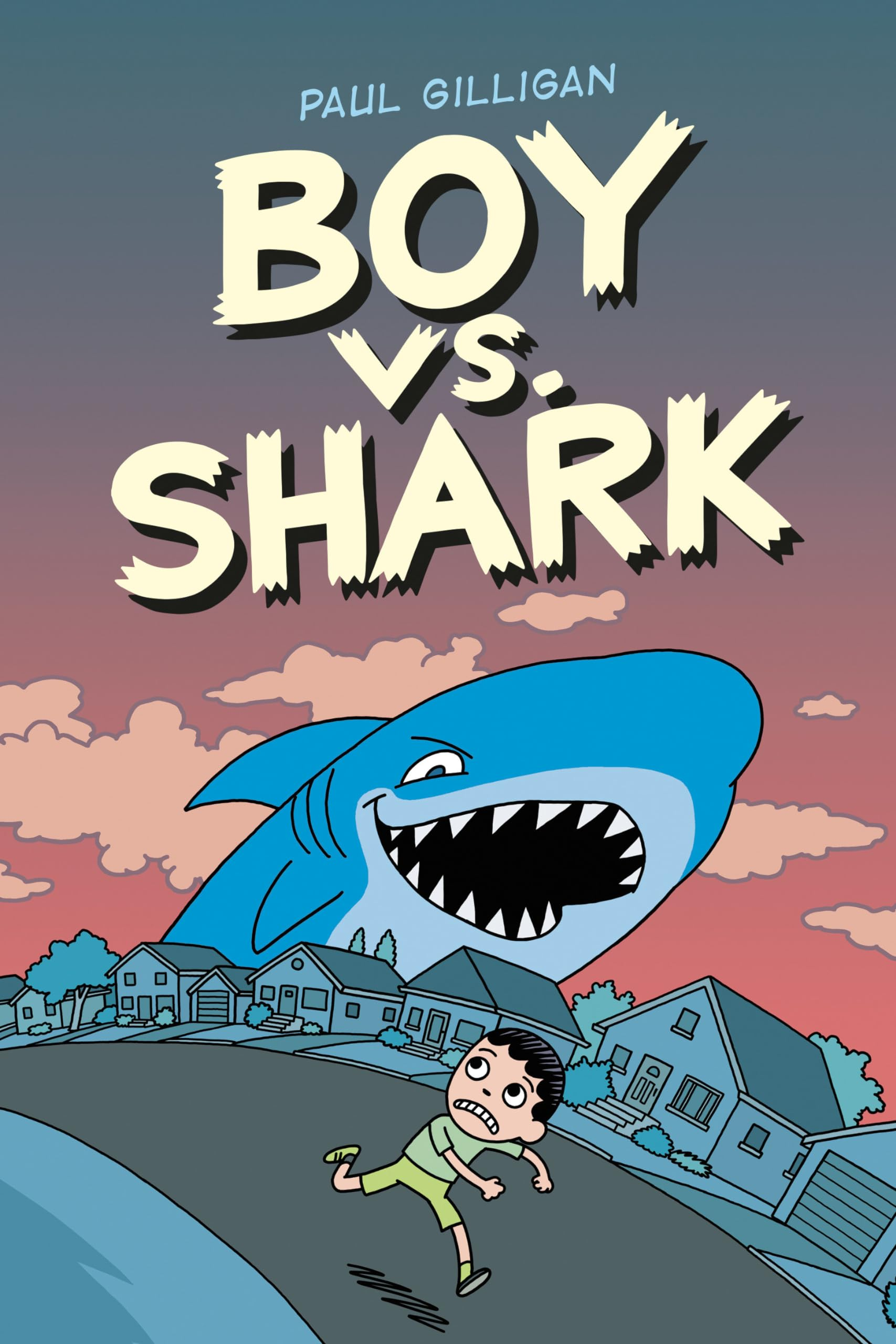
Boy vs. Shark by Paul Gilligan (Tundra, 240 pages, grades 4-7). Paul is already struggling with a best friend named David who wants to hang out with the local bully, Swain, and a dad who wants him to toughen up and stop spending so much time drawing and reading comics. The last thing he needs is the new movie Jaws that everyone is talking about, and the peer pressure he feels to go see it himself. But off he goes to the theater with his dad, and the film proves to be every bit as terrifying as he was afraid it would be. Before long, the shark is haunting Paul’s imagination, telling him he needs to be cooler and go along with what David and Swain want to do. When Paul listens to the shark and gives in, he finds himself in a world of trouble and discovers that doing his own thing and being honest with his parents is actually what works best for him. And when Swain’s shenanigans result in David falling off a roof and breaking his arm, David begins to see the light as well, saving his friendship with Paul. Includes a pictorial glossary of such Jaws-era terms from the story as The Six Million Dollar Man and the Easy-Bake Oven.

As someone just a year older than David, I could relate to his terror of Jaws. While I didn’t see it at the time, just the knowledge of its existence was enough to cast a dark shadow over my happy Jersey shore summer vacations. The story is a fun romp through the 1970’s (no glossary necessary for this boomer), but it’s also a timeless tale of growing up, peer pressure, and friendship, and it’s nice to see this kind of graphic novel written with boy main characters.

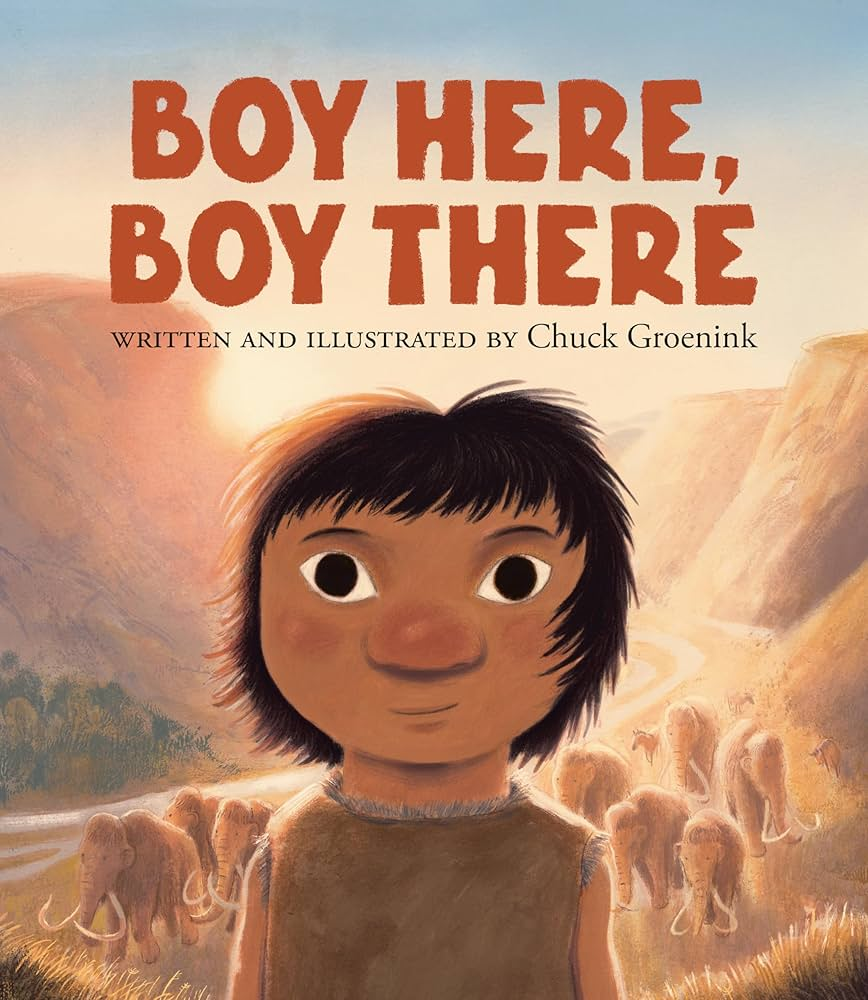
Boy Here, Boy There by Chuck Groenink (Tundra, 56 pages, grades K-3). A boy living in prehistoric times leads a nomadic life with his family. While they set up a home in a cave, he explores the surrounding environment, encountering animals like wolves and mammals, and enjoying running, jumping, and rolling in the grass. His most surprising find is a boy similar to himself, whom he sees across the river. That boy waves to him, then walks off with his family. Back at home that night, the boy eats dinner with his family, then blackens his hand with the smoke from the fire and makes handprints on the cave walls to commemorate the wave from the other boy. An author’s note gives more information about Neanderthal people, which is what the boy is, and Homo sapiens, the group the other boy belonged to. Includes a list of sources.

Readers will be fascinated at this glimpse of prehistory, written in short phrases that feel like early language. The Neanderthal boy’s adventures as he explores his new neighborhood have many elements that kids will relate to, and the illustrations do a great job of capturing his joy and wonder at what he sees. It’s not clear from the text who the other boy is, but the author’s note adds the necessary additional information.

Master storytellers

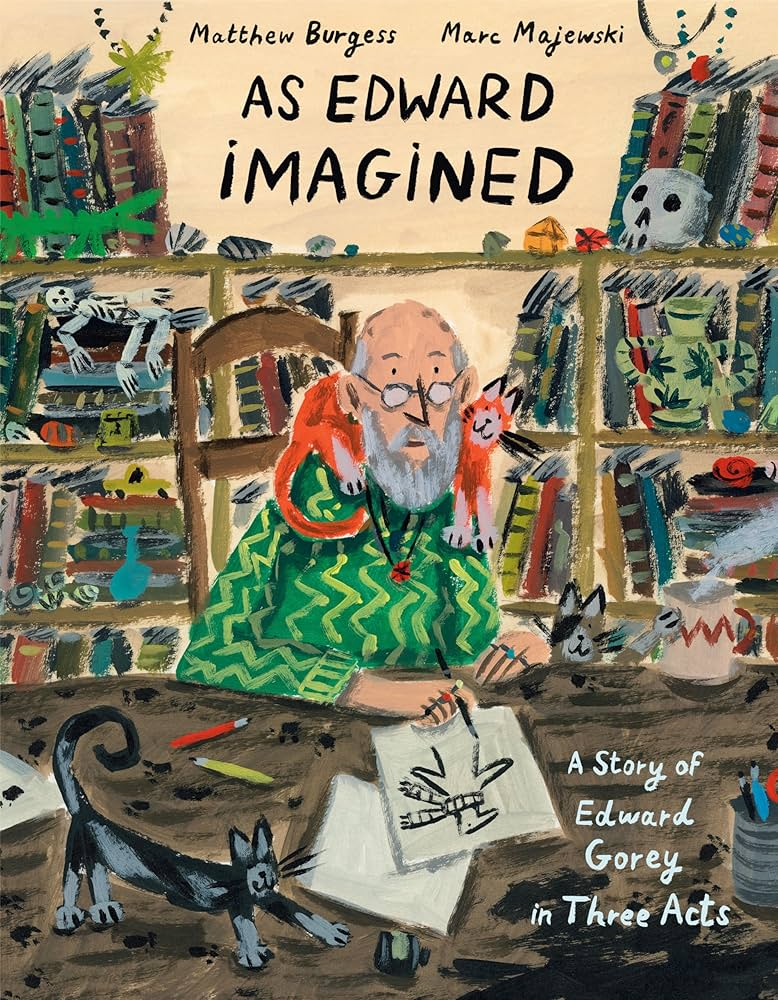
As Edward Imagined: A Story of Edward Gorey in Three Acts by Matthew Burgess, illustrated by Marc Majewski (Knopf Books for Young Readers, 48 pages, grades 2-5). In Act 1, we meet a young Edward Gorey, who learned to read when he was 3 and devoured books, including Dracula at the age of six. This led him to create his own spooky stories, something that he continued to do when he moved to New York City as an adult (Act 2). Not only did he write his own stories, but he illustrated other writers’ books and gained his greatest fame designing the sets for the Broadway adaptation of Dracula and creating introductions to PBS’s Mystery! series. With money earned from those projects, Gorey headed to Act 3, purchasing a house on Cape Cod where he continued to write, draw, and work with local theaters. Edward always led life on his own terms, whether that was wearing green toenail polish as a child, attending nearly every performance of the NYC Ballet for twenty years, or keeping six cats at Elephant House on the Cape. Includes an author’s note, additional resources, and chronology.

Kids may need to be introduced to Edward Gorey’s work, but they will undoubtedly embrace his spooky illustrations and books, and perhaps be inspired to live life to the beat of their own drummer, as Edward Gorey most definitely did. I first learned of Gorey through John Bellairs’ books, which were only briefly mentioned both in this book and when I visited the Edward Gorey Museum on the Cape; this seems like an unfortunate oversight.

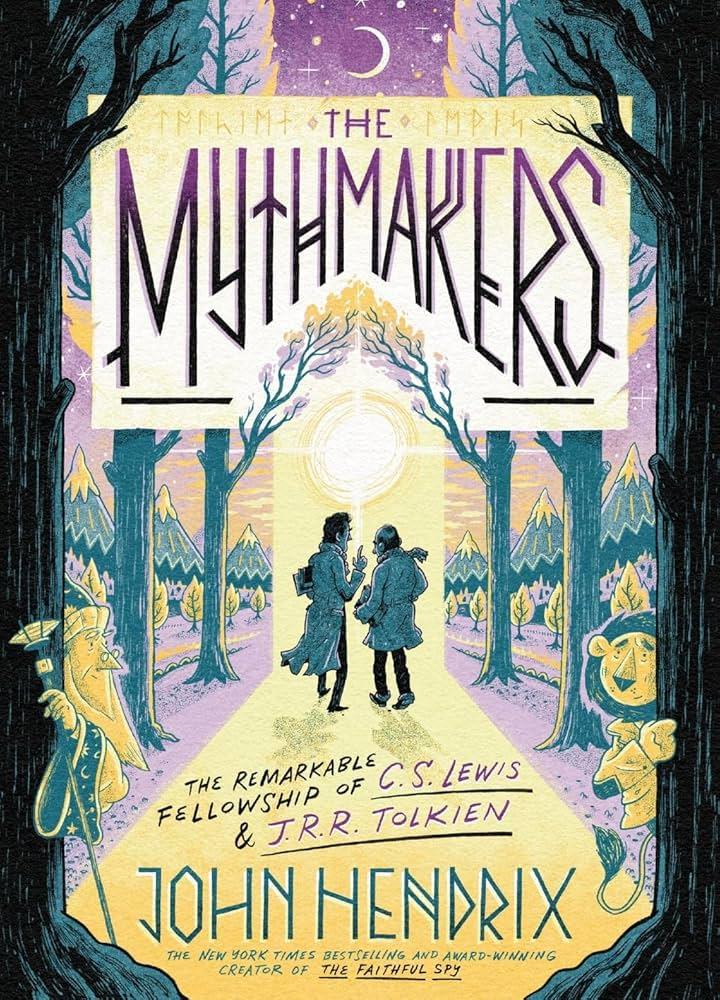
The Mythmakers: The Remarkable Fellowship of C.S. Lewis and J.R.R. Tolkien by John Hendrix (Harry N. Abrams, 224 pages, grades 7-12). C.S. Lewis and J.R.R. Tolkien both suffered early childhood losses but also had mystical experiences of joy as children, often associated with reading myths and fairy tales. After horrific experiences fighting in the trenches of World War I, they both became Oxford dons, where they developed a delightful friendship based on their mutual love of myths and interest in religion. A lifelong Catholic, Tolkien encouraged the agnostic Lewis to follow his spiritual longings, eventually leading Lewis to a dramatic conversion to Christianity. Each supported the other in his writing, and it’s pretty clear that neither the Chronicles of Narnia and especially The Lord of the Rings would have existed without the influence of their friendship and the literary group The Inklings which grew out of that relationship. The main chapters are interspersed with comics featuring a lion and a wizard traveling through the landscapes of Tolkien’s and Lewis’s life, and a poignant final chapter imagines the two men, who sadly had a falling out in the last decades of their lives, reuniting for one last conversation before moving into the great beyond. Includes extensive additional information about mythology, as well as an author’s note about his research, notes, a bibliography, and an index.

As someone who is both a John Hendrix fan and was an obsessive enough fan of C.S. Lewis to actually write a biography of him, I was excited to see this new book. Although it bills itself as a graphic novel, the amount of information far exceeds most of that genre. The lion and wizard segments are in comic format, while the rest of the book is more like an illustrated text. The emphasis is on the friendship between the two men and how their common love of mythology influenced their literary masterpieces. I was a bit disappointed that Lewis’s relationship with Janie Moore, which lasted for decades and had a huge impact on his life, was pretty much left out of the story. Additionally, some of the information about mythology got a bit too dense for me, and I imagine many young adults will have the same experience. Nevertheless, this is a rich story of an extraordinary friendship between two men who changed the landscape of fantasy literature and left behind books that are still beloved today.

Space travel

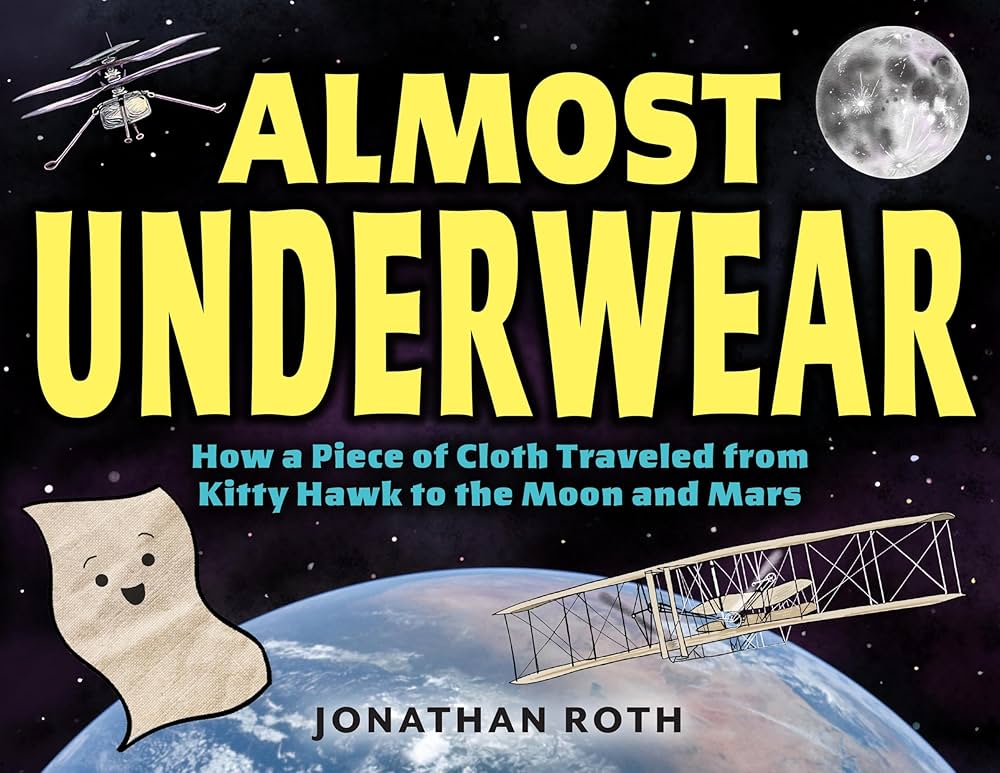
Almost Underwear: How a Piece of Cloth Traveled from Kitty Hawk to the Moon and Mars by Jonathan Roth (Christy Ottaviano Books, 40 pages, grades 1-5). Back in 1903, unbleached muslin was most commonly used to make ladies’ underwear. But one bolt of fabric was purchased by Wilbur and Orville Wright and used for a completely different purpose: to help make the wings of their new flying machine. Although they succeeded, and the muslin went airborne, the machine ultimately was wrecked and went into storage for many years. Shortly before his death, Orville donated swatches of fabric to the new Carillon Historical Park museum in Dayton, Ohio, where it stayed until 1969, when Neil Armstrong carried a piece of it into space. The cloth made it all the way to the Moon, where Armstrong carried it on his moonwalk. The cloth’s final adventures took place in 2020, when it traveled all the way to Mars on board the rover Perseverance. Not only that, but the cloth was attached to Ingenuity, a four-pound helicopter that became the first machine to fly on a different planet. Not bad…for something that could have been some underwear. Includes an author’s note, a glossary of the Perseverance instruments, and a bibliography.

The title reveals the clever hook used to look at three different milestones in air and space travel history, illustrated with combinations of historical photographs and cartoons, including a fun cartoon rendering of the happy piece of cloth. The author does a great job of making STEM history accessible to elementary readers. Pro tip: be very specific when doing a Google images search for Almost Underwear.

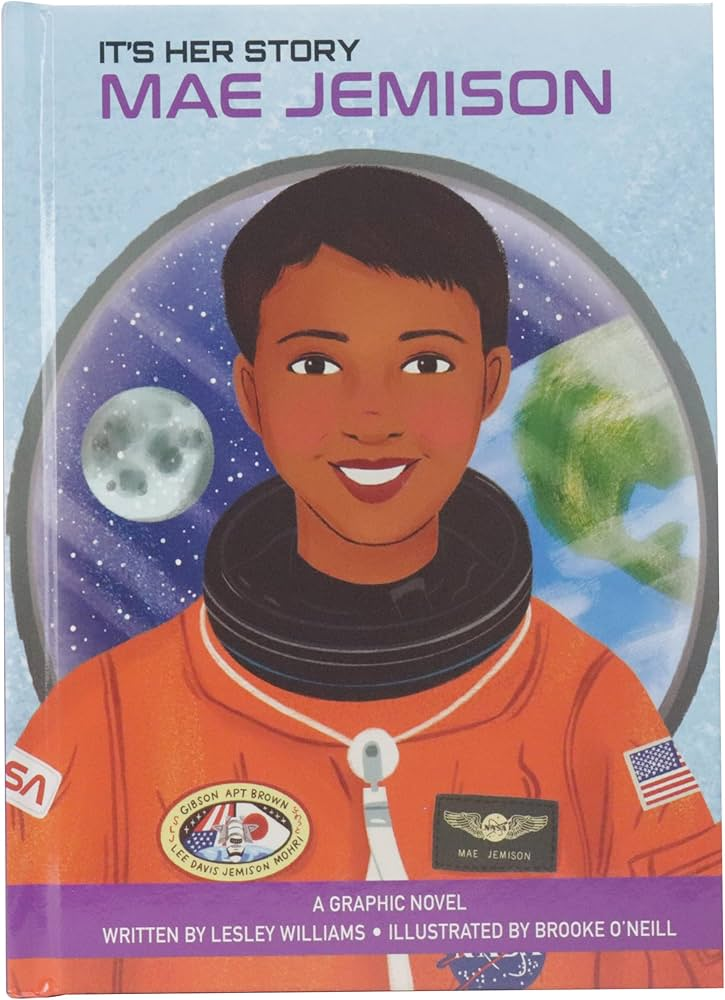
Mae Jemison: A Graphic Novel (It’s Her Story) by Lesley Williams, illustrated by Brooke O’Neill (Sunbird Books, 48 pages, grades 2-5). This short graphic biography tells the amazing life of Mae Jemison, who graduated from high school at age 16, attended Stanford, became an M.D., then transitioned to a career as an astronaut, becoming the first Black woman to go into space. She also loved music and was an accomplished dancer, as well as working for civil rights as a college student and advocating for STEM education as an adult. The last page invites readers to share their dreams, remembering that Mae’s hard work and persistence made hers come true.

This is the first volume of this series I’ve seen, but it looks like there are several others about famous women. The short page count and graphic format will make it appealing to many different types of readers, and it brings Mae Jemison to life in a way that kids will relate to, showing her as a child who had many interests in addition to science. Some additional resources at the end would have been a nice addition.

Graphic memoirs

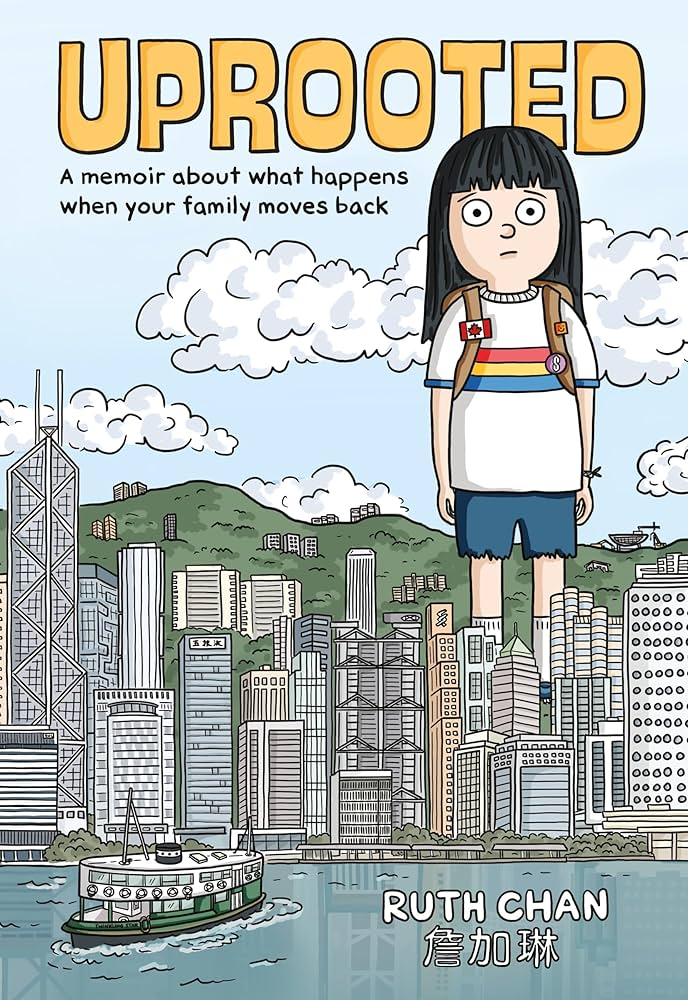
Uprooted: A Memoir About What Happens When Your Family Moves Back by Ruth Chan (Roaring Brook Press, 288 pages, grades 4-7). Having spent her whole life in Toronto, Ruth’s not excited about moving back to Hong Kong to be closer to her mother’s family. Her brother, a senior in high school, stays behind at a Canadian boarding school, and her dad is in China much of the week at his job there. Ruth finds Hong Kong exciting but challenging, with different school subjects than what she’s used to and a language (Cantonese) that she understands but doesn’t feel comfortable speaking. Her mom is enjoying reconnecting with family and friends, leaving Ruth feeling pretty much on her own–except when her parents find out about her grades and nag her to do better at school. Finally, she explodes and tells her parents about all the difficulties she’s dealing with. They’re surprisingly understanding, having believed that Ruth was capable of making all the adjustments, but offering to make some changes to try to help. Her dad’s story of his birth and early days during a difficult time in Chinese history, is woven through the contemporary story, and Ruth draws on it for courage and perseverance during her own difficult times. By the time her brother comes for a visit, Ruth is confident enough to show him all around the city, even trying out her Cantonese on the natives. Includes an author’s note and photos that give more details about her story.

Unlike many immigration graphic novels, like Parachute Kids or Measuring Up, this one is about going back to a country of origin when North America (in this case, Canada) has started to feel like home. Ruth Chan writes in the author’s note that in Canada people saw her only as Chinese, but in Hong Kong, she wasn’t Chinese enough. It’s an interesting perspective, and her father’s stories add an extra dimension that I wish had been developed a bit more. All in all, Ruth comes across as a resilient girl, able to make friends easily and to communicate (in her 13-year-old way) with her parents when things get tough.

Dear Dad: Growing Up With a Parent in Prison–and How We Stayed Connected by Jay Jay Patton with Kiara Valdez and Markia Jenai (Scholastic Graphix, 128 pages, grades 4-8). Jay Jay Patton’s spent her early life without her dad, who was incarcerated. Her parents did their best to keep the family connected, but phone calls were difficult and expensive, and visits were extremely rare. They relied on letters to keep in touch, with Jay Jay especially liking the math problems and puzzles her father created and sent to her. When Jay Jay was ten, Dad was released from prison, and the family relocated to Florida. Jay Jay struggled with a new school, a new family structure, and the uncertainty of how to tell new friends about her family’s history. Her father had a new job in the tech industry, and the two of them bonded over coding, eventually working together to create the Photo Patch app that helps parents and kids stay in touch when a family member is in prison. Today, at the age of 18, Jay Jay and her dad run the Photo Patch Foundation as well as events to teach kids coding. Includes several pages of photos and additional information about Photo Patch.

This is a fascinating story about a topic (incarcerated parents) that’s not written about much in children’s books. Jay Jay is an amazing role model, and I’m grateful that she’s shared her story, as well as her dad’s. The story itself is only 110 pages without a lot of text, so it felt like some pretty complex issues were given only the briefest coverage.

Hair-raising stories

Crowning Glory: A Celebration of Black Hair by Carole Boston Weatherford, illustrated by Ekua Holmes (Candlewick, 32 pages, ages 4-8). Starting with “five queens” (five Black women, who, in 2019, won the titles of Miss America, Miss USA, Miss World, Miss Universe, and Miss Teen USA ), the rhyming text and vibrant illustrations celebrate Black hair. Cornrows, ‘fros, locs, puffs, ponytails, and more–all get their moment to shine. “To heed beliefs or cheer gray days,” women cover their hair with hijabs, geles, headwraps, and hats. “A ritual of hand and heart,/each stunning head a work of art./Each royal coil coaxed by kin./Each strand a story without end.” Includes a glossary.

I hope this beautiful book will be considered for both Coretta Scott King and Caldecott awards. I always love Ekua Holmes collage illustrations, and these are gorgeous. The focus is on female hair, so this could make a good companion to read with Crown: An Ode to the Fresh Cut by Derrick Barnes, which features a barbershop.

My Hair Is a Book by Maisha Oso, illustrated by London Ladd (HarperCollins, 32 pages, ages 4-8). This book looks similar to Crowning Glory, and it has gotten at least two starred reviews. I’ve had it on hold at the library for weeks now, but I haven’t been able to get a copy. Now that I’m finally giving up, it will probably be on its way to me tomorrow!

Knots by Colleen Frakes (HarperAlley, 240 pages, grades 4-7). Nervous about starting at a new school, Norah tries to give herself a new look by first bleaching her hair, then dyeing it blue. It turns out surprisingly well, and school gets off to a good start. But a few weeks in, a boy shares with the class that he is mostly responsible for his two younger sisters because his parents aren’t home much. Norah and some of the other kids get pulled out of class by the police as witnesses, and the boy and his sisters end up getting sent to live at their grandparents’ house. When Norah’s mom and younger sister move across the state for a new job, Norah finds herself feeling neglected by both parents and worries that something similar will happen in her family. Another attempt to change her hair turns out to be disastrous, and her disheveled appearance makes a caring teacher start questioning Norah’s home life. When the family is reunited for the holidays, they finally start communicating about what’s going on, and, while things are still far from perfect, some changes are made that help get them back on track. Includes an author’s note about incidents from her own life that inspired the story and the evolution of the book.

Raina Telgemeier fans will enjoy this fictionalized graphic novel memoir that explores family issues, as well as school and friendship concerns. The hair dyeing is somewhat symbolic of the changes Norah and her family are going through, but also includes a reassuring message that with hair and life, there are always chances for a do-over. The scene with the police pulling the kids out of class as witnesses was kind of jarring; yes, teachers are mandated reporters, but hopefully such methods are not used to find out what’s going on at kids’ homes.

Ghostly graphic novels

Welcome to Scare School (Scare School Diaries, book 1) by Jarrett Lerner (Aladdin, 144 pages, grades 1-4). Bash is one nervous ghost about starting Scare School, an institution that caters to monsters. His classmates are vampires, spiders, werewolves, and even a snot monster, a creature that scares Bash more than any of the others. He’s happily surprised to find a friend in Itsy, a spider who winds up as his roommate. Classes are tough, though, and the hardest one is his Creature Intensive with grouchy Mr. Crane, where Bash has to learn the skills specific to ghosts. If he’s not proficient by the end of the first two weeks, he’ll get sent home. With the help of Itsy and some other surprising supporters, Bash finds a way to get through it all and is ready to take on whatever else might come his way at Scare School.

Written in a diary format with lots of illustrations, this very unscary book will appeal to kids moving into longer chapter books. Despite being a ghost with some pretty unconventional classmates, Bash has experiences at school that kids will relate to. I’m happy this is billed as book 1, and I hope we won’t have long to wait for a sequel. Scare factor: Too small to detect.

The Night Librarian by Christopher Lincoln (Dial Books, 256 pages, grades 4-8). Twins Page and Turner Reed are alone a lot, with parents who travel all over the world and a nanny who likes to take a lot of time off. With not much better to do, they decide to go to the New York Public Library one day to find out how much their father’s rare copy of Dracula is worth. When the book goes missing at the library, they’re plunged into a wild series of adventures, guided by Night Librarian Ms. Literati, who shows them how fictional characters can be released from their books. Aided by Wonderland’s Alice, Jim Hawkins, Jack of beanstalk fame, and Tinkerbell, the team sets off on a mission to rescue the library from some of the evil characters who have managed to escape from their books. The final scene results in chaos and the destruction of the library…until H. G. Wells’s time machine turns things back again.

While not exactly scary, the black and purple palette of the nighttime library conjures up spookiness, offset by the fun adventures and opportunities to meet literary characters. Younger readers might need a little help straightening out who’s who, but the nonstop action, humor, and fun characters will appeal to kids right through middle school. Oldsters like myself will be inspired to learn that author Christopher Lincoln is publishing his debut graphic novel at the age of 71. Scare factor: Pretty low, mostly just a spooky atmosphere.

Read At Your Own Risk by Remy Lai (Henry Holt and Co., 160 pages, grades 3-6. Hannah recounts in a journal the story of how she has been cursed. It started when she and her friends went up to the school’s attic and played a Ouija board-like game to try to summon up spirits. Hannah tried to trick them, and as a result, it seems as though she’s been cursed. At first, there are small signs, like being pushed by invisible hands and skinning her knees, but soon things get more gory: a gash in her forehead, a tooth that mysteriously falls out, silverfish crawling through her gums and coming out of the gash. School rumor has it that she has eight days to break the curse–or else. By day eight, it seems as though everything is in a downward spiral, but there may be one last hope….

Wow, Remy Lai sure has changed since she created the cute and charming Pawcasso! Although there’s some humor and maybe even a little macabre charm, this story is a genuine horror tale. It’s a pretty quick read, thank goodness, because you won’t want to put it down! Kids who are looking for scary stories will be flocking to this one, for sure. Scare factor: Considerable.

Graphic novels that root for the underdogs

We Are Big Time by Hena Khan, illustrated by Safiya Zerrougui (Knopf Books for Young Readers, 240 pages, grades 3-7). Aliya’s not happy that her family is moving from Tampa to Milwaukee just as she’s about to start high school. Although it’s nice to be close to her grandparents, she misses the Florida weather and her basketball friends. Her new Islamic school has a girls’ basketball team, but they’re not very good. A new coach arrives at the school at the same time Aliya does, and before long the girls are working harder than ever on their conditioning and teamwork. Slowly, huge losses turn into smaller losses, then wins. As the team improves, they start attracting some media attention, which more often than not focuses more on their clothing and religion than on their basketball playing. The girls learn to navigate all kinds of new situations as they slowly build a winning season and make their way to the big end-of-the-year tournament. When the season finally comes to an end, the team and their families have plenty to celebrate. Include’s an author’s note about the real-life team that inspired this book and a behind-the-scenes look at the development of some of the artwork.

This is sure to be a big hit with fans of Raina Telgemeier-inspired graphic novels. The story reminded me a little bit of Hoops, with its team of scrappy underdogs breaking barriers for girls’ sports. Their turnaround from huge losses to wins seemed to happen very quickly, reminding me of the storytelling limitations of graphic novels.

Lion Dancers by Cai Tse (Simon and Schuster Books for Young Readers, 304 pages, grades 4-7). Wei is trying to find his place in middle school, but despite academic success, he hasn’t found a place where he feels he belongs. When he literally runs into a teenager wearing a lion dance t-shirt, Wei begs him for a chance to join his team. Wei’s late father was a championship lion dancer, and Wei danced a few years back, but he quit when he had some conflicts with another boy named Hung. Hung is part of the new team as well, and Wei struggles to work with him. When Lunar New Year comes around, the team is booked solid with performances all over the city, and everyone has to pitch in to make things work. When Wei and Hung’s rivalry gets in the way of one of their dances, it threatens everything the team has worked for. Wei has to decide if he’s going to work through his problems to continue with the dance form he loves or once again walk away from it.

I struggled a little at the beginning trying to keep the various characters straight and get up to speed with lion dancing, but once I figured things out, I very much enjoyed learning more about the dance and seeing how all the interpersonal drama played out. After reading this and Lunar New Year Love Story, I am ready to attend my first lion dance performance.