Samira’s Worst Best Summer by Nina Hamza (Quill Tree Books, 336 pages, grades 4-7). Sammy’s hoping for some down time over summer vacation to recover from a rough seventh grade year. Painfully shy and insecure, her best times are when she’s behind a camera observing and taking pictures. When her house is toilet papered on the last day of school, she’s sure her ex-best friend Kiera is behind it, part of a campaign of cruelty that has gone on all year. Sammy’s grandmother, Umma, arrives from India to look after Sammy and her younger brother Imran, while their parents and older sister travel to India for a family wedding. Umma is loving, supporting, and also extremely outgoing, and she slowly draws Sammy out of her shell, helping her to connect with some of the neighbors, especially Alice, a new girl on the street. As Sammy and Alice work together to solve the mystery of the TP’ing and another mean prank, Sammy slowly learns to speak up for herself and to claim a new identity for herself as Samira.
Summer Vamp by Violet Chan Karim (Random House Graphic, 240 pages, grades 3-7). Maya’s another one recovering from a difficult school year, her only refuge being the kitchen where she enjoys whipping up delicious masterpieces. She’s not sure how she feels when her dad and his girlfriend, Charlotte, announce on the last day of school that Charlotte is moving in, but the blow is softened when she learns that Charlotte has offered to send her to culinary camp. A mix-up at the bus station lands Maya at Camp Dracula, where the other campers have fangs, drink blood boxes instead of juice boxes, and don’t have reflections. Horrified at first, she slowly begins to bond with the other campers and finds them friendlier and more accepting than the humans she’s been around recently. By the time she gets the opportunity to switch to culinary camp, Maya realizes that Camp Dracula is where she belongs.
Although these books have many differences, they are remarkably similar with introverted protagonists who have endured a grueling middle school year, and who find supportive friends and family to help them embrace their strengths and come into their own during summer vacation. I found both of them extremely engaging stories that would make for some great beach reading. Of all the vampires I’ve been forced to read about over the years, Maya’s friends may be my favorites.
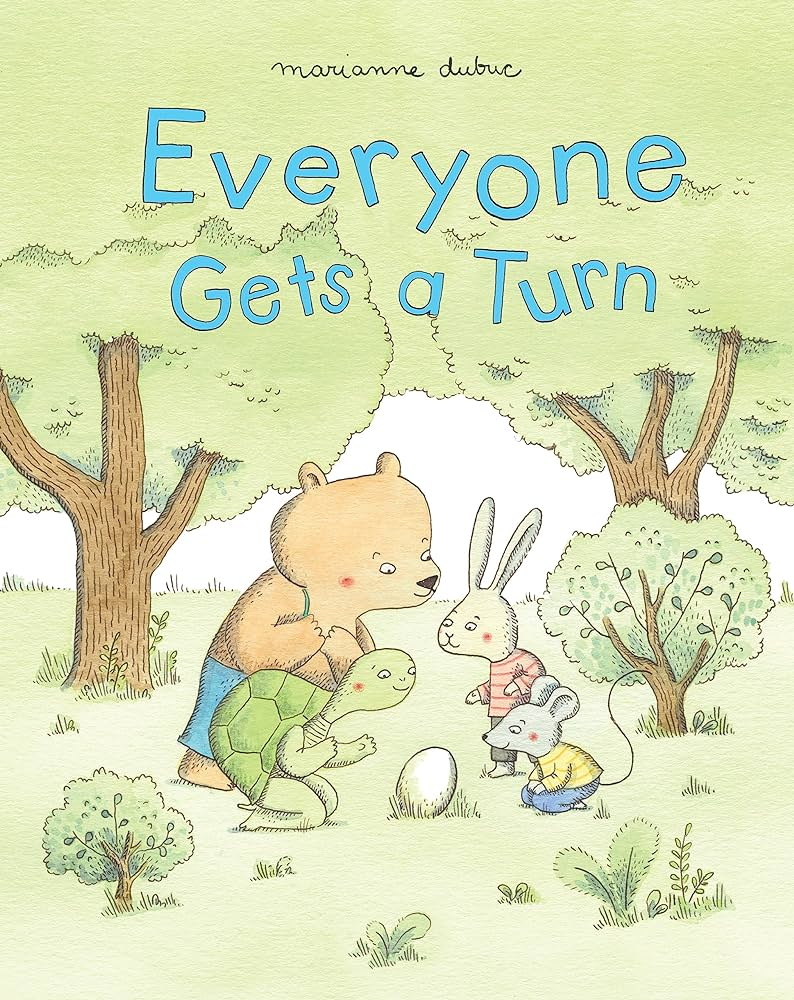
Everyone Gets a Turn by Marianne Dubuc (Princeton Architectural Press, 60 pages, ages 4-9). When friends Bear, Mouse, Turtle, and Hare discover an egg, each one wants to take it home. The egg provides the answer: “Everyone gets a turn!” Mouse found the egg, so he brings it home first, getting to know the egg and learning how to keep it comfortable. Next is Bear, who gets a surprise: the egg hatches, and Little Bird arrives. Hare and Turtle figure out how to feed and care for a young bird, and by the time the visit with Turtle ends, Little Bird has built her own home and is ready to take care of herself. There’s a housewarming party, at which time Little Bird declares she will henceforth be known as Clara, and the five friends and neighbors “continue to grow, each in their own way.” The story could hardly be any cozier or more heartwarming, and the longer page count and graphic novel format will make it appealing to older readers as well as younger kids. I’d love to know the story of how this came to be published by the Princeton Architectural Press.
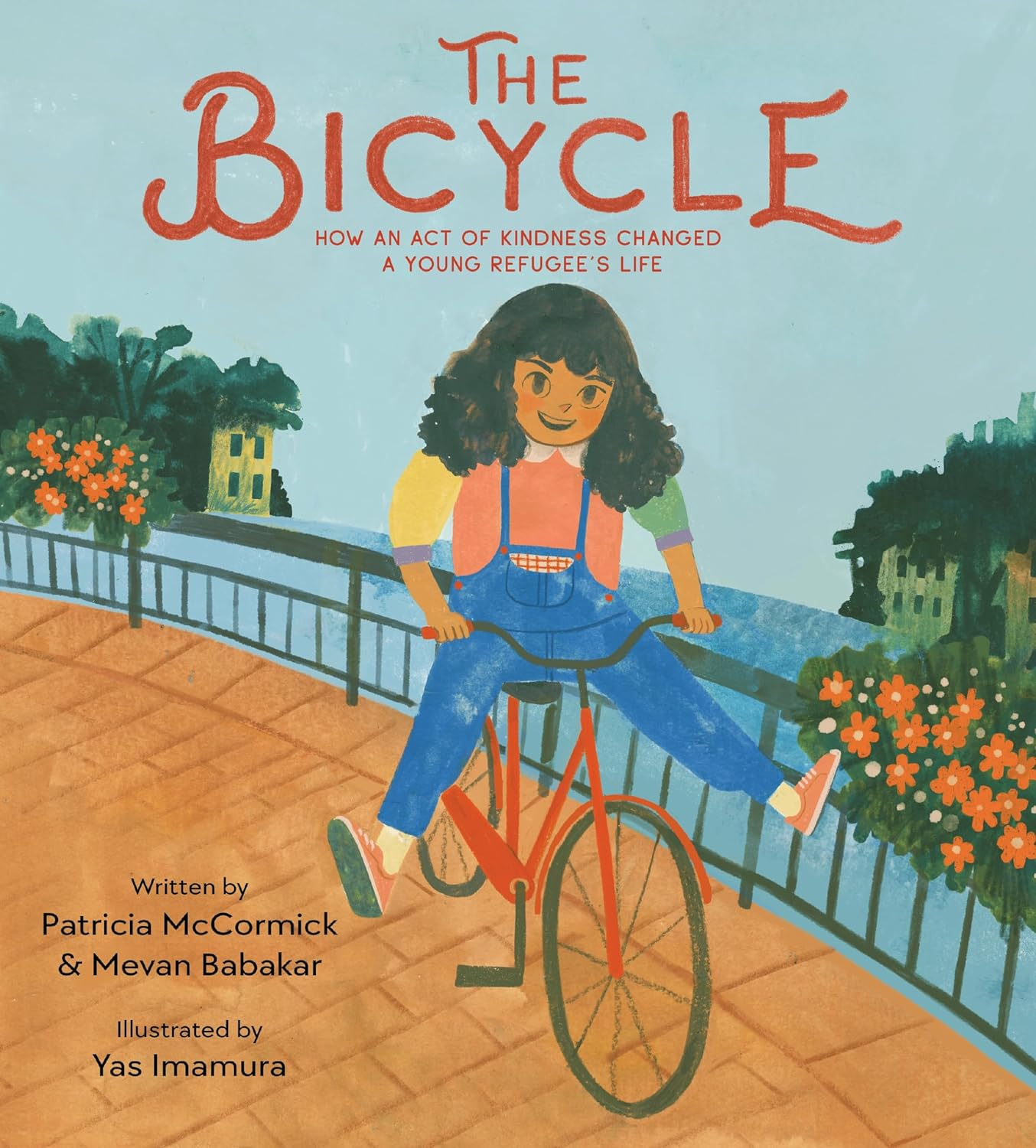
The Bicycle: How an Act of Kindness Changed a Young Refugee’s Life by Patricia McCormick and Mevan Babakar, illustrated by Yas Imamura (Balzer + Bray, 40 pages, grades 1-4). Mevan tells the story of her childhood, beginning with idyllic early years surrounded by family in Kurdistan. When the Iraqi government begins persecuting the Kurdish people, Mevan and her family are forced to flee, first to Turkey, then to Russia, and finally to the Netherlands. Mevan learns to make herself as invisible as she can. In the Netherlands, she watches people outside her window riding bicycles, but she rarely leaves the apartment herself. It feels like no one sees her, but it turns out that Egbert, the building’s handyman, has noticed her, and one day he brings her a red bicycle. His gift makes Mevan feel “a hundred feet tall,” and before long, she’s outside riding with the rest of her neighbors. An epilogue describes the miraculous reunion she had with Egbert as an adult, including a photo of the two of them, and an author’s note describes her life as a refugee, how it has made her feel like an outsider, and the miraculous power of kindness. This is a touching if bittersweet memoir with an emphasis on the power of one person’s kindness to make a difference. I like how the epilogue ends, describing the ripple effect of her story of finding Egbert: “In a world where there are many people running from war, from hunger, from hatred, people everywhere, of every age, asked themselves: What’s one kind thing I can do?”
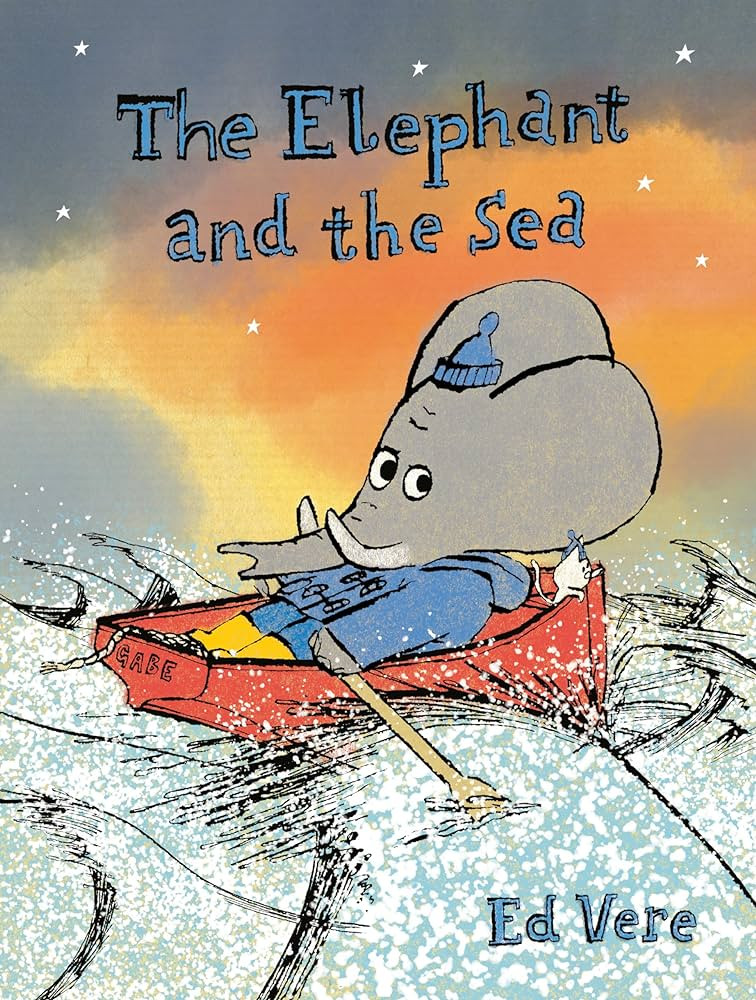
The Elephant and the Sea by Ed Vere (Doubleday Books for Young Readers, 32 pages, ages 4-8). Gabriel is an old elephant when we meet him on the first page, sitting in the harbor and remembering his younger days. Back then, he loved to visit the lifeboat crew and dreamed of helping sailors at sea, singing “Heave away, haul away, heave-HO!” But then Gabriel grows…and grows, and the other animals say he’s too big for the lifeboat. He refuses to give up his dream, though, and spends his days collecting driftwood and building. When a storm hits that’s too strong for the lifeboat crew, Gabriel is ready with his own boat that he uses to haul in the entire fleet. “Brave Gabriel, our hero!” the animals hail him. “Can we join you?” “Of course,” Gabriel replies. “But we might need a bigger boat.” And Gabriel enjoys a career of lifesaving, bringing us back to the old elephant remembering. It’s a cute story with a nice theme of perseverance and determination, with a fun “Heave away” repeating refrain. This would make a nice companion to read with Swashby and the Sea.
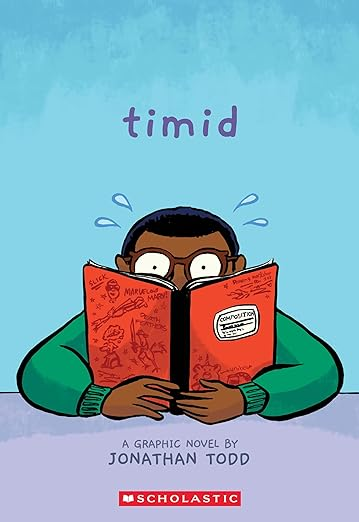
Timid: A Graphic Novel by Jonathan Todd (Graphix, 272 pages, grades 4-7). Based on the author’s adolescence, Timid traces Cecil’s journey from Florida, where he’s lived most of his life, to Massachusetts and figuring out how to fit into a new middle school. His passion is drawing, although this is actively discouraged by his father, who tries to get him to focus on architect rather than cartoonist as a career choice. But drawing proves the entry point into middle school society, as kids begin to ask Cecil to design posters and t-shirt when they discover his talents. Cecil experiences a different kind of racism than he did in Florida, with kids calling him an Oreo when he hangs out with white kids and assuming he’s a Metco student (bussed from Boston) because he’s Black. It takes some missteps, but Cecil finally finds his people and figures out where he belongs. Includes an author’s note and acknowledgements that made me realize how hard it is to create a graphic novel and get it published.
South of Somewhere by Kalena Miller (Albert Whitman and Company, 288 pages, grades 4-7). Chapter one: Mavis’s mom decided to take a taxi from the airport to their Chicago home, while Mavis rides in the family SUV with her dad, brother, and sister. They’re greeted by the FBI, looking for Mom, and the kids are shocked when they look out the rear window and see the taxi make a quick U-turn and speed away. Turns out their mother is wanted for embezzlement, which means the family is locked out of their home, bank accounts, and credit cards. Dad seeks refuge for the family with his estranged sister and her four-year-old daughter, and the four of them move into Aunt Melissa’s basement. Mavis not only has to come to terms with the loss of her home and wealthy lifestyle, but with the fact that her mother is not who she thought she was. The family pulls together to make ends meet, and even Mavis is able to earn money by starting a babysitting service with a new friend. When she and her siblings finally figure out where their mom is hiding, they are met with disappointment but also given the opportunity for a fresh start, their tragedy forging close family bonds with their dad, aunt, and cousin.
Kids will find a lot to relate to in both of these middle grade books, particularly the disillusionment of learning that parents can be far from perfect. While Cecil’s dad is well-intentioned but clueless about what’s important to his son, Mavis’s mom is a complete narcissist who seems to have no understanding of what she’s done to her family. I was hoping there would be at least a little redemption for her character, but there really wasn’t. Readers will take comfort in the fact that Mavis learns how to be resourceful and has great support from her family and new friend.
I was buried by an avalanche of graphic novels this week, which I managed to claw through, writing reviews as I dug my way out.
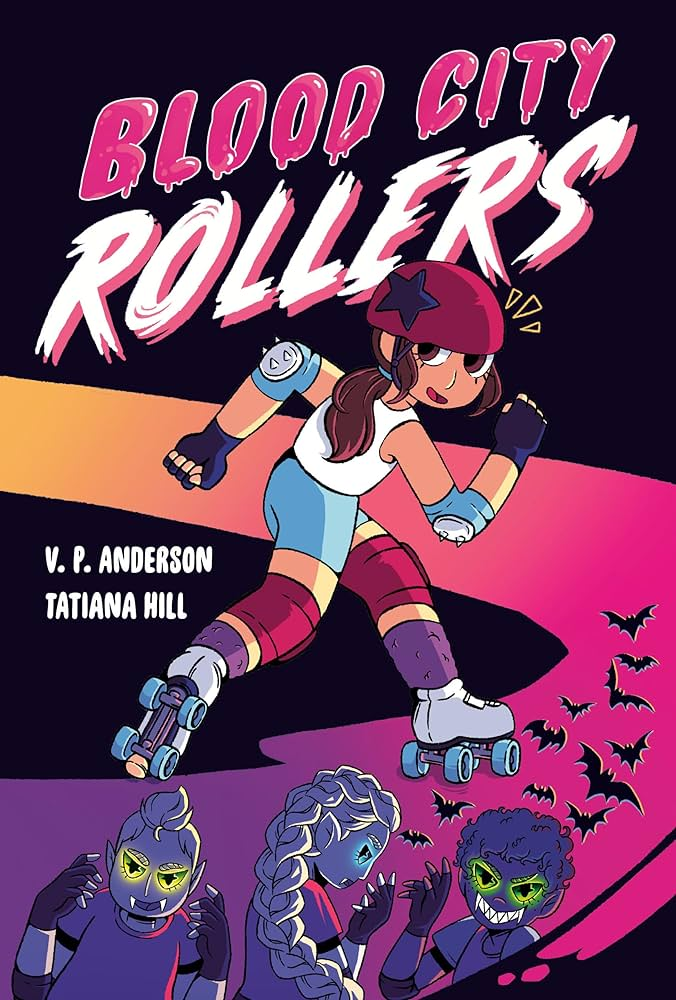
Blood City Rollers by V. P. Anderson, illustrated by Tatiana Hill (Labyrinth Road, 192 pages, grades 5-8). Mina’s a figure skater with Olympic dreams about to win a big competition when she sees some dark figures crouched in the rafters of the skating rink. Distracted, she falls and breaks her arm in what may be a career-ending injury. On her way out of the hospital, she’s abducted by a group of girl vampires and taken to an abandoned mall, where she learns their plan to make her the jammer on their roller derby team (their rules dictate that the jammer must be a human). Her arm magically healed, Mina is amazed to begin feeling more like herself as part of the vampire team than she ever has as a figure skater. A crush on the team captain adds to her emotional turmoil, and as the big match against the witches approaches, Mina wonders if she should become a vampire herself. Another injury forces her to return home, and when she finally makes her way back to the mall, she finds that it’s been abandoned by the vampires. They’ve left her a note, though, and the final page promises “to be continued…”.
Imagine Roller Girl with vampires, and you’ll get the vibe of this girl-powered story with a main character who learns to be herself and the hint of a queer romance or two thrown in. There are so many characters and subplots that I found myself confused at various points in the story, despite the excellent guide to all the team members early in the book.
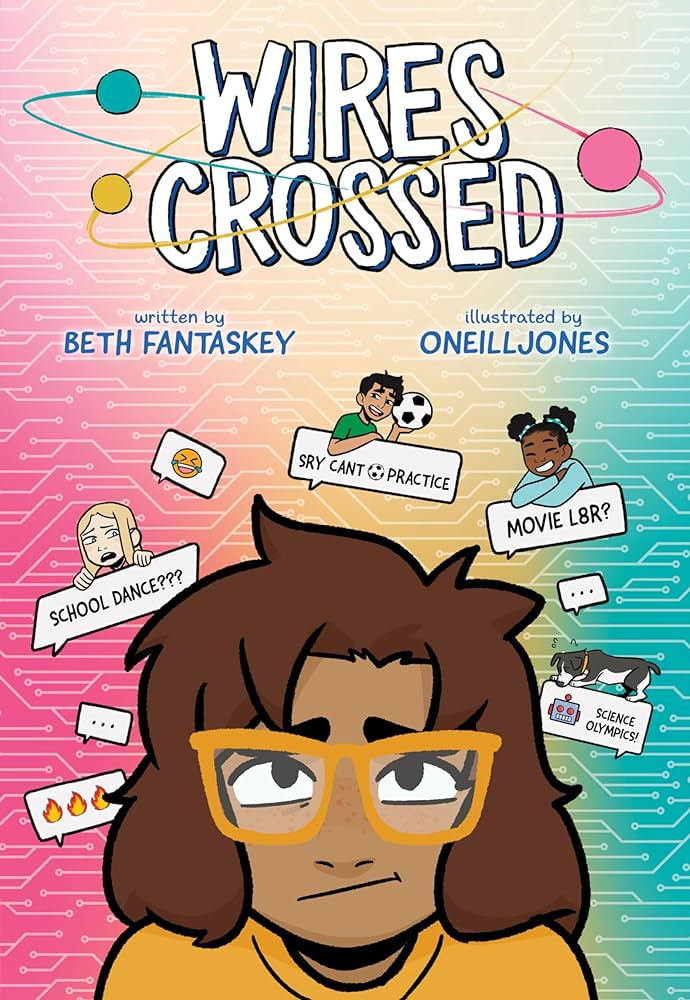
Wires Crossed by Beth Fantaskey, illustrated by ONeillJones (Clarion Books, 240 pages, grades 3-7). Mia’s going through a tough time in middle school, as her former best friend Addy is making a move to get into the popular group. So it’s good timing when she learns that her science camp best friend Tariq is moving to town. When Mia’s family picks him up from the airport, though, Mia’s shocked to see that Tariq has traded his glasses for contacts and has shot up several inches. The girls at school all love Tariq, but he’s a loyal friend, and pretty soon he and Mia have paired up for the science fair, adding quirky girl Kinsey and loveable goofball Ethan to make a team. The four become good friends, and soon Kinsey has replaced Addy as Mia’s best friend. There’s trouble brewing, though, when Mia discovers that Tariq and Kinsey are going to the big dance together, but some heart-to-heart talks get everything straightened out. After a hilariously disastrous science fair presentation, the four friends end up going to the dance together, and even Addy comes around for a reconciliation.
This is your standard middle school graphic novel fare, now familiar to fans (like me) of the Raina Telgemeier genre. I appreciated the loveable nerdiness of the characters, as well as their ultimate decision to choose friendship over romance.
The Egg Incident by Ziggy Hanaor, illustrated by Daisy Wynter (Cicada Books, 72 pages, grades 1-4). Humpty Dumpty’s nephew Humphrey has the world’s most protective parents, who caution him to look where he’s going at all times, never run and jump, and of course, NEVER climb a wall. When Humphrey arrives at the park one day (after a s-l-o-w walk to get there), he meets an adventurous girl who tries to get him to climb a tree, play tag, or catch a ball. Humphrey will have none of it. When they finally decide to head home, they discover the gate is locked, and the only way out is–you guessed it–to climb the wall. Humphrey’s new friend coaches him up to the top, where he enjoys the beautiful view before losing his balance and falling! Surprisingly, he’s okay, and his friend, who turns out to be a princess, takes him to see the king’s men, who not only give him a clean bill of health but assure him that the Humpty story is a rumor. The last they heard, Humpty was running a rock-climbing school in Scotland. From that day on, Humphrey is a new egg, and even convinces his parents to take a few risks and have some fun.
Okay, it may not be great literature, but this book not only cracked me up (pun intended) but deftly delivered a message for overprotective parents. I thought it was a picture book, but at 72 pages, it’s a bit long for that designation, although a bit short to qualify as a graphic novel. It’s engaging enough that kids with a decent attention span could enjoy reading or listening to it in a single sitting.
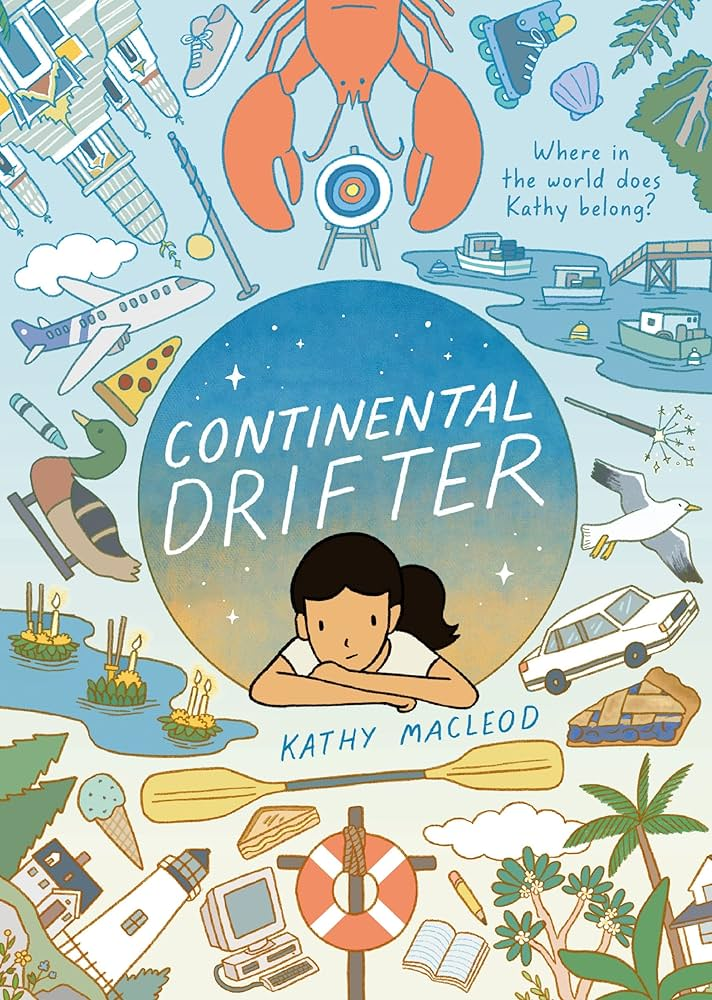
Continental Drifter by Kathy MacLeod (First Second, 224 pages, grades 4-7). Kathy lives in Thailand with her American father, Thai mother, and older sister Jennie. She attends an international English-only school in Bangkok and feels more closely identified with her American side. But when the family spends the summer in Maine visiting her dad’s relatives, Kathy feels like an outsider wherever she goes, especially during her three weeks at summer camp. In addition, her parents are older, both were married before, and Kathy feels like she knows very little about them and their pasts. In Bangkok, they don’t spend much time together, so it feels strange at first when they do so much together in Maine. By the end of the summer, Kathy is coming to appreciate the parts of herself that are unique, and feeling less of the need to blend in with everyone else, but she realizes that whether she’s in Thailand or America, she’ll always feel a longing for the other country.
Kathy MacLeod’s memoir masterfully captures what it’s like to have strong connections two different countries and cultures as she navigates both her Thai and American roots. She makes astute observations about her family dynamics, which often sadly four lonely people whose fears kept them apart from each other.
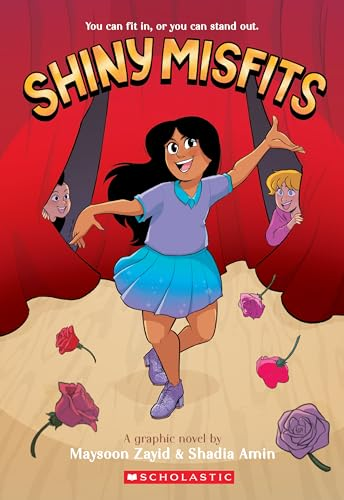
Shiny Misfits by Maysoon Zayid, illustrated by Shadia Amin (Graphix, 256 pages, grades 4-8). Bay Ann loves to dance and is excited to perform as a tap-dancing zombie bride in the Halloween talent show. Despite her cerebral palsy, her dancing is good enough to earn her the top prize. When her crush, Alyee Maq, gives her a kiss, it seems like the perfect night. But the kiss knocks Bay Ann over, and the next day it’s all over social media, showing Alyee Maq rescuing “a special girl,” whose face is blurred out. Bay Ann is determined to both get revenge on Alyee Maq and have her own posts go viral. She’s helped by her two best friends, her talking cat, her understanding father, and–occasionally–her strict, demanding mother. Not only do they support Bay Ann in her endeavors, but they try to hold her back when her revenge plans get out of control. This causes sparks to fly on occasion, but in the end, Bay Ann learns to shine and that being a loyal friend is more important than going viral.
I had high hopes for this book, and it is a fun story featuring a character with CP who is athletic and determined. Although it’s probably an accurate portrayal of a middle schooler, I found Bay Ann a bit too uncaring of the feelings of her family and friends as she doggedly pursued her revenge. And far be it from me to judge middle school crushes, but Alyee Maq really did not seem worth the effort.
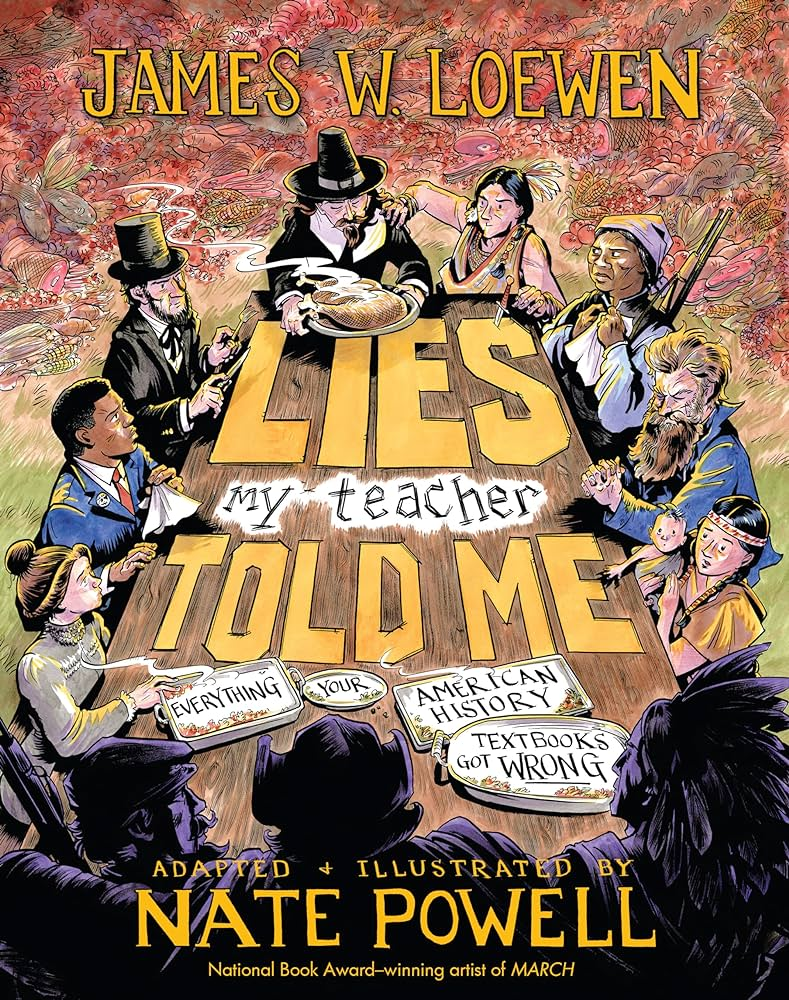
Lies My Teacher Told Me: A Graphic Adaptation by James W. Loewen, adapted and illustrated by Nate Powell (The New Press, 272 pages, grades 9-12). James W. Loewen’s 1995 book (updated in 2007 and 2018) examined twelve high school American history textbooks and how they present the history of the United States. His conclusions are fascinating, showing how the narrative presents a patriotic view of steady progress over time, with Americans defending freedom and democracy around the world. Racism, genocides, corporate greed, and government secrecy are pretty much excluded from this version of history. He also investigated how and why textbooks are written like this, which turns out to be in large part because the committees that adopt the books for their states demand it. Loewen concludes by emphasizing the importance of telling the truth to students, presenting American history in a way that makes them think critically about events from the past and how they shape the future, in order to help them become active and engaged citizens.
I’ve heard of this book but never read it, and I am grateful for Nate Powell’s amazing graphic adaptation (Powell worked with John Lewis to create his March trilogy). I found it compelling reading, with so much of the history relevant to today’s current events at home and abroad. I can usually zip through graphic novels in a few days, but this took me quite a bit longer, with text-heavy pages and lots of fascinating ideas to consider. There were times that I wish I knew more about the topics being discussed, and many readers will want to consult the original work to get a fuller picture.
The Monster and the Maze (Monkey King and the World of Myths) by Maple Lam (G. P. Putnam’s Sons Books for Young Readers, 240 pages, grades 3-7). Sun Wukong, or the Monkey King, comes to life in a graphic tale combining Chinese and Greek mythologies. Bold, confident and fearless, the Monkey King sneaks into heaven where he confronts the gods with his request to become one of them. Although he’s a lowly beast, he’s told his wish will be considered if he can go on a quest to slay a monster. Sun Wukong ends up in Crete, on a quest to destroy the legendary Minotaur. When he finds the monster, tough, he learns that he’s not evil and is suffering at the hands of his father, King Aegeus. The Monkey King discovers the problem–an evil spirit has possessed Aegeus–and is able to convince the king to release the spirit and return to his kindly ways, making an impassioned case for beasts and monsters in the process. Sun Wukong’s work may be done in Crete, but it looks like there will be more adventures for him ahead. The two mythologies are woven together seamlessly, making a fun and extremely engaging story. Includes additional information about the mythical characters and an author’s note.
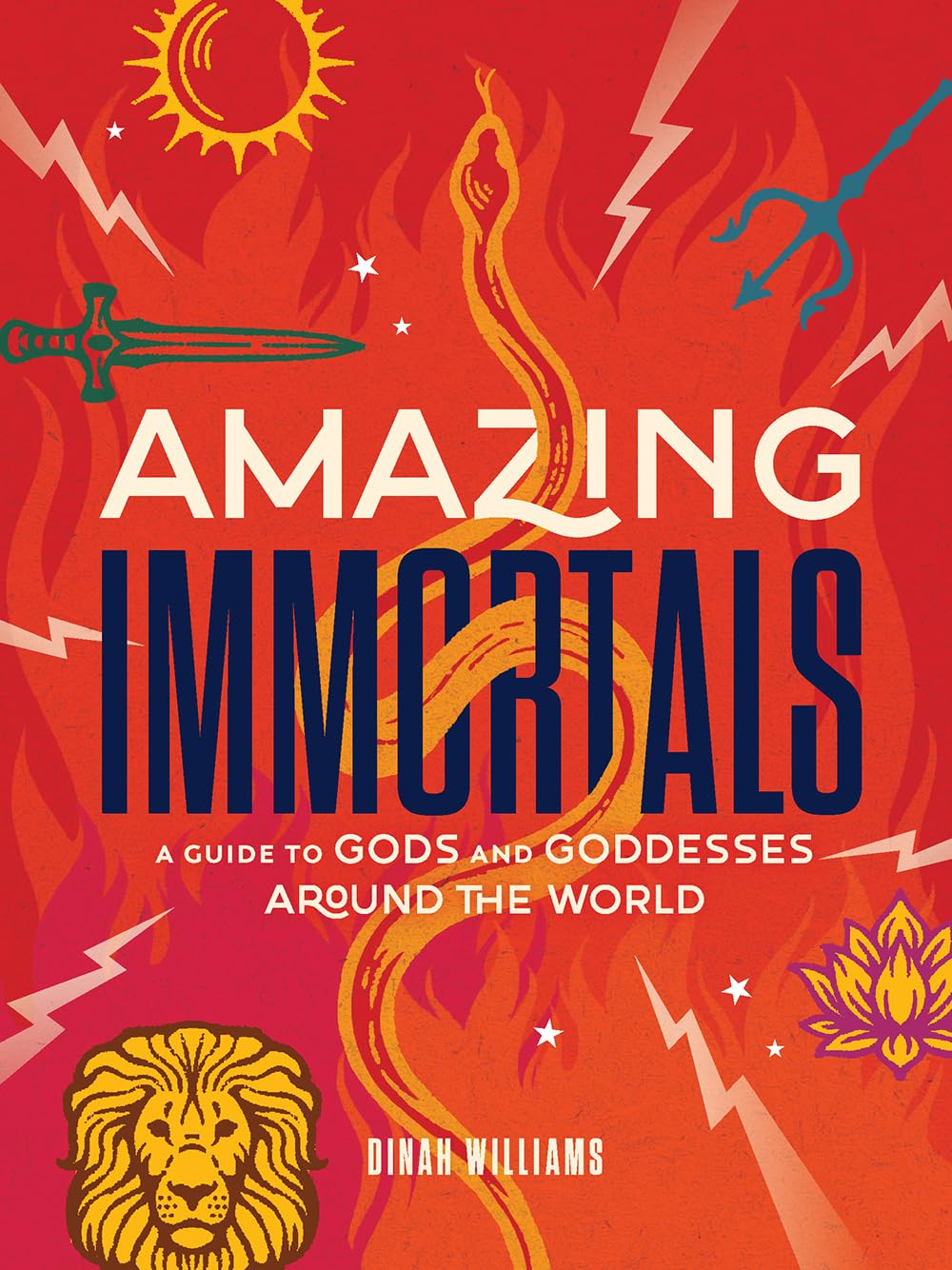
Amazing Immortals: A Guide to Gods and Goddesses Around the World by Dinah Williams (Harry N. Abrams, 208 pages, grades 4-8). Arranged by categories of power (creation, weather, tricksters, etc.), this collection of myths focuses on cultures other than the familiar Greek and Roman ones. Each two-page spread contains a brief retelling of the myth, along with gorgeous color art, created by 17 different artists. The left-hand margin contains information about the country (or region), culture, and era of each myth, which is unfortunately small enough that it took some diligent searching for me to discover. Each myth includes a fun fact or a tie-in to modern times, like Marvel movies or Rick Riordan books. The back matter includes information about the author and artists, as well as an index, a list for further reading, and an extensive bibliography, making this a great starting place for more research. It’s an amazing and visually appealing resource for upper elementary and middle school mythology fans.
Unicorn Boy by Dave Ryan (First Second, 208 pages, grades 3-7). Brian leads a pretty ordinary life until the day a unicorn horn sprouts from his head. He tries to ignore, remove, or hide the horn, but there’s no getting around the fact that it’s there to say…and did I mention that the horn sings? A talking muffin turns out to be a cursed wizard who offers some help, and Brian’s best friend Avery is always a source of support, that is, until Avery is kidnapped by evil shadow creatures. Before long, Brian learns that his unicorn horn gives him superpowers, leading him on a quest to rescue Avery. There’s plenty of adventure along the way, and Avery discovers their own superpowers. The two friends look forward to additional adventures, as, no doubt, will the reader.
Ant Story by Jay Hosler (HarperAlley, 160 pages, grades 3-7). Rubi is a cartoon ant living in a colony of regular ants. She tells the other ants stories and talks to herself nonstop, but never gets to have a real conversation until she meets Miranda. At first Miranda seems to be a talking ant, but eventually they learn that she is a phorid, a parasitic insect who lays its eggs inside of ants’ heads, eventually destroying them. Despite their adversarial natures, the two become friends, and Rubi takes Miranda on a tour of the ant world, filled with dangers, adventures, and narrow escapes. The two fly off together on the last page (thanks to Miranda’s newly developed wings), hoping for a “happily ever after” life together.
Both of these are fun graphic novels that are sure to find an enthusiastic audience. As he did in The Way of the Hive, Jay Hosler brings entomology to life, portraying ants through exciting stories and a certain amount of gross-out factor that is sure to be appreciated. As for UnicornBoy, I was literally laughing out loud all the way through, and I’m sure kids will be eagerly anticipating a sequel.
Finding Home: Words from Kids Seeking Sanctuary by Gwen Agna and Shelley Rotner, photographed by Shelley Rotner (Clarion Books, 32 pages, ages 4-8). Children and their families from around the world come to the United States seeking sanctuary from war, famine, natural disasters, and other dangers. Many of the photos have cartoon bubbles with kids describing in their own words how they felt when they had to leave their countries, what they miss, and the difficulties and joys in their new homes. There’s additional narrative at the end about how some of the families got to the United States, as well as resources for kids, adults, and parents, caregivers, and educators about how to make families feel welcome.
This book has some personal connections to me, because: 1. the author and photographer live near me, and I have met Shelley Rotner, 2. my Quaker meeting is part of a Circle of Care for one of the families in this book, and 3. my school in Springfield has three classes of refugee kids who have missed at least two years of school due to their circumstances. This book is at just the right level for helping kids (and adults) understand what these families have gone through and to help make them welcome in the U.S.
The Circuit: Graphic Novel by Francisco Jiménez, illustrated by Celia Jacobs (Clarion Books, 240 pages, grades 4-8). Francisco Jiménez’s memoir has been adapted as a graphic novel, telling the story of Francisco as a child, moving with his family from Mexico to California, where they became migrant workers, traveling from one farm to the next to pick cotton, strawberries, grapes, and other crops. Francisco loves to learn, but school is sandwiched between jobs, and his story is a series of losses, as he befriends kids he’ll never see again and loses his precious journal in a fire. There’s enough humor and joy to prevent the story from getting too bleak, and the story feels somewhat timeless, although I think it takes place in the 1940’s. The heart stopping cliffhanger on the last few pages will leave readers like me fervently hoping that more of Jiménez’s books will be published in graphic format.
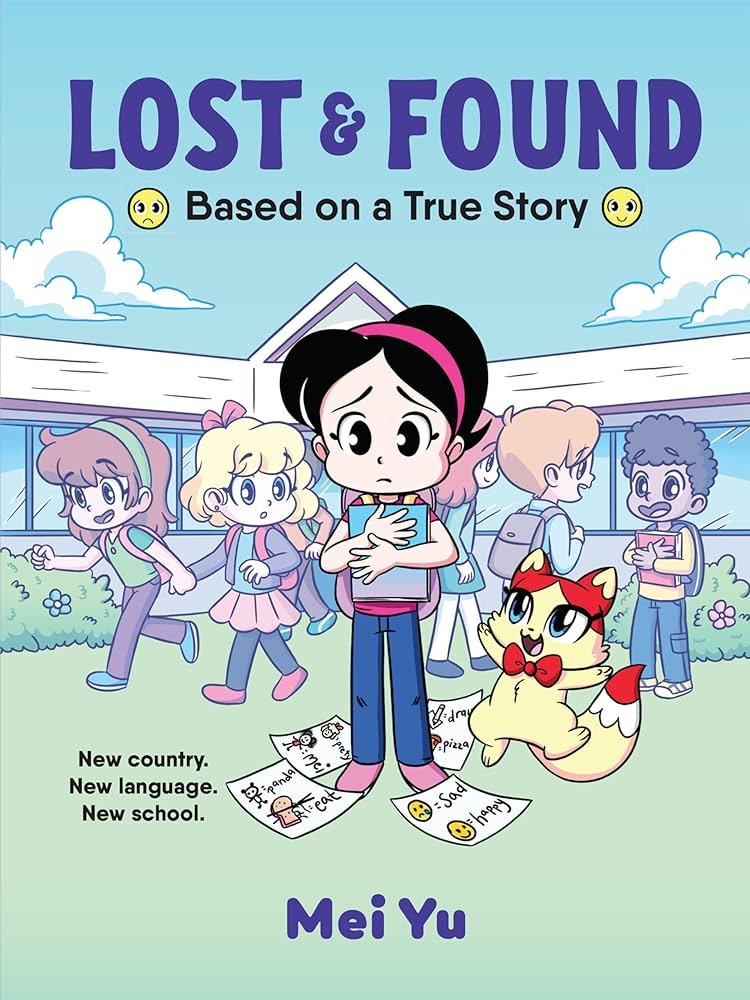
Lost & Found: Based on a True Story by Mei Yu (Union Square Kids, 128 pages, grades 2-5). Mei Yu recounts her memories of moving from China to Canada at a young age (probably six or seven). With English words in a green font, readers can see how few words she understands at school and the scary situations that ensue: using the wrong bathroom, thinking kids are laughing at her, losing her beloved sketchbook. Mei eventually uses the sketchbook to create a collection of English words, and before long, she is able to communicate and begin to make friends. An author’s note gives more information about her experience, as well as a simple glossary of Chinese words. There’s a funny bonus story about how Mei got her beloved toy cat, who appears real to her, a la Calvin and Hobbes.
It’s a pretty simple story, but the difficulties of immigration are presented in a way that beginning readers will be able to understand, and everyone is sure to love the manga-style artwork.
Blue Stars: The Vice Principal Problem by Kekla Magoon and Cynthia Leitich Smith, illustrated by Molly Murakami (Candlewick, 176 pages, grades 3-7). Cousins Maya and Riley are almost polar opposites, but they’re forced to share a room at their grandmother’s house when Maya’s military parents are stationed in Japan and Maya’s family moves away from the Muscogee reservations for opportunities in Urbanopolis.
At the start of sixth grade, outgoing Riley gravitates towards gymnastics and a big group of friends, while Maya prefers her own company and working on robotics. They unite against the villainous vice principal, though, when they learn of his plan to cut all after-school clubs to fund the expansion of his detention space. Working together, they discover each one has talents that lend themselves to the defeat of this plot. They begin to see themselves as superheroes, befriending two boys who become their sidekicks and assistants. The kids manage to save their school activities, but the vice principal is still at the school plotting his evil deeds, making a sequel seem inevitable.
Next Stop by Debbie Fong (Random House Graphic, 272 pages, grades 4-7). Pia’s family has endured an almost unimaginable loss, and they are dealing with it in different ways. Her mother has become withdrawn and depressed, while her dad insists that they move to have a “fresh start.” Pia is caught in the middle, blaming herself and trying to navigate her parents’ emotions. When she’s offered a bus trip to a lake rumored to have magical powers, she jumps at the chance.
The journey proves memorable, with a quirky cast of characters that slowly starts to feel like family as they travel to such sites as the world’s smallest corn maze, the Prickly Park cactus cruise, and a motel shaped like a chicken. The tour guide, a friend of Pia’s father, looks after Pia, who develops a memorable friendship with the guide’s daughter. There’s an older couple desperately seeking a cure for the wife’s illness, and a family with a young daughter with whom Pia bonds. The story of the trip is interspersed with flashback scenes in a more muted palette, slowly showing the reader what has happened to Pia’s family. When the tour finally reaches the lake, a dramatic scene unfolds in which Pia begins to get closure and to forgive herself for what happened. It may not be exactly what she was hoping for, but it helps her family move toward healing when she returns home.
Having just disparaged graphic novels for not being more creative, I am now forced to eat my words after reading these two. They both offer something new, and I found the format and story of Next Stop particularly compelling. The family tragedy and the sadness that pervades the story may make it a bit more appropriate for the older end of the recommended age range. As for Blue Stars, I loved the premise and the contributions to the story by both of the award-winning authors. I wished the book had been a bit longer to develop the plot more fully (the girls went from being enemies to close friends in the space of about a page and a half), but I think kids will love this series opener and will look forward to more to come.
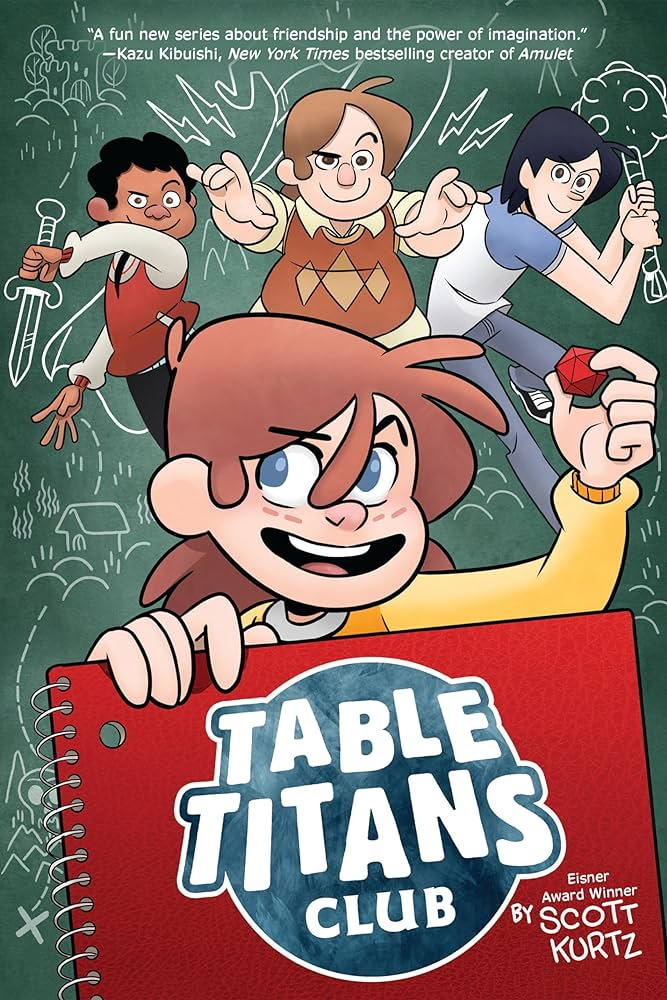
Table Titans Club by Scott Kurtz (Holiday House, 224 pages, grades 3-7). Valeria “Val” Winters is new at school, and her mom’s reminder of a fresh start tips readers off that she may have struggled before. Val’s first day is rough, but she catches the attention of the Table Titans Club, a group of Dungeons and Dragons players. After much debate among the members, one of them invites Val to join their school club. Val’s thrilled, although she’s never played D&D.
Turns out she’s a natural, and all seems to be going well until their teacher sponsor announces that his wife is having a baby, and he has to cut back on his hours. When he tells them that Coach Bitner will be replacing him, the Titans are sure their club is doomed. But Val manages to win Coach Bitner over and secure a spot on the wrestling team. After a number of bumps in the road, Val and the Titans (including another new girl Titan) manage to save the club and secure a wrestling team victory. Val’s announcement about a role-playing fantasy summer camp she’s discovered just about assures a sequel.
Duck and Moose: Duck Moves In! by Kirk Reedstrom (Disney Hyperion, 64 pages, grades 1-3). Moose loves peace and quiet, so when Duck settles in on his antlers, Moose is furious. He tries to convince/trick Duck to find a home in a pond, on a mountaintop, and inside a cave, but Duck is convinced they should be neighbors. Finally, Moose gives up. When Duck realizes how upset Moose is, he sets up a home a short distance away, then invites Moose over for a movie night. They unexpectedly bond over a favorite movie and snacks, and a surprising friendship is born.
These two graphic novels are sure to be big hits, with some funny characters, situations, and artwork as well as heartwarming conclusions. However, I couldn’t help but feel a sense of deja vu: a loveable troublemaker starting middle school is a familiar graphic novel theme and we’ve seen the introvert/extrovert friendship in other early reader series like Narwhal and Jelly, Beak and Ally, and Frank and Bean. Guess I can’t blame publishers for wanting to go with a sure thing, but a few creative risks would be nice to see as well.









 A Kids Book A Day