Tru and Nelle by G. Neri

Published by HMH Books for Young Readers 
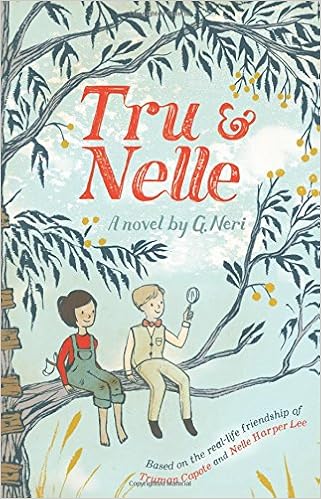
Summary:  When Tru and Nelle first meet, he thinks she is a boy and she thinks he is a girl.  After exchanging a few rounds of insults, the two become fast friends.  Both live in Monroeville, Alabama, a sleepy little town in the throes of the Great Depression, but their combined imaginations create a force to be reckoned with.  They love to read, and Sherlock Holmes becomes a favorite.  Before long, Tru is Sherlock and Nelle is Watson, and they’re on the prowl for a real mystery.  A break-in at the local drugstore provides one, but it ends in disaster, and the two decide it’s safer to write their stories than to act them out in real life.  Eventually, Tru’s socialite mother remarries and sends for him to join her in New York City, but first he throws a blow-out farewell party that results in a confrontation with the local Ku Klux Klan.  The writing, the friendship, the wild party…all foreshadow what would happen to these two children who grew up to become Truman Capote and (Nelle) Harper Lee. 336 pages; grades 3-5.

Pros:  Fans of To Kill a Mockingbird will enjoy learning more about the real-life Scout and Dill.  The writing beautifully captures the Depression-era South.  Modeled on Capote’s Breakfast at Tiffany’s, the book ends with a few short stories which are flesh out the longer novel.

Cons:  Readers in the targeted age range aren’t likely to be familiar with Harper Lee or Truman Capote, making this a much less appealing choice for the younger crowd.
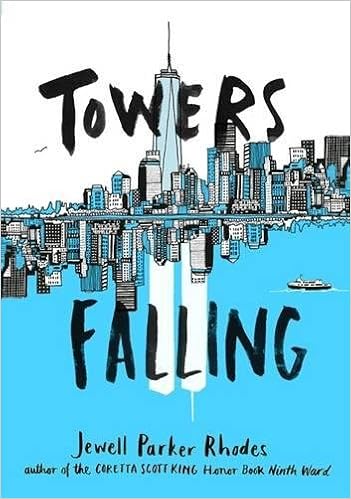
Towers Falling by Jewell Parker Rhodes

Published by Little, Brown Books for Young Readers

Summary:  Deja’s home is a single room that she shares with her parents and younger brother and sister in a Brooklyn homeless shelter.  Her father, for reasons that are unclear to Deja, is unable to hold a job; her mother’s salary as a waitress isn’t enough to cover basic living expenses for the family.  With the move to the shelter, Deja has to change schools.  She’s nervous at first, but quickly makes two friends, Ben and Sabeen, and discovers that she likes this school better than any other she’s attended.  There’s a new curriculum for the fifth graders this year, teaching them about 9/11 and their connection to that event.  At first, Deja’s mystified by this, as she’s never heard about the events of 9/11.  Gradually, she comes to understand not only the tragic day itself, but its impact on her friends—Ben, whose father served in the military in Iraq and Sabeen, whose Muslim family has had to deal with prejudice and discrimination—and her own family.  As Deja becomes more insistent, her father gradually tells her about what happened to him on that fateful day, and together, they begin to move toward healing and rebuilding their family.  240 pages; grades 4-6.

Pros:  A powerful story to commemorate the 15th anniversary of 9/11.  Readers who weren’t alive in 2001 will learn along with Deja the events of that day and how it changed the people of the United States.

Cons:  It was difficult for me to believe that a fifth-grader who had spent all her life in New York City had never heard about the World Trade Center or 9/11.

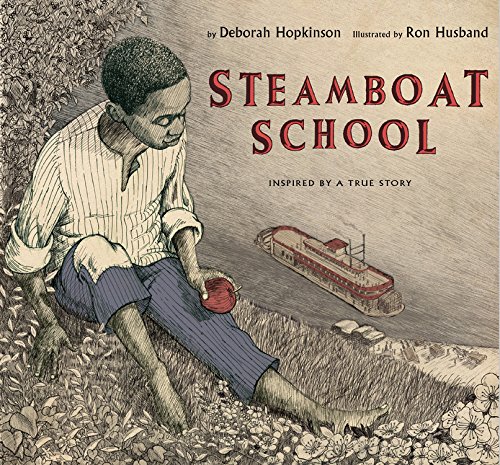
Steamboat School: inspired by a true story by Deborah Hopkinson, illustrated by Ron Husband

Published by Disney Hyperion 

Summary:  James isn’t too enthusiastic on his first day of school.  Held in a windowless church basement, it’s the only school available for free blacks living in Missouri in the 1840’s.  It’s called a Tallow School, because it’s lit by candles.  “We make our own light here,” explains his teacher, Reverend John.  When a state law is passed prohibiting schools for “negroes and mulattoes”, Reverend John is undaunted.  He spends months building and refurbishing a steamboat on the Mississippi river.  Finally, one morning at dawn, the children meet their teacher, who rows them out to the boat.  It’s a school!  And state law doesn’t apply to the river, so the students are safe to resume their education.  An author’s note tells more about John Berry Meachum, who was the real Reverend John.

Pros:  A fascinating and inspiring piece of historical fiction, beautifully illustrated by the first African-American animator at Walt Disney Studios.

Cons:  Not much is known about this school and the students who attended it.

Nine, Ten: A September 11 Story by Nora Raleigh Baskin

Published by Atheneum Books for Young Readers 

Summary:  On September 10, 2010, four kids deal with difficulties in their lives.  In Shanksville, Pennsylvania, Will is still grieving the loss of his father, killed when trying to help a stranded motorist on the highway.  Aimee’s mother is off on another business trip to New York City, while Aimee stresses about starting a new school in California.  Sergio is so upset with his absentee father that he skips school and rides the NYC subway, where he meets a kind firefighter who takes Sergio under his wing.  Naheed is starting middle school and for the first time in her life, is self-conscious about the hijab she wears.  Everything changes early the next morning, when events unfold across the U.S. that will impact all four children for a long time into the future.  The final chapter, “One Year Later” brings them together for the one-year ceremony at Ground Zero.  An author’s note tells her personal story of 9/11 and how she came to write this book.  208 pages; grades 3-7.

Pros:  Four engaging stories come together on two fateful days.  Fans of the “I Survived” series will enjoy this book—while there isn’t much of the survival element, it is gripping historical fiction about a catastrophic event.

Cons:  So many characters in a relatively short book makes it hard to get to know any one of them.

A Bandit’s Tale: The Muddled Misadventures of a Pickpocket by Deborah Hopkinson

Published by Knopf Books for Young Readers 

Summary:  When 11-year-old Rocco is accused of stealing from his parents’ landlord in Italy, he is sold off to a padrone who brings him to New York City to work as a street musician.  In reality, he’s little more than a beggar and a slave, forced to turn over his earnings to the padrone in return for minimal food and shelter.  Hungry and desperate to return home, Rocco joins a band of pickpockets.  He turns out to be a pretty good bandit, and for a while, it looks like he may have found a way to get enough money for a return passage to Italy.  But a bungled robbery results in his arrest, and Rocco finds himself in a reform school on an island off of Manhattan.  A daring escape during the Blizzard of 1888 almost kills him, but he is a rescued by a kind Irish man and his daughter.  Living with them begins a chain of events that puts Rocco’s life back on track and allows him to help other immigrant boys caught in his circumstances.  Back matter includes more information on the historical period covered and about the picaresque novel.  304 pages; grades 3-7.

Pros:  Rocco’s adventures cover a dizzying array of real and imagined people and places from late 19th century New York City.  He’s a scrappy, likeable narrator, and kids will learn a lot of history while enjoying a page-turning set of adventures.

Cons:  The author’s notes seemed a bit too long to hold most kids’ attention.

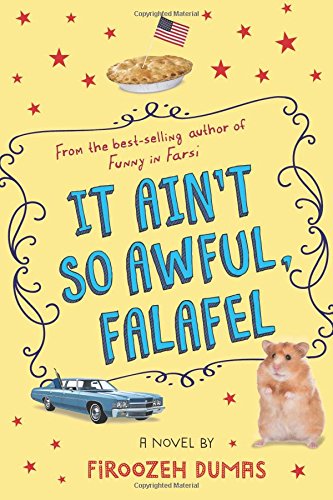
It Ain’t So Awful, Falafel by Firoozeh Dumas

Published by Clarion Books 

Summary:  Zomorod is starting sixth grade in Newport Beach, California, the latest stop on her family’s shuffle between their native Iran and her father’s petroleum engineering jobs in California.  It’s not an easy transition, but Zomorod knows one step she can take to help herself—change her name to Cindy.  Middle school has its ups and downs, but Cindy makes some good friends, is at the top of her classes, and finds herself enjoying life in America.  It’s 1978, though, and as events in Iran deteriorate, so does Cindy’s life.  The anti-Iranian sentiment peaks with the taking of American hostages, and Cindy’s father’s job gets cut.  No one is hiring Iranian engineers, and as the crisis in Iran drags on, Cindy finds herself withdrawing from her friends.  Finally, the family is out of savings, and it looks like they will have to go back to Iran—an Iran they hardly recognize anymore under the Ayatollah Khomeini.  Just as things are bottoming out, help comes from a most unexpected source, and Cindy’s friends and neighbors show her that kindness is an international virtue.  An author’s note tells about the semi-autobiographical nature of her story and introduces the Falafel Kindness project.  384 pages; grades 4-7.

Pros:  If Judy Blume were an Iranian immigrant and didn’t write about puberty issues, she might sound something like this.  Cindy’s story is a perfect blend of middle school girl story, historical fiction, and lessons in compassion.

Cons:  When events from your own high school days are categorized as “historical fiction”.

Wolf Hollow by Lauren Wolk

Published by Dutton Books for Young Readers 

Summary:  1943 is the year Annabelle turns 12, and a year when heart-wrenching circumstances change her life forever.  The catalyst is the arrival of Betty Glengarry, the 14-year-old granddaughter of Annabelle’s neighbors, and a girl who quickly establishes herself as a bully.  Her targets include Annabelle and Toby, a World War I veteran who lives as a squatter on a smokehouse near Annabelle’s family’s farm.  Although some of the neighbors have always been wary of Toby, Annabelle and her parents know him as a good man, if somewhat reserved and eccentric.  When Betty goes missing, Toby is a prime suspect, and Annabelle believes it is up to her to help.  Despite her efforts, tragic events unfold, and Annabelle sees the best and worst of humanity encapsulated in her small Pennsylvania community.  304 pages; grades 5-8.

Pros:  The beautiful writing, engagingly flawed characters, and subtle but profound messages have put this book at the top of my 2017 Newbery contender list.

Cons:  This is definitely a tragedy…there’s not a happy ending, although it’s appropriate, and in many ways, satisfying.   Young readers will need some help to understand the many layers of the story.

Brave Like My Brother by Marc Tyler Nobleman

Published by Scholastic 

Summary:  Joe is off to England from Cleveland, Ohio, having been drafted to fight in World War II.  His younger brother Charlie slips a letter into his bag before he leaves, and this begins a correspondence between the two brothers that lasts from June 6, 1942 until August 2, 1944.  Only the first and last letters are from Charlie, although others are alluded to as Joe writes home about his war experiences.  Although Charlie’s always looked up to Joe, Joe doesn’t see himself as a hero, just an ordinary guy struggling to survive in extremely difficult conditions.  Training, dealing with a bully in his unit, capturing a spy, and a (sort of) failed mission are all detailed in his letters, which lead up to the climax of D-Day on June 6, 1944.  The final letter is Charlie’s, telling Joe how his courage helped Charlie deal with a bully at home.  An author’s note gives a little more background on Joe’s mission and the history recounted in soldiers’ letters home during World War II.  112 pages; grades 2-5.

Pros:  A good introduction to World War II for younger readers, with likeable characters, inspiring courage, and some adventure, but not too much gory detail.

Cons:  Joe’s mission, which seems to have taken a couple days, takes him almost five months to describe in his letters.

A Year of Borrowed Men by Michelle Barker, illustrated by Renne Benoit

Published by Pajama Press


Summary: In 1944, when Greta was 7 years old, she and her family were told by the German government that they were getting three French prisoners of war to live on their farm. They were “borrowed men”, only there for the duration of the war, which Greta likened to the way her father has been “borrowed” to serve in the war. The men had to live in the barn with the pigs; when Greta invited them in for dinner one night, her mother was called into town and threatened with imprisonment. But despite the difficult living situation and the lack of a common language, the family and the prisoners became friends. Greta found a way to help them decorate their tiny Christmas tree, and they helped her when she accidentally melted the hands and feet of her new Christmas doll. A year later, the war ended and the prisoners were liberated, but the memory of the friendship continued on. An author’s note gives more information about her mother, Greta. 40 pages; grades 1-4.

Pros: A gentle and touching introduction to World War II. Although a few wartime atrocities are alluded to, all the characters in this story are kind, wanting to help each other despite being on different sides.

Cons: Kids will need some historical context before reading or hearing the story.

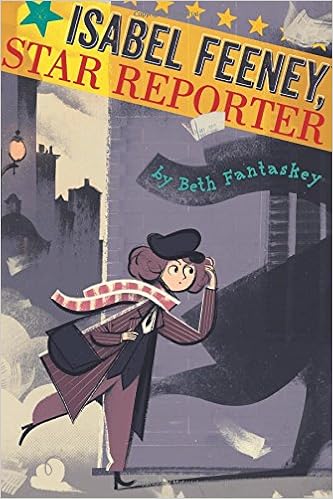
Isabel Feeney, Star Reporter by Beth Fantaskey

Published by Houghton Mifflin Harcourt 

Summary: Isabel Feeney is a newsgirl in 1920s Chicago. One night, she sells a paper to one of her favorite customers, Miss Giddings, who then walks off with her boyfriend. A few minutes later, shots ring out in an alley. The boyfriend is dead, and Miss Giddings is arrested for murder. Isabel’s sure she’s innocent, and sets out to prove it. She gets the reluctant help of her hero, Maude Collier, a reporter for the Chicago Tribune who covers Murderess’s Row at the Cook County Jail. There are red herrings aplenty—mob connections, an angry ex-husband, a jealous sister—and Isabel finds herself in real danger. As a key witness, she’s called in to testify at Miss Giddings’s trial, and it’s there that she finally realizes (and dramatically reveals) the true murderer’s identity. 352 pages; grades 4-7.

Pros: Historical fiction meets mystery in this tale of gangster-ridden Chicago. Isabel is a funny and feisty heroine, and the 97 short chapters, many with cliffhanger endings, keep the action going.

Cons: I wasn’t exactly shocked to learn the identity of the murderer.