World War II in fact and fiction

Max in the House of Spies: A Tale of World War II by Adam Gidwitz (Dutton Books for Young Readers, 336 pages, grades 4-7). “Once there was a boy who had two immortal creatures living on his shoulders. This was the fourth most interesting thing about him.” The other things about Max are that he’s a genius, particularly in the mechanical realm, that his parents send him from Berlin to England as part of the Kindertransport in 1939, and that he falls in with some spies, even though he’s only 11. The immortal creatures, a kobold named Berg and a dybbuk named Stein are invisible and inaudible to everyone but Max, which proves both huge help and a terrific nuisance.

Max wants nothing more than to return home and save his parents. Much to his surprise, he ends up living with a Jewish family in London, giving him the chance to observe British antisemitism up close. It’s this family that brings him into contact with the spies, allowing Max to use his genius to get them to agree to send him back to Berlin as a British spy. First there’s an intense training, where it takes every bit of Max’s brains, as well as help from Berg and Stein, to pass to the next level. Finally, Max is ready to go, assigned to be carried in by a paratrooper in the dead of night. That’s as much as I can tell you now, except to assure you that the cliffhanger ending will have you praying that Adam Gidwitz is a speedy writer who can produce book 2 ASAP.

The Enigma Girls: How Ten Teenagers Broke Ciphers, Kept Secrets, and Helped Win World War II by Candace Fleming (Scholastic Focus, 384 pages, grades 5-9). If you’ve seen The Imitation Game, you’re familiar with Bletchley Park, the top-secret British facility where thousands of men and women worked day and night to crack German codes. This book focuses on ten of the young women, many still in their teens, who came to work in various jobs there. Each one had a very specialized task, whether it was translating, indexing, or keeping machines running. The work was absolutely grueling, with rotating eight-hour shifts to keep a 24-hour schedule, and it was top, top secret. Workers couldn’t even discuss what they were doing with those in a different department.

All were motivated by a desire to save lives and win the war, although at one point, one of the women reflects on the fact that saving British lives meant losing German lives. They all put their lives on hold, some for years, to do their important work. When the war ended, the girls went their separate ways, never telling anyone, including spouses and family members, what they had done. It wasn’t until the late 1970’s that some of the secrecy was lifted and stories started to be told. In the 1990’s, what was left of Bletchley Park was restored and opened as a museum. An author’s note and extensive source notes and index are a testament to the research done by Candace Fleming.

Reading these two books caused me to reflect on how World War II is still being mined for stories for all ages, more than any other time period I can think of. It seems like an era that easily lends itself to unambiguous tales of good versus evil. I appreciate how Adam Gidwitz subtly points out the racism and antisemitism that was prevalent in Britain, as well as making a point of England’s centuries of colonialism and empire building that preceded the war, with little concern for indigenous people in the conquered lands. The Enigma Girls is a more straightforward war story, with an interesting emphasis on the importance of women’s work that is often missing (e.g., Christopher Nolan’s Oppenheimer). Ten enigma girls were a lot for me to keep track of, especially since their stories were all woven together, and, although I would have liked to have known each one better, it did emphasize the diversity of backgrounds of those who ended up at Bletchley Park. It’s also unfortunate, although understandable, that not many photos exist of the facility, and Candace Fleming made the decision not to include any of the women’s photos, since she couldn’t find pictures of all of them.

Stories from the past to inspire future generations

The Last Stand by Antwan Eady, illustrated by Jarrett and Jerome Pumphrey (Knopf Books for Young Readers, 40 pages, ages 4-8). A boy tells the story of his grandfather’s farm stand, the last stand in a community where there used to be a whole farmers’ market. Not only does Papa grow food and sell it at his stand, but he delivers to neighbors who can’t get out. The day comes when Papa is the one who isn’t well enough to go to the stand, and the boy has to use his own resourcefulness to keep the business going. Fast forward a few years, and the last page shows the boy grown, Papa apparently having passed away, and another stand re-opened, offering hope that the market can come back again.

I’m thrilled to see a new book illustrated by the Pumphrey brothers, almost as thrilled as I was when they won a Caldecott Honor this year for There Was a Party for Langston. This story harkens back to my favorite book of theirs, The Old Truck, with its empowering themes of Black farmers surviving despite the odds being stacked against them and passing a legacy down to the next generation. Be sure to read the author’s note to learn more about the struggles of Black farmers, as well as offering an acknowledgement of discrimination against other farmers, including women and Indigenous communities.

Tree of Life: How a Holocaust Sapling Inspired the World by Elisa Boxer, illustrated by Alianna Rozentsveig (Rocky Pond Books, 40 pages, grades 1-4). In the Czechoslovakian ghetto of Terezin, a teacher named Irma Lauscher secretly taught children to read, write, and celebrate Jewish holidays. To help them observe Tu Bishvat (The New Year of the Trees), she obtained a maple sapling, putting herself and the prisoner who got it for her at enormous risk. The children shared their water rations with the sapling, watching it grow, until many of them were “taken away on trains to a place that was even worse.” Miraculously, the tree grew and flourished until the end of the war when it was five feet tall. Eventually it grew to sixty feet, and Irma Lauscher, who also miraculously survived, sent seeds from the tree to places around the globe. When the tree finally died in 2007, there were 600 descendants all over the world, including one planted outside New York City’s Museum of Jewish Heritage in 2021.

Elise Boxer’s author’s note also adds context to this story of brave people finding hope in tragedy, and offers additional information about Terezin, a Nazi propaganda camp that sent most of its inhabitants to Auschwitz. It includes the chilling statistic that 90% of Europe’s Jewish children were killed in the Holocaust, serving as a timely reminder of the horrors of war in which the innocent are victims. I hope this will be a contender for the Sydney Taylor award.

Some brave girls

Small Shoes, Great Strides: How Three Brave Girls Opened Doors to School Equality by Vaunda Micheaux Nelson, illustrated by Alex Bostic (Carolrhoda, 40 pages, grades 2-5). Ten minutes before Ruby Bridges entered William Frantz Elementary School on November 14, 1960, three other six-year-old girls, Leona Tate, Tessie Provost, and Gail Etienne, started school across town at McDonogh 19 Public School. Escorted by U. S. Marshals, the girls were in a first-grade class taught by Miss Florence Meyers. Although there were other white students at school that day, they quickly left, leaving the girls as the only three students in the building for the rest of the year.

The girls were heroic, as were their parents, Miss Meyers, and the marshals, who helped them find the courage to keep going and made their first-grade year as normal as possible. Second grade proved a bit easier; after Christmas, about twenty-five new students arrived, and the kids were allowed to go outside for recess. Unfortunately, the girls were sent to a different school the following year, where they experienced bullying, racism, and occasional physical violence from students and even some of the teachers. In the end, the girls “survived and helped change our nation.”

This fascinating book will appeal to kids who are familiar with Ruby Bridges’s story. Leona, Tessie, and Gail were all interviewed for the book, as was one of the surviving U.S. Marshals. The text is quite long, and there’s a ton of back matter: more about school desegregation in New Orleans and Norman Rockwell’s painting based on it, what happened to the three girls when they grew up (two opted for all-Black schools in sixth grade, but all graduated high school, and two finished college.) There are also photos, a glossary, a bibliography, and websites with additional information.

Do You Know Them? Families Lost and Found After the Civil War by Shana Keller, illustrated by Laura Freeman (Atheneum Books for Young Readers, 40 pages, grades 1-4). After the Civil War, Lettie and her Uncle Charlie are searching for lost family members. The newspapers are filled with ads, mostly people seeking information about their families, but occasionally someone reporting that a loved one has been found. Lettie holds on to this hope as she saves her pennies and reads the ads aloud to the congregation at church. Finally, she and Uncle Charlie have saved the fifty cents needed for an ad. Weeks go by, until one Sunday, Lettie is able to share the ad from a woman saying she knows their family. “Hallelujah!” rings out through the church, celebrating with Lettie.

This moving historical fiction story of the post-Civil War years weaves some of the real ads into the narrative (the author’s note at the end tells more about them) and doesn’t shy away from stories that don’t end as happily as Lettie’s. The illustrations are beautiful, incorporating the ads and the pennies Lettie saves into the main pictures.

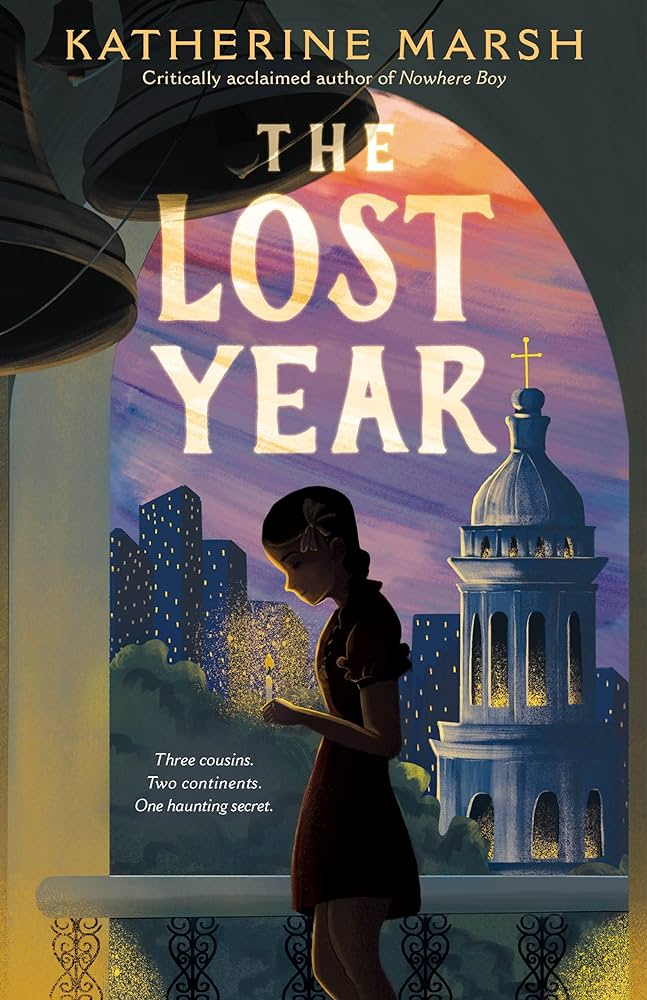
The Lost Year by Katherine Marsh

Published by Roaring Brook Press

Summary:  During the 2020 pandemic lockdown, Matthew is stuck at home with his harried mother and his 100-year-old great-grandmother, GG.  After too many hours in front of screens, Matthew loses his video game privileges and is ordered to help GG sort through her boxes of possessions.  When he discovers photos of her as a girl with another girl named Helen, Matthew begins to ask questions.  Reluctantly at first, GG begins the story of three cousins: Mila, a wealthy girl living in 1930’s Ukraine with her father, a devoted Soviet official; Helen, living in Brooklyn during the Great Depression; and Nadiyah, a peasant girl facing starvation during Holodomor, the Ukrainian famine caused by Stalin’s policies.  The narratives slowly reveal a secret GG has kept for decades, and by the end both she and Matthew are ready to share her story with the rest of the family.  Includes several pages of additional historical information.  368 pages; grades 4-8.

Pros:  I’d love to see this well-written, extensively researched book considered for a Newbery.  In addition to the main plot, which is super engaging and had a twist that completely blindsided me, there’s an interesting subplot about journalistic integrity and efforts (largely successful, unfortunately) to suppress the story of the Holodomor.

Cons:  I personally enjoyed the connection to 2020, but I saw some reviewers on Amazon who didn’t like that, and, as I’ve mentioned before, I find pandemic books to be a hard sell to the kids at my school.

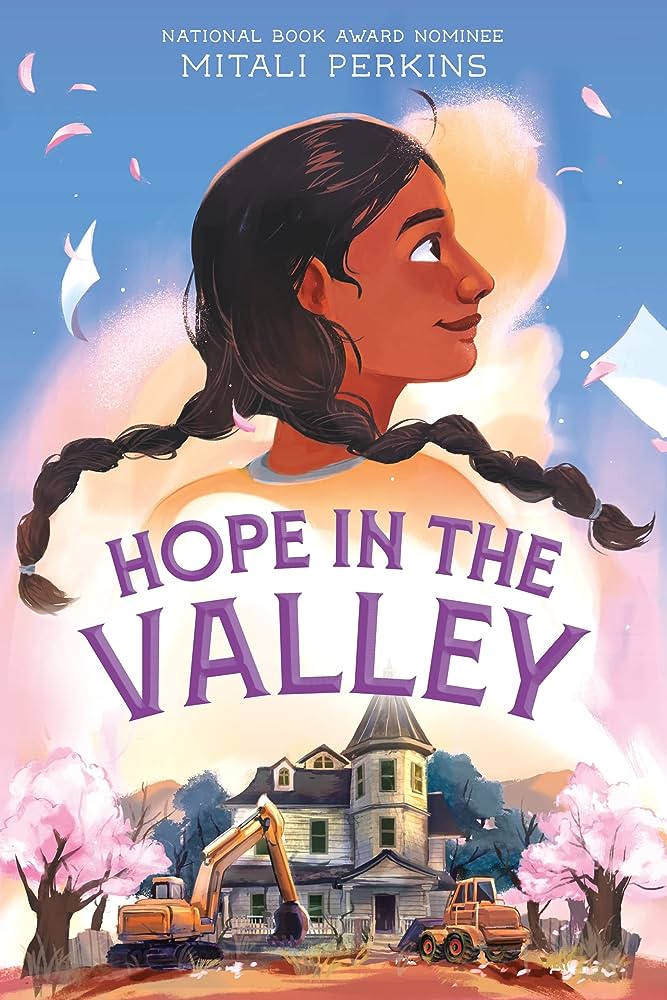
Hope in the Valley by Mitali Perkins

Published by Farrar, Straus and Giroux

Summary:  Pandita is looking forward to a relaxing summer of reading in her favorite secret hiding place–the porch of the abandoned house next door, a place she and her late mother liked to spend time.  When she learns that the house is being torn down by developers, Pandita is horrified and becomes part of a group trying to save it for historical preservation.  Her research on the old house leads to some surprising discoveries, as well as some new friendships.  There are other changes afoot during the summer, including four weeks of drama camp and a potential new stepmother whose brash opinions cause Pandita to label her The Intruder.  At first reluctant to attend drama camp, Pandita eventually discovers a talent for singing and learns to overcome her fear of speaking in public, a lesson that serves her well in her fight for the house.  Although things don’t turn out exactly the way Pandita wants them to, she discovers that change can be a good thing sometimes, leading to new connections and experiences.  304 pages; grades 4-7.

Pros:  This engaging historical novel documents the rapid changes going on in Silicon Valley in the 1980’s.  Introverts will take Pandita’s struggles and triumphs to heart and cheer her on as she discovers new talents and makes new friends.

Cons:  Although The Intruder eventually won the family over, she seemed pretty obnoxious at times, and I foresee some rocky times ahead for her and Pandita.

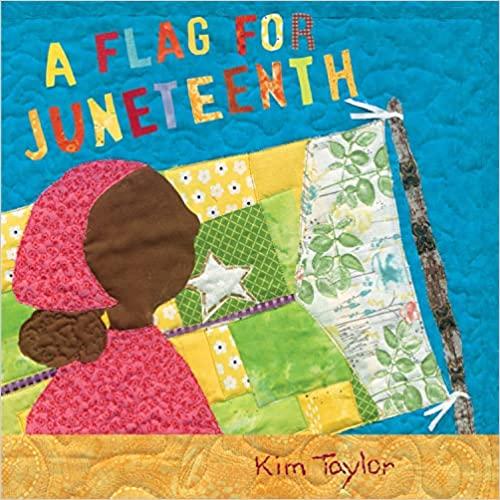
A Flag for Juneteenth by Kim Taylor

Published by Neal Porter Books

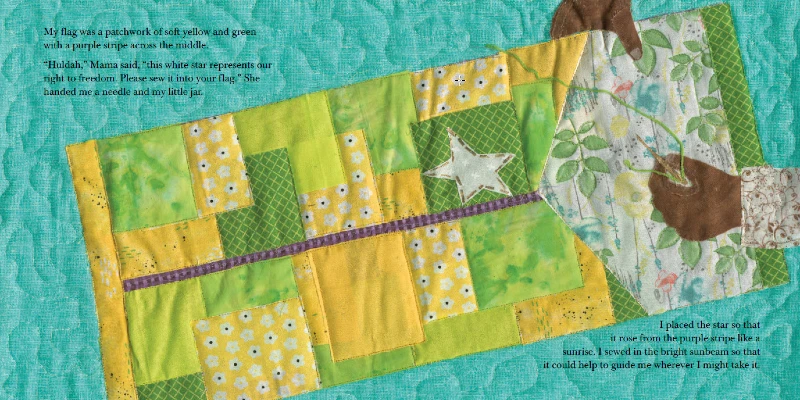
Summary:  Huldah is excited to be turning ten on June 19, 1865.  That excitement grows when, on the morning of her birthday, soldiers ride up to the Texas plantation where Huldah and her family live and announce that all slaves are free and have been since Abraham Lincoln signed the Emancipation Proclamation two years earlier.  All around her is a celebration, and a group of women begins to create freedom flags.  Huldah takes some time for herself, climbing a tree to capture a sunbeam in a jar.  When she returns, it’s time for her birthday celebration.  Her friends and family give her her own freedom flag; later, during a moonlit walk with her family, she wraps her baby sister in the flag, and the family celebrates this day of jubilee.  Includes an author’s note about how she came to create the quilts that illustrate this book.  40 pages; ages 4-8.

Pros:  With Juneteenth coming up in a few weeks, this is a great introduction for younger readers, illustrated with distinctive quilt-inspired illustrations.  Kids may want to design their own freedom flags after reading this.

Cons:  There’s not a ton of information about Juneteenth here, so you may want to supplement with some other resources.

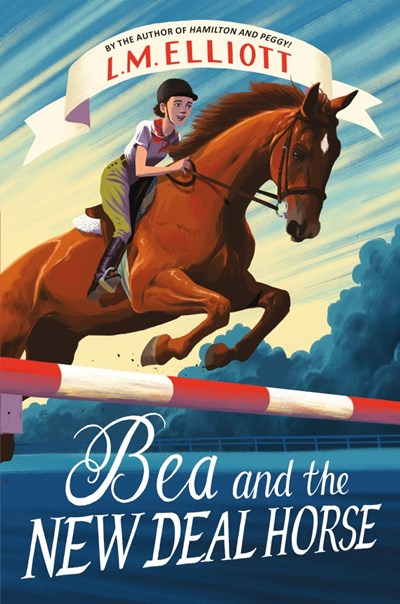
Bea and the New Deal Horse by L. M. Elliott

Published by Katherine Tegen

Summary:  The Great Depression has taken just about everything away from Bea: her dad’s job, her mother, and her home.  Now her father is drinking too much, trying to hold things together for Bea and her younger sister Vivian as they travel from one place to the next.  After sleeping in a barn in Virginia one night, Bea wakes up to discover her father has left a note and vanished.  The note says that Mrs. Scott, the owner of the farm, is the mother of the girls’ mother’s college roommate and will give them a place to live.  Bea is cautious about revealing their identity, but eventually Mrs. Scott discovers them and reluctantly lets them stay on her horse farm.  She is facing financial difficulties as well and has recently made things worse by buying an ornery chestnut horse to save him from an abusive owner.  Bea takes a liking to the horse, and after many ups and downs, Mrs. Scott agrees to train her to ride, with the hope of showing and selling him in a few months.  Bea, Mrs. Scott, and the horse have all been through some tough times, and it’s difficult for them to trust one another, but slowly they start to forge a bond, helped by Malichi, a blind Black WWI veteran who works in the house and Ralph, a loyal stable hand for many years.  By the time of the horse show, despite the high stakes, the somewhat patchwork group has solidified into something resembling a family.  Includes a lengthy author’s note with additional historical information and a list of sources.  384 pages; grades 4-7.

Pros:  Fans of The War That Saved My Life will want to check out this historical fiction novel with a heroine whose gritty determination has been shaped by hardship.  Anyone who loves horses will also appreciate the many scenes of riding and barn life, and I encourage you to keep a few Kleenexes handy for the final horse show.

Cons:  I was not crazy about the name they finally chose for the chestnut horse.

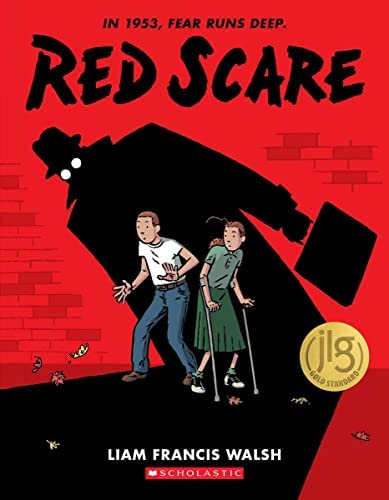
Red Scare by Liam Francis Walsh

Published by Graphix

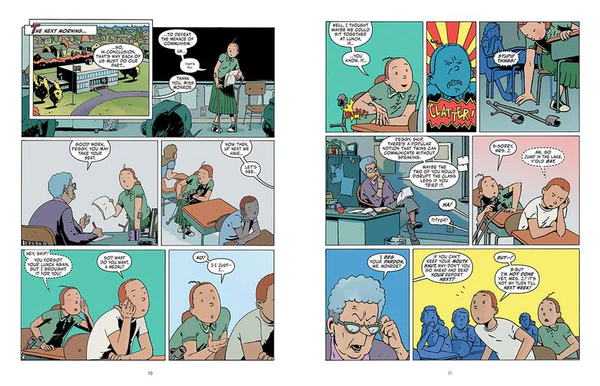
Summary:  Peggy’s got a lot going on: she’s recovering from polio and has to use crutches, her twin brother Skip has started being mean to her, and her father has returned from the Korean War with serious physical and psychological injuries, forcing her mother to work as a hotel maid.  One night, Peggy goes to work with her mom and winds up being a witness to a murder and unknowingly coming into possession of a mysterious substance.  When she realizes that she has this potion and that it enables her to fly, she and her new neighbor Jess begin having adventures all over town.  The FBI catches up with them eventually, intent on recovering the potion no matter who gets in their way.  When a suspenseful showdown atop a fire tower puts Peggy, Jess, and Skip in danger, Peggy finds out that she is braver than she thinks.  Includes additional information about polio, the red scare, and the atomic age. 240 pages; grades 4-7.

Pros:  Great snakes!  Tintin fans will love the Hergé-inspired artwork and nonstop adventures of this historical graphic novel that features the red scare of the 1950’s, polio, UFO’s, the Korean War, and a stirring speech about freedom and respecting others’ beliefs delivered by Peggy’s father to the mob going after Jess’s Communist dad.  

Cons:  There was a lot going on in 240 pages, both the rapid-fire plot and the characters’ development and growth, making some resolutions feel a bit too speedy.

The Door of No Return by Kwame Alexander

Published by Little, Brown Books for Young Readers

Summary:  11-year-old Kofi has a good life as part of his West African community.  He finds his English-speaking teacher pretentious but likes to learn and enjoys hanging out with friends at school, especially Ama, the girl he has a crush on.  His cousin is his rival, and Kofi is preparing for a swimming race between the two of them that may determine his future with Ama.  When his older brother Kwasi accidentally kills a prince in a wrestling match, life begins to take some dark turns.  The prince’s family kidnaps both Kwasi and Kofi; Kofi is eventually shackled and crowded onto a ship (the door of no return) with others to be taken away from their homes.  A plot twist in the end leaves the readers in suspense, preparing the way for the next book in this planned trilogy.  Includes a Twi glossary and guide to Adinkra symbols that appear in the book.  432 pages; grades 6-9.

Pros:  Kwame Alexander has produced another masterpiece novel in verse that is sure to win some awards.  The transition from Kofi’s life in Africa to his captivity is stark, violent, and may be disturbing to younger or more sensitive kids, but the whole story adds so many important dimensions to the narrative of slavery.

Cons:  The story takes place in 1860, which seemed late to me.  I thought the slave trade ended well before that.  I wish there had been more historical notes at the end to explain what was going on at that time.

Me and Muhammad Ali by Jabari Asim, Illustrated by AG Ford

Published by Nancy Paulsen Books

Summary:  Langston is excited when he learns that Muhammad Ali is coming to his town. Langston admires Ali as much for his poetry as for his fighting, and his mom likes that the boxer is fighting to make the world a better place.  On the day of the big event, Langston gets his Afro shaped to look just like his hero’s, listening to the men in the barbershop talk about their own athletic exploits as well as their stories of Muhammad Ali.  Finally, Langston and his mom arrive at the high school, only to be stopped by a security guard who tells them the event is only for students.  No matter how much they plead with the guard, he refuses to let them inside.  “What’s the problem here?” asks a man, and when Langston looks up, Muhammad Ali is standing right in front of them.  Ali personally escorts them inside, and Langston’s dream comes true.  Includes an author’s note about the 1975 event that inspired this story.  32 pages; ages 4-8.

Pros:  It’s great to see so many Black history books for younger kids this year.  This one includes some of Muhammad Ali’s poetry, as well as poems that Langston makes up.  The illustrations do a great job of capturing the 1975 vibe.

Cons:  No list of additional resources on Ali.