Saving Sunshine by Saadia Faruqi, illustrated by Shazleen Khan

Published by First Second

Summary:  Pakistani American twins Zara and Zeesh are constantly fighting, despite sharing scientific passions, Zara for animals and Zeesh for astronomy.  When their parents take them to Key West for a medical conference where their doctor mother will be honored, the two bicker the entire way down.  Exasperated, their parents take away their phones, telling them that they must spend some time together.  Without the distractions of technology, the two eventually find and help rescue a stranded loggerhead sea turtle.  Woven into the main story are incidents of prejudice and racism, including flashback scenes showing Zara’s decision to start wearing hijab, and the bullying that led to Zeesh’s quitting the space club.  224 pages; grades 3-7.

Pros:  This graphic novel seamlessly incorporates the experience of being Muslim and Pakistani American into a universal tale of sibling rivalry and devotion that many readers will connect with.

Cons:  When Zeesh gets annoyed at people always asking where he’s from (he was born in the US), both his dad and later, the white vet dismiss his feelings.

The Wild Robot Protects written and illustrated by Peter Brown

Published by Little, Brown Books for Young Readers

Summary:  Everyone’s favorite robot is back.  At the end of The Wild Robot Escapes, Roz had finally returned to the beloved island that she made her home in The Wild Robot.  Now that home is being threatened by the poison tide, a toxic substance in the ocean that is sickening and killing animals.  When it reaches her island, Roz decides she must travel north to find the legendary shark who is said to have the power to stop the poison tide.  After discovering that her new body is waterproof, Roz walks and swims through the ocean until she finds not only the shark but the source of the poison, which turns out to be a substance created during the mining process for minerals used to make robots.  A lengthy battle ensues that results in the destruction of the mining operation and almost the destruction of Roz.  She survives, though, and makes it home to meet her new grandchildren/grandgoslings.  320 pages; grades 3-7.

Pros:  I don’t usually review three books in a series, but I had to find out what was new with Roz and was not disappointed.  Peter Brown explores the themes of home and the interconnectedness of life (to quote from his author’s note) in an exciting adventure that sees the wild robot exploring the ocean depths and making new friends with the animals she meets there.

Cons:  As in the other two books, I kind of skimmed through the battle scenes, my least favorite part of the story.

Mascot by Charles Waters and Traci Sorell

Published by Charlesbridge

Summary:  Six eighth graders and their teacher take on the topic of racist mascots when they are assigned to a debate about their town’s Braves mascot, which often inspires face paint and tomahawk chopping at sports events.  At first, only the girls are opposed: Callie, a member of the Cherokee nation and Black; Priya, the Indian American editor of the school paper; and Tessa, a White girl who has been homeschooled through seventh grade.  The boys mostly just want to enjoy the local teams, but eventually Franklin, who is Black, joins the girls in their campaign and loses Luis’s friendship in the process.  Sean’s family is struggling with poverty but has long supported the Braves and opposes changing tradition.  As the school year draws to a close, tensions mount as the anti-mascot campaign kicks into gear and the kids learn more about what is most important to them and to their families.  Includes lists of Cherokee and Salvadoran Spanish words used in the text and additional information about mascots and taking action.  256 pages; grades 4-8.  

Pros:  A timely issue is explored through the voices of a diverse group of middle school kids, all of whom are presented sympathetically with realistic reasons for their various points of view.  A quick read that could easily inspire students to look around them to see what might need to change in their own communities.

Cons:  The story was extremely agenda-driven; the novel-in-verse format didn’t allow for much character or plot development outside of the mascot issue.

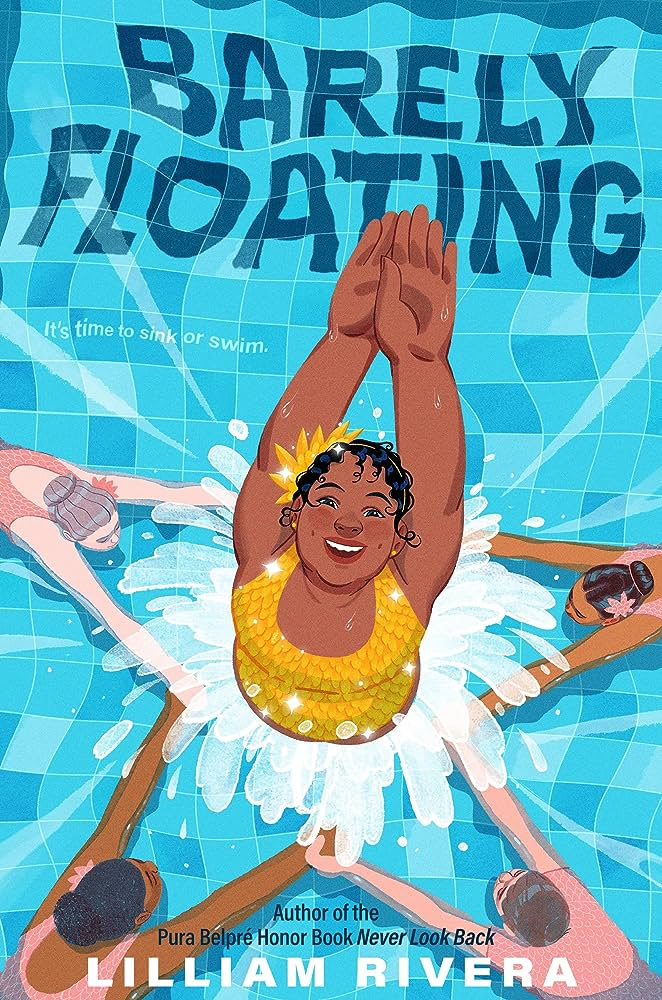
Barely Floating by Lillian Rivera

Published by Kokila

Summary:  Nat has grown up in a very progressive household, always encouraged to stand up for herself and to see herself as beautiful.  Her mom doesn’t understand Nat’s love of fancy clothes and make-up, and when Nat sees the L.A. Mermaids perform a synchronized swimming routine, she knows her parents won’t get why she wants to become part of the team.  They do, in fact, deny her request to join, so Nat enlists her older cousin Sheila to help her sneak off to practices and competitions, hoping that when she’s good enough she’ll be able to reveal her secret and persuade her parents.  But soon she’s entangled in a web of lies, hurting Sheila, her best friend Joanne, and herself.  When Nat’s deceptions catch up with her, she and her mother are finally able to communicate about their differences and to find a compromise that works for both of them.  240 pages; grades 4-7.

Pros:  A fun introduction to synchronized swimming with a memorable narrator who is both confident and vulnerable about putting herself out there.  The Mermaids are a gutsy group of kids who defy the stereotypes of thin white girls participating in the sport and really make it their own.

Cons:  I can generally get behind a good social justice warrior, but Nat’s mom’s constant outspokenness to various family members about progressive causes started to wear on me after a while.

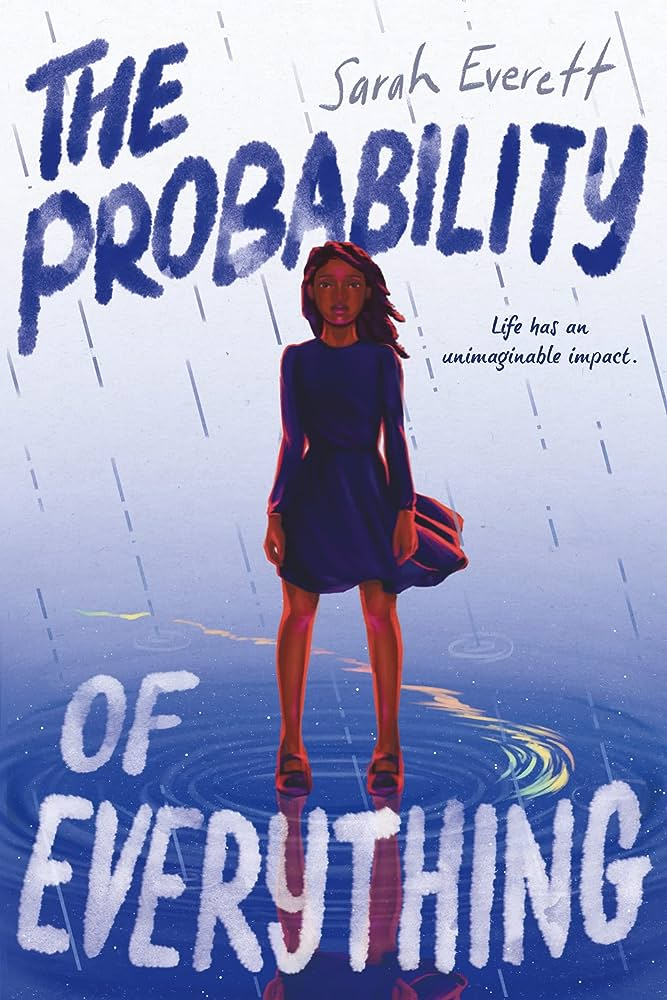
The Probability of Everything by Sarah Everett

Published by Clarion Books

Summary:  It’s an ordinary day for 11-year-old Kemi when the news of an asteroid rapidly approaching Earth changes everything.  Kemi’s passion for statistics and probability tells her that the 84.7% chance of a collision means that life as she knows it will most likely end in four days.  As her extended family gathers together, Kemi decides to put together a time capsule to show anyone who finds it what her family was like. From her grandmother’s Nigerian recipes to her family’s “magical” sweatshirt, the time capsule soon has representation of each family member except her dad. Kemi goes on a scientific quest to find out his true passion, something he’s been searching for since leaving a demanding job.  As the days tick by, a huge plot twist emerges, and readers learn why it feels like the end to Kemi and her family, as they learn that even when the world ends, there is always an after.  336 pages; grades 4-7.

Pros and cons:  I started this book at the end of July, and it has taken me almost six weeks to finish it.  With record summer temperatures and wildfire smoke in the sky, it took all my willpower to keep reading about the impending destruction of the world.  But as I finally neared the end and learned what had really befallen Kemi’s family, it occurred to me that this may be the most timely book of 2023, with its meditations on loss, grief, racism, violence, and of course, the end of the world as we know it.  A Newbery contender for sure, if only Sarah Everett were American, not Canadian.

Two Tribes by Emily Bowen Cohen

Published by Heartdrum

Summary:  Mia lives with her mother and stepfather, observing her Jewish faith both at home and at her Jewish day school.  When a boy at school tells her she’s not a “real Indian,” Mia goes on a quest to discover her Muscogee culture, passed down to her from her father’s side.  She and her best friend hatch a plan in which Mia uses some of her bat mitzvah money to take a bus from L.A. to Oklahoma.  She manages to pull it off and spends a few days with her dad and his family, learning more about her heritage, before her mother discovers where she is and flies down to get her.  Back home, Mia must face the consequences of her actions, but her new discoveries have given her courage to talk to her mother and stepfather about making some changes to allow her dad and her Muscogee family to be part of her life.  Includes a note from the author about her own Jewish-Muscogee heritage, a glossary of Muskvoke terms used, and a note from Heartdrum author-curator Cynthia Leitich Smith.  256 pages; grades 4-7.

Pros:  This debut graphic novel offers an interesting look at a unique heritage and the difficulties of embracing that when divorce separates a family.  Readers will empathize with Mia and enjoy learning about her Jewish and Muscogee cultures alongside her.

Cons:  I was a bit stressed about Mia’s secret 24-hour bus trip on her own.

We Still Belong by Christine Day

Published by Heartdrum

Summary:  Wesley is excited about two things as she heads to seventh grade one day: having her poem about Indigenous People’s Day appear in the school newspaper and asking her crush Ryan to the school dance.  As the day unfolds, however, both dreams are destroyed in true middle school fashion. A teacher criticizes her poem, telling her it’s not good enough to read aloud in his class, and Ryan shows up on social media with another date to the dance.  Defeated, Wesley heads to the annual powwow with her family, where her day starts to turn around.  Not only does she get encouragement about both the poem and Ryan, but she discovers a new friend and comes to embrace and appreciate her family and her Upper Skagit community even more. Includes an author’s note. 256 pages; grades 3-7.

Pros:  Readers will enjoy getting to know Wesley as they follow her through a day in her life, navigating friendships, family issues, and school.  Information about indigenous culture is expertly woven into the story and expanded upon in the author’s note.

Cons:  While I appreciated the excellent writing and storytelling, I found this book a little slow going at the beginning.

Ghost Book by Remy Lai

Published by Henry Holt

Summary: July has “yin-yang eyes”, meaning that she can see ghosts, but she feels as invisible as a ghost most days.  Her mom died when she was born, her dad is too preoccupied with work to pay much attention to her, and teachers and kids at school often overlook her.  Desperate for a friend, she tries to summon a ghost.  William shows up instead–a boy who is in a coma, and whose spirit is wandering around trying to figure out if he is dead or alive.  As the two kids do some investigating, they discover that they have a life-long connection, and that only one of them is meant to be alive.  Their explorations take them into the underworld, where they hope to change fate so that they can both live.  There, they are pursued by a variety of spirits bent on their destruction, but their friendship saves the day and helps them to figure out a way forward for both of them.  320 pages; grades 3-6.

Pros:  I’m a big fan of Remy Lai’s graphic (and semi-graphic) novels, and her latest one does not disappoint.  Part ghost story, part friendship story, part adventure, this will keep kids turning the pages until the surprising but totally satisfying conclusion.

Cons:  This is a bit darker than Lai’s previous books.

The Museum of Lost and Found by Leila Sales

Published by Harry N. Abrams

Summary:  Vanessa is mourning the loss of her friendship with former best friend Bailey when she discovers an abandoned museum near her house.  She decides to create an exhibit about Bailey to try to discover what went wrong between the two of them.  Although Vanessa tries to keep her museum a secret, before long her older brother and a few of her friends discover it and want to set up their own exhibits.  The group begins to bond as they create a map, admission fees, and a security system, and start inviting other kids to see their museum.  The most popular item on display is a mysterious painting Vanessa found in a back room of the museum.  Through some detective work, she eventually tracks down the artist, a move that ends up exposing the museum to adults.  This means the end of the museum as Vanessa has known it, but also an interesting new beginning.  Before long, other kids are creating their own museums all over town, including Bailey, who shows Vanessa her own take on their friendship that leads to the beginnings of a reconciliation.  304 pages; grades 4-7.

Pros:  Whew! I didn’t even touch on Vanessa’s trichotillomania, a disorder she discovers she has near the end of the story, or her active-duty military father with whom she has a complicated relationship.  There are a lot of issues explored, but Leila Sales does it with grace and plenty of humor, creating an imperfect but lovable protagonist in Vanessa and delving into a myriad of topics that will resonate with middle grade readers.

Cons:  Vanessa’s disorder takes the form of picking at her skin, especially her cuticles, which kind of made me cringe every time I read about it.

Buzzing by Samuel Sattin, illustrated by Rye Hickman

Published by Little, Brown Ink

Summary:  The bees swarming around Isaac’s head represent the thoughts brought on by his obsessive-compulsive disorder (OCD).  They’re constantly reminding him that if he doesn’t tug his ear five times or keep the foods on his plate from touching, his house may burn down, or his car may crash.  When another kid at school makes friendly overtures, the bees remind Isaac how worthless and weird he is.  His overprotective mom keeps him on a strict regimen of therapies, causing his older sister Miriam to feel ignored and resentful.  Isaac’s talent for drawing fantasy creatures catches a classmate’s eye, and Micah invites Isaac to join a group playing Swamps & Sorcery, a role-playing game (think Dungeons & Dragons).  Isaac loves the group immediately, but his mother is less sure.  When she eventually prohibits him from playing the game, Isaac’s world goes into a tailspin.  Fortunately, Miriam is perceptive enough to see what is happening, and the siblings work together to finally break through to their mother and help her to accept Isaac exactly as he is.  Includes an author’s note about his own OCD and neurodivergence. 224 pages; grades 5-8.  

Pros:  This graphic novel perfectly captures the vibe of a group of middle school outsiders who have fully embraced their weirdness (their word).  Isaac’s joy at finding the group is shown by the switch from monochromatic illustrations at home to full color when he’s with his friends.  

Cons:  RPG fans will undoubtedly enjoy the fantasy subplot based on the kids’ game that’s woven throughout the main story, but I found those sections to be more of a distraction.