Food for the Future: Sustainable Farms Around the World by Mia Wenjen, illustrated by Robert Sae-Heng

Published by Barefoot Books

Summary:  From a honey farm in Yemen to a circular garden in Senegal to an underwater biosphere in Italy, this book takes readers on a tour of innovative sustainable food production sites around the world.  Each two-page spread has a rhyming couplet about the farm or other site, with illustrations showing people at work.  A map at the end shows all the sites and provides information about sustainable farming and food justice.  There’s additional information about each place, including a description and why it’s sustainable.  Includes notes from the author and illustrator about how they were inspired to create this book.  40 pages; ages 4-8.

Pros:  An inspiring look at sustainable food production that includes both indigenous practices and new technology.  The built-in definitions and pronunciation guides make this a great resource for younger kids, who will also find the bright folk art style illustrations appealing.

Cons:  Some additional resources would have been nice.

Super Small: Miniature Marvels of the Natural World by Tiffany Stone, illustrated by Ashley Spires

Published by Greystone Kids

Summary:  Each of the fifteen tiny animals profiled here has a superpower. Whether it’s the pygmy seahorse’s ability to camouflage, the axolotl’s regenerative powers, or the black-footed cat’s lethal aim, each animal has something that allows it to survive despite being so small.  Each profile includes an illustration, a poem, and a comic strip that gives the animal the chance to show off its special abilities.  The final poem asks readers to consider what their superpowers might be.  36 pages; grades K-4.

Pros:  The cute poems, comics, and illustrations offer a fascinating look at some unique animal adaptations, and the last poem is a nice way to get kids thinking about what makes them unique as well.

Cons:  I would have loved some additional information at the end, particularly about how the hydra stays young forever.

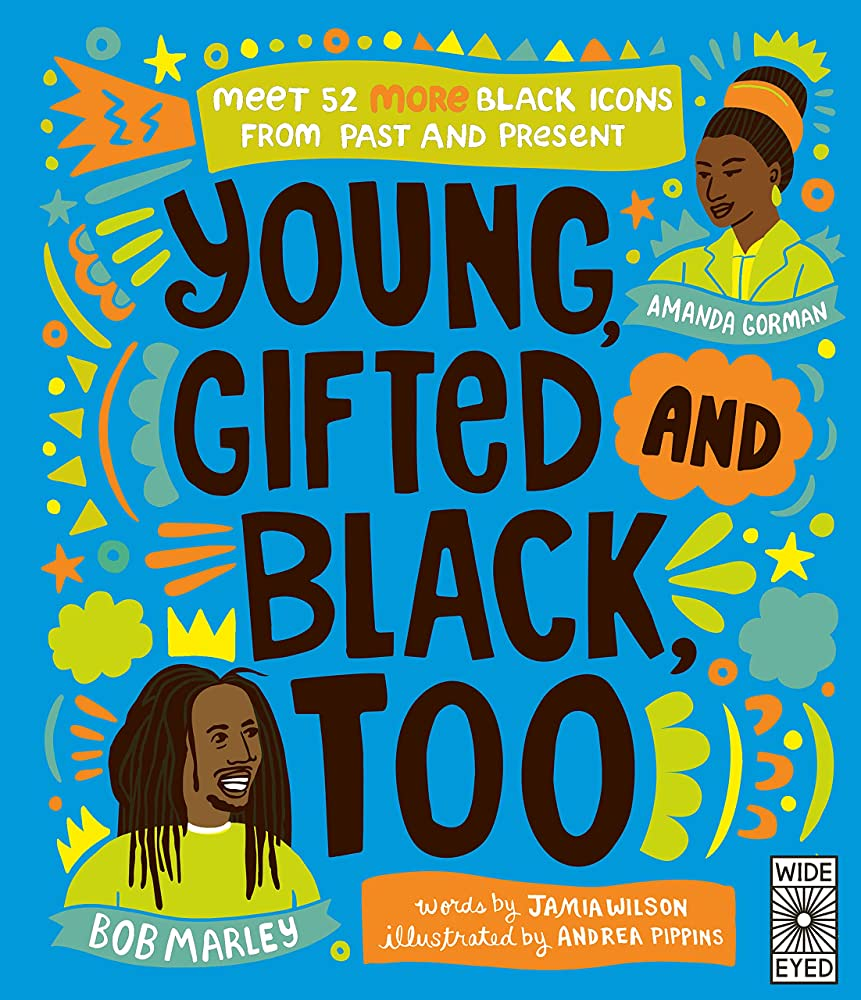
Young, Gifted, and Black, Too: Meet 52 More Black Icons from Past and Present by Jamia Wilson, illustrated by Andrea Pippins

Published by Wide Eyed Editions

Summary:  In this second volume of the series, profiles of 52 Black people from all over the world are arranged chronologically, beginning with Spanish poet Juan Latino (c. 1518-c. 1594) and concluding with Flint, Michigan activist Mari Copeny (2007-present).  Each subject gets several paragraphs of text and a folk art-style illustration that includes objects that show the subject’s area of expertise.  The introduction encourages readers to think about what contributions they want to make to the world.  Includes a glossary.  64 pages; grades 2-6.

Pros:  An excellent addition to Black history collections, with plenty of recognizable names like Thurgood Marshall and Coretta Scott King but lots of lesser-known ones that deserve to have some light shone on them.  There’s lots of international representation and the illustrations do a nice job celebrating the subjects’ achievements.

Cons:  The information is necessarily short, so additional resources will be needed for more in-depth research.

Rise to the Sky: How the World’s Tallest Trees Grow Up by Rebecca E. Hirsch, illustrated by Mia Posada

Published by Millbrook Press

Summary:  The tallest living thing isn’t an animal: it’s a tree.  Trees can grow taller than the Statue of Liberty or Big Ben, closing in on 400 feet.  Amazingly, they all start as a small seed, but the ideal conditions of sunlight and water can result in lots of growth and a long life, sometimes thousands of years, with protection from their bark and roots.  From their great height, the trees send down their seeds to the ground, beginning the process all over again.  Includes additional information about trees, photos and facts about some of the world’s tallest trees, a couple of tree activities, and a list of resources.  32 pages; grades K-4.

Pros:  An excellent informational book with beautiful illustrations and plenty of back matter.  Perfect for any unit on trees, plants, or seeds.

Cons:  It would have been nice to have a map showing where the tallest trees live, since they seem to be concentrated in just a few places in the world.

Love Is Loud: How Diane Nash Led the Civil Rights Movement by Sandra Neil Wallace, illustrated by Bryan Collier

Published by Simon and Schuster/Paula Wiseman Books

Summary:  Growing up in Chicago, Diane Nash went to integrated schools and didn’t experience much discrimination.  When she went to Fisk University, though, she was appalled by the Jim Crow laws she encountered in Nashville.  Unwilling to accept the status quo, she overcame her fears to protest segregated lunch counters, eventually leading a movement that led to the mayor desegregating all of Nashville’s counters.  She went on to work with Martin Luther King, Jr. and the Freedom Riders to end segregation of interstate buses.  When she was sent to jail while expecting her first child, her refusal to be released on bail drew national attention.  Diane later returned to Chicago and continued her activism, losing her passport when she traveled to North Vietnam in 1966.  She’s traveled across the U.S. for decades, continuing to deliver her message that love creates change.  Includes an author’s note, an illustrator’s note, a timeline, and additional resources.  48 pages; grades 2-6.

Pros:  An inspiring story of a woman whose incredible courage led to real changes during the civil rights movement, and who has kept that work going to this day (she was awarded the Presidential Medal of Freedom in 2022).  As usual, Bryan Collier’s beautiful watercolor and collage illustrations should be considered for Caldecott or King award.

Cons:  I found the second-person narrative (“You arrive in the spring of 1938…”) confusing when it came to describing some of the events Diane Nash was involved in.

Jumper: A Day in the Life of a Backyard Jumping Spider by Jessica Lanan

Published by Roaring Brook Press

Summary:  As a young girl explores a backyard garden, a jumper spider engages in parallel activities.  They both have senses to explore the world around them, but Jumper’s senses are extra keen, with sound-detecting hairs all over her body and eight eyes that see in all directions.  These senses, plus her jumping abilities, keep her safe from predators like a chickadee and a wasp.  She also uses them for hunting, and the final pages show her successful capture of a fly as big as she is.  Includes four pages of additional information, a glossary, a list of resources, and steps for finding and identifying spiders.  48 pages; ages 4-8.

Pros:  Spectacular illustrations portray a spider’s-eye view of the world, including a gatefold illustration of what the garden looks like through eight eyes.  The extensive back matter makes this an excellent resource for research.  Could be a Caldecott or Sibert contender.

Cons:  The capture of the fly is not for the faint of heart.

How Do You Spell Unfair? MacNolia Cox and the National Spelling Bee by Carole Boston Weatherford, illustrated by Frank Morrison

Published by Candlewick

Summary:  MacNolia Cox loved reading, studying, and spelling, which paid off when she won her eighth-grade spelling bee in 1936.  This victory qualified her for the Akron, Ohio all-city bee, where her correct spelling of “voluble” made her the first African American winner of that contest and sent her to the National Spelling Bee in Washington, D.C.  After weeks of preparation, fundraising, and a bit of celebrity, MacNolia and her mother were on their way to Washington.  As they headed south, they had to move to the Blacks-only car, and in D.C., they stayed with a local doctor, since they were barred from the all-white hotel.  She and another Black girl had to enter the spelling bee stage from the back door and sit at a separate table from the other contestants.  Despite the discrimination, MacNolia succeeded, advancing to the final five before getting out on the word “nemesis” (which was questioned, since it hadn’t been on the official list).  She didn’t win, but MacNolia helped level the playing field for spellers of the future, including Zaila Avant-garde, who in 2021 became the first African American to win the Scripps National Spelling Bee.  Includes an epilogue with additional information about the fight to end racism and discrimination in spelling bees.  40 pages; grades 2-5.

Pros:  A fascinating story about a courageous girl who persevered to follow her dreams.  The text cleverly asks readers to spell words appropriate to the story, and Frank Morrison’s distinctive illustrations portray MacNolia and her family with dignity and grace.

Cons:  I was sorry to read in the epilogue that MacNolia couldn’t afford college and worked as a maid for a doctor.

Champion Chompers, Super Stinkers and Other Poems by Extraordinary Animals by Linda Ashman, illustrated by Aparna Varma

Published by Harry N. Abrams

Summary:  Using mask poems (poems in which the writer speaks in the voice of someone or something else), Linda Ashman has animals give hints as to what they are and what superlatives (fastest, biggest, stinkiest, etc.) they hold in the animal world.  Each poem has an illustration showing part of the animal to give an additional clue.  Turn the page, and the animal is pictured in full, along with a paragraph of information.  Opening and closing poems introduce the contest.  Includes additional information about protecting endangered animals, measurements, and mask poems, as well as a glossary, and lists of websites and books.  48 pages; grades 1-4.

Pros:  I do love a good guessing book to keep kids engaged, and this one lets readers guess both the animals and the records they hold.  The illustrations are cute and offer hints to go with each poem.  Kids can try their hands at mask poems after reading these.

Cons:  It may be a little long for primary kids to get through all of these in one sitting.

We Are Starlings: Inside the Mesmerizing Magic of a Murmuration by Robert Furrow and Donna Jo Napoli, illustrated by Marc Martin

Published by Random House Studio

Summary:  Two starlings rest on a chilly morning, then fly away with others.  They travel for days, with more starlings joining them, until thousands of them are flying as a group, called a murmuration for the sound all those flapping wings make.  The huge flock provides warmth and protection, demonstrated when a peregrine falcon tries to attack.  After surviving that, the starlings are ready for some fun, diving and swooping in spectacular formations until they find a place to land and roost together.  Includes a two-page note about starlings.  40 pages; ages 4-8.

Pros:  The spectacular illustrations capture the movement of the murmuration, showing the black birds silhouetted against a beautiful sky at sunrise or sunset.  The poetic text gives just enough information to intrigue readers, with more offered in the note at the end.

Cons:  No additional resources.

Jackie Ormes Draws the Future: The Remarkable Life of a Pioneering Cartoonist by Liz Montague

Published by Random House Studio

Summary:  Jackie Ormes loved drawing from an early age and captured her dreams of adventure through her art.  After high school, she took a job as a freelance reporter for the Pittsburgh Courier, a Black newspaper, and eventually created the cartoon character Torchy Brown, a fashionable nightclub star who moved from the South to Harlem.  Torchy made people laugh but also addressed issues like racism and segregation.  When Jackie and her husband moved to Chicago, Torchy’s run ended, and Jackie had the opportunity to formally study art for the first time in her life.  Several years later, she returned to the world of comics with Patty-Jo, a six-year-old girl who spoke out about current events, and who would become Jackie’s most famous creation.  Includes additional information about Jackie Ormes and Patty-Jo, including a photo of the Patty-Jo doll, described as “America’s first upscale Black play doll,” an author’s note, and a list of selected sources.  40 pages; grades 2-5.

Pros:  A fun and insightful look at cartoonist Jackie Ormes’s life, with illustrations inspired by Jackie’s work, and an emphasis on the theme of the perseverance that led to her success.  Kids will relate to Jackie’s love of art and her determination to be successful and make a difference.

Cons:  The story ends shortly after World War II, and Jackie died in 1985; like another recent biography of Ormes, this doesn’t tell much about the second half of her life.