Summary: While many animals live in groups–a parade of elephants, a tower of giraffes, a pod of whales–there are some that live alone. The panther at the watering hole, the octopus in the ocean, the sloth in the jungle, and the bald eagle high in the sky are all solitary animals who have evolved to survive best on their own. A final page gives additional information about solitary animals, including a comparison with humans that concludes, “All creatures find their own balance.” 48 pages; ages 4-8.
Pros: The amazing digital illustrations of this book highlight animals both in groups and alone. The text emphasizes that different animals do well with different amounts of sociability, a lesson that kids may apply to themselves as well.
Cons: Is it just me, or is the word “introverts” becoming a bit hackneyed?
Summary: Environmental activist Rob Greenfield has lived in an off-grid tiny house, bicycled across the country, gone without showering for 1,000 days, and worn a “trash suit” through the streets of New York City to show people how much garbage they generate in a month. Diving into different environmental issues like energy, food waste, and transportation, he encourages kids to think about changes they can make in their lives and profiles young environmental activists. He includes sections on disconnecting from technology and building community, and how living more simply can encourage growth in both areas. Includes a glossary, list of resources, and index. 87 pages; grades 3-7.
Pros: An inspiring and accessible read, with lots of photos, infographics, and short sections of text that encourage kids to see how making small (and big) lifestyle changes can have a real impact.
Summary: The book starts off with a series of questions: Are some things more for girls and some for boys? Who made those rules? What happens if we don’t follow them? The text and pictures then show differences in sex and explain what gender identity is. Different families and gender roles are portrayed, with an emphasis on treating others with respect and love, no matter how they identify or choose to raise a family. A few people are profiled, like the Army’s first male nurse (Edward T. Lyon), the first openly transgender state senator (Sarah McBride of Delaware), and the first woman in space (Valentina Tereshokova). The final page asks, “Won’t it be nice to live in a world where we can all just be ourselves?”. Includes two pages of fun facts about gender and clothing. 40 pages; ages 4-8.
Pros: The authors do an excellent job of presenting a complicated subject in a way that young children will understand. Elise Gravel’s illustrations are fun and help to further illuminate the topics covered. An outstanding resource all around (although I wish it had a list of additional resources).
Cons: I’m sure it’s just a matter of time before the cultural warriors get this into their book-banning crosshairs.
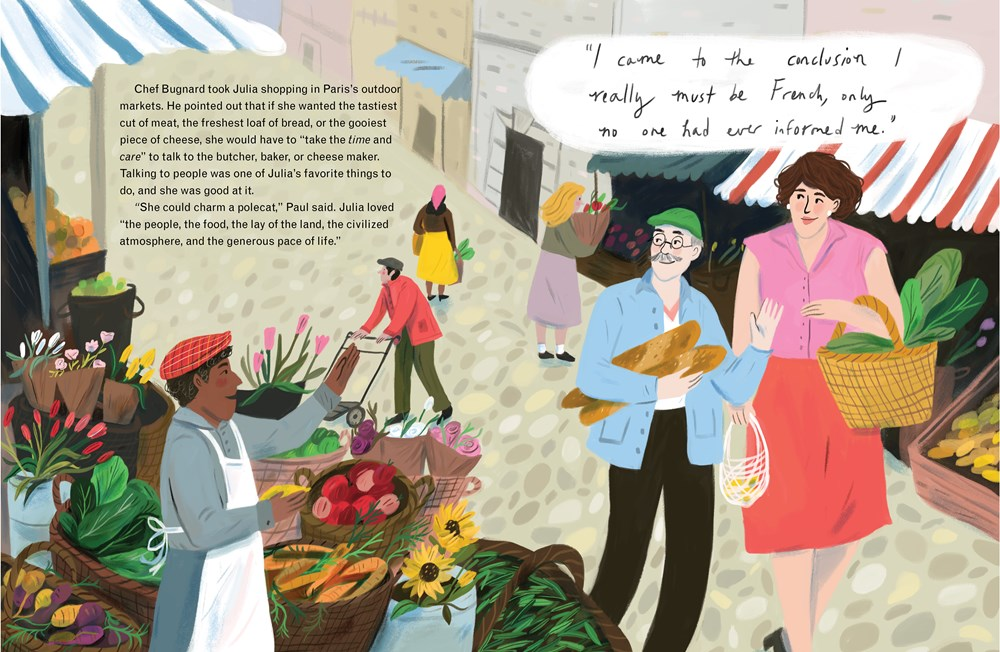
Summary: “I was born hungry, not a cook,” Julia Child said of her early days. Her family employed a cook, so young Julia never had to learn to prepare food. With a hunger for adventure, Julia volunteered for the Office of Strategic Services (OSS) during World War II, where she was sent to Ceylon (now Sri Lanka) and met her future husband, Paul Child. Paul had lived in France and introduced Julia to fine food and wine. After getting married, the couple moved to Paris, where Paul worked at the US embassy and Julia threw herself into learning French cooking. She signed up for classes at Le Cordon Bleu and read French cookbooks at night. The book ends with her opening L’Ecole des Trois Gourmandes (The School of the Three Hearty Eaters) with two French friends and a picture of Julia on TV. Includes a two-page author’s note with photos that gives more information about Julia’s television career, an extensive list of resources, and a recipe for scrambled eggs (Oeufs Brouillés) . 40 pages; grades 1-5.
Pros: Alex Prud’homme’s grandfather was Paul Child’s brother, and he worked with Julia Child on her memoirs. His intimate knowledge of her life makes for an engaging picture book, with mouth-watering descriptions of food that are enhanced by the illustrations (often accompanied by the word “Yum!”).
Cons: I was sorry that the story ended just as Julia’s career as the French Chef was beginning.
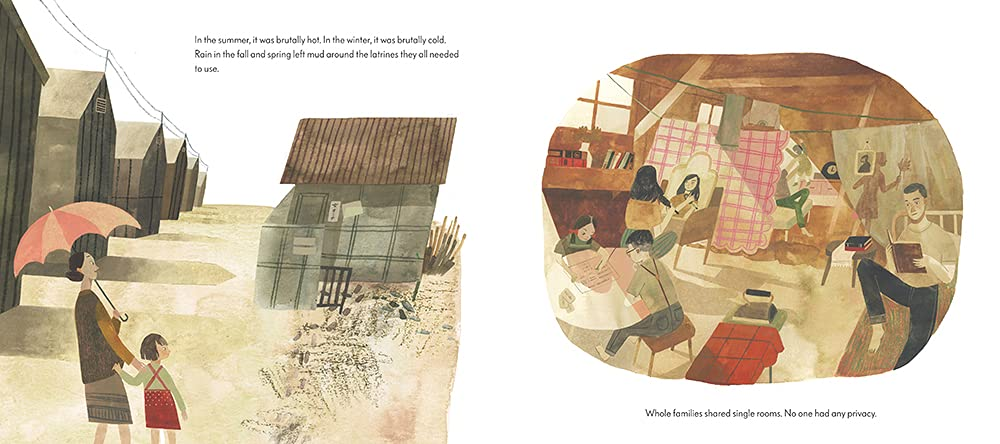
Summary: Tama and George have been at Minidoka, a prison camp for Japanese Americans, for a year. Tama works in the library, and George visits every day to check out a stack of books. The camp is dusty and hot in the summer, brutally cold in the winter, with monotonous days and no privacy for anyone. Tama tries not to think about her previous life, when she would have graduated from college, instead immersing herself in the world of books at the library. When she sighs over a book, George asks her what’s wrong. Tama tries to put into words all that she’s feeling, and George assures her that she’s human to feel that way. Tama realizes that George isn’t coming to the library just to check out a stack of books. The two of them get married and have their first child in camp, and Tama sums up her experiences in her journal: “The miracle is in us. As long as we believe in change, in beauty, in hope.” Includes an author’s note about her grandparents, George and Tama (with a photo), and with additional information about the 120,000 Japanese Americans who were incarcerated during World War II. 40 pages; grades 2-6.
Pros: This moving story does not hesitate from looking at the bleak conditions of Minidoka nor the racism that brought George, Tama, and so many others to live there, but also focuses on the hope and beauty of their story.
Cons: Early elementary kids may not relate to the romance of this story.
Summary: Clara Barton’s role in the battle of Antietam is documented in her own words, poems written by the author, and realistic illustrations of battlefront scenes. She nurses men (including one who is shot as she is giving him water), helps doctors, and cooks gruel from Indian meal she unexpectedly finds used as packing material. At the end of the ordeal, she’s put on a makeshift bed in the back of a wagon and driven 80 miles back to Washington, where she collapses from exhaustion and typhoid fever. Includes several pages of additional biographical information about Clara Barton, a bibliography, and a list of places to visit. 40 pages; grades 2-5.
Pros: The narrative and illustrations combine to portray the horrors of war, as well as the tirelessness that Clara Barton brought to the battlefield. The extensive back matter will help researchers understand more about Barton’s life.
Cons: Kids will need some prior knowledge of the Civil War and Clara Barton’s life to understand what is going on.
Summary: Growing up in Hawaii, Patsy Takemoto learned about her family’s Japanese heritage, including the expression “fall down seven times, stand up eight” that meant persisting in the face of adversity. Patsy faced adversity over and over again, being rejected from medical schools despite excellent grades, struggling to get a job as a lawyer after graduating from the University of Chicago law school, and being defeated in a bid for Congress. On her second try, though, she won, and in 1965, Patsy Takemoto Mink became the first woman of color in the U.S. Congress. Her personal experiences of discrimination, as well as letters she got from women all over the country, led her to fight for civil rights. She cosponsored Title IX, a bill requiring schools to treat men and women equally. It passed, but another bill was introduced that would have made sports exempt from the ruling. After a fierce fight, that bill was defeated, and Title IX became the law. Includes an author’s note, timeline, and bibliography. 48 pages; grades 1-5.
Pros: This excellent biography tells the story of a woman who may not be known to many but who helped bring about changes that have had a positive impact on girls and women all over the country.
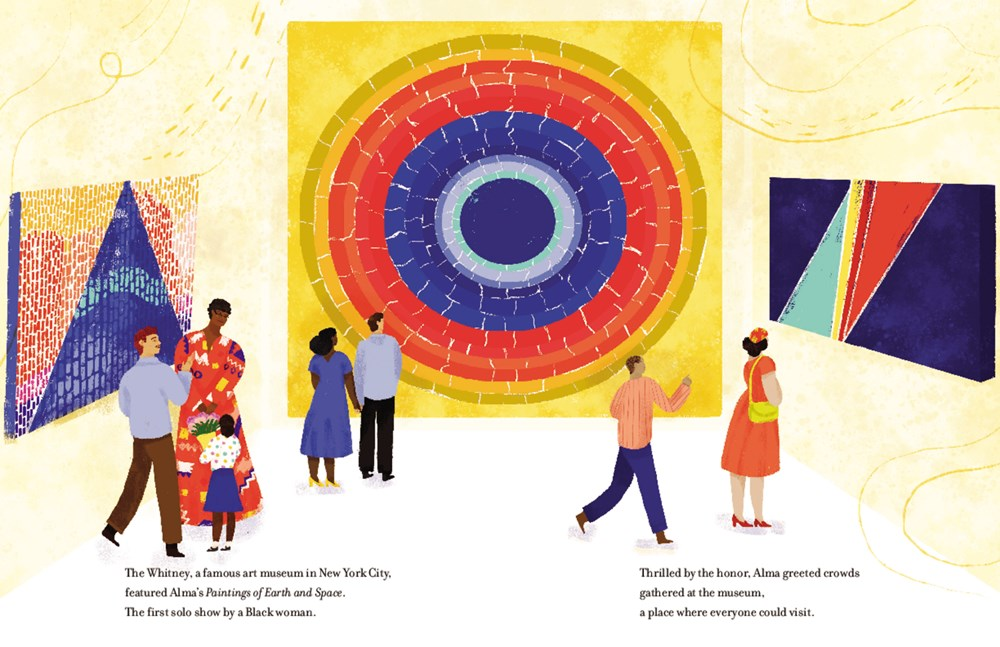
Summary: As a child in Georgia, Alma Thomas loved observing the bright colors around her and making things with her hands. She and her three younger sisters weren’t allowed to go to the white school or library, so their parents filled their house with books and teachers. When Alma was 15, her family moved to Washington, D.C. to give their daughters more opportunities, and Alma graduated from high school and college, where she studied art. She taught for many years before retiring at age 69 and pursuing her own art. Using the bright colors she had loved as a child, she created paintings inspired by nature and by space travel. Alma was the first Black woman to have a solo show at the Whitney Museum in New York. Years after her death in 1978, Barack and Michelle Obama chose one of Alma Thomas’s paintings to hang in the White House, the first artwork there by a Black woman. Includes notes from the author and illustrator, photos, a timeline of events in Alma’s life and the United States during her lifetime, and a list of sources. 40 pages; grades K-4.
Pros: I had never heard of Alma Thomas, but I loved her story and the illustrations inspired by her art. While the intended audience may not appreciate the fact that Alma’s art career took off after she turned 70, I found that inspiring.
Cons: It seemed at odds with the theme of the book that the photo of Alma was in black and white.
Summary: Mary Katharine Goddard grew up in the Connecticut colony with her parents and younger brother William. Unlike most girls of the time, she learned to read and write alongside her brother. When her father died, she and her mother moved to Providence, Rhode Island, while her brother served an apprenticeship as a printer. He started several newspapers but had the unfortunate habit of abandoning them to move onto other endeavors. Mary Katharine learned the business and took over the papers, first in Providence, then in Philadelphia, and finally in Baltimore. When William started a new project, creating a postal service for the colonies, Mary Katharine took on additional responsibilities as postmaster of Baltimore. She was known as a loyal patriot, so when the Continental Congress decided to print a copy of the Declaration of Independence with the names of the signers, they gave her the job. Usually, Mary Katharine used the name M. K. Goddard for her printing work, but for the Declaration she used her full name, the only name of a woman to appear on the document. Includes an author’s note, list of important terms with definitions, and a list of sources. 40 pages; grades 2-5.
Pros: This is a great resource to add to American Revolutionary War units, featuring a little-known but fascinating woman who seems to have been way ahead of her time. The author’s note gives lots of additional information, including the fact that Mary Katharine had an enslaved woman who helped her run her business (and to whom she granted freedom and left all her possessions when she died).
Cons: I saw this recommended for kids as young as 5, but the text-heavy story, small font, and need for some historical context make it a better choice for older kids.
A handful of picture book biographies about women arrived for me at the library this week, and since March is Women’s History Month, I’ll be featuring them for the rest of the week.
Published by Farrar, Straus, and Giroux
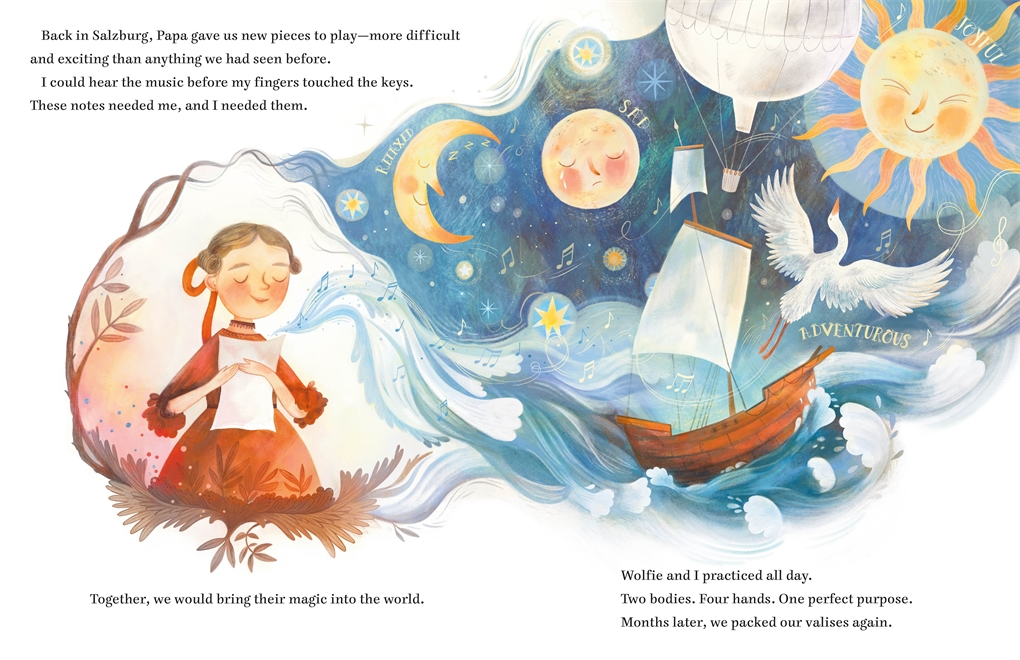
Summary: Maria Anna Mozart, known as Nannerl, tells the story of her life growing up with her younger brother, Wolfie. The two of them took to music at an early age and were playing concert halls in cities across Europe from the ages of five and ten. Nannerl also loved composing, but her father forbade it, saying that writing music was only for men. When Nannerl turned eighteen, she was told that touring was over for her and that she would stay home and get married. Wolfie continued to tour, and their correspondence grew less and less frequent until one devastating day when she learned of his death. Nannerl lived for almost forty more years, returning to Salzburg and her beloved harpsichord. Includes an author’s note explaining that this book is creative nonfiction, not a strict biography; also, a timeline, glossary, and list of books and online sources. 40 pages; grades K-4.
Pros: This is a fascinating story made more interesting by being told in Nannerl’s voice. The illustrations are a beautiful addition, particularly the ones that show the music created by the Mozarts.
Cons: A quick look at Wikipedia tells me there is a lot more to Maria Anna’s story and her relationship with her brother and father than this book is able to cover.













 A Kids Book A Day