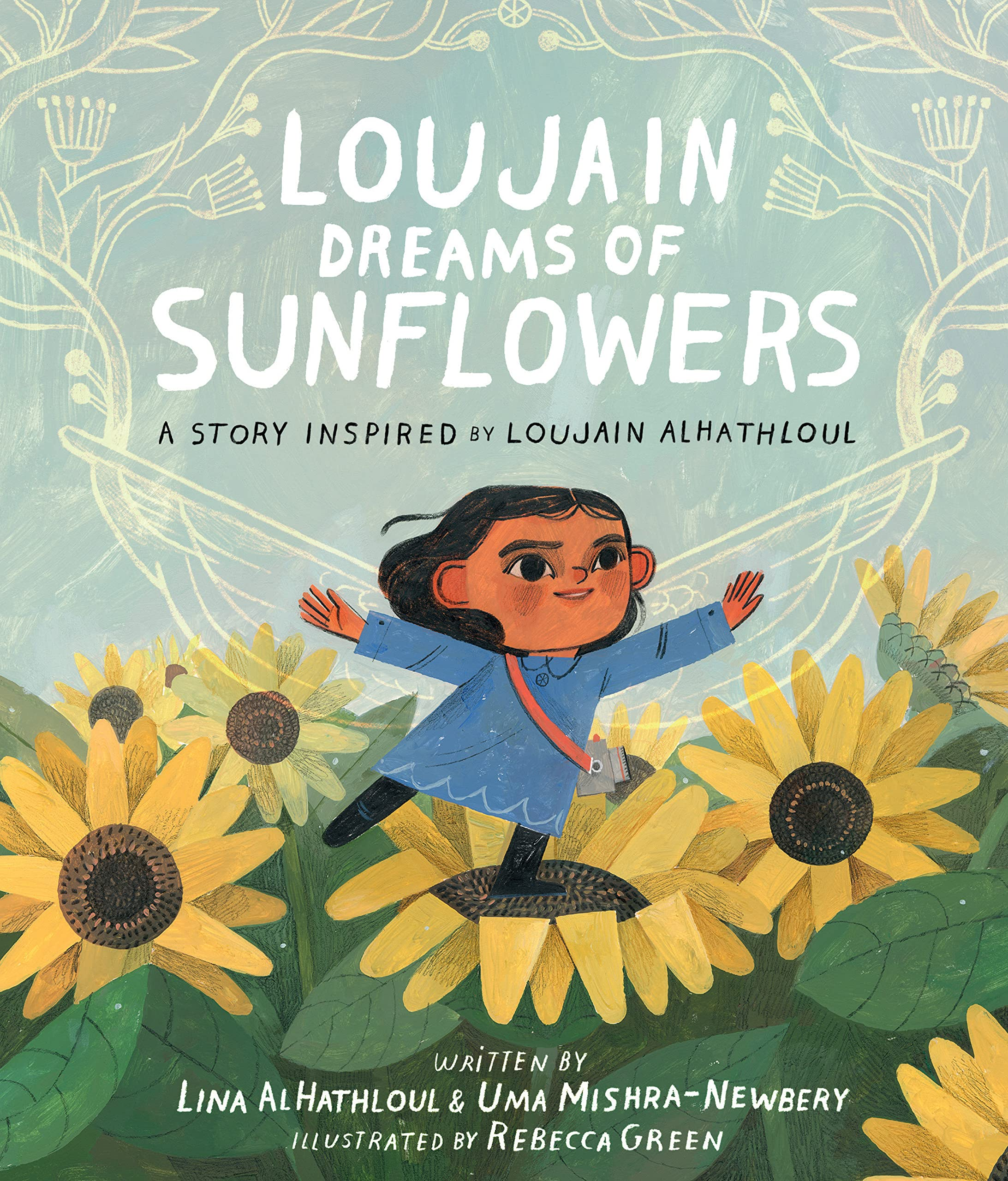
Loujain Dreams of Sunflowers by Lina AlHathloul and Uma Mishra-Newbery, illustrated by Rebecca Green

Published by mineditionUS

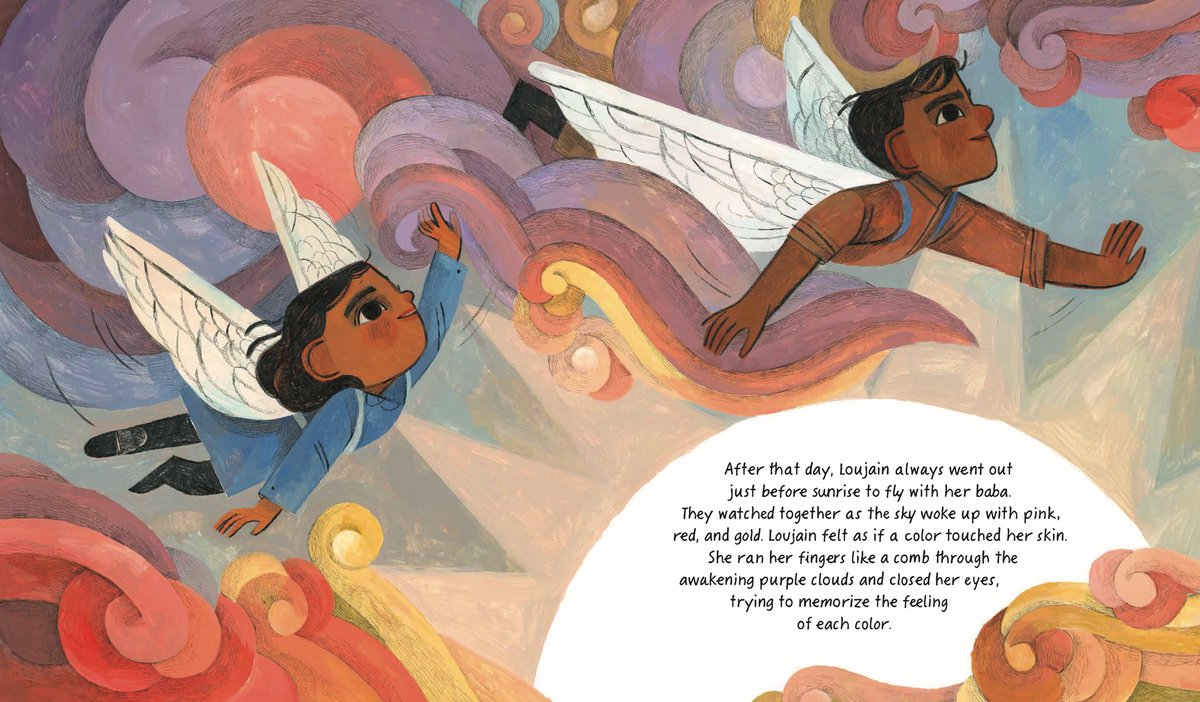
Summary:  Loujain dreams of flying to a beautiful field of sunflowers with her baba.  But in her community, only boys and men are allowed to fly.  All Loujain can do is put on a set of wings and run around the garden, pretending.  Baba tells her that she will fly “someday”.  Finally, Loujain confronts him and tells him that it’s not fair that boys can fly and she can’t.  She wants to learn to fly now.  Her wise mama tells him, “If you don’t support her, who will?  You have to believe things will change.  Otherwise they never will.”  Soon Loujain and Baba are getting up before sunrise for flying lessons.  One day he wakes her up extra early, telling her that they have a long flight to make.  It’s the field of sunflowers!  The next day, Loujain is in the news for defying the flying law.  Her parents are proud of her, and a young girl in the market sees her and immediately asks her baba to teach her to fly.  Includes a note about the real Loujain: Loujain AlHathloul, the author’s sister, who has been jailed for protesting the law prohibiting Saudi women from learning to drive.  40 pages; grades 1-5.

Pros:  This inspiring book would make an excellent discussion starter with older elementary students.  The information about Loujain AlHathloul gives a real-world example about protesting unjust laws.

Cons: The message of the book sometimes seemed to take priority over the story.

Bok’s Giant Leap: One Moon Rock’s Journey Through Time and Space by Neil Armstrong, illustrated by Grahame Baker Smith

Published by Crown Books for Young Readers

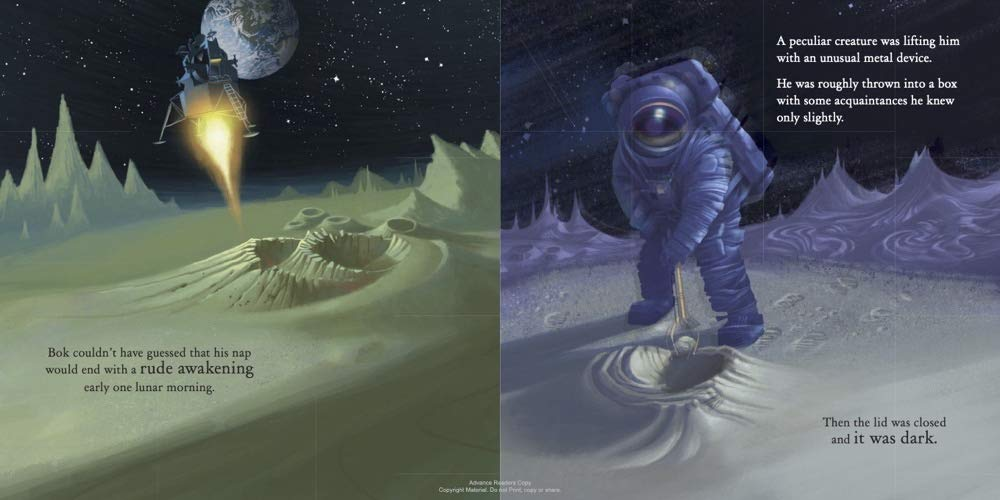
Summary:  While Neil Armstrong was dreaming of flight from his boyhood home in Ohio, a rock was hanging out on the moon, where it had lived for the last four billion years.  Young Neil learned how the moon had been formed when a small planet crashed into Earth, and how rocks were created at the end of the turbulent early time of the moon’s history.  As the years went by, different creatures came and went from the Earth, and eventually humans appeared.  The ancient rock slept through most of human history, but when Neil Armstrong finally traveled to the moon, he picked up the rock and brought it back to Earth.  Neil named the rock Bok, and it now rests in the Cincinnati Museum Center.  Includes additional information about the moon, the Earth, and Neil Armstrong’s journey to the moon.  48 pages; ages 4-8.

Pros:  Kids interested in space exploration, geology, and/or paleontology will get a taste of all of these in this whirlwind tour of the moon and Earth.  Armstrong’s personal connection with the moon and Bok makes the scientific facts even more interesting.

Cons:  Covering five billion years in a picture book means a pretty sketchy history and there are no resources given for additional research.

Good Eating: The (Short) Life of Krill by Matt Lilley, illustrated by Dan Tavis

Published by Tilbury House Publishers

Summary:  A tiny egg sinks deep into the ocean.  As the days pass it changes shape, growing spines, eyes, and a mouth.  In four weeks, the organism travels almost two miles from the depths of the sea to the surface.  Finally, it is a full-grown krill, with 26 legs and spots that can light up.  There are millions and millions of other krill, and it’s a good thing because they provide food for all kinds of animals like seabirds, penguins, and the gigantic blue whale.  Includes additional facts about krill and a list of resources: books, websites, and a National Geographic game called Krill Smackdown.  36 pages; grades 1-4.

Pros:  It seems like it would take considerable creative energy to write an engaging story about an animal whose main purpose in life is to be eaten, and to illustrate it with a cute and endearing krill, but this team has pulled it off.  The additional material at the end makes it a good research resource and emphasizes the important role krill plays in food chains around the world.

Cons:  Kids may need to be persuaded that they really want to read a book about krill.

A Is for Oboe: The Orchestra’s Alphabet by Lera Auerbach and Marilyn Nelson, illustrated by Paul Hoppe

Published by Dial Books

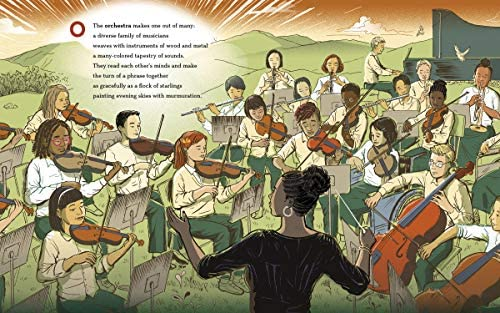
Summary:  This musical alphabet book has a poem for every letter: from the A the oboe plays to warm up the orchestra to the Zzz’s the musicians and audience members catch after the performance.  In between there are poems celebrating different instruments, the people involved in making music, and the music itself, both what’s written on paper and what is performed.  40 pages; grades 1-5.

Pros:  An A to Z poetry book of music didn’t really grab me, but once I started reading, I found every poem engaging and I zipped through the book in no time.  Many different aspects of music were covered (and of course I appreciated the fact that the letter L celebrates music librarians), and the energetic illustrations help readers understand the topics of the poems.

Cons:  Readers unfamiliar with music will need some additional context; it would have been nice to have some of that provided with either information on each page or with some back matter.

Because Claudette by Tracey Baptiste, illustrated by Tonya Engel

Published by Dial Books

Because Claudette: Baptiste, Tracey, Engel, Tonya: 9780593326404: Amazon.com:  Books

Because Claudette – Books of Wonder

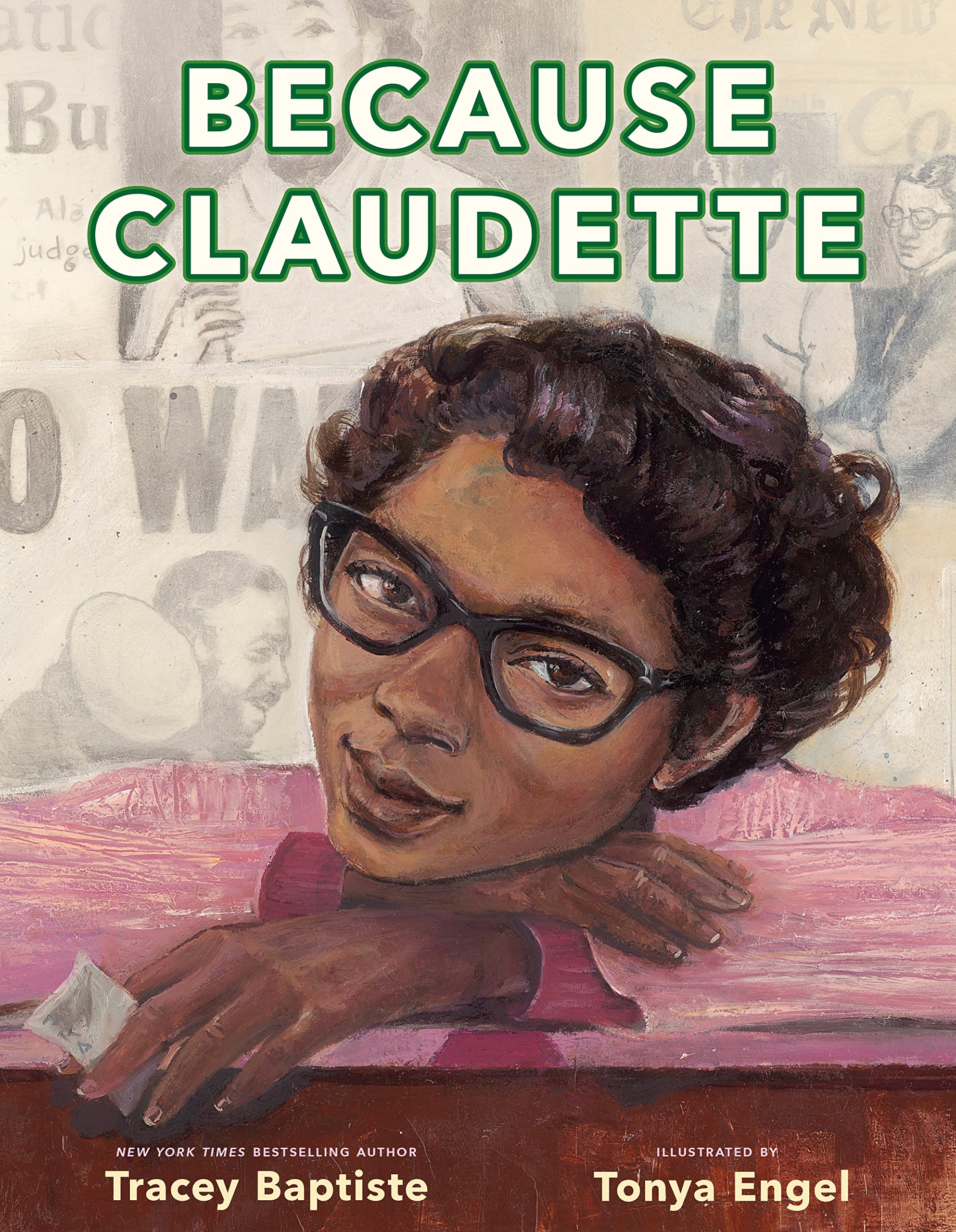
Summary:  “Because fifteen-year-old Claudette Colvin didn’t give up her seat on the bus for a white person on March 2, 1955, she was arrested.”  Thus begins a chain of events that leads Claudette to become friends with Rosa Parks, get involved with the Montgomery bus boycott, and to testify in court when her lawyer challenged the segregation laws.  Claudette was inspired by Black activists from the past as well as her contemporaries like Martin Luther King, Jr., Rosa Parks, and other women who refused to give up their bus seats.  When the Supreme Court ruled that bus segregation was unconstitutional, Claudette read about it in the newspaper.  “On December 21, 1956, anyone could sit wherever they liked on the bus.  And all of it happened because of Claudette.”  Includes a brief author’s note, and a list of two books and three websites for further research.  32 pages; grades K-3.

Pros:  The simple text and beautiful illustrations (I love that cover) show how one young person can make a big difference.  This would be an inspiring book to read to younger kids for Black History Month.

Cons:  The lack of back matter was a real missed opportunity: there could have been photos, a lot more biographical information on Claudette, as well as more about the the others pictured in the text.

Sweet Justice: Georgia Gilmore and the Montgomery Bus Boycott by Mara Rockliff, illustrated by R. Gregory Christie

Published by Random House Studio

Sweet Justice: Georgia Gilmore and the Montgomery Bus Boycott: Rockliff,  Mara, Christie, R. Gregory: 9781524720650: Amazon.com: Books

Sweet Justice: Georgia Gilmore and the Montgomery Bus Boycott: Rockliff,  Mara, Christie, R. Gregory: 9781524720643: Amazon.com: Books

Summary:  “Georgia Gilmore was cooking when she heard the news.”  Rosa Parks had been arrested for refusing to give up her seat on a city bus, news that came as no surprise to Georgia who had had her own run-in with a bus driver and no longer used the buses.  She was delighted when a boycott was announced and enjoyed the company of others when she walked to work.  Georgia started cooking to raise money for the drivers giving rides to those whose commute was too far to walk.  Later, she helped her friend and neighbor Dr. Martin Luther King, Jr. by testifying in court at his trial for organizing the boycott.  King reciprocated by giving Georgia money to start her own restaurant when she was fired from her job.  Soon, the restaurant overflowed with enthusiastic diners, and Georgia was cooking once again when she heard the news that the U.S. Supreme Court had ruled that segregated buses were unconstitutional.  Includes additional information about Georgia Gilmore, a list of sources, and a note about research that should be required reading for all young researchers.  40 pages; grades K-5.

Pros:  Mara Rocklin’s engaging writing style and Caldecott honoree R. Gregory Christie’s vivid illustrations bring to life this unsung heroine of the civil rights movement.  Readers will be inspired to learn how humble actions like cooking and walking to work helped bring about important changes.

Cons:  I could have enjoyed a recipe or two.

Alice Waters Cooks Up a Food Revolution by Diane Stanley, illustrated by Jessie Hartland

Published by Paula Wiseman Books

Alice Waters Cooks Up a Food Revolution: Stanley, Diane, Hartland, Jessie:  9781534461406: Amazon.com: Books

Alice Waters Cooks Up a Food Revolution: Stanley, Diane, Hartland, Jessie:  9781534461406: Amazon.com: Books

Summary:  Growing up in the Garden State, Alice Waters enjoyed fresh produce from her family’s backyard.  In college, a semester abroad introduced her to the wonders of French cuisine, which she tried to duplicate for her friends when she returned home.  After graduation, she bought an old house that she fixed up and turned into Chez Panisse, a restaurant that served a single meal each night.  The restaurant was a huge success, but Alice struggled to find the fresh ingredients she remembered from her childhood and her trip to France.  She traveled through northern California, looking for small farms where food was produced in traditional ways. Using this food in her restaurant helped start the movement toward local food that is popular today.  Includes two pages of additional information, including Alice’s work with schools to produce local fresh food; a timeline, and a bibliography.  48 pages; grades K-5.

Pros:  This quirky book perfectly captures the spirit of Alice Waters’ restaurant, where the staff would dance late into the night after the diners left and a friend once cooked and ate his shoe after losing a bet.  The mouth-watering descriptions of fresh food may even entice kids to eat their vegetables.

Cons:  Like Alice, I grew up in Chatham, New Jersey and ate produce from my father’s backyard garden all summer; unlike her, I did not turn out to be a world-class restaurateur or even a particularly good cook.  

Who Are Your People? by Bakari Sellers, illustrated by Reggie Brown

Published by Quill Tree Books

Who Are Your People?: Sellers, Bakari, Brown, Reggie: 9780063082854: Amazon.com:  Books

Who Are Your People? – HarperCollins

Summary:  “When you meet someone for the first time, they might ask, ‘Who are your people?’ and ‘Where are you from?’”  A father sets out to give his two children some answers to those questions, explaining that their people were strong and smart; fighters and activists.  The illustrations show the faces of well-known Black activists, as well as Black people working in cotton and sugarcane fields and participating in protests at lunch counters and marches.  The last few pages celebrate a supportive community that allows the kids to dream about the ways they will change the world.  32 pages; ages 4-8.

Pros:  My school celebrates Black History Month with guest readers in every classroom, and I’ve been looking for books for the younger kids.  This one is perfect, not shying away from the troubling aspects of Black history, but also emphasizing the strength and resilience of the community.

Cons:  Some back matter with additional information about the people and incidents in the illustrations would have made this a more useful resource for both younger and older kids.

Opal Lee and What It Means to Be Free by Alice Faye Duncan, illustrated by Keturah A. Bobo

Published by Tommy Nelson

Opal Lee and What It Means to Be Free: The True Story of the Grandmother of  Juneteenth: Duncan, Alice Faye, Bobo, Keturah A.: 9781400231256: Amazon.com:  Books

Amazon.com: Opal Lee and What It Means to Be Free: The True Story of the  Grandmother of Juneteenth eBook : Duncan, Alice Faye, Bobo, Keturah A.:  Kindle Store

Summary:  When Opal Lee’s great grandson asks her for a story, she looks around their Juneteenth celebration and tells the kids the history of the holiday. People in Texas didn’t learn about the end of slavery until almost a year and a half after Abraham Lincoln issued the Emancipation Proclamation.  Juneteenth marks the day they found out, and the celebration that happened when they did.  “What was Juneteenth like when you were a kid?” the children then want to know. Opal Lee tells them of her segregated childhood, and how her family’s new house was burned down in 1939. But, she assures them, she has continued and will continue to work for freedom as long as she needs them.  As the children run off to play, she reminds them, “Freedom is for everyone.  Juneteenth is YOU and ME.”  Includes a recipe for Juneteenth Red Punch, a Juneteenth timeline, additional information about Opal Lee and Juneteenth, and a list of sources.  32 pages; ages 4-8.

Pros:  With Juneteenth being a new national holiday, librarians and teachers will be looking for excellent educational resources like this one.  Opal Lee’s easygoing storytelling imparts a lot of information, aided by the bright, colorful illustrations that portray a diverse crowd of kids at the Juneteenth celebration.

Cons:  The author’s note mentions Opal Lee’s walk across the United States from 2016 to 2020 to collect signatures for a petition to make Juneteenth a national holiday.  She was 94 when President Biden signed legislation to make this happen.  I wish there had been more information about that walk, which sounds like a fascinating piece of history.

Evicted! The Struggle for the Right to Vote by Alice Faye Duncan, illustrated by Charly Palmer

Published by Calkins Creek

Evicted!: The Struggle for the Right to Vote: Duncan, Alice Faye, Palmer,  Charly: 9781684379798: Amazon.com: Books

Evicted: An Interview on a Timely Topic with Alice Faye Duncan - A Fuse #8  Production

Summary:  When a Black man was falsely found guilty of murder by an all-white jury in 1959, the Black community of Fayette County, Tennessee began a voter registration movement.  Led by John McFerren and Harpman Jameson, their actions led to swift reprisals and families lost their jobs and homes.  Papa Towles, one of the few Black landowners in the county, pitched army surplus tents on his property and invited families to stay there.  Progress was slow, but publicity about the movement began to grow.  College students came to Fayette County to help out in the summer, and Martin Luther King, Jr. and John F. Kennedy sent food and other supplies.  The Voting Rights Act of 1965 brought about the changes that the original protestors had been seeking, and Black candidates began to win elections in Fayette County.  The story includes many different people who played a role and is seen through the eyes of James Jamerson, a boy who spent his childhood with his Uncle Harpman and helped integrate Fayette County High School.  Includes a five-page timeline, photos, and a resource guide.  64 pages; grades 5-8.

Pros:  There’s a lot packed into these 64 pages.  The story of Fayette County mirrors the larger civil rights movement going on during this time, with an emphasis on the courage and ingenuity of the Black community activists.  The paintings by Coretta Scott King/John Steptoe award winner Palmer (author and illustrator of yesterday’s book, Gravity) beautifully capture the people involved in this struggle.

Cons:  The book has the look of a picture book, but it’s a complicated story with a large cast of characters that includes information about a lynching.  Definitely more of an upper elementary and middle school book.