The Faithful Spy: Dietrich Bonhoeffer and the Plot to Kill Hitler by John Hendrix

Published by Harry N. Abrams
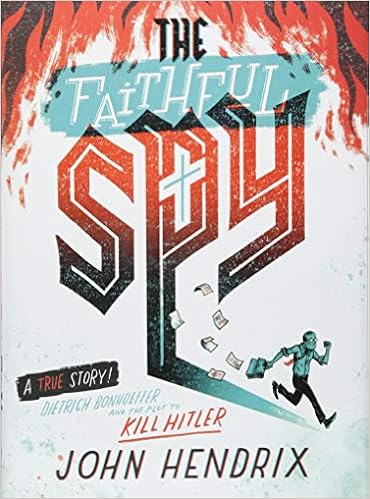
Image result for faithful spy dietrich amazon

Summary:  Growing up in Germany in a family of scientists, Dietrich Bonhoeffer went his own way, showing a keen interest in theology at a young age.  At age 12, he lost his older brother in World War I and began a lifelong quest to understand human suffering in the light of his Christian faith.  When Hitler came to power in Germany, Bonhoeffer found himself with increasingly difficult choices to make. He founded the illegal Confessing Church to support those who opposed Hitler’s takeover of the German churches.  When that was shut down, he decided the moral choice was to join forces with those who sought to assassinate Hitler, and was part of two unsuccessful attempts before being arrested. He spent a year and a half in prison, ministering to other prisoners and guards and refusing a chance at escape because of the danger it would bring to his family.  Finally, Bonhoeffer was found guilty of trying to kill Hitler, and was executed on April 9, 1945, just three weeks before Hitler committed suicide.  Includes an author’s note, bibliography, notes, and an index. 176 pages; grades 6-12.

Pros:  I’ve read a lot of good reviews of this book, and I was not disappointed.  It’s kind of like a graphic novel, with the text well-incorporated into the black, turquoise, and red illustrations.  The rise of Hitler is chilling, and the lessons to be learned from the complacency of those in power in Germany can’t be overstated.  Hendrix clearly wants readers to think about how those lessons can be applied to today’s political situations. Bonhoeffer’s faith and humanity in the face of an increasingly inhumane world is inspiring to say the least.  Both the Newbery and Caldecott committees should give this book consideration.

Cons:  Some of the print was so small I had to take my glasses off to read it.  (If you’re over 45, you’ll understand what I’m talking about).
If you’d like to buy this book on Amazon, click here.

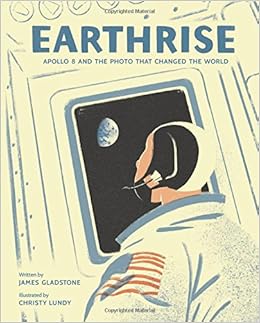
Earthrise: Apollo 8 and the Photo That Changed the World by James Gladstone, illustrated by Christy Lundy

Published by Owlkids

Image result for earthrise apollo 8 james amazon

Image result for earthrise apollo 8 christy lundy

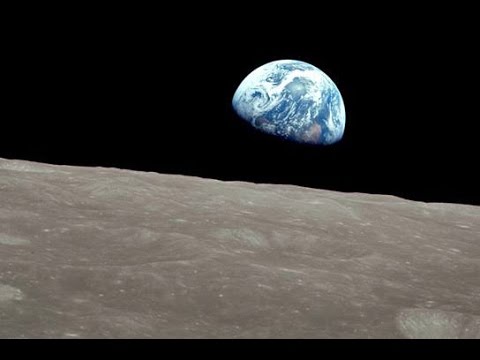
Summary:  1968 was a year of war, unrest, and marches that demanded peace and justice.  At the end of the year, three astronauts, Frank Borman, Jim Lovell, and Bill Anders, flew into space as the Apollo 8 mission.  They traveled further than any humans had gone before, going all the way to the Moon to figure out the best place for future missions to land.  On their fourth orbit around the Moon, they saw the Earth rising above the moon, and snapped a color photo of it from their window.  That photo became famous, showing the Earth as a peaceful planet with no national borders, home to all people.  Includes a brief note with additional information about Apollo 8 and the Earthrise photo.  32 pages; ages 4-8.

Pros:  A perfect introduction to the space program for young kids with a nice message about a photo that inspired people to see Earth in a different way.

Cons:  It’s a pretty brief introduction with no resources for further research.  Also, I wound up with Bette Midler’s “From A Distance” stuck in my head for hours after reading this.

Image result for earthrise photo apollo 8

If you would like to buy this book on Amazon, click here.


Lifeboat 12 by Susan Hood

Published by Simon and Schuster Books for Young Readers

Image result for lifeboat 12 amazon

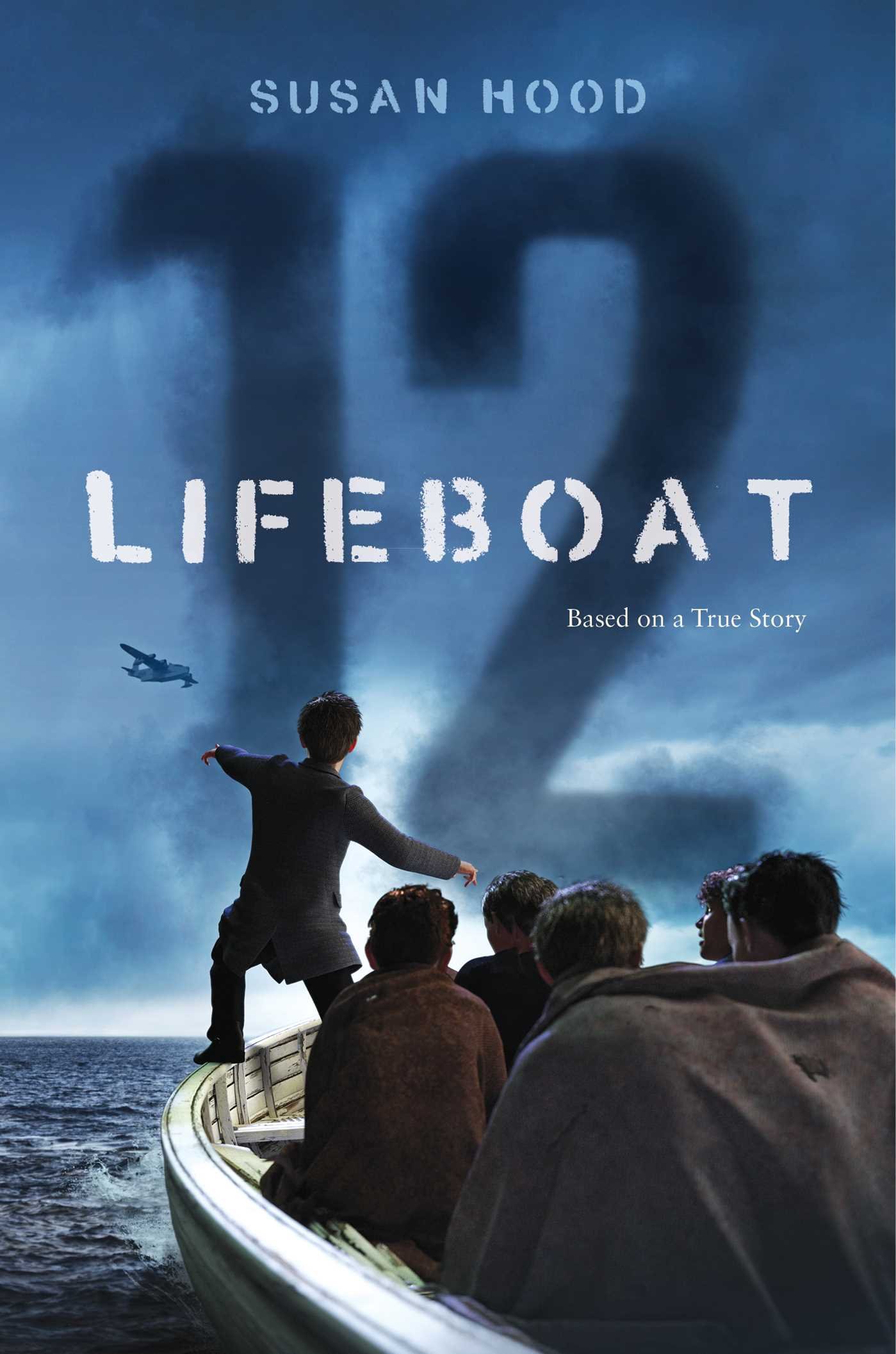
Summary:  As the London Blitz begins, 13-year-old Ken Sparks is sent on the SS City of Benares as part of a group of 90 children evacuating to Canada.  He is glad to go, both to get away from the bombing and because he feels unwanted by his stepmother.  The ship is luxurious, and when the crew assures them they’ve passed the danger zone for torpedoes, the kids relax and enjoy themselves.  During the first night of “safety”, there’s an explosion, and all passengers are hurried to the lifeboats. The Benares has been hit by the Germans and is sinking fast.  Ken is assigned to Lifeboat 8, but forgets his coat, and after running back to get it, ends up on Lifeboat 12.  When the sun rises, they are alone at sea: six boys, one of their chaperones (the only woman), a Catholic priest, and a few dozen crewmen.  They drift for many days, enduring hunger, thirst, trench foot, and the unknown of whether they will live or die. There are many examples of heroism, and Ken plays a part in their rescue with his knowledge of different aircraft.  There’s a happy ending for Lifeboat 12, although many others were not so lucky, including all those assigned to Lifeboat 8. Ken gets a huge welcome home, assuring him that he is loved and cherished by his father, stepmother, and 3-year-old sister.  Includes many pages of additional information, resources, and photographs, including a reassuringly healthy one of Ken Sparks in 2015 at age 88. 336 pages; grades 4-8.

Pros:  This extensively-researched novel in verse will attract all kinds of readers with its edge-of-your-seat suspense and historical detail.  Fans of the I Survived series will enjoy this real-life World War II adventure featuring kids much like themselves.

Cons:  It was not particularly relaxing reading all the details of the many days at sea.  I do hope I never suffer from trench foot.

If you would like to buy this book on Amazon, click here.

Tigers and Tea With Toppy by Barbara Kerley and Rhoda Knight Kalt, illustrated by Matte Stephens

Published by Scholastic

Image result for tigers and tea with toppy amazon

Image result for tigers and tea with toppy

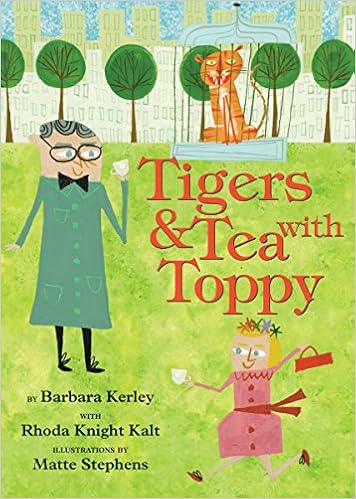
Summary:  Rhoda loves spending weekends in New York City with her Grandpa Toppy and Grandma Nonnie.  On Saturday, Toppy, whose real name is Charles R. Knight, takes his granddaughter to the American Museum of Natural History where he shows her the paintings he created of animals and prehistoric scenes.  Even though he is legally blind, he is able to draw and paint the dinosaurs from their fossilized skeletons. The next day they visit the Central Park Zoo where Toppy shows Rhoda the animals he studied so closely to learn how to draw them accurately.  Rhoda, Toppy, and Nonnie finish off the weekend with a celebratory tea at the Plaza Hotel. Includes author and artist notes with more information about Knight and the creation of the book; source notes; some of Knight’s animal drawings; and photos of Toppy and Rhoda.  48 pages; grades K-3.

Pros:  A fun way to introduce the life of Charles Knight.  One interesting tidbit: illustrator Matte Stephens is legally blind, like Knight was, and uses some of the same techniques to create his art.

Cons: I would have enjoyed seeing more of the prehistoric paintings.

If you would like to buy this book on Amazon, click here.

Hammering for Freedom: The William Lewis Story by Rita Lorraine Hubbard, illustrated by John Holyfield

Published by Lee and Low

Image result for hammering for freedom hubbard

Image result for hammering for freedom hubbard

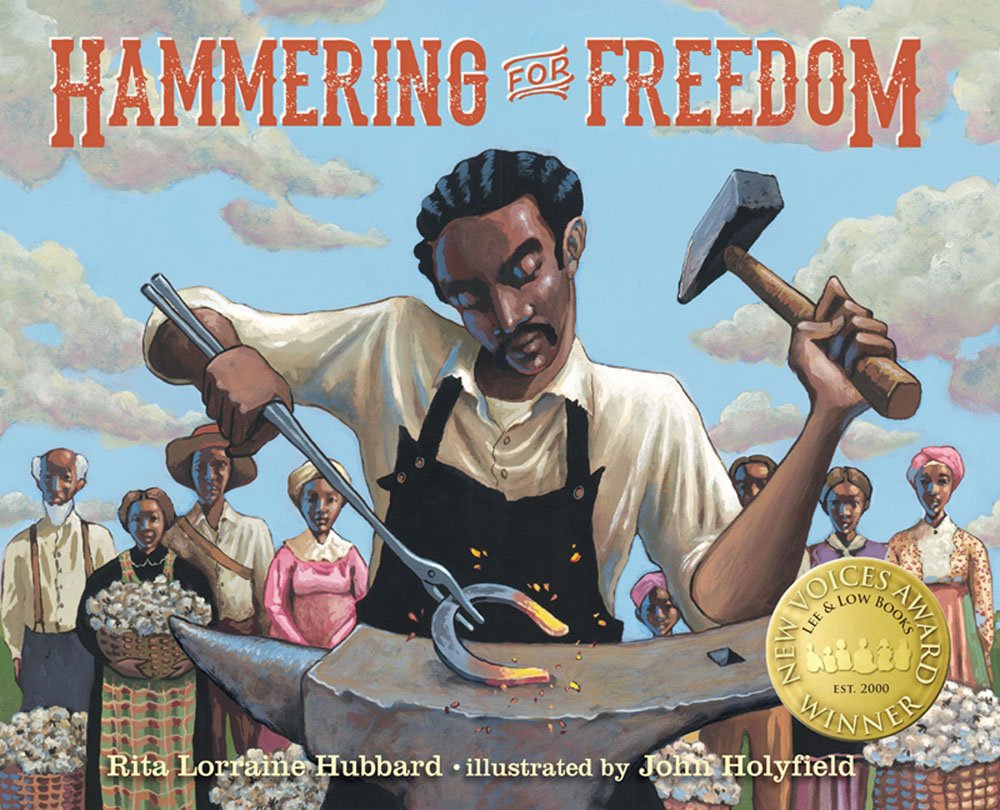
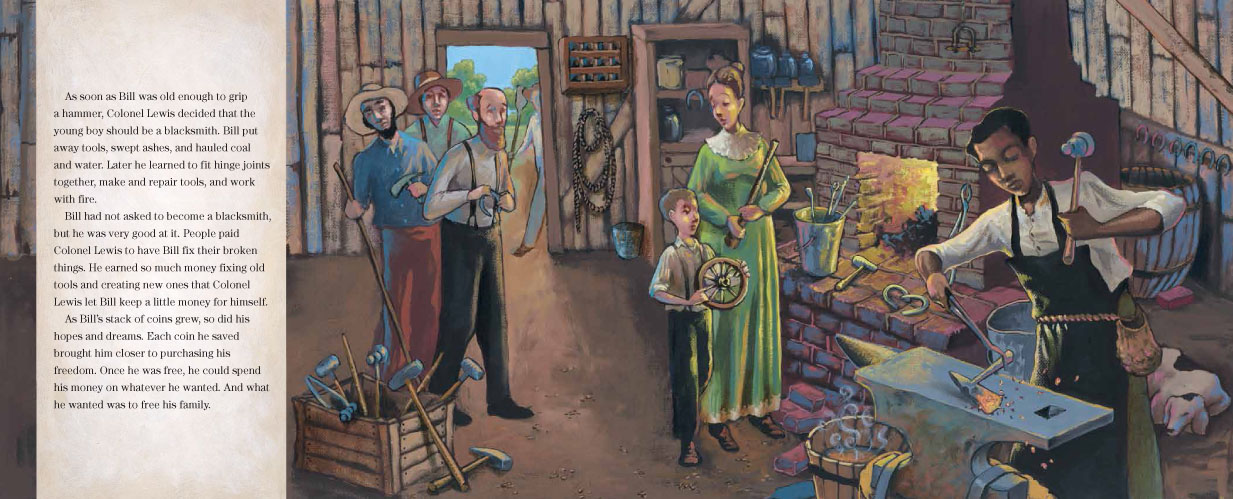
Summary:  William “Bill” Lewis was born on a Tennessee plantation in 1810, where he and his family had to work long days in the fields of Colonel Lewis’s plantation.  At a young age, he was moved to the blacksmith’s shop where he became good enough at repairing and building tools that he was able to make a little money.  By the age of 27, he had saved enough to rent himself out and start his own business in Chattanooga.  By that time he had also married and had a son.  Slowly he saved enough money to buy his own freedom, his son’s, and his wife’s, which meant the rest of their children were born free.  He paid cash for a large house for them all to live in.  Twenty six years after arriving in Chattanooga, he finally succeeded in freeing his mother, aunt, and all of his siblings.  Includes an author’s note with more information about Lewis and source notes.  32 pages; grades 1-5.

Pros:  An inspiring story of an ordinary man who lived a life of hard work, thrift, and community service to improve the lives of himself and his family.

Cons:  I was disappointed to learn in the author’s note that, after all that hard work, Lewis lost a good deal of his net worth post-Civil War.

If you would like to buy this book on Amazon, click here.

Mama Dug A Little Den by Jennifer Ward, illustrated by Steve Jenkins

Published by Beach Lane Books

See the source image

Image result for mama dug a little den amazon

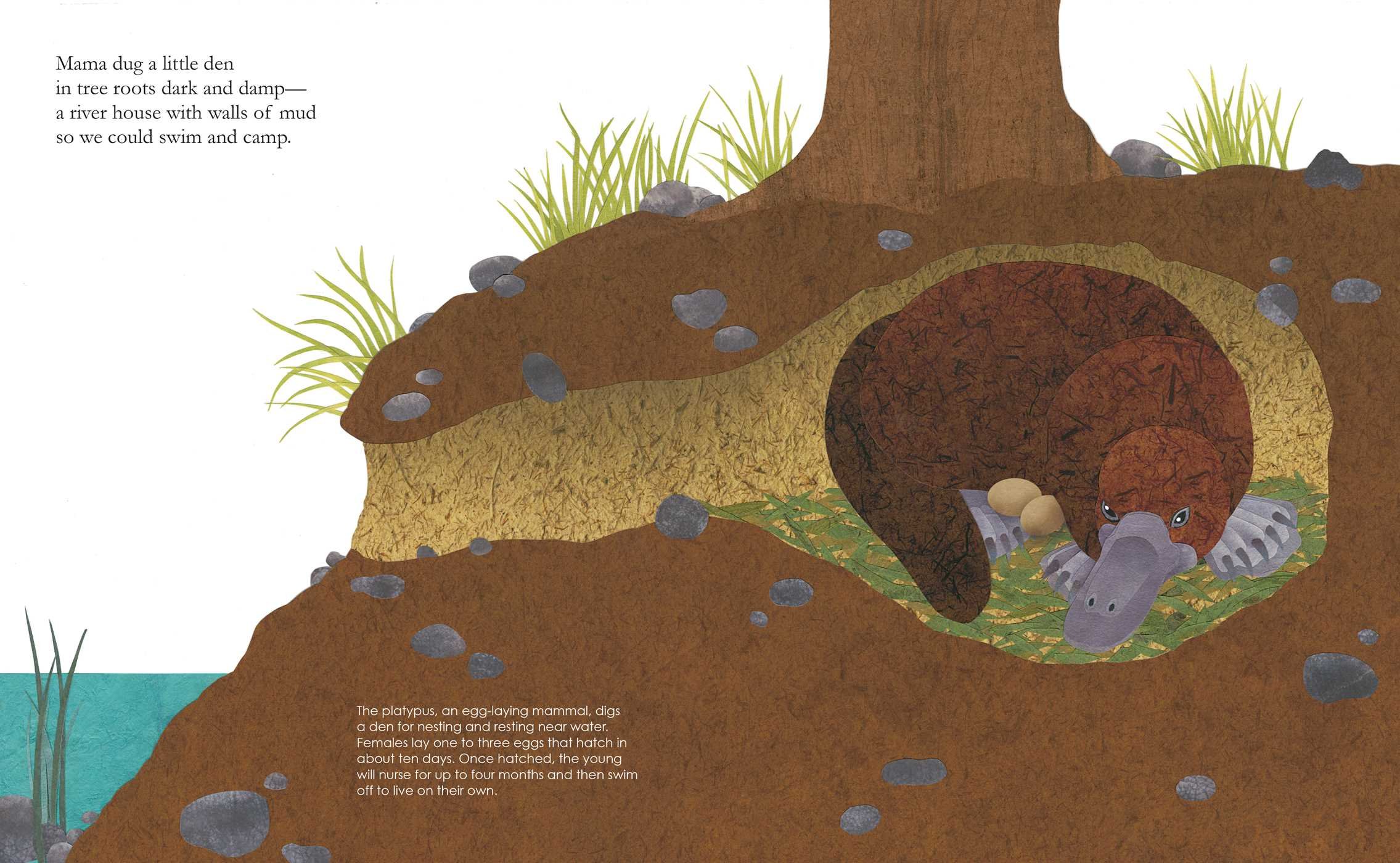
Summary:  Each two-page spread has a rhyme beginning with the line “Mama dug a little den” (“Mama dug a little den/beneath a fallen tree./An earthy home as soft as moss,/a nursery for three” is the first one about red foxes).  A smaller paragraph gives additional information. The illustrations are in Steve Jenkins’ signature cut-paper collage style, and show the animal in its den and some of the surrounding habitat. A final page contains a note from the author about how she came to write the book, and some additional information about what to look for if you find a den to determine what kind of animal lives there.  32 pages; ages 4-8.

Pros:  In this follow-up book to Mama Built A Little Nest, preschoolers will learn a bit about animal homes and how to discover them in their own backyards.  As president of the Steve Jenkins fan club (well, I would be, if there were such a thing), I appreciated the beautiful illustrations.

Cons:  The back matter was so small and unobtrusive, many readers may miss it.

If you would like to buy this book on Amazon, click here.

So Tall Within: Sojourner Truth’s Long Walk Toward Freedom by Gary D. Schmidt, illustrated by Daniel Minter

Published by Roaring Brook Press

Image result for so tall within sojourner amazon

Image result for so tall within sojourner minter

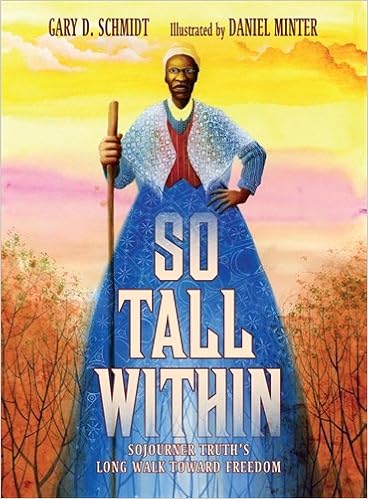
Summary:  Each section of Isabella Baumfree’s life (later renamed Sojourner Truth) begins with a page that starts “In Slavery Time”.  “In Slavery Time, when Hope was a seed waiting to be planted,” or “In Slavery Time, when Happiness was a dream never coming true,”.  The last few sections begin with “In Freedom Time”. Each section tells part of Isabella’s remarkable life, starting with her childhood in slavery, and continuing with the determination that eventually led her to run away to freedom, and to bring a lawsuit to demand her son be returned home from a plantation in Alabama (he was).  Fifteen years after running away, now calling herself Sojourner Truth, she traveled across New York, to Washington, D.C., and to other parts of the country, first working to end slavery, then later speaking for human rights in other areas. She died in her 80’s, and the book ends with her quote: “My lost time that I lost being a slave was made up.”  Includes a biographical note and an extensive bibliography with notes about the various sources. 48 pages; grades 2-5.

Pros:  The poetic text and stunning illustrations give a compelling outline of Sojourner Truth’s life.  The excellent bibliography will help readers learn more. Deserving of an award or two for both the writing and the illustrations.

Cons:  There are some disturbing elements to Sojourner Truth’s story which young readers may need some help with.

If you would like to buy this book on Amazon, click here.

Who Eats Orange? by Dianne White, illustrated by Robin Page

Published by Beach Lane Books

Image result for who eats orange diane white amazon

Image result for who eats orange robin page

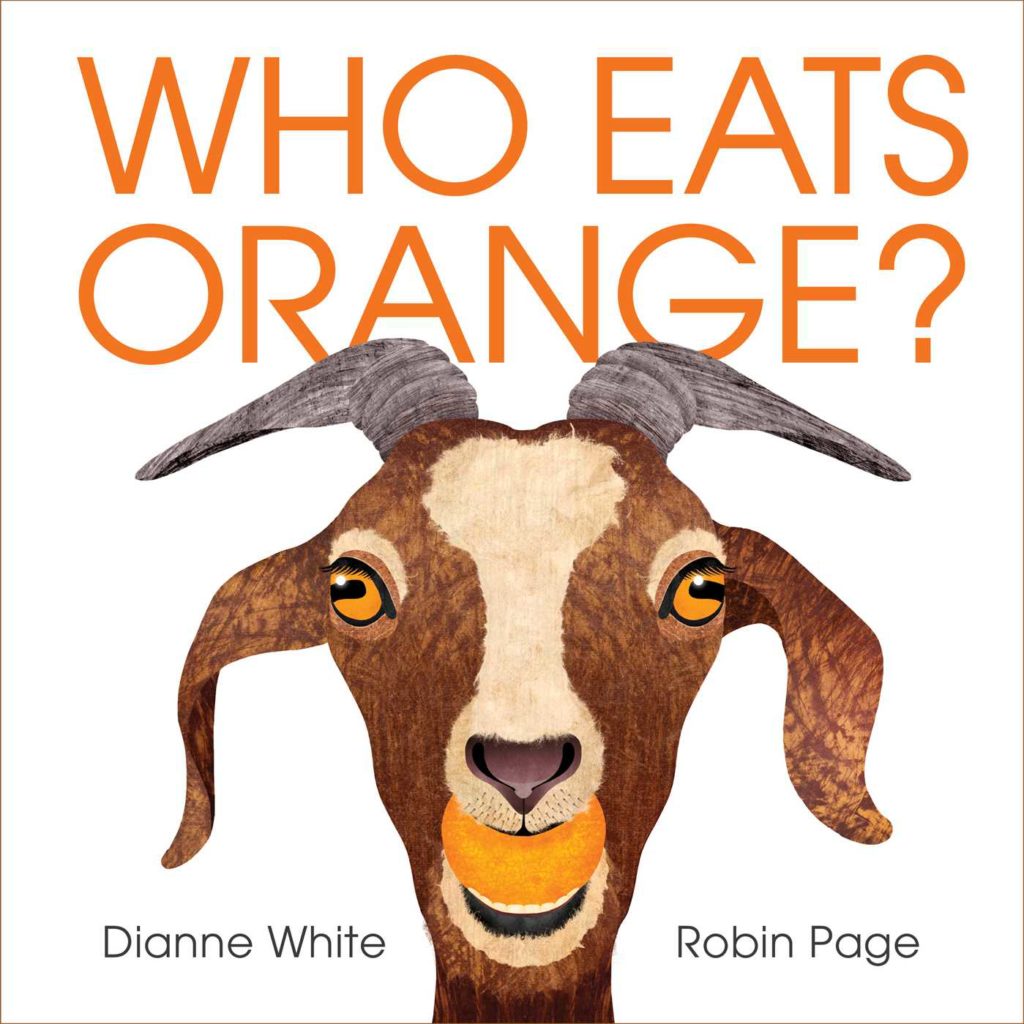
Summary:  Animals, foods, colors, and habitats are introduced in this book that has a repeating question and answer format: “Who eats orange? Bunnies in their hutches do. Chickens in the henhouse too.  Who else eats orange? Goats. Pigs. Gorillas too? Gorillas? No! Gorillas don’t eat orange. They eat…green.” The large illustrations have plenty of color on a simple white background. Humans, the book concludes, eat a rainbow of colors.  The last two pages list various habitats with the animals from each listed and additional information about what and how that animal eats. 32 pages; ages 4-8.

Pros:  Catchy rhymes and eye-catching graphics make this an appealing introduction for a wide variety of topics.

Cons:  The habitats listed at the end include farms, Africa, ocean, forest, rainforest, and tundra; but Africa is a continent with many different habitats.

If you would like to buy this book on Amazon, click here.

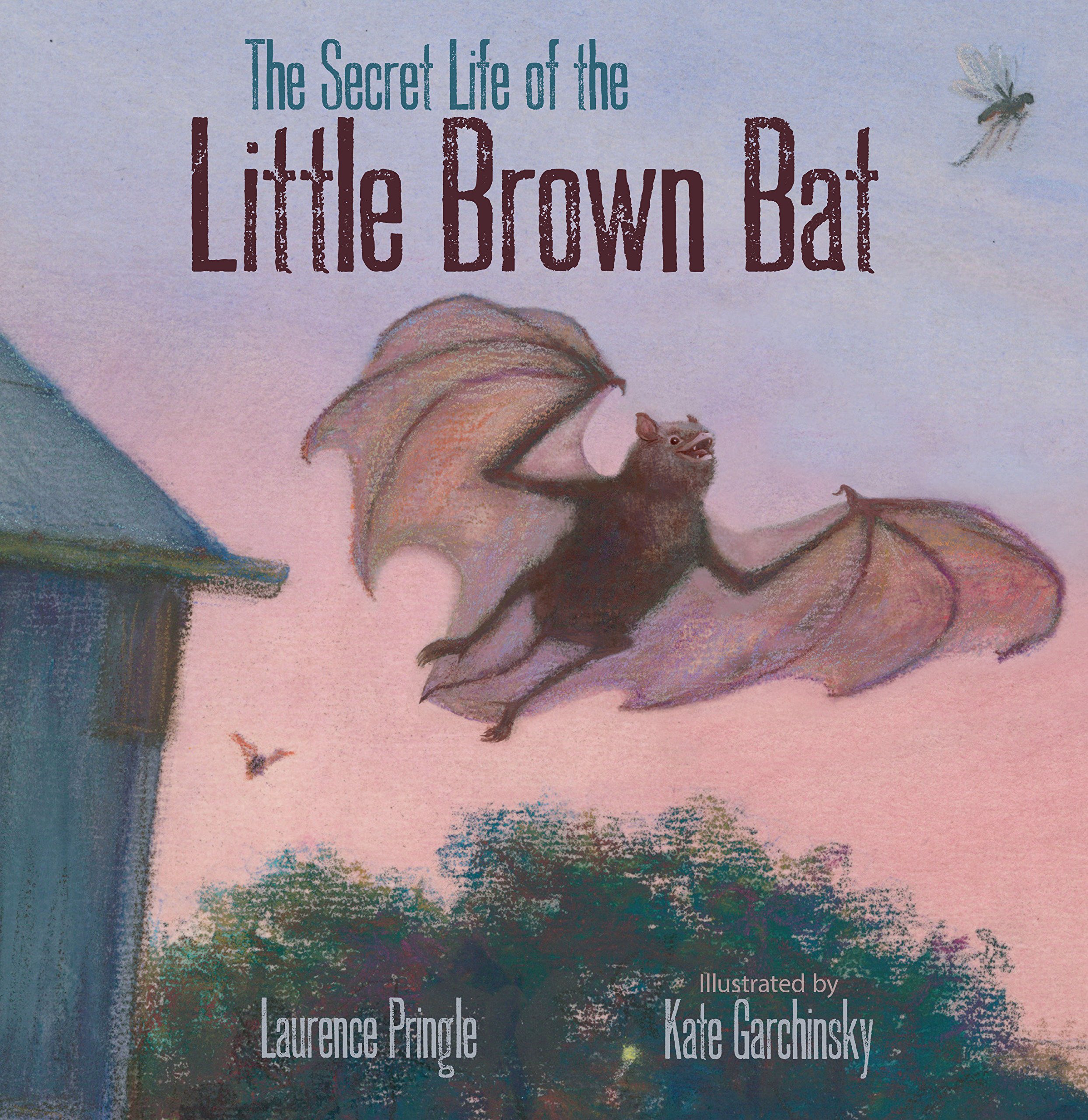
The Secret Life of the Little Brown Bat by Laurence Pringle, illustrated by Kate Garchinsky

Published by Boyds Mills Press

Image result for secret life little brown bat amazon

Summary:  This story starts shortly after Otis, a little brown bat, has left his mother and is living on his own.  Watching how Otis spends his days and nights, the reader will learn the physical characteristics of bats, their diet, where they live, how they hunt using echolocation, and their life cycle.  The illustrations mostly portray Otis at night in a variety of settings: roosting in an abandoned building, hibernating in a cave, flying through the sky, and hunting for insects in a meadow. At the end, Otis has found a mate and is settling down for a long winter’s sleep.  Includes two pages of additional information about little brown bats and a glossary. 32 pages; grades 1-4.

Pros:  An excellent introduction to a bat’s life, told in a narrative form that will hold readers’ interest.  The pastel illustrations on the dark background provide striking portrayals of Otis (whose name comes from his species’ scientific name, Myotis lucifugus) and the other bats.

Cons:  Otis didn’t really seem to be leading a “secret life”.

If you would like to buy this book on Amazon, click here.

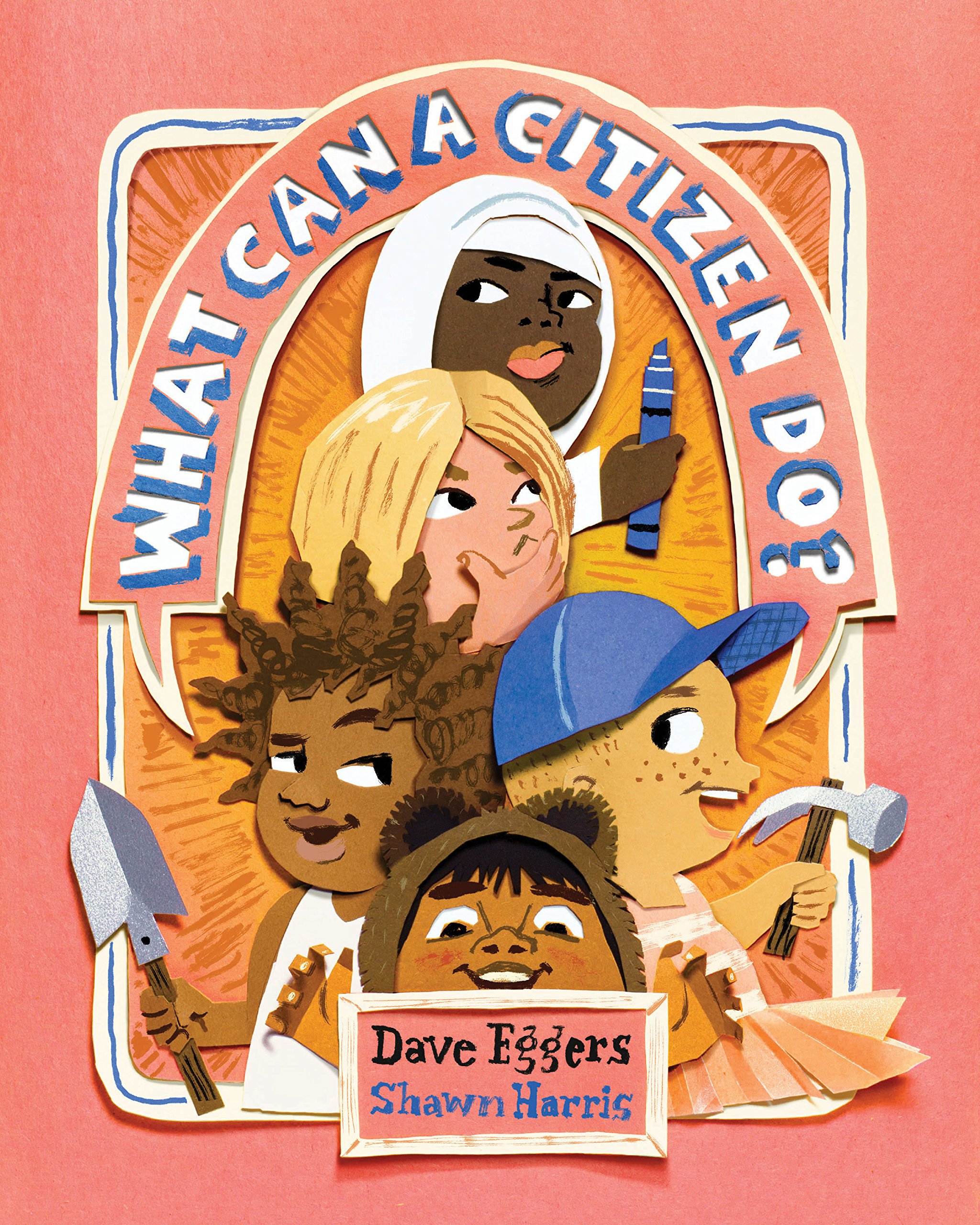
What Can a Citizen Do? By Dave Eggers, illustrated by Shawn Harris

Published by Chronicle Books

Image result for what can a citizen do eggers amazon

Image result for what can a citizen do eggers amazon

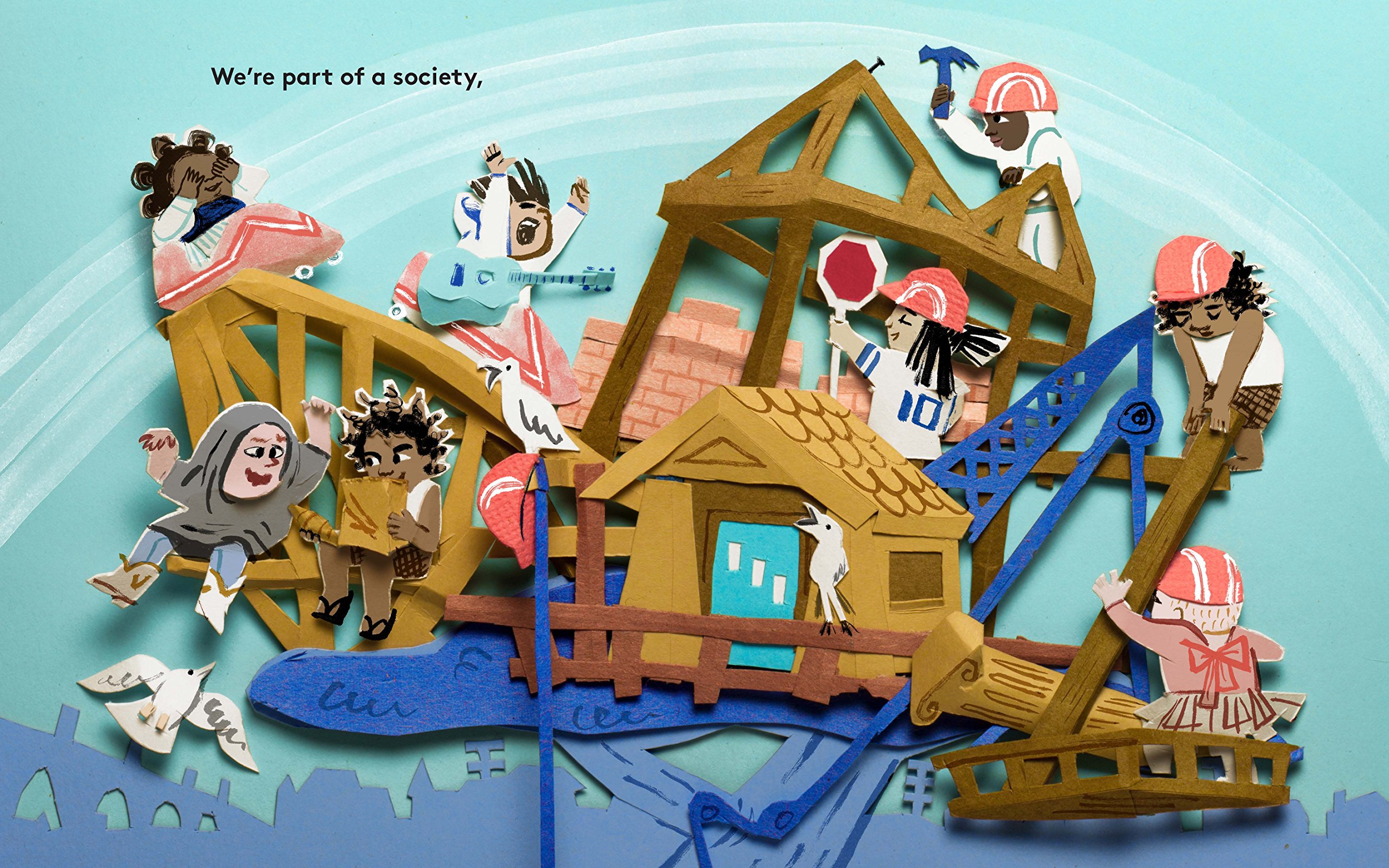
Summary:  The team that brought us Her Right Foot takes a look at the rights and responsibilities of citizenship.  The rhyming text is simple, emphasizing the importance of helping others and working to make a better society.  Suggestions include helping a neighbor, joining a cause, writing a letter, and the generic “righting a wrong”. There may be a sly political message in the “No Trumpets” sign in a couple of the illustrations.  The conclusion? “So forget yourself a second/Grab a shovel or a pen/Do something for another./Don’t you dare doubt that you can!/Everything makes an impact/on a bigger big than you./And it all starts with the question:/What can a citizen do?”  40 pages; ages 4-8.

Pros:  A basic introduction to civics for preschool and primary students.  The illustrations are the star of the show here, with a diverse cast of kid characters portrayed in collage illustrations that seem to pop out of the page.  

Cons:  If ever a book cried out for back matter, this is it.  What is a citizen? What are some specific actions citizens can take?  Definitely some missed opportunities here, particularly after the thought-provoking Her Right Foot.

If you would like to buy this book on Amazon, click here.