Her Right Foot by Dave Eggers, illustrated by Shawn Harris

Published by Chronicle Books

Summary:  Think you know about the Statue of Liberty?  Chances are, you will learn something new if you read this book.  It starts in France, where the Statue herself started, and describes the creation and construction of it, first in France and then again in the United States.  It was brown for about 35 years until the copper turned its current shade of green.  The author relates some quirky details about different parts of the statue, then focuses on one specific part: her right foot, which is lifted as though she is walking away.  Where is she going?  He concludes that she is an immigrant, like all the other immigrants she has welcomed over the years.  Immigrants don’t stand still.  They are always moving forward, and like them, the Statue of Liberty is moving toward the ocean to greet the people who continue to come to the United States.  Includes a page of sources for further reading.  104 pages; grades 2-6.

Pros:  A quirky, moving book that is part history and part celebration of immigration, told in a conversational tone and beautifully illuminated with unique cut-paper illustrations.

Cons:  Nonfiction? 104-page picture books?  About the Statue of Liberty?  Or immigration?  It’s hard to know how to categorize this 104-page picture book that jumps from one topic to the next.

If you’d like to buy this book on Amazon, click here.

The Red Bandanna (Young Readers Adaptation) by Tom Rinaldi

Published by Viking

Summary:  On September 11, 2001, as people were struggling to evacuate the Twin Towers, some were led out by a young man with a strong, clear voice and a red bandanna over his face.  Although he helped many people to safety, he himself did not survive.  This book tells the story of Welles Crowther, a 24-year-old Wall Street trader who had worked as a volunteer firefighter, and was considering a career change to FDNY.  From a young age, Welles was fascinated with firefighting, and was a compassionate and exuberant boy who often helped his friends.  He always carried that red bandanna, and it later helped identify him, allowing the survivors he helped to connect with his family.  A feature on ESPN spread his story around the world, and continues to remind others to follow Welles Crowther’s inspiration to help.  176 pages; grades 5-8.

Pros:  Keep the tissues handy for this moving story of a young man whose brief life has touched many, many others around the world.

Cons:  “Bandanna” just looks wrong, but apparently “bandana” and “bandanna” are both correct.

If you’d like to buy this book on Amazon, click here.

Full of Fall by April Pulley Sayre

Published by Beach Lane Books

Summary:  “September sun is low in the sky/So long summer/Green, goodbye!” So begins this homage to autumn.  Each page has a few lines of poetry, describing the colors as leaves change from green to red and gold to brown.  Large, colorful photographs show the stages in detail, as well as animals often associated with the season, like squirrels and geese.  “Goodbye, leaf show/Winter is coming/Oh, hello, snow!”  The last page provides a perfect transition to check out a similar book by the author, Best in Snow.  Includes two pages that give more scientific information about what is happening on each page of the book.  40 pages; ages 3-8.

Pros:  Another gorgeous book about the seasons from April Pulley Sayre (see also Raindrops Roll).  Combine this with In the Middle of Fall by Kevin Henkes (see my 9/22 review) for a perfect autumn story hour.

Cons:  All that raking.

If you’d like to buy this book on Amazon, click here.

How to Be an Elephant: Growing Up in the African Wild by Katherine Roy

Published by Roaring Brook Press

Summary:  When a baby elephant is born, she has a lot to learn; good thing she has a protective family and herd to teach her.  From walking to using her complex trunk to figuring out the different smells in her environment, the youngster will spend several years learning all the elephant ways.  Labelled diagrams and full-page illustrations complement the text to impart all the intricate knowledge the elephant needs to survive.  Includes a note from the author about her research and the endangered status of African elephants, and a list of resources for further information.  48 pages; grades 2-6.

Pros:  Readers will learn a ton of information about elephants, both through the text and the illustrations, which should be considered by the Caldecott committee.

Cons:  While the book has the look and feel of a picture book, the information and vocabulary is pretty advanced for primary grades.

If you would like to buy this book on Amazon, click here.

Imagine That: How Dr. Seuss Wrote the Cat in the Hat by Judy Sierra, illustrated by Kevin Hawkes

Published by Random House

Summary:  In 1954, there were lots of great new books for kids like Charlotte’s Web and Horton Hears a Who!.  Good books for those who already knew how to read; for children just learning, there wasn’t much.  Ted Geisel, a.k.a. Dr. Seuss, was hired to write a fun and interesting book for beginning readers, using an “official” list of approved words.  He thought it would take him a week or two, but he ended up spending over a year getting it just right.  The result, of course, was The Cat in the Hat, and it became an instant hit, leading Ted to write more books for beginning readers like The Cat in the Hat Comes Back and Hop on Pop.  When his friend Bennett Cerf challenged him to write a book with just 50 different words (The Cat in the Hat had 236), Geisel rose to the occasion once again with Green Eggs and Ham.  Includes writing and illustrating tips from Dr. Seuss, notes from the author and illustrator, and a list of books by Dr. Seuss. 48 pages; grades K-3.

Pros:  A fun look at creative genius, with a few pages of Seuss-inspired rhyming text and plenty of Seuss-inspired illustrations.  Messages about perseverance and hard work are subtly woven into the story.

Cons:  A brief biography or timeline at the end would have been a nice addition.

If you would like to buy this book on Amazon, click here.

What Makes a Monster? By Jess Keating, illustrated by David DeGrand

Published by Knopf Books for Young Readers

Summary:  From the team that brought you Pink Is for Blobfish comes this collection of animals that can seem “monstrous”.  Each two-page spread features a photo of the animal, a brief description of the animal and what makes dangerous or deadly, a sidebar with facts like diet and habitat, and another interesting fact or two.  Many of the animals have monster-sounding names like the assassin bug, the horror frog, and the tyrant leech king.  And some of them are downright creepy, like the cordyceps fungus that takes over insects’ brains, causing them to self-destruct.  The final page is the seemingly obligatory inclusion of humans with a catalog of how we are wreaking havoc on the planet.  Includes a page connecting animals to famous monsters (e.g., Dracula and the vampire bat), a page explaining how what we see as scary is really an animal’s way of protecting itself, and a glossary.  48 pages; grades 1-4.

Pros:  The gross-out factor combined with striking graphics and appealing page layouts makes this a surefire nonfiction hit.

Cons:  An introductory page would have been nice to give an overview of the book before diving into the first animal.

Dazzle Ships: World War I and the Art of Confusion by Chris Barton, illustrated by Victo Ngai

Published by Millbrook Press

Summary:  During World War I, Great Britain was desperate to find a way to protect its ships from German torpedoes.  Desperate enough to consider training seagulls or sea lions to spot submarines, or to have swimmers try to smash the subs’ periscopes.  But then a Royal Navy officer had an idea to camouflage the ships.  The camouflage, however, wasn’t to make the ships blend in with their surroundings, but rather to use brilliant patterns to break up the shape of the boats and confuse the Germans looking at them through their periscopes.  The Navy hired teams of women to come in and “dazzle” many of its ships.  The U.S. copied the idea, and over 4,000 ships were painted before the end of the war in 1918.  Did this method really work?  The verdict is still out; more ships did avoid torpedoes, but there were other tactics used like convoys and depth charges that might have been more effective.  The dazzle ships do celebrate, in an eye-catching way, the power of creative thinking and problem solving.  Includes notes from the author and illustrator with more history and a description of how they created this book, as well as a timeline of WWI events, and some photos of Wilkinson, his team of painters, and one of their ships.  36 pages; grades 2-5.

Pros:  An fascinating bit of little-known military history, illustrated with amazing art nouveau paintings that celebrate patterns and the art of the time.  I would love to see this considered for a Caldecott.

Cons:  It was disappointing to learn that the dazzle ships might not have actually prevented any torpedo attacks.

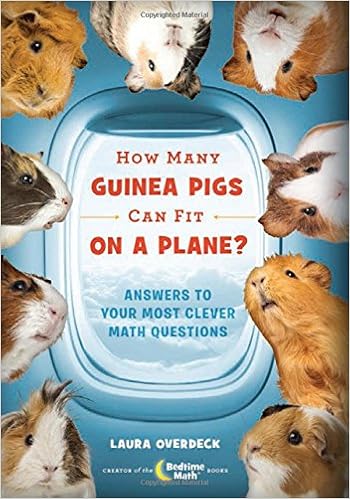
How Many Guinea Pigs Can Fit on a Plane? Answers to Your Most Clever Math Questions by Laura Overdeck

Published by Feiwel and Friends

Summary:  From the creator of the Bedtime Math books and website comes this collection of questions submitted by real kids and answered using math.  The answer to the question in the title is found using the dimensions of a guinea pig, calculating how many could fit in one cubic foot, then showing how many cubic feet are in a 747 jet.  And that would be 472,500 guinea pigs.  The cute and eye-catching illustrations of guinea pigs show their measurements in all directions.  There’s even an interesting non-math fact thrown in (guinea pigs prefer company so much that in Switzerland it’s illegal to own a single pig).  Questions are divided into five chapters: Animal Math, Nature Gone Wild (“Which wind blows faster, a tornado or a hurricane?”), Math for Your Mouth (“How much food do we eat every day?”), Your Life in Numbers (“When will I be a billion seconds old?”), and Earth and Friends (“How many soccer balls will fit inside a hollow Earth?”).  The final section, “Now Do It In Your Head!” shows some tricks for quick mental math calculations.  144 pages; grades 2-6.

Pros:  Kids will be drawn into this book by the questions, and even those who claim to dislike math will follow along with the calculations to see how to find the final answer.  Check out the website (www.bedtimemath.org) for more mathematical fun.

Cons:  I wish there were more awesome kids’ math books like this being published.

Shell Beak Tusk: Shared Traits and the Wonders of Adaptation by Bridget Heos

Published by HMH Books for Young Readers

Summary:  Porcupines and echidnas both have spiky spines.  Turtles and snails both have shells.  Yet these animals aren’t related to each other, and, in the case of the porcupine and echidna, don’t live on the same continents.  Animals often evolve with shared traits, even if they’re not closely related.  Each two-page spread shows a photograph of both of the animals with a paragraph about that animal and the trait the two share.  The first and last page give additional information about adaptation and evolution.  Includes a pretty extensive bibliography and an index.  32 pages; grades 1-4.

Pros:  The large, colorful photos provide a draw to pick up this book.  The idea of shared traits is an interesting concept that could be extended by having kids think of and research other animals who have shared traits.

Cons:  The writing and format are pretty straightforward, and may not have as much appeal as some flashier books about animals.

Far Apart, Close in Heart: Being a Family When a Loved One is Incarcerated by Becky Birtha, illustrated by Maja Kastelic

Published by Albert Whitman and Co.

Summary:  What does it feel like to have a parent in jail, and how do you deal with those feelings?  The children in this book all react differently to their parents’ incarceration.  They feel scared, angry, and confused.  One girl wonders if it was her fault her mom went to jail.  A boy’s mom begs him not to tell anyone about his dad, so he stops talking altogether.  Another girl’s family is torn apart when her mom gets arrested and sent to jail, just like her dad.  Kids are encouraged to share their feelings with other adults in their lives, and to try to stay in touch with their incarcerated parents through visits, or, if that’s not possible, phone calls and letters.  One mom writes to assure her daughter that, “You and I may be far apart, but you’re always close to me in heart.”  Includes an author’s note and tips for adults from the National Resource Center on Children and Families of the Incarcerated.  32 pages; ages 4-8.

Pros:  A useful and engaging book to help kids feel more accepting of having a parent in prison, and to learn how to deal with their feelings about it.

Cons:  With nine kids featured, there were a lot of people to keep track of in such a short book.