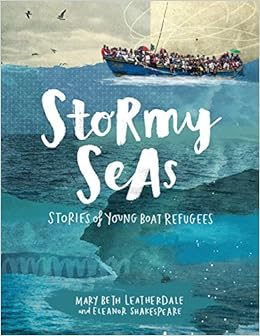
Stormy Seas: Stories of Young Boat Refugees by Mary Beth Leatherdale, illustrated by Eleanor Shakespeare

Published by Annick Press

Summary:  Sixty five million people worldwide have been forced to leave their homes due to war, persecution, or natural disaster. Many of them, including a large number of children, are seeking refuge in countries in Europe and North America.  This book profiles five refugee kids from Germany, Vietnam, Cuba, Afghanistan, and Ivory Coast over the last 60 years.  They have undertaken dangerous journeys by boat, been attacked by pirates, been turned back from their original destinations, and have often arrived in an unknown place with little more than the clothes on their backs.  Yet each one has worked hard and become a productive citizen of his or her new country.  Each profile includes the narrative of the subject, much of it in his or her own words, a timeline of the journey, and a “What happened to?” section that tells the happy ending to each story.  Includes timelines and a list of resources.  64 pages; grades 4-7.

Pros:  Readers will empathize with the refugees’ stories, and by extension, the plight of refugees everywhere.  Fans of the “I Survived” series will find these suspenseful real-life survival tales riveting reading.  The collage illustrations add interest.

Cons:  There are some disturbing details, like the 14-year-old girls from Vietnam who are taken off the boat by marauding pirates.

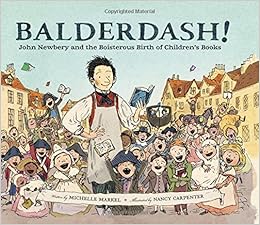
Balderdash! John Newbery and the Boisterous Birth of Children’s Books by Michelle Markel, illustrated by Nancy Carpenter

Published by Chronicle Books

Summary:  Pity the poor children growing up in early eighteenth century England.  Although there were plenty of books around for adults, kids only got preachy poems, sermons, and books of rules about manners and such.  Fortunately for them, a young printer named John Newbery thought they deserved better.  The fact that his books were entitled A Little Pretty Pocket-Book and The History of Little Goody Two-Shoes and became overnight bestsellers demonstrates what a deplorable condition children’s literature was in at that time.  John continued to work throughout his career to produce popular books for kids, and we remember him every January when the Newbery Medal is awarded to the book that has made “the most distinguished contribution to American literature for children”.  An author’s note gives additional biographical information.  44 pages; grades K-4.

Pros:  A lighthearted look at the life of a man whose name many librarians and teachers know, but whose life we are less familiar with.  Readers will appreciate the wealth of children’s literature that has grown since Mr. Newbery’s time.

Cons:  The subject may be of greater interest to adults than to kids.

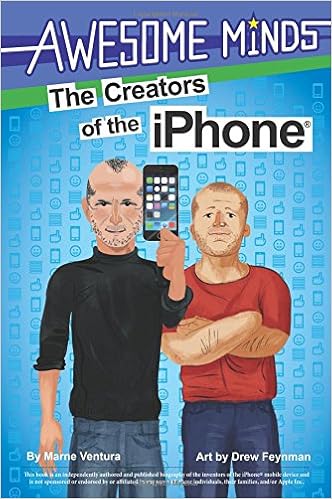
Awesome Minds: The Creators of the iPhone by Marne Ventura, art by Drew Feynman

Published by duopress

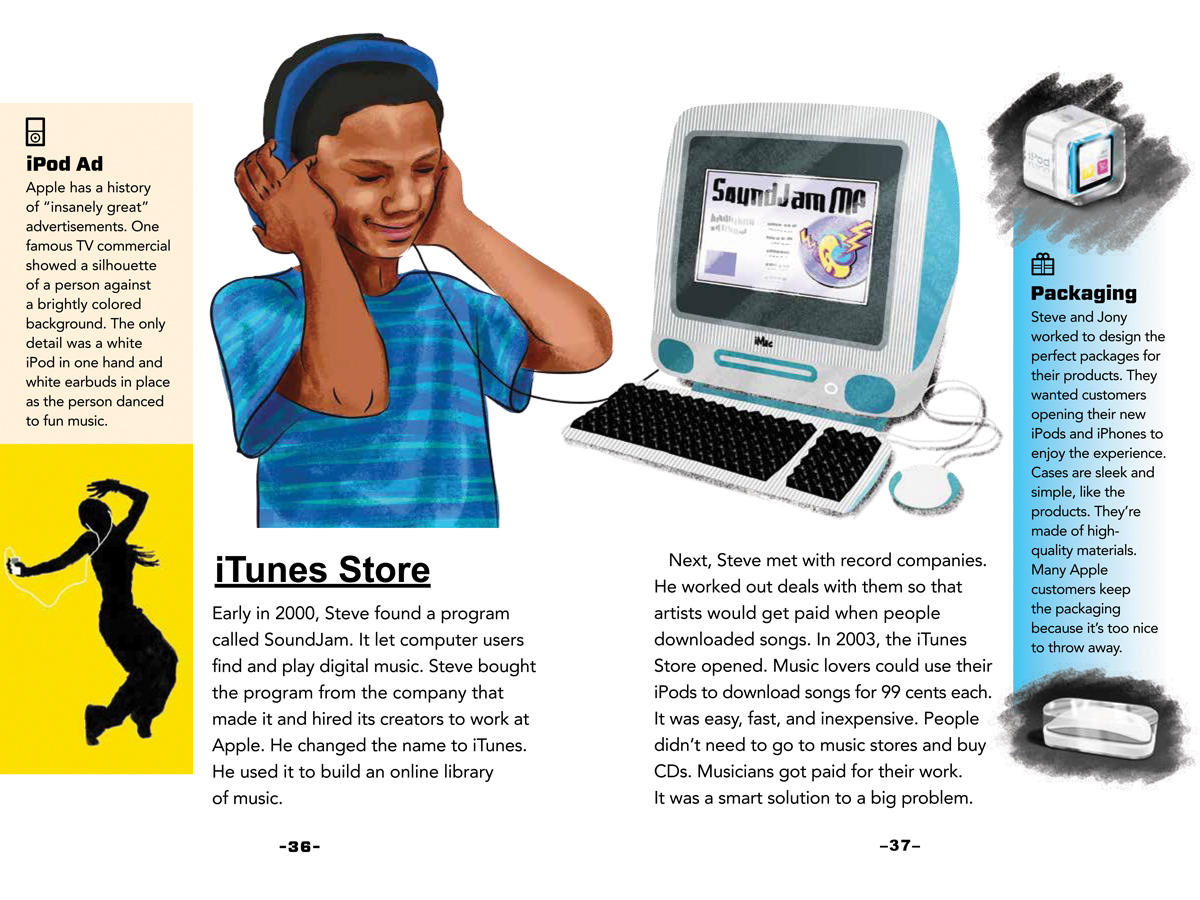
Summary:  We all take our smartphones for granted these days, but it wasn’t so long ago that portable phones were roughly the size and weight of a brick (at least it doesn’t seem that long ago to me).  It was the genius of Steve Jobs and industrial designer Jony Ive that created the first iPhone.  It was a long road to get there, though, beginning with the creation of the Apple company, and continuing with the many machines and software that came before the iPhone: personal computers in a variety of shapes and sizes, the iPod, iTunes, and more.  This book takes a brief look at the whole history, starting with the creators’ early lives, and concluding with Steve Jobs’ death and the iPhone today.  Includes a glossary, list of books and websites, and index. 56 pages; grades 2-5.

Pros:  A fast-paced, colorful look at a topic that’s sure to be of interest to kids.  The design is appealing, with plenty of sidebars and graphics .

Cons:  So much material is covered in such a short book that it sometimes seems disjointed and choppy.

The Secret Life of the Red Fox by Laurence Pringle, illustrated by Kate Garchinsky

Published by Boyds Mills Press

Summary:  A year in the life of Vixen, a female fox.  The reader follows her as she hunts in the snow, pouncing on a mouse in an acrobatic move, and escapes a couple of barking dogs.  She meets up with her mate, and eventually moves into a den.  When spring comes, there are four fox kits in the den.  The grow all summer, and on the last page, they are ready to go off on their own, just as autumn arrives.  There are two pages of additional information about the red fox, plus a brief glossary and bibliography.  32 pages; grades 1-4.

Pros:  The story of Vixen is packed with information about foxes.  Woven into the story are facts about how foxes find food, what they eat, how they take over other animals’ burrows for their dens, and how the parents take care of their babies.  The illustrations are beautiful and add additional information.  There is plenty here for a research report, or simply to satisfy a curious child.

Cons:  I seriously hope I never stumble across a hole in the snow like the one Vixen used as a storage place for her dead mice.

Hello Spring! by Shelley Rotner

Published by Holiday House

Summary:  Lots of colorful photographs provide an introduction to spring.  The focus is all on flora and fauna as a diverse group of kids discover flowers and other plants and hold baby farm animals.  Wild animals are also mentioned, particularly those who are waking up after a long winter’s sleep.  The text is brief, with some rhyming words and plenty of action verbs (“Frogs hop.  Earthworms creep.  Turtles crawl.”).  The final page announces the longest day of the year, which means the season changes again, to summer.  Includes a brief glossary.

Pros:  Young readers will enjoy familiar springtime sights and will learn to be on the lookout for signs of spring.  The photos are large, colorful, and appealing.

Cons:  It would have been nice to include signs of spring in the city, along with all the suburban/rural photos.

Penguin Day: A Family Story by Nic Bishop

Published by Scholastic Press

Summary:  When a baby rockhopper penguin is hungry, his mother goes in search of food while his father stays home to protect him.  The mother is part of a group of penguins that climbs cliffs and dives into the ocean, braving sea lion and orca predators, to hunt for fish and krill.  Meanwhile, when the baby penguin wanders off to explore, his father must protect him from a hungry skua (bird).  Finally, the family is reunited, and baby penguin gets his (apparently regurgitated) meal.  An author’s note gives more information on these Antarctic penguins.  32 pages; ages 4-8.

Pros:  Nic Bishop has another winning collection of nature photographs that will be popular with primary grades.  The story will draw them in, and the author’s note can be used to teach more about the penguins.

Cons:  The story was a bit more mundane than the photos.

The Playbook: 52 Rules to Aim, Shoot, and Score in This Game Called Life by Kwame Alexander, photographs by Thai Neave

Published by HMH Books for Young Readers

Summary:  Kwame Alexander begins this book with his own athletic journey from basketball to football to tennis, where he finally found the sport that made him a high school champion.  After this introduction, the book is divided into four quarters, like a game, entitled Grit, Motivation, Focus, and Teamwork.  Each section begins with a profile of an athlete who personifies that trait, then there are 13 rules, each one accompanied by a drawing or photo of an athlete, and an inspirational quote.  Alexander refers to the rules as “poems”, but that feels like a bit of a stretch.  The quotes are mostly from athletes, but a few other celebrities like Oprah Winfrey and Michelle Obama are included. 176 pages; grades 5-8.

Pros:  Anyone looking for a little inspiration will find plenty of it in these pages.  Young athletes will particularly enjoy the sports stories and quotes.  The sharp black, orange, and gray graphics are similar to the covers of Alexander’s books “The Crossover” and “Booked”.

Cons:  This feels more like a graduation gift or self-help seminar than an actual reading experience.

Bicycles by Patricia Lakin

Published by Aladdin

Summary:  Aaron Dykstra is a craftsman who creates handmade bicycles and sells them through his company, Six Eleven Bicycle Company (named for the 611 train that was supposedly the best and most beautifully designed).  The first few pages of this book give a history of the bicycle and a brief biography of Dykstra and how he came to be a bicycle maker.  Then the reader is shown the twenty steps of his creation process, from getting the customer’s specifications to the final item rolling out of the shop.  There’s a photo of each step, with a short caption explaining the process.  The next two pages tell about Aaron’s program for middle school students, The Making Foundation, and invite readers to try creating by hand.  Finally, there is a four-page timeline of the bicycle, followed by a glossary and resources (books and websites).  32 pages; grades 3-7.

Pros:  A perfect complement to any makerspace program.  A second book in the series, Skateboards was published simultaneously.  The book’s design has the feel of a blueprint or how-to manual, and the photos and biographical information about Aaron make the creation process appealing.

Cons:  I looked at Aaron’s website, and he requires a $1500 deposit before starting on a bike.

Math Lab for Kids: Fun, Hands-On Activities for Learning with Shapes, Puzzles, and Games by Rebecca Rapoport and J. A. Yoder

Published by Quarry Books

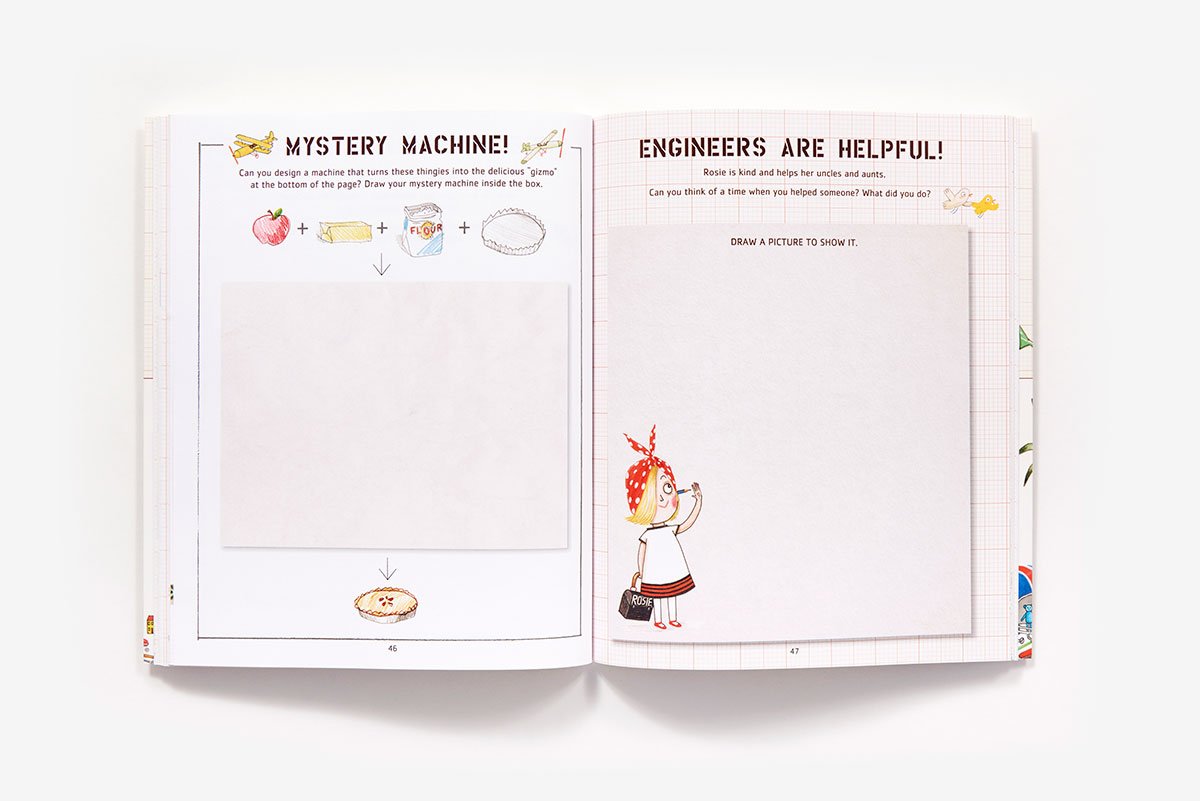
Summary:  37 labs in nine chapters introduce a wide variety of mathematical topics, such as geometry, topology, fractals, and graph theory.  Each chapter begins with a “Think About It” question to be considered before diving into the labs.  Each lab includes a materials list, a boxed math fact, instructions, and diagrams.  The activities seem like simple games, puzzles, and craft projects, but don’t be fooled, constructing with toothpicks and gumdrops can lead to a greater understanding of antiprisms and Platonic solids.  In the authors’ introduction, they state that the activities have been tested on kids ages 6-10, but can be enjoyed by middle school students, high school students, and adults.  Back matter includes pull-outs to use with a few of the labs, hints and solutions for many of the labs, and an index. 144 pages; grades 2+

Pros:  “Mathematicians play,” the authors state in their introduction.  If you think you hate math, or you know a child who hates math, this book may be just the remedy.  Every activity looks like fun and is simple to set up, yet leads to a mathematical way of looking at the world.  The colorful photos of kids engaged in the activities and the simple, clear diagrams add to the fun.

Cons:  My neighbors may call for reinforcements when I head outside with five feet of string, two broomsticks, and some chalk to draw a giant ellipse in my driveway.

The Youngest Marcher: The Story of Audrey Faye Hendricks, A Young Civil Rights Activist by Cynthia Levinson, illustrated by Vanessa Brantley Newton

Published by Atheneum Books for Young Readers

Summary:  Growing up in Birmingham, Alabama, nine-year-old Audrey Hendricks heard talk of civil rights marches from dinner guests Martin Luther King, Jr., Frederick Shuttlesworth, and James Bevel.  Audrey was eager to get involved, feeling the unfairness of having to use a dirty water fountain, getting worn-out books at school, and riding the freight elevator at the department store.  When Jim Bevel called on young people to “fill the jails” by protesting, Audrey eagerly signed up.  The youngest member of the march, she was quickly arrested with other kids and teens, and put in jail, where she stayed for a week.  With bad food, an uncomfortable bed, and mean guards, it was a tough time for Audrey, but she was proud when, on the fifth day, she learned there was no more room in the jail.  Their mission was accomplished, Audrey and the others were released, and two months later, Birmingham removed segregation laws from the books. Includes an author’s note giving more information about Audre, a timeline, and a recipe for the “hot rolls baptized with butter” that Audrey enjoyed for her first meal out of jail.  40 pages; grades 1-5.

Pros:  Cynthia Levinson draws on her research from We’ve Got a Job, her longer book on the Birmingham Children’s March, to tell this fascinating story for younger readers.  Kids will connect with Audrey and be inspired by her courage and positive attitude.

Cons: It’s pretty unbelievable that a nine-year-old spent a week in jail in 20th-century America.